

Insights from recent episode analysis
Audience Interest
Podcast Focus
Publishing Consistency
Platform Reach
Insights are generated by CastFox AI using publicly available data, episode content, and proprietary models.
Total monthly reach
Estimated from 1 chart position in 1 market.
By chart position
- 🇳🇿NZ · Mental Health#733K to 10K
- Per-Episode Audience
Est. listeners per new episode within ~30 days
900 to 3K🎙 Daily cadence·106 episodes·Last published 2w ago - Monthly Reach
Unique listeners across all episodes (30 days)
3K to 10K🇳🇿100% - Active Followers
Loyal subscribers who consistently listen
1.2K to 4K
Market Insights
Platform Distribution
Reach across major podcast platforms, updated hourly
Total Followers
—
Total Plays
—
Total Reviews
—
* Data sourced directly from platform APIs and aggregated hourly across all major podcast directories.
On the show
Recent episodes
The Circle of Connection: Essential Frameworks for Trauma Work
May 15, 2026
53m 53s
Understanding Trauma, Stress, and Healing with Bryan Post
May 3, 2026
46m 17s
The Spirit of MI: A Way of Being
Apr 27, 2026
48m 16s
Foundations of IFS-Informed EMDR
Apr 9, 2026
1h 09m 50s
Self-Compassion, Being Enough and Our Common Humanity
Apr 5, 2026
49m 11s
Social Links & Contact
Official channels & resources
Official Website
Login
RSS Feed
Login
| Date | Episode | Description | Length | ||||||
|---|---|---|---|---|---|---|---|---|---|
| 5/15/26 |  The Circle of Connection: Essential Frameworks for Trauma Work | In this special livestream episode of Empowered Through Compassion, David and Heather are joined by an extraordinary panel of contributors from the book IFS-Informed EMDR: Creative and Collaborative Approaches for an amazing conversation exploring foundational frameworks that shape trauma healing. Together, Bridger Falkenstien, David Archer, Michelli Simpson, Athena Phillips, and Laura Kosak discuss the relational and systemic dimensions of healing, including: intersubjectivity, anti-racist psychotherapy, dissociation and spirituality. We even bring up topics such as predictive processing, structural dissociation, and revolutionary joy! We look at the role that culture and identity plays in therapy. Throughout the conversation, a shared thread emerges: healing does not happen in isolation. Trauma exists within systems, relationships, histories, and bodies. As a result, healing often requires compassionate attunement within a relational space. This discussion explores how therapists can move beyond techniques and toward a deeper understanding of the therapeutic relationship itself as part of the healing process. The panel reflects on the importance of slowing down, listening to protective systems, cultivating consent and of course being mindful of co-regulation. We can honor spirituality by understanding how people make meaning of their surroundings and their inner world. This episode is for therapists, healers, and anyone interested in the evolving intersection of EMDR, IFS, attachment, dissociation, systems thinking, and relational trauma healing. THEMES DISCUSSED IFS-informed EMDR Dissociation and structural dissociation Predictive processing and memory reconsolidation Intersubjective and relational healing Trauma and systemic oppression Anti-racist psychotherapy Spirituality and meaning-making Co-regulation and consent Therapist parts and relational presence GUEST HIGHLIGHTS Bridger Falkenstein Bridger discusses Somatic Integration and Processing (SIP), intersubjectivity, and the importance of understanding therapy as a relational field rather than a one-person psychology. He explores the “window and mirror” metaphor and how therapists must remain aware of both the client’s experience and their own presence within the room. Website: https://beyondhealingcenter.com David Archer David Archer explores anti-racist psychotherapy, systems awareness, predictive processing, and the relationship between trauma, oppression, dissociation, and culture. He emphasizes the importance of understanding clients within broader systemic and historical contexts. Website: https://archertherapy.com/ Michelle Simpson Michelle highlights the importance of recognizing the systems surrounding both therapist and clients. She speaks about cultural identity, embodied dissociation, and how therapists can become allies to disempowered and subjugated people. Specifically, she shares importance of being a compassionate witnesses and advocating for clients who are threatened by the larger culture. Website: https://www.spirosperopllc.com/ Athena Phillips Athena shares powerful insights on structural dissociation, fragmentation, consent, pacing, and co-regulation. She explores how dissociation can be understood as an adaptive survival strategy and emphasizes the importance of slowing down and gaining permission within trauma work. Website: https://athenaphillips.com/ Laura Kakalec Laura discusses spirituality, meaning-making, transpersonal healing, and the importance of helping clients reconnect with a larger sense of belonging and connection. She also reflects on the emerging relationship between AI, emotional support, and the human longing for connection and meaning. Website: https://laurakosak.com/ ABOUT THE BOOK IFS-Informed EMDR: Creative and Collaborative Approaches explores the evolving integration of Internal Family Systems (IFS) and Eye Movement Desensitization and Reprocessing (EMDR). Featuring a diverse group of contributors, the | 53m 53s | ||||||
| 5/3/26 |  Understanding Trauma, Stress, and Healing with Bryan Post | In this episode, I sit down with Bryan Post to explore a simple yet powerful idea: that all behavior arises from a state of stress, and beneath that stress is either fear or love. What stood out to me in this conversation is how Bryan’s work and model aligns with IFS, Motivational Interviewing and EMDR. There is an understanding through all of this work how healing does not happens just through technique, but through presence. As we process distress, we are able to bring more awareness and love to our inner systems. Bryan and I explore how trauma becomes interwoven with our personality and shapes the states of being we move through in our daily lives. These states influence how we perceive ourselves, others, and the world. How we react to a given situation is usually based more on past experiences than on the present moment. Bryan speaks of the importance of relationship and co-regulation in the healing process. Love is something that becomes the most powerful change agent. He defines this love as presence and breath. This conversation holds a beautiful invitation for us to slow down, and become more aware of how we can move from fear to love in our lives. Themes Trauma as a state of prolonged stress Fear and love as core organizing forces How trauma becomes embedded in personality and state of being The role of co-regulation and relationship in healing Breath and awareness as pathways to connection About Bryan Post Bryan Post is a clinician, author, and expert in trauma-informed care, known for his development of the Stress Model. His work focuses on helping children, adults, and families understand how stress and trauma shape behavior, and how healing can occur through relationship, awareness, and connection. Resources & Links Bryan Post’s website: bryanpost.com LEAF Wraparound program: leafwraparound.com Fear to Love program: feartolove.com Bondify AI (relational AI platform): bondify.ai Bryan Post’s books include From Fear to Love The Great Behavior Breakdown Beyond Consequences, Logic, and Control (and many more) Empowered Through Compassion is a podcast exploring the integration of Internal Family Systems, EMDR, and Motivational Interviewing. Through these compassionate conversations, we aim to deepen our understanding of trauma and healing. We hope that information here can inspire connection and support to both clinicians and individuals. | 46m 17s | ||||||
| 4/27/26 |  The Spirit of MI: A Way of Being | In this episode of Empowered Through Compassion, I sit down with Sarah Cameron to explore the heart of Motivational Interviewing (MI) and how it comes alive not just as a technique, but as a way of being. Our conversation moves beyond skills and into something deeper, "the spirit", and how it parallels "Self-energy" in Internal Family Systems. We talk about Sarah’s work at Amiga and her passion for helping clinicians embody the spirit of PACE in real-world conversations. This is a feeling of Partnership, Acceptance, Compassion and Empowerment, which is foundational for MI. We discuss how these words are not just "check boxes" we have to fill out and "do", but rather, that are qualities that we continue to access and live throughout our lives. MI can be added to IFS-informed EMDR, not as a competing model, but as a complementary path that adds more dimensions of what can be possible through therapy. I share my own journey with MI, and how it provided me with a language which opened up space for me to really listen and reflect change as it was happening in the therapy space. Sarah and I connected around what it means to build bridges across models, and disrupt feelings of being in a community without integration might feel siloed. This conversation is about presence, about hope, and about what becomes possible when we begin to embody the spirit of the work we are doing. Themes of episode The spirit of Motivational Interviewing as reflected in P.A.C.E. MI as a way of being, not just a set of techniques Parallels between MI spirit and Self energy in IFS “Lending hope” becoming a “hope merchant” two ways of communicating something extremely valuable Integration of MI, IFS, and EMDR in clinical practice Moving toward collaborative frameworks Suggesting there are some discussions and spaces where the focus on change talk might not fit. About Sarah Sarah Cameron is a Motivational Interviewing trainer and leader within the MINT community. She is deeply involved in advancing MI as a developmental and relational practice, helping clinicians move beyond technique into embodiment of MI spirit. Through her work with Amiga, she focuses on cultivating real-world application of MI in a way that is sustainable, human, and transformative. Sarah's books Sarah has contributed to several important works in the field of Motivational Interviewing: Becoming MI introduces the MI Metamorphosis Map and reframes MI as a developmental journey, offering guidance for trainers, supervisors, and clinicians to meet people where they are and support growth over time. The Aspirational Spirit of Motivational Interviewing explores how the true depth of MI lies not just in mastering techniques, but in embodying its spirit as an ongoing, evolving process. Ask-Offer-Ask: Bringing Motivational Interviewing to Life in Child Welfare offers a practical framework for navigating difficult conversations, especially in high-pressure environments, using a simple and effective MI-informed structure. Resources Amiga: https://amigallc.com/ Sarah website: https://www.ignitingchangeco.com/ Empowered Through Compassion is a podcast exploring the integration of Internal Family Systems, EMDR, and Motivational Interviewing. Through these compassionate conversations, we aim to deepen our understanding of trauma and healing. We hope that information here can inspire connection and support to both clinicians and individuals. | 48m 16s | ||||||
| 4/9/26 |  Foundations of IFS-Informed EMDR | This special episode was recorded in front of a live audience. Heather and David Polidi host an incredible group of contributors to IFS Informed EMDR: Creative and Collaborative Approaches. We explored the foundational sections of the book. In this gathering we expressed our thoughts on healing, and how it is not a technique. Instead, it begins with awareness and with a relationship. Each contributor reflected on their chapter, and what stood out for them. In the introduction, David hoped to convey how everyone can healing their trauma wounds, no matter how much suffering someone carries. There is an inner wisdom that knows how to move toward healing when the right relational space is created. Our role as therapists is to help create that space. Zandra Bamford shared how impacted she has been through by IFS and its non-pathologizing nature. Particularly, Zandra felt it was a very gentle model to understand protectors. Then, we discussed the foundations of combining the two models in a unified way. Integration becomes a way of holding multiple perspectives at once. A key shift that emerges in IFS informed EMDR is focusing on "parts" as the true focus of healing, rather than memory networks. "Parts" hold pain, parts and organize around protection. As we deepen relationships with these parts, we can offer EMDR, and bilateral stimulation, to unburden these parts. Annabel McGoldrick emphasized how IFS invites us to stay aware of our own parts, our assumptions, and our internal responses as we sit with another. This awareness becomes part of the healing field itself. Bruce Hersey articulated the Syzygy model, which integrates EMDR, IFS, and Coherence Therapy. Bruce shared that instead of calling this work "parts work" he understands it as "Self work." Recognizing the importance of Self in the system, opens up a new way to appreciate necessary elements of dual awareness. Michelle Richardson expanded Syzygy's “Discovery” phase, and how valuable this is when working with highly protective systems. Peggy Kolodny’s shared how the integration of art, somatics, and Jungian active imagination, can also add so much to these trauma healing models. What emerges is not just a model, but a way of being. A way of practicing therapy that is slower, more relational, and deeply respectful of the complexity of the human system. Featured Guests & Resources Bruce HerseyWebsite: https://www.brucehersey.comSyzygy Institute: https://www.syzygyinstitute.comBruce Hersey is a leading voice in the integration of EMDR and Internal Family Systems and co-founder of the Syzygy Institute. He is an EMDRIA-approved consultant and an IFS Approved Clinical Consultant who has presented internationally on IFS-informed EMDR integration. His work focuses on using multiple therapeutic lenses simultaneously to deepen trauma healing and reconsolidation processes. Annabel McGoldrickWebsite: https://www.emdrinsight.comBook: Mind Over MurderAnnabel McGoldrick is an EMDR Consultant and IFS practitioner with over 25 years of clinical experience. She is known for her work in IFS-informed EMDR training and her contributions to peace journalism, for which she received the Luxembourg Peace Prize. Her work bridges clinical depth with a broader vision of healing and global awareness. Michelle RichardsonWebsite: https://mindfulsoulwellbeing.com/michelle-richardson/Michelle Richardson is an EMDRIA-approved consultant, IFS-certified therapist, and co-founder of the Syzygy Institute. She specializes in complex trauma, dissociation, and attachment wounds, and is known for her work on the “Discovery” phase, helping therapists navigate highly protective and blended systems with clarity and compassion. Peggy KolodnyPeggy Kolodny is a licensed, board-certified art psychotherapist specializing in trauma treatment and the integration of EMDR, IFS, and expressive therapies. With decades of experience, she brings a unique perspective that incorporates somatic, symbolic, and creat | 1h 09m 50s | ||||||
| 4/5/26 |  Self-Compassion, Being Enough and Our Common Humanity | In this deeply moving and expansive conversation, David sits down with Soulla Demetriou, author, coach, and founder of Soulshine Retreats, to explore the heart of self-compassion and what it means to truly feel “enough.” Soulla shares how her work integrates Internal Family Systems (IFS), somatic awareness, mindfulness, and ancient wisdom traditions to help people reconnect with their inner world. At the center of her approach is a powerful idea: that the body holds deep wisdom, and that healing begins when we learn to listen. Together, David and Soulla explore the natural alignment between IFS and somatic practices, including yoga, and how both invite us into a more compassionate relationship with ourselves. They reflect on how safety, presence, and awareness open the door to new ways of responding to our inner experiences, rather than reacting from old patterns. Soulla also shares vulnerably about her own journey with complex trauma and how it shaped her path toward this work. Her upcoming book, You Have Always Been Enough, was born from a core question many of us carry: Am I enough? This conversation offers a grounded and hopeful path forward, highlighting how healing is not about fixing ourselves, but about building a compassionate relationship with the parts of us that have long felt unseen. Key Themes Self-compassion is a foundation of healing There can be a natural integration between IFS and somatic practices The body as a source of wisdom and awareness The space between stimulus and response is where our freedom is Reparenting and building internal safety help us set boundaries “Not being enough” is a universal wound Healing as both personal and relational About Soulla Demetriou Soulla Demetriou is an author, transformation and somatic coach, and founder of Soulshine Retreats. With over 15 years of experience facilitating transformational work, she integrates Internal Family Systems, mindfulness, somatic practices, and ancient wisdom traditions to support deep healing and self-connection. Her work centers on self-compassion and the belief that we are inherently worthy and whole. Drawing from her own lived experience, including complex trauma and neurodivergence, Soulla offers a deeply embodied and relational approach to healing. Her upcoming book, You Have Always Been Enough: An Inner Guide to Self-Love and Inner Freedom, releases April 9, 2026. Resources Mentioned Soulla’s Website: www.withsoulla.com Book: You Have Always Been Enough Instagram: www.instagram.com/withsoulla Pre-order links: Kindle (UK): https://www.amazon.co.uk/You-Have-Always-Been-Enough-ebook/dp/B0FD94DV6W International: https://www.waterstones.com/book/you-have-always-been-enough/soulla-demetriou/9780008403577 US (Sept 2026): https://www.amazon.com/You-Have-Always-Been-Enough/dp/0008403570 Bonus: Pre-orders before April 23 include access to a complimentary one-day Self-Compassion Retreat (April 24) The Empowered Through Compassion podcast explores trauma healing at the crossroads of Internal Family Systems (IFS), EMDR, and Motivational Interviewing. Through meaningful conversations with leading voices in the field, David and Heather create a space for reflection, learning, and connection, helping therapists and humans alike deepen their understanding of healing, relationship, and compassion. | 49m 11s | ||||||
| 3/16/26 |  The Resilience of Connection | In this conversation, David Polidi speaks with author and cultural critic Soraya Chemaly about the cultural mythology of resilience and what it means to truly heal after hardship. In much of Western culture, resilience is framed as an individual trait. We are encouraged to bounce back quickly, return to productivity, and prove our strength by pushing through pain. Soraya challenges this narrative and invites us to reconsider resilience through a relational lens. What if resilience is not primarily about individual toughness, but about connection? Throughout the conversation, Soraya explores how narratives of resilience have been shaped by individualism, gender conformity, colonial thinking, and dominance based hierarchies. These narratives often isolate people rather than helping them heal. When resilience becomes synonymous with endurance and productivity, it can reinforce systems of power that separate us from one another. David and Soraya explore how healing requires something very different. Healing often emerges through relational energy. It grows when people feel understood and connect with one another. The conversation also explores how cognitive flexibility allows us to adapt to life’s changes rather than attempting to return to a past version of ourselves. Ultimately, the myth that resilience is only an individual achievement, is not only inaccurate but dangerous. Instead, we can understand resilience is something that also grows through relationship, compassion, and shared humanity. Key Themes • The cultural myth of resilience and the pressure to “bounce back”• How individualism shapes Western ideas of strength• Trauma, grief, and the non linear nature of healing• Cognitive flexibility and adapting to change• Power structures that encourage separation and domination• Gender, hierarchy, and cultural narratives about strength• The erosion of social trust and the rise of loneliness• Why connection is one of the most powerful forces in healing A Quote from the Episode “You have to be a daily pessimist but an eternal optimist.” Soraya Chemaly reflects on the importance of holding both realism and hope at the same time. Strategic pessimism allows us to plan, organize, and act collectively, while long term optimism helps sustain movements for change and healing. Guest Bio Soraya Chemaly is an award winning writer, speaker, and cultural critic whose work focuses on gender, power, culture, and social justice. She is the author of Rage Becomes Her and The Resilience Myth. Her writing has appeared in publications including The Atlantic, Time, The Guardian, and The Washington Post. Her work examines how cultural narratives shape our understanding of emotions, power, and identity. Resources Soraya Chemaly’s websitehttps://www.sorayachemaly.com The Resilience Myth by Soraya Chemalyhttps://www.simonandschuster.com/books/The-Resilience-Myth/Soraya-Chemaly/9781982188733 Podcast Description Empowered Through Compassion explores trauma healing at the crossroads of Internal Family Systems, EMDR, and Motivational Interviewing. Through conversations with therapists, researchers, and thought leaders, the podcast examines how compassion, relational attunement, and integrative approaches to therapy can support deeper healing for individuals, couples, and communities. | 47m 24s | ||||||
| 3/8/26 |  Pastor Michael Neely | Faith, Domestic Violence, and Protecting Survivors | In this episode of the Empowered Through Compassion podcast, David Polidi speaks with Pastor Michael Neely about domestic abuse, faith, and the responsibility of religious communities to protect those who are suffering. Pastor Neely is the author of Black Eyes and Sweet Talk: A Biblical Perspective on Domestic Violence. Drawing from years of pastoral counseling, he challenges harmful messages that survivors sometimes hear within faith communities, including the belief that God expects people to remain in abusive marriages. Instead, Pastor Neely offers a clear and compassionate perspective: abuse has no place in a healthy relationship, and faith communities must prioritize safety, dignity, and truth. During the conversation, Pastor Neely shares powerful stories from his ministry, including a woman who came to him in such deep distress that she was considering ending her life. These moments highlight how critical it is for pastors, counselors, and communities to recognize abuse and respond in ways that support safety rather than spiritualizing suffering. David and Pastor Neely also explore the relationship between therapy and faith. Rather than existing in opposition, both pastoral care and trauma-informed therapy can work together to help people heal and reclaim their sense of worth and freedom. Pastor Neely also discusses themes from his developing work examining generational trauma, including how patterns of violence in the Black community may trace back to the historical legacy of slavery and corporal punishment. This conversation invites both therapists and faith leaders to consider how compassion, honesty, and trauma awareness can create communities where survivors are protected and healing becomes possible. In this episode we explore • Domestic violence within faith communities• The dangers of encouraging survivors to remain in abusive marriages• How pastors and therapists can work together to support healing• Stories from pastoral counseling and crisis intervention• Generational trauma and the historical roots of violence Guest Pastor Michael Neely is a pastor, counselor, and author focused on addressing domestic violence within faith communities. He is the author of Black Eyes and Sweet Talk: A Biblical Perspective on Domestic Violence, which challenges harmful theological messages that can keep survivors trapped in abusive relationships and encourages churches to respond with truth, protection, and compassion. Resources Mentioned Black Eyes and Sweet Talk: A Biblical Perspective on Domestic ViolencePastor Michael Neely’s website: blackeyessweettalk.com Connect with Empowered Through Compassion Websiteempoweredthroughcompassion.com Instagram@empowered.through.compassion Podcast Description The Empowered Through Compassion podcast explores trauma healing, compassionate leadership, and the integration of therapeutic approaches such as Internal Family Systems, EMDR, and Motivational Interviewing. Hosted by trauma therapist David Polidi, the podcast brings together therapists, authors, educators, and community leaders who are working to create spaces of safety, dignity, and healing in the world. Each conversation invites listeners to explore the intersection of psychology, relationships, and compassionate systems change. | 49m 17s | ||||||
| 3/3/26 |  IFS, Marriage, and the Launch of Our Monthly Livestream Series | In this special episode of Empowered Through Compassion, I am joined by my wife and partner in life and work, Heather Polidi, LICSW. After graduating from Boston University's School of Social Work in different years, we both began our careers at Wayside Youth and Family in different departments. Heather served as Program Director of the Children’s Behavioral Health Initiative and CSA program, while I worked as an In-Home Therapist within CBHI. Today, we are co-owners of Empowered Through Compassion, a practice specializing in trauma healing and IFS-informed EMDR work. This episode marks the beginning of something new. We are launching a free monthly Livestream series, held on the second Tuesday of each month from 12:00 to 1:00 PM EST. Our first session is March 10. This kickoff will introduce the series and our recently released book, IFS-Informed EMDR: Creative and Collaborative Approaches. Our hope is to create a thoughtful and compassionate space for meaningful conversation. In the months ahead, contributing authors from the book will join us for deeper discussions. In this conversation, Heather takes an important step into the public side of our shared work. We talk about how Internal Family Systems has shaped not only our clinical practice, but also our marriage, communication, and shared vision for healing in community. IFS has given us language to understand our internal worlds and how they interact. It has helped us cultivate compassion for our protector parts and develop a steadier way to stay connected during stress and conflict. Heather speaks openly about the parts that surfaced as she chose to step more visibly into this next chapter of ETC. We would truly love for you to join us on our Livestream. Registration information for the Livestream series will be available soon on our website: EmpoweredThroughCompassion.com We are so appreciative of you being a part of this next chapter, in whatever way feels right for your system. | 38m 38s | ||||||
| 3/2/26 |  Reclaiming Faith, Identity, and Inner Freedom | In this episode of Empowered Through Compassion, I speak with Brooke Kekos, trauma recovery mentor, clinical hypnotherapist, NLP practitioner, and author of Shattered, Broken, & Beautiful: Losing My Religion and Finding Faith. Brooke was raised in a third-generation Jehovah’s Witness family and shares her courageous journey of leaving a high-control religious environment and breaking free from patterns of emotional and relational abuse. Our conversation explores religious trauma, identity loss, nervous system dysregulation, and the long, layered process of reclaiming self-trust. Brooke reflects on moving from indoctrination and shame toward autonomy, integration, and spiritual awakening on her own terms. What makes this conversation so powerful is Brooke’s authenticity. She holds a deep honesty and a profound hope. We talk about how high-control systems shape belief and how healing begins with trusting your inner wisdom. Brooke beautifully describes change as “planting seeds,” in others to help them have space for their own inner truth. In this way, we can help others reclaim their radical and beautiful authenticity. | 52m 26s | ||||||
| 2/16/26 |  Heartbreak, Healing and Self Leadership Through Divorce | Divorce can feel like the shattering of a world. In this episode, I sit down with Oona Mertz, a psychotherapist with over 30 years of experience, to explore what truly helps people navigate the emotional and relational complexity of divorce. After her own divorce and healing journey, Oona began leading open-ended divorce groups for women, which she has facilitated for over 12 years. Out of this work, she has authored a new book: Unhitched: The Essential Divorce Guide for Women, a resource grounded in the lived wisdom of her clients and the stages of divorce they navigate. We discuss why the traditional Kübler-Ross stages of grief do not fully capture this process and how Oona’s framework moves from heartbreak, through emotional turbulence, toward mending, letting go, and ultimately moving on. We also explore the loneliness of divorce, the mixed feelings that arise internally, its impact on children, and the powerful role group support can play in healing and growth. Topics Discussed • Why the Kübler-Ross DABDA model does not fully fit divorce• Oona’s stages: Heartbreak, Rollercoaster, Mending, Letting Go, and Moving On• Managing intense emotionals• Supporting children through divorce• The unspoken rules within marriage• Divorce as trauma that can shatter our worldview• The healing power of community About Our Guest Oona Mertz is a psychotherapist with over 30 years of clinical experience. After navigating her own divorce and healing process, she began facilitating divorce groups for women — a practice she has continued for more than a decade. Her newest book, Unhitched: The Essential Divorce Guide for Women, offers insight, guidance, and lived wisdom from her extensive group work and clinical experience. Learn more about Oona and her work here:https://oonamertz.com Reflection Divorce can be one of the most isolating human experiences, but it does not have to be endured alone. Oona reminds us that healing begins with acknowledging the heartbreak and finding connection with others who truly understand. Through this work, many discover unexpected resilience and even renewal. As Oona shares, some even go through this work and end up saying, “I can’t believe this, but my divorce became the best thing that ever happened to me.” | 50m 00s | ||||||
Want analysis for the episodes below?Free for Pro Submit a request, we'll have your selected episodes analyzed within an hour. Free, at no cost to you, for Pro users. | |||||||||
| 2/14/26 |  Not a Trigger, It's A Trailhead | Episode Summary: In this conversation, we explore what it really means to understand IFS as a relational therapy. Alyce and I discuss how attention itself is relational, how Self-energy becomes an internal secure base. Everything happening inside our system shapes how we show up in our external relationships. We talk about titrating small changes, noticing shifts in Self-energy, and reframing “triggers” as trailheads into deeper awareness and healing. This episode invites you to see IFS not simply as a model of parts, but as a pathway toward secure internal attachment and relational integration with ourselves and others. If you’re interested in how IFS and attachment theory deepen trauma work and everyday relationships, this episode offers both clinical clarity and practical insight. Topics Discussed: How attention itself is relationalWhy IFS is fundamentally a relational therapyNoticing and strengthening Self-energyReframing triggers as trailheadsTitrating small shifts instead of forcing changeHow internal relationships shape external onesGently leading and creating boundaries with our children About Our Guest: Alyce Messer, LCSW-S, is an EMDRIA-Approved Consultant and IFS Level 2-trained therapist specializing in complex trauma and therapist wellness. She integrates EMDR and IFS to help clinicians and clients cultivate differentiation, Self-leadership, and healing through secure internal attachment. At its core, this conversation is about how the core of healing is really cultivating relationship, both with ourselves and others. | 42m 08s | ||||||
| 1/26/26 |  Listening to Pain and Dissociation with IFS and EMDR | In this episode, David speaks with Tina Taylor, a Syzygy trainer, IFS Institute assistant trainer, and contributor to IFS Informed EMDR. Together, they explore the intersection of IFS, EMDR, pain, dissociation, and safety in trauma healing. Tina shares how EMDR was instrumental in addressing her social anxiety, and how IFS later helped her heal legacy burdens connected to that anxiety. This layered healing highlights how different models can work together to address both symptoms and deeper roots. Tina offers a powerful theme when working with pain: “Pain is communication.”Rather than something to eliminate or override, pain can be understood as a message from parts of the system. Some parts may amplify pain to be heard, while others attempt to suppress or escape it. IFS allows us to slow down and listen to what pain is asking for. The conversation also explores dissociation and Dissociative Identity Disorder. Tina reflects on how IFS can look different when working with highly dissociative systems and why goals and pacing matter deeply in this work. While there are clinicians integrating IFS with dissociation, there is currently no dedicated IFS Institute training focused specifically on DID, beyond the Level 2 trauma track. David and Tina discuss how dissociation itself can be understood as a meaningful communication from the system. The work begins not with pushing toward exiles, but with safety, stability, and strengthening managers so the system can regulate more evenly. A key takeaway is the importance of cultivating Self energy as a form of resourcing. Tina notes that the amount of Self needed, the “critical mass of Self,” is relative to the intensity of the burden being held. Protectors often know what the system is ready for, and IFS invites us to trust them. As Tina emphasizes, IFS gives us a simple but profound instruction:“Just ask.” | 50m 17s | ||||||
| 1/12/26 |  Integrating IFS and EMDR with Dr. Kendhal Hart | In this episode we sit down with Dr. Kendhal Hart, clinician, educator, author and trauma expert who has spent years refining how Internal Family Systems (IFS) and Eye Movement Desensitization and Reprocessing (EMDR) can be brought together in a structured, relational, and highly usable way. Dr. Hart’s work helps therapists move beyond seeing these models as separate tools and toward an integration that honors both clinical structure and the lived experience of clients. A central theme of our conversation is how couples therapy can be relational, safety-focused, and bring in elements of trauma and parts. We also reflect on making therapy more accessible for people with diverse nervous systems and learning styles — specifically how clinicians can be taught more specific about strategies in IFS to help them understand concepts of direct access and Self. Dr. Hart is the author of Treating Trauma with EMDR and IFS: A Clinician’s Guide to Integrating Eye Movement Desensitization and Reprocessing Therapy with Internal Family Systems, the first full-length book dedicated to this integration. This guide offers clear, practical steps for integrating IFS across all eight phases of EMDR, and it has become one of our favorite resources, together with my book, for clinicians seeking depth, coherence, and compassion in trauma work. If you are a clinician interested in thoughtful, grounded, and relational trauma therapy, this conversation is for you! Check out Dr. Hart's website here: kendhalhart.com Check out her book here: https://www.amazon.com/Treating-Trauma-EMDR-IFS-Desensitization/dp/1648487076/ref=sr_1_1?crid=19GPVFUYOZ2X2&dib=eyJ2IjoiMSJ9.dJHFPN7PsVEdJS-txTB1OIkvKCpE3Iuhazeep5zeOOU.w0xvDgDGUIJTPgbsiBETYStLgdw2mwHSESa00afmi8o&dib_tag=se&keywords=kendall+hart&qid=1768189580&sprefix=kendhal+hart%2Caps%2C161&sr=8-1 | 1h 09m 35s | ||||||
| 12/16/25 |  From Military Service to Healing: Trauma, Loss, and EMDR | What happens when military service, racial trauma, profound loss, and EMDR converge into a path of healing, purpose, and compassion? In this powerful episode of Empowered Through Compassion, I had the honor of speaking with Dr. Arielle Jordan. She is an army veteran, trauma therapist, EMDR consultant and trainer, author, and advocate whose work sits at the intersection of lived experience and evidence-based healing. Dr. Jordan shared her experience serving in the military as a Black woman and mother, naming both the strength she developed through service and the racism she endured within military systems, and her devastating loss of her daughter and father in a short period of time. Her story is an inspirational one, where she was able to move through adversary with grace and determination. Dr. Jordan spoke with honesty about how EMDR became not just a professional modality, but a deeply personal pathway for healing. We explored how trauma lives in the body and how compassionate, attuned therapy can help people metabolize pain that feels unbearable. Her work brings a vital racial trauma lens to EMDR, reminding clinicians and clients alike that trauma is often both personal and systemic, and must be treated with humility, cultural awareness, and care. Her incredible books are: Holding Space: My Story of Grief, Remembering, and Thriving After Traumatic Loss United We Serve, United We Heal. Find out more about Dr. Jordan here: https://www.ariellenjordan.com/ #EmpoweredThroughCompassion #TraumaHealing #TherapyPodcast #HealingConversations #CompassionCentered #EMDRTherapy#EMDRConsultant #TraumaInformedCare#Psychotherapy #TherapistLife #VeteranMentalHealth #MilitaryTrauma #GriefAndHealing #LossAndResilience#InvisibleWounds #RacialTrauma #BlackTherapists #HealingJustice #SystemicTrauma #RelationalHealing#NervousSystemHealing #AttachmentHealing #HealingTogether #PodcastEpisode #NewEpisode #MustListen #DeepHealing | 54m 31s | ||||||
| 12/8/25 |  Traveling Through Multiple Worlds of Wicked: For Good | Welcome to this latest episode. I am so thrilled to welcome back Jamie Marich to the podcast. In this episode we returned to Wicked and dove into a discussion about how Wicked: For Good can connect to therapy, trauma, parts, and of course politics. Jamie is a leader in trauma treatment, EMDR, dissociation, queer-affirming healing, and expressive arts therapy. They are also the author of many important books and a powerful voice in the trauma community. So, Jamie was a perfect guest to speak about how deeply Wicked has touched both of our systems, and how we can connect this powerful story to our work in the field. We explored some of the symbolic language of the movie, and how the narrative could be integrated into trauma work. Wicked offers a story about oppression, identity, longing, courage, and hope. We can also see our political climate of fear and manipulation reflected in this story. The resistance to this, we learn, is friendship. A powerful message of this movie was how we can see things from multiple perspectives. It was great riffing on this with Jamie in this episode. We explored how Glinda was able to step outside of her "bubble" and observe some of the ways she was adding to the evil of the universe. For my system it was also so interesting to see the multi-dimensional aspects of Glinda, and how she had a lot of sadness that was being exiled in her system. It was so much fun to speak with Jamie about the magic in this movie, and about the magic of being a part of multiple worlds (such as Elphaba). Stepping out of our perspective, and being able to hold the multiplicity really does seem to enable magic! We even got a chance to speak about Jamie's new book, Queering EMDR, which is such a gift to the therapy community! I hope you enjoy this special episode! You can learn more about Jamie's work at: jamiemarich.com Jamie's newest published book: instituteforcreativemindfulness.com/queering-emdr. Jamie's Substack: jamiemarich.substack.com David's Substack: empoweredthroughcompassion.substack.com. | 48m 33s | ||||||
| 11/17/25 |  The Art of Healing Trauma with Coherence Therapy | In this episode of Empowered Through Compassion, I sit down with psychologist Dr. Tori Olds to explore the simple and profound act of slowing down. Tori is known for her clarity, depth, and ability to translate complex emotional processes into something the body can feel. Our conversation centers on what becomes possible when we pause long enough to listen to the quiet truths living inside us. Together we explore Coherence Therapy and the idea that symptoms are not random. They are expressions of implicit emotional learning. These learnings often formed early in life, outside of conscious awareness, and continue to shape how we protect ourselves. Coherence Therapy gives us a way to bring these emotional truths into the light, making the implicit explicit. When people can see the juxtapositions or mismatches between what they consciously believe and what their inner emotional world holds as true, real transformation becomes possible. Tori and I also talk about the elegance in the language and pacing of Internal Family Systems. Both of us have found that integration of models invites a more complete picture to understand how our inner systems are structured, and how we can heal trauma. If you have ever felt stuck in the same emotional patterns, or sensed that something deeper is guiding your reactions, this conversation offers insight into what is going on in your mind and how it connects to your emotional history. This episode is an invitation to turn toward all of it with compassion. #EmpoweredThroughCompassion#IFS #InternalFamilySystems #CoherenceTherapy #TraumaHealing #SomaticTherapy #EmotionalLearning #PartsWork #SelfLeadership #MindBodyConnection #TherapistLife #HealingJourney #ToriOlds #PodcastEpisode #NeuroscienceAndTrauma #PresentMomentHealing | 56m 32s | ||||||
| 11/10/25 |  Trauma, Gaza, and the Power of Listening | In this episode of Empowered through Compassion, I sit down with psychotherapist, trauma expert and peace-journalism pioneer Annabel McGoldrick to explore one of the most urgent humanitarian crises of our time: the crisis in Palestine. We spoke about how healing works, and the importance of connection, balance and equality. Annabel brings together nearly 25 years as a clinician specializing in trauma, EMDR and IFS-informed therapy, alongside her earlier career and passion in peace journalism. She has a deep commitment to opening up dialogue even for difficult and needed topics. We speak about how the silencing by our field, of the horrors that have been going on in Palestine feels antithetical to the healing work we are tasked to do. Together, we explore how the story of Gaza has been told, and discuss how it might be re-told in ways that reclaim the voices of the those who continue to be oppressed and subjugated in this space. Annabel's event that she is organizing is called "Breaking the Silence: Trauma Therapists Talk about Gaza." Gabor Mate will be the guest of honor. You can buy tickets here: https://events.humanitix.com/breaking-the-silence-trauma-therapists-talk-about-gaza The event will feature trauma therapists and activists to share wisdom and reflect on what it takes to truly listen to Palestinian voices, to understand deep collective wounds, and to consider how trauma-informed care intersects with humanitarian justice. There will be emotionally powerful conversation, reminding us that amid conflict and pain, we have the power to listen to provide our presence, which are radical acts of peace! If you’re drawn to conversations that sit at the intersection of power, trauma, identity and hope, this episode is for you! I’m deeply grateful to Annabel for her generosity of voice and for modeling what it looks like to hold suffering with complexity and dignity. You can find out more information about Annabel at her website: https://emdrinsight.com | 1h 21m 40s | ||||||
| 10/29/25 |  IFS informed EMDR and Formation of the Syzygy Institute | In this episode of Empowered Through Compassion, I sit down with clinician-trainer Michelle Richardson, who is the co-founder of the Syzygy Institute. Michelle is a leading voice in integrating Internal Family Systems (IFS) with Eye Movement Desensitization and Reprocessing (EMDR) therapy. We explore how these two powerful models can be woven together to create deeper healing. Michelle shares how she has found how creating space and building meaningful relationships with protector parts can in itself be extremely healing. Whether you’re an EMDR therapist looking for parts-work fluency, or an IFS practitioner exploring reprocessing protocols, this episode offers actionable insights, clinical humility & relational depth. Tune in to find out how you can deepen your clinical toolkit, and expand your confidence in parts-informed trauma work. Syzygy: https://www.syzygyinstitute.com/ Michelle's Practice: https://mindfulsoulwellbeing.com/ #EmpoweredThroughCompassion #ETCmodel #IFS #EMDR #IFSInformedEMDR #SyzygyInstitute #TraumaTherapy #TherapyTraining #PartsWork #TraumaInformed | 1h 11m 18s | ||||||
| 10/12/25 | 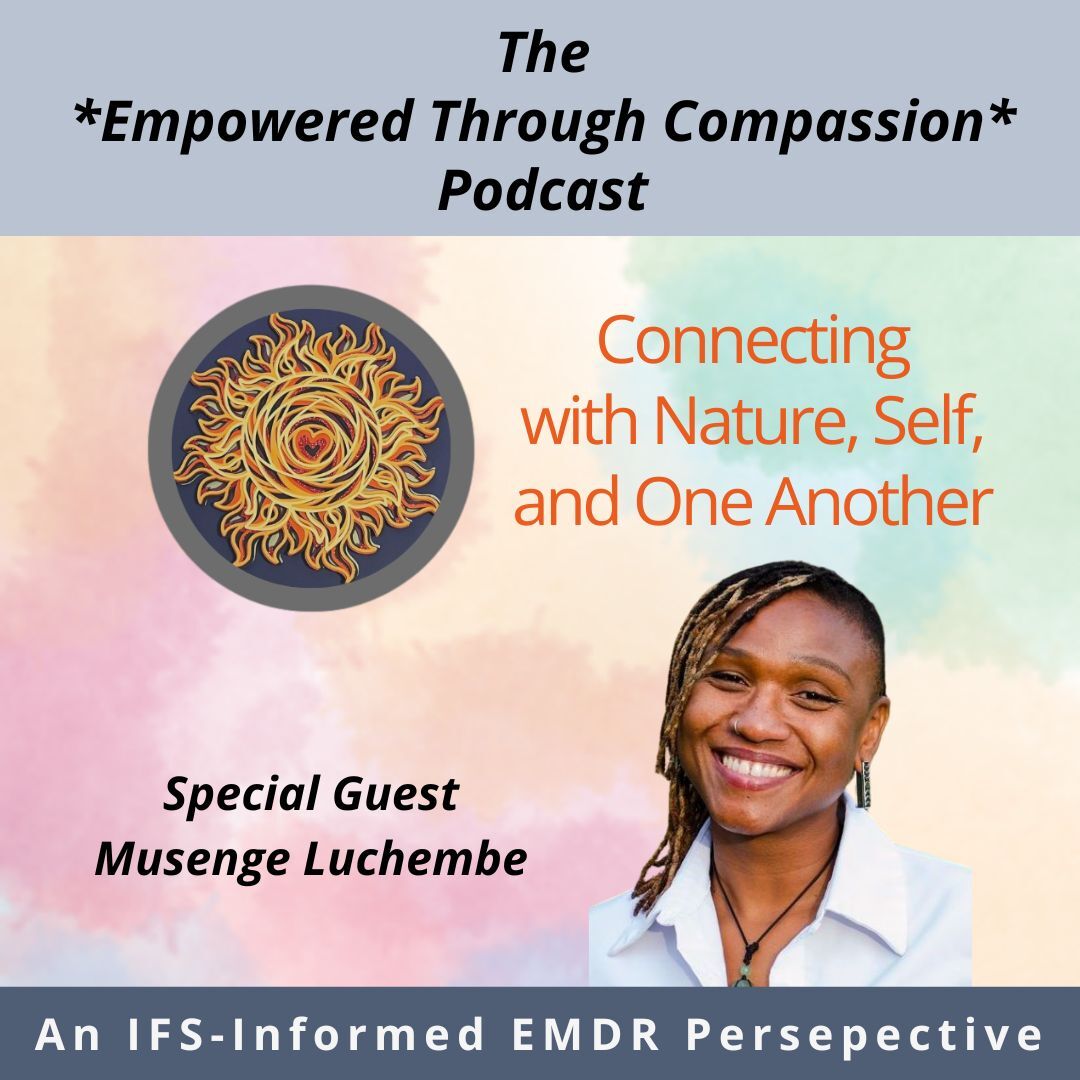 Connecting with Nature, Self, and One Another | In this episode of I speak with Musenge Luchembe, a gifted ecotherapist, licensed psychotherapist, and IFS-certified clinician who was a program assistant when I took my IFIO (Intimacy From the Inside Out) training. In this episode, Musenge and I dive into how nature and the natural world can support deep healing, bringing together her work in ecotherapy, somatic modalities and couples work. She shares reflections on how being held by the land, the elements, and relational attunement fosters integration and opens the way toward wholeness. You can find more about Musenge on her website: Musenge.com | 35m 32s | ||||||
| 10/12/25 |  Special Meditation: Nature Ally | Here is a special bonus to the upcoming episode with Musenge Luchembe. Throught this special ecotherapy meditation, she invites us to become a non-human being, and reconnect with nature's deeper and majestical powers. This invites us into a space within that is quiet, spacious and alive. It's one of those moments you'll want to keep revisiting. And each time you return, you'll be able to find something new. | 14m 15s | ||||||
| 9/23/25 |  The Healing Power of Music with Alison Hughey | Music is more than just sound, it’s a universal language that connects us and heals us. In this episode, I sit down with Alison Hughey, a gifted music therapist who brings people together through the power of music. From adults who are neurodivergent and struggle with stillness, to individuals living with dementia, Alison creates pathways of safety and belonging through sound. Our conversation explores how music reaches the into the unconscious parts of us, and deep into our body and stirs powerful memories and emotions. Alison shares how the nervous system can be calmed through melodies, beats, lyrics, singing and movement. We also talk about music as a tool for emotional expression. For trauma survivors, songwriting or playing music can help release a variety of feelings from anger to grief to anxiety. For those with dementia, familiar songs can connect them to happy moments in their past. Alison’s dogs even joins the conversation, adding to the ambience and authenticity of the episode by singing their own rendition of, “Let’s All Bark at the Lawn Mower Guy.” It was such a pleasure speaking with Alison about music, and taking a deeper dive into the magic of music therapy. Find out more about Alison: On Instagram: @composeyourselfcare On the web: Carolinamusictherapy.com | 45m 15s | ||||||
| 9/14/25 |  Bonus: "IFS Love Practice Meditation" | This special bonus episode features a guided meditation from Corey, continuing our conversation from Part 2. Corey invites us into his "IFS Love Practice" demonstrating how he connects with his parts in a very accepting and compassionate way. This meditation is a powerful tool for inner healing, and I hope this inspires you to take some time to experience a deep connection within. #IFS #Meditation #InnerHealing #GuidedMeditation #SelfCompassion #MindfulnessPodcast #TraumaHealing | 16m 38s | ||||||
| 9/14/25 |  Awakening an "IFS Love Practice": Corey Busch Part 2 | In this second conversation with Corey Busch, we explore the difference between using Internal Family Systems (IFS) for healing and for awakening. Corey has developed what he calls the IFS Love Practice, a way of blending mindful meditation with IFS. In this practice, a part is accepted just the way it shows up. It does not need to relax back, or change, or be healed. It already is OK. Together, we reflect on: * How awakening can be a practice of settling into what is already here, rather than striving for change. * How mindful meditation can be used in IFS to reassure parts that they are welcome exactly as they are * The invitation to parts that they can change or not change (however they see fit). * The many “flavors” of love, and the ocean-like OK-ness of Self. This conversation reminds us that love and acceptance aren’t something our parts need to earn, but rather they can "awaken to" and feel how this energy is already around them. To find out more about Corey, check out his website: coreybusch.com/ We also celebrate our love and admiration for Sid, who can be found here: effortlessifs.com #InternalFamilySystems #IFS #PartsWork #SelfHealing #TraumaHealing #Mindfulness #Meditation #Awakening #SelfAcceptance #Compassion #HealingJourney #Podcast | 48m 05s | ||||||
| 9/8/25 |  Coming Home to Self with Corey Busch | In this inspiring conversation with Corey Busch, we explore how Internal Family Systems (IFS) opens the door to deeper spiritual connection and relational healing. Together, we reflect on the gift of seeing our inner multiplicity and how this awareness naturally connects us to our family, our community, and even to the spiritual universe. Corey shares how meaningful Christian centering prayer was for him. This contemplative practice of silently resting in a sacred word became a lifeline for Corey during when he was struggling with physical pain and traditional mindfulness was not fully working. Through centering prayer, Corey discovered that he could “come home to Self” without asking parts to step aside. There was an abiding and always present love that Corey found within himself. Rather than going through all the formal steps of IFS, Corey found a way to simply relax, unblend, and return to the OK-ness of Self. This was not something that he used to replace IFS (he still loves this model) but rather, it was something to augment IFS. This shift revealed another way to unblend from parts. Rather than asking to see if they would relax back, or even witnessing them, Corey was able to just spend time appreciating the divine presence and unconditional love all around him. This is part one. Part two is a conversation with Corey about his “IFS Love Practice” which outlines his gentle and effortless way to reconnect with Self. Key Insights in this Episode: Multiplicity opens us to interconnectedness. Centering prayer as a doorway to Self. Self as abiding love, always here, beneath parts’ striving. Effortless IFS: resting in Self without an agenda. Spontaneous healing through simple awareness. #InternalFamilySystems #IFS #SelfLeadership #CenteringPrayer #ChristianMysticism #SpiritualHealing #PartsWork #TraumaHealing #AbidingLove #ContemplativePractice #Mindfulness #SpiritualityAndTherapy #IFSCommunity #HealingJourney #SelfEnergy #CompassionateHealing #Wholeness #EffortlessIFS #EmotionalHealing #PodcastForHealing | 45m 58s | ||||||
| 9/1/25 |  Building a Healing EMDR Community with Kathy Couch & Tamera Brown | In this conversation with Kathy Couch and Tamera Brown, we explore what it really means to move from competition to collaboration in the healing professions. Too often, therapists feel pressured to compare themselves to others, and start feeling better than, less than, not enough... As Tamera beautifully describes, healing is a tapestry: and all of our voices matters. Every one of us, whether we are therapists or clients (or both) have something unique and valuable to offer. Kathy brings her wisdom from working with the original EMDR text, showing therapists how to stay grounded in the foundations while also translating them into meaningful, accurate notes. Her work reminds us that documentation isn’t just paperwork; it’s part of the therapeutic process itself. We discuss the wisdom of Dr. Arielle Schwartz, and bringing in awareness of our own nervous-system. This episode is an invitation to honor your uniqueness and value and feel welcomed into the healing EMDR space! Find out more about Tamera and Kathy's Journey Through the Eyes Podcast here: https://www.rewired360.com/podcasts/journey-through-the-eyes-an-emdr-podcast Find out more about Kathy's Rewired360 here: https://www.rewired360.com #WoundedHealer #HeartOfEMDR #TherapistCommunity #HealingTapestry #EMDRTherapy #CollaborationOverCompetition | 46m 08s | ||||||
Showing 25 of 109
Sponsor Intelligence
Sign in to see which brands sponsor this podcast, their ad offers, and promo codes.
Chart Positions
1 placement across 1 market.
Chart Positions
1 placement across 1 market.