
The Feral Behaviourist
by “Dog behaviour without the sugar-coating (or the shock collars).”
Is this your podcast?Insights from recent episode analysis
Audience Interest
Podcast Focus
Publishing Consistency
Platform Reach
Insights are generated by CastFox AI using publicly available data, episode content, and proprietary models.
Total monthly reach
Estimated from 1 chart position in 1 market.
By chart position
- 🇨🇦CA · Pets & Animals#40100K to 300K
- Per-Episode Audience
Est. listeners per new episode within ~30 days
50K to 150K🎙 Weekly cadence·3 episodes·Last published 3w ago - Monthly Reach
Unique listeners across all episodes (30 days)
100K to 300K🇨🇦100% - Active Followers
Loyal subscribers who consistently listen
30K to 90K
Market Insights
Platform Distribution
Reach across major podcast platforms, updated hourly
Total Followers
—
Total Plays
—
Total Reviews
—
* Data sourced directly from platform APIs and aggregated hourly across all major podcast directories.
On the show
Recent episodes
Trust Isn't an Insult
Apr 23, 2026
8m 56s
Good Dogs and the Performance of Safety
Apr 16, 2026
15m 49s
You’re Allowed to Feel This: The Emotional Side of Dog Guardianship
Mar 19, 2026
9m 23s
Regulation First, Training Second: Rethinking How We Help Dogs
Mar 3, 2026
5m 55s
Fear & Facts: What the Statistics Really Say about Animals, People & Fireworks
Nov 14, 2025
10m 44s
Social Links & Contact
Official channels & resources
Official Website
Login
RSS Feed
Login
| Date | Episode | Description | Length | |
|---|---|---|---|---|
| 4/23/26 |  Trust Isn't an Insult | Your dog can love you… and still not feel safe in every situation.This week’s podcast explores why trust isn’t an insult, what building trust really looks like, and why listening to communication matters more than obedience ever will. 🩵🐾 This is a public episode. If you'd like to discuss this with other subscribers or get access to bonus episodes, visit muttsandmischief.substack.com/subscribe | 8m 56s | |
| 4/16/26 |  Good Dogs and the Performance of Safety | We’re often taught that a “good dog” is one who is quiet, still, and compliant.But what if that quietness isn’t calmness…but coping?In this episode of The Feral Behaviourist, we explore the difference between:* Safety vs suppression* Calmness vs inhibition* Behaviour vs emotional stateAnd why some of the “goodest” dogs are the ones we need to look at more closely.This episode introduces the concept of the performance of safety, and how shifting our perspective can transform how we support our dogs. This is a public episode. If you'd like to discuss this with other subscribers or get access to bonus episodes, visit muttsandmischief.substack.com/subscribe | 15m 49s | |
| 3/19/26 |  You’re Allowed to Feel This: The Emotional Side of Dog Guardianship | This one’s a bit… feral.Not in the loud, chaotic way—but in the honest, emotional, slightly unfiltered way.We’re talking about the side of dog guardianship that doesn’t always get said:The frustration.The guilt.The grief.The exhaustion of holding everything together for a dog who needs more.I didn’t polish this one too much.I just spoke.And afterwards… I actually felt pretty drained.Which I think says a lot about how much this part of the journey holds.So if this episode feels a bit heavier…That’s okay.Take it slowly.Pause it if you need to.Come back to it.You’re allowed to feel this too 🩵🎧 Listen now📖 Blog coming tomorrow morning This is a public episode. If you'd like to discuss this with other subscribers or get access to bonus episodes, visit muttsandmischief.substack.com/subscribe | 9m 23s | |
| 3/3/26 |  Regulation First, Training Second: Rethinking How We Help Dogs | In this episode, I explore why we can’t cue a dog into calmness, and why regulation must come before repetition, obedience, or skill-building.We look at:• What regulation actually means• Why arousal is often misunderstood• How “stubbornness” is frequently stress• Why training only sticks when the nervous system feels safeWhen we shift from control to co-regulation, everything changes.Training becomes clearer.Progress becomes steadier.And dogs feel understood, not managed.If this resonates, you’ll love the deeper nervous system work inside my memberships and resources.Regulation first. Always. This is a public episode. If you'd like to discuss this with other subscribers or get access to bonus episodes, visit muttsandmischief.substack.com/subscribe | 5m 55s | |
| 11/14/25 |  Fear & Facts: What the Statistics Really Say about Animals, People & Fireworks | Tonight’s episode walks through:💥 Real-time emotional first aid💥 Why sudden fear can develop even after years of stability💥 Koda’s experience this year💥 Practical things you can do immediately💥 How to support yourself, tooMutts and Mischief is a reader-supported publication. To receive new posts and support my work, consider becoming a free or paid subscriber. This is a public episode. If you'd like to discuss this with other subscribers or get access to bonus episodes, visit muttsandmischief.substack.com/subscribe | 10m 44s | |
| 10/16/25 |  The Feral Behaviourist. Episode 2 Why We Say Emotionally Challenged, Not Reactive | Hi everyone, and welcome back to The Feral Behaviourist, where we talk all things dogs, behaviour, emotions, and connection — always with kindness at the heart. I’m Tasha Attwood, your host, and today I want to explore something that’s been changing across the dog training and behaviour world — and something I’m really passionate about — the language we use to describe dogs who struggle emotionally.Specifically, why I, and many others in the welfare-first community, are moving away from the word “reactive” and instead using “emotionally challenged.”Now, I know what you might be thinking — “It’s just a word, right?”But actually, the words we use carry huge weight. They shape how we perceive behaviour, how we talk about our dogs, and even how we feel about them in those difficult moments.“Reactive” has become a bit of a blanket label. We use it to describe dogs who bark, lunge, growl, snap, or show big emotional displays towards people, dogs, or certain triggers. But over time, it’s also become a label that defines the dog, rather than describing what they’re going through.And that’s where I feel we can do better.When we say a dog is reactive, it tends to frame the dog as the problem — as if they’re choosing to “overreact.”But when we say a dog is emotionally challenged, we’re acknowledging that what we’re really seeing is a dog who’s struggling to cope with an emotion — fear, frustration, anxiety, or even excitement — in that particular moment.It reframes the behaviour from being a fault to being a form of communication.Think about it this way: if a child was overwhelmed, frightened, or anxious, we wouldn’t call them “reactive.”We’d probably say they were finding something difficult or that they were emotionally dysregulated. We’d look for the why — not just the what.Dogs deserve that same compassion.They don’t wake up in the morning thinking, “I can’t wait to bark at that Labrador today.”They’re responding from emotion, not intention.And when we recognise that, it completely changes how we approach helping them.Using the term emotionally challenged helps guardians see their dog through a trauma-informed lens.It encourages empathy. It invites curiosity instead of frustration.When a guardian hears “reactive,” they often feel embarrassed, ashamed, or even defensive — like they’ve failed.But when they hear “emotionally challenged,” they can start to think:“Okay, my dog is struggling emotionally. What can I do to help them feel safe?”That’s a much healthier starting point for both the dog and the guardian.And from a behaviourist’s point of view, it also helps us guide training in a more holistic, relationship-based way.Because we’re no longer focusing on suppressing a reaction — we’re focusing on supporting an emotion.That means meeting needs, adjusting environments, using enrichment, collaborative care, and gradual exposure — not punishment or pressure.It also ties into neuroscience — when dogs are emotionally flooded, the thinking brain, the neocortex, simply goes offline.What we’re left with is the limbic system — fight, flight, freeze, fawn.By addressing the emotion, we help the brain re-regulate and reduce the intensity of those responses over time.So, the change in language isn’t just about being politically correct — it’s about being scientifically and emotionally accurate.It’s about reminding everyone that behind every bark, growl, or lunge is a feeling.And behind every feeling, there’s a story — of fear, pain, confusion, or unmet need.When we call a dog emotionally challenged, we leave room for that story to be heard.So, next time you see a dog struggling on a walk, or your own dog reacts to something that feels “too much” — try to reframe it.Instead of saying “My dog is reactive,” try saying “My dog is emotionally challenged right now.”You might be surprised at how that small shift in language changes your mindset — and your compassion.Thanks for joining me for this short but important episode.If this resonated with you, you can find more about this topic in my Zero to Hero Volume 2 – Emotionally Challenged Dogs ebook, where I dive deeper into emotions, neuroscience, and practical strategies to help your dog feel safe again.Until next time — stay kind, stay curious, and remember: it’s never about control — it’s about connection. This is a public episode. If you'd like to discuss this with other subscribers or get access to bonus episodes, visit muttsandmischief.substack.com/subscribe | 6m 00s | |
| 9/23/25 |  The Feral Behaviourist: Episode 1 – Why “Feral”? | Welcome to the very first episode of The Feral Behaviourist! I’m Tasha Attwood — a canine behaviourist, author, and educator — and I wanted to create a space where we can have real conversations about dogs. Not the Instagram-perfect, polished kind of training you often see online, but the messy, complex, and sometimes uncomfortable truths about living a… This is a public episode. If you'd like to discuss this with other subscribers or get access to bonus episodes, visit muttsandmischief.substack.com/subscribe | 8m 46s | |
| 2/27/25 |  Fun not formality - Building Connections Through Paws to Play | Prey drive is a natural instinct in dogs—some have more of it, some have less, and it can be influenced by genetics, environment, and training. But here’s the thing: prey drive is not a justification for punishment.I often hear the argument that dogs with a strong prey drive must be managed with shock collars to prevent them from chasing wildlife or livestock. But that simply isn’t true. In the videos I’m sharing, you’ll see my dogs in close proximity to a herd of deer, cows, and even a horse. The fencing and hedging separating them is only 4ft—something they could easily clear if they wanted to. Yet, they choose not to. They watch, they observe, and they disengage without issue.This isn’t because I’ve punished them into submission. It’s because I’ve built a foundation of trust, engagement, and choice. They don’t need force to make the right decision—they need guidance, reinforcement, and an understanding of expectations.As a wheelchair user, I can’t rely on physically intervening if my dogs make a sudden movement. Instead, I focus on long-distance handling, reinforcing communication and connection so my dogs actively choose to disengage. This proves that mobility challenges don’t mean you need harsher tools—just smarter training.If you have a dog with strong prey drive, punishment isn’t the answer. Instead, focus on:🦌Management – Secure areas, long lines, and controlled environments.🦌 Training – Teaching disengagement, recall, and alternative behaviors.🦌 Fulfillment – Satisfying their needs through appropriate outlets like scent work, flirt poles, or structured play.A dog’s instincts should never be a reason to resort to pain or fear. With the right approach, we can work with their natural drives, not against them.Mutts and Mischief is a reader-supported publication. To receive new posts and support my work, consider becoming a free or paid subscriber. This is a public episode. If you'd like to discuss this with other subscribers or get access to bonus episodes, visit muttsandmischief.substack.com/subscribe | 2m 26s | |
| 10/4/24 | 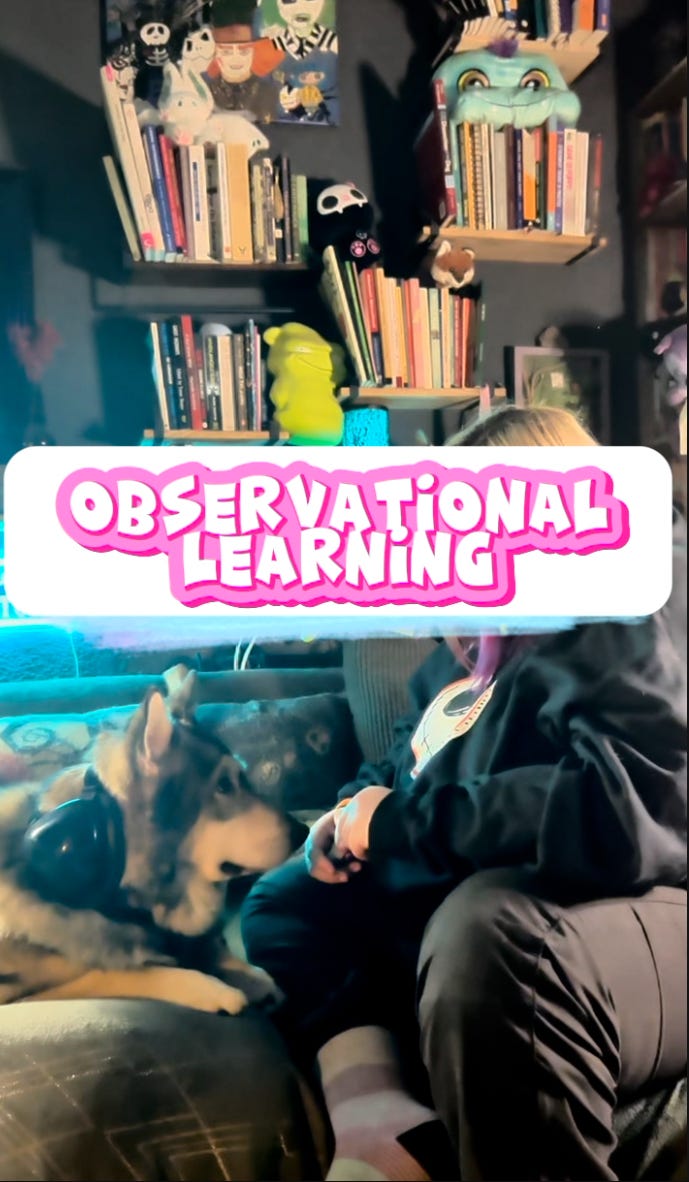 Observational learning using Mutt Muffs | Ever wondered if dogs can learn just by watching? My four dogs and I put this theory to the test with some Do as I Do training using Mutt Muffs! 🐾✨In this video, I explain the concept of observational learning—where dogs pick up new skills and behaviours by watching their guardians or other dogs. Whether you’re curious about enhancing your training techniques or just want to see some fun doggo teamwork in action, this is for you!Check out the full explanation and see how my dogs got involved with their Mutt Muffs in tow! 🎧👆Mutts and Mischief is a reader-supported publication. To receive new posts and support my work, consider becoming a free or paid subscriber. This is a public episode. If you'd like to discuss this with other subscribers or get access to bonus episodes, visit muttsandmischief.substack.com/subscribe | 6m 22s | |
| 9/24/24 | 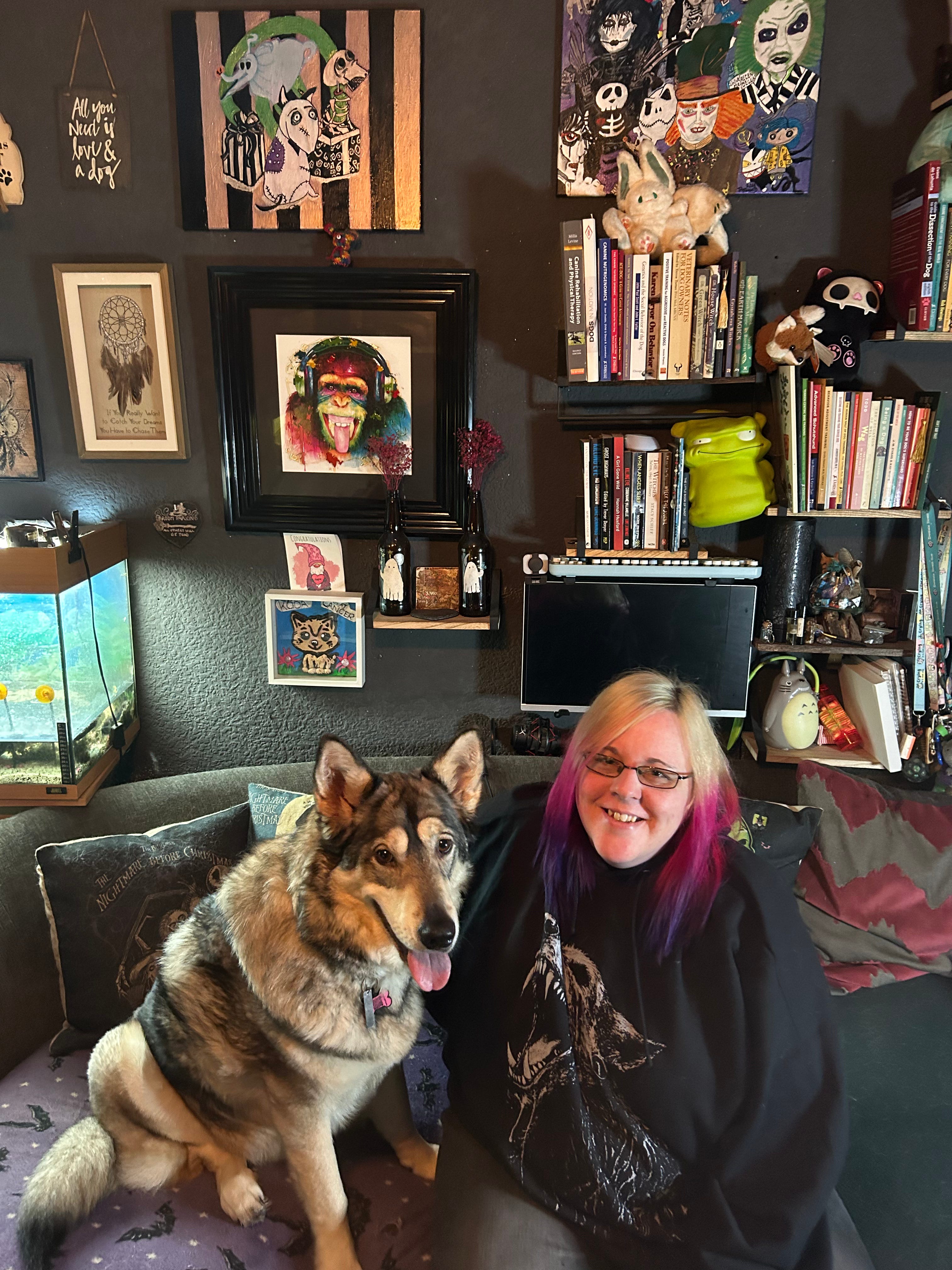 This is the reason many of us are in this job | I hope whomever you choose as your dog professional, looks at your dog like this! This is a public episode. If you'd like to discuss this with other subscribers or get access to bonus episodes, visit muttsandmischief.substack.com/subscribe | 0m 32s |
Showing 10 of 10
Sponsor Intelligence
Sign in to see which brands sponsor this podcast, their ad offers, and promo codes.
Chart Positions
1 placement across 1 market.
Chart Positions
1 placement across 1 market.