

Insights from recent episode analysis
Audience Interest
Podcast Focus
Publishing Consistency
Platform Reach
Insights are generated by CastFox AI using publicly available data, episode content, and proprietary models.
Most discussed topics
Brands & references
Est. Listeners
Insufficient chart data. Estimates will improve as the show charts.
- Per-Episode Audience
Est. listeners per new episode within ~30 days
N/A🎙 Weekly cadence·63 episodes·Last published 1mo ago - Monthly Reach
Unique listeners across all episodes (30 days)
N/A - Active Followers
Loyal subscribers who consistently listen
N/A
Market Insights
Platform Distribution
Reach across major podcast platforms, updated hourly
Total Followers
—
Total Plays
—
Total Reviews
—
* Data sourced directly from platform APIs and aggregated hourly across all major podcast directories.
On the show
From 11 epsHost
Recent guests
Recent episodes
Welcome to the “Countermovement”!
May 7, 2026
13m 36s
Public Health’s Historical Prejudice Against Men and Boys
Apr 22, 2026
14m 26s
Weekly Roundup
Apr 18, 2026
4m 59s
Australia's Manosphere Guide for Teachers
Mar 23, 2026
48m 43s
Australian Research Council Funds Biased Project on “Anti-Women” Movements
Mar 4, 2026
8m 12s
Social Links & Contact
Official channels & resources
Official Website
Login
RSS Feed
Login
| Date | Episode | Topics | Guests | Brands | Places | Keywords | Sponsor | Length | |
|---|---|---|---|---|---|---|---|---|---|
| 5/7/26 |  Welcome to the “Countermovement”!✨ | feminismgender equality+3 | — | Foreign AffairsUN Women+5 | — | feminismgender equality+3 | — | 13m 36s | |
| 4/22/26 |  Public Health’s Historical Prejudice Against Men and Boys✨ | public healthmen's health+3 | — | American Journal of Public HealthUniversity of California – San Francisco | — | public healthmen's well-being+3 | — | 14m 26s | |
| 4/18/26 |  Weekly Roundup✨ | health caremental health+5 | — | Big PharmaNCHS+2 | — | health careexercise+5 | — | 4m 59s | |
| 3/23/26 |  Australia's Manosphere Guide for Teachers✨ | manosphereeducation+3 | Tom Golden | ABC NewsAustralia’s National Research Organisation for Women’s Safety+5 | — | manospheremisogyny+5 | — | 48m 43s | |
| 3/4/26 |  Australian Research Council Funds Biased Project on “Anti-Women” Movements✨ | research biasanti-women movements+3 | — | Australian Research CouncilMapping of the Neo-Manosphere(s): New Directions for Research+2 | — | Australian Research Councilanti-women movements+3 | — | 8m 12s | |
| 2/17/26 |  eSafety Commissioner’s Sex-Biased Grants on Online Abuse✨ | online abusegender-based violence+3 | — | Australian Communications and Media AuthorityeSafety Commissioner | AustraliaFirst Nations | eSafety Commissionergrants+3 | — | 8m 57s | |
| 2/13/26 |  The Notebook and Romantic Love✨ | Hollywood representationromantic love+3 | — | Evie MagazineFox News+1 | — | Hollywoodromantic love+3 | — | 24m 57s | |
| 2/4/26 |  Research Ethics Matter Now That Women Are Exercise Study Participants✨ | research ethicsexercise science+3 | — | Journal of Academic EthicsNational Institute of Child Health & Human Development | United States | research ethicsexercise science+3 | — | 14m 06s | |
| 1/29/26 |  Rejecting the Gynocentric Approach to Paternity Leave✨ | paternity leavegender equality+3 | — | Organisation for Economic Co-operation and DevelopmentPaid leave for fathers: Recent OECD policy trends | — | paternity leavegender equality+3 | — | 11m 04s | |
| 1/19/26 |  Backlash Against the Backlash✨ | women's rightsfeminism+3 | — | United Nations (UN)Carnegie Endowment for International Peace | — | feminist movementsbacklash+3 | — | 12m 19s | |
Want analysis for the episodes below?Free for Pro Submit a request, we'll have your selected episodes analyzed within an hour. Free, at no cost to you, for Pro users. | |||||||||
| 1/13/26 |  Researchers Left in the Dark✨ | academic peer reviewpaper submission process+4 | — | SportRxivThe Nuzzo Letter+2 | — | peer reviewsubmission portal+4 | — | 10m 32s | |
| 1/8/26 |  United States to Defund UN Women | United Nations (UN) Women is the entity within the UN that is said to be dedicated to “gender equality” and the empowerment of women. However, many problems exist with UN Women. Fundamental to these problems is UN Women’s ideological bias, which stems from an adherence to intersectional feminist philosophy. This adherence has led UN Women to continuously push feminist propaganda at taxpayer expense. In 2025, I published a report that detailed UN Women’s use of feminist propaganda on X, and I concluded the following:“UN Women’s tweets are often inaccurate, biased, contradictory, unprofessional, overly emotional, and lacking in common decency and empathy for boys and men. At minimum, member state representatives should insist on reform at UN Women. If UN Women refuses to rid itself of its problematic feminist ideology, member states should stop funding UN Women at the earliest possible instance. Taxpayers should not be forced to fund feminist propaganda.”With that said, I am happy to report the recent news that the United States (U.S.) will no longer fund UN Women.No More U.S. FundsOn January 7, 2026, the Trump White House issued Executive Order 14199: Withdrawing the United States from International Organizations, Conventions, and Treaties that Are Contrary to the Interests of the United States.According to the Executive Order, the U.S. Secretary of State and the U.S. Representative to the UN conducted a review of international intergovernmental organizations that the U.S. is a member of and provides funding or other support for to determine which organizations operate in conflict with U.S. interests. In total, 66 organizations or entities were identified as operating in conflict with U.S. interests. Thirty-one of those entities are part of the UN, and one of the UN entities on the list is UN Women. UN Women appears on the list under the name “UN Entity for Gender Equality and the Empowerment of Women,” which is a name sometimes used to refer to UN Women.In the Executive Order, Trump issued a directive to all executive departments and agencies to “take immediate steps to effectuate the withdrawal of the United States from the organizations listed…as soon as possible. For United Nations entities, withdrawal means ceasing participation in or funding to those entities to the extent permitted by law.”UN Women Getting What It DeservesFunding cuts at UN Women have been long-deserved, given UN Women’s ideological bias and unwillingness to reform. In 2020, I published an academic paper documenting widespread bias against boys and men at the UN, including at UN Women. In 2025, I tallied the number of days of observance that the UN recognizes for girls and women and compared it to the number of days observance that it recognizes for boys and men. In total, the UN recognizes 13 days of observance for girls and women and zero days for boys and men (see diagram below). Finally, in November of 2025, I published a report detailing the propaganda techniques that UN Women uses on X to deceive its audience.Importantly, I am not the only one who has highlighted issues at UN Women. The Domestic Abuse and Violence International Alliance (DAVIA) has published numerous press releases over the past five years highlighting problems at UN Women and the UN more broadly. Examples press releases are listed below:· Dec. 2025 - ‘Online Violence’ Campaign Reveals Rampant Dishonesty at United Nations· Dec. 2025 - UN Launches ‘Online Violence’ Campaign to Smear Men and Frighten Women· Nov. 2025 - UN Women Pushes Gender Propaganda· Sep. 2025 - World Leaders Scold United Nations for Embracing Marxist-Feminist Ideology· May 2025 - UN Women Must Condemn Wave of Feminist Violence on International Women’s Day· Mar. 2025 - UN Women’s Conference Ends in Disarray as Global Criticism of Feminism Mounts· Jan. 2024 - UN Women Report Falsifies the Truth about Civilian Deaths in Gaza· Dec. 2022 - UN Women’s Denial of Female-Perpetrated Abuse is a Threat to Women· Nov. 2022 - UN Women Media Post about Journalists Killed in Duty — Offensive to Decency and Fairness· Dec. 2021 - UN Women’s Abuse Campaign Mocks the Message of International Human Rights Day· Dec. 2020 - UN Women Pushes COVID Abuse Myths, Exploits Women’s Fears· Jun. 2020 - UN Women’s Coronavirus Propaganda CampaignHow Much Money Will UN Women Lose?Historically, the U.S. has sent about $15M directly to UN Women each year (see graph below). One outlier year was 2022 when the U.S. sent about $45M directly to UN Women.Between 2011 and 2023, the U.S. sent about $200M directly to UN Women. Over that time, U.S. contributions accounted for 4.8% of funds that UN Women received from member states. This made the U.S. the 9th leading member state funder of UN Women over that time. Importantly, this total does not account for the fact that 15% of UN Women’s financial contributions come from other UN entities, and those other entities are presumably also highly funded by the U.S.Each year, UN Women receives about $540M across all financial contributors. About 80% of those funds come from UN member states. The funds from the U.S. that will no longer go directly to UN Women represent only a drop in the bucket of UN Women’s coffers. UN Women is still likely to receive significant funds from other member states and other sources such as private companies and non-governmental organizations. The member states who contribute the most funds directly to UN Women are Sweden (13.5% of member state contributions to UN Women), Norway (8.2%), European Commission (8.5%), Finland (6.8%), United Kingdom (6.2%), Australia (5.7%), and Canada (4.5%).ConclusionOver the past several years, UN Women has continually demonstrated ideological bias and an unwillingness to reform. Thus, the U.S. is correct to defund UN Women, and presumably the funding cuts will happen immediately assuming there are no legal issues associated with the Executive Order. The total funds that will no longer go from the U.S. direct to UN Women are only a drop in the bucket of UN Women’s coffers. Nevertheless, the funds are not unsubstantial, and the decision is symbolic and might make it easier for other countries to follow suit.In the coming days, one can expect feminists and the mainstream media to frame the U.S. funding cuts to UN Women as “an attack on women” or “an attack on gender equality.” In fact, in 2025, the UN appeared to be preparing for such a moment. On social media, they regularly catastrophised about impending funding cuts, as approximately 9% of their tweets included content about funding of women’s issues (see section 4.3.2. of this report). One example tweet from May 16, 2025 said: “Women’s rights are under threat. Funding cuts are pushing women’s organizations in crises settings to a breaking point. Half may shut down in 6 months. Women and girls can’t afford to lose these lifelines.”Girls and women are unlikely to lose their lifelines from funding cuts to UN Women. To the extent there is a smidgen of truth to such a claim, the blame rests on UN Women. All UN Women had to do was give up its ideological bias and be fair and objective. It refused to do that, and now it will experience the consequences.Related Content at The Nuzzo LetterSUPPORT THE NUZZO LETTERIf you appreciated this content, please consider supporting The Nuzzo Letter with a one-time or recurring donation. Your support is greatly appreciated. It helps me to continue to work on independent research projects and fight for my evidence-based discourse. To donate, click the DonorBox logo. In two simple steps, you can donate using ApplePay, PayPal, or another service. Thank you.Thanks for reading The Nuzzo Letter! Subscribe for free to receive new posts and support my work. This is a public episode. If you would like to discuss this with other subscribers or get access to bonus episodes, visit jameslnuzzo.substack.com | 9m 41s | ||||||
| 12/21/25 |  Women in STEM, Men in… | STEM and WomenThe seemingly never-ending campaign to recruit more women into science, technology, engineering, and mathematics (STEM) continues in Australia. On November 26, 2025, the federal government’s Department of Industry, Science and Resources announced that it would invest another $9.77 million into the Women in STEM and Entrepreneurship program. According to the Department, the program supports “investment in gender equity initiatives that aim for lasting systemic change by eliminating barriers for women’s participation in STEM education and careers, and entrepreneurship.”More specifically, the program will fund projects that:(a) reduce and/or mitigate systemic and cultural barriers to participation in STEM education, careers, innovation and entrepreneurship by girls and women;(b) reduce the multiplier effect of intersectional barriers to participation, development and leadership of girls and women in STEM education, careers, innovation and entrepreneurship;(c) address inequality or discrimination against girls and women in STEM education, careers, innovation and/or entrepreneurship.Psychology and …Interestingly, a couple of weeks later, on December 15, 2025, the Australian Department of Health, Disability and Ageing announced funding of $16 million for its Postgraduate Psychology Incentive Program. This program is part of the government’s larger grant scheme called Addressing Critical Psychology Shortages. The scheme is intended to resolve current bottlenecks in the psychology training pipeline that are apparently impacting workforce availability and service delivery.If one traces back the various rounds of funding associated with this scheme, one finds that a purpose of Round 1 of funding in 2024 was to support universities who create “additional postgraduate psychology places in courses which lead to general registration and can lead to relevant areas of practice endorsement.” Importantly, this round of funding was contingent upon universities demonstrating the ability to grow postgraduate student enrolments by at least 8.7%. However, unlike the STEM grants, no mention was made of student sex. Instead, the government stated that half the internship and supervisor trainings associated with the programs will be offered to “people in First Nations communities, culturally and linguistically diverse communities and people living in regional, rural and remote areas of Australia.”Sex Bias in the “Underrepresentation” ArgumentThe main aim of the psychology workforce grants is to increase the number of student placements. Secondary aims appear to be to increase student enrolments in psychology and to create an overall more efficient psychology training pathway to meet society’s mental health needs. Thus, given that sex differences in proportional representations are the bases for other Australian education and career development grants, such as those aimed at increasing women’s representation in STEM, it is odd that sex differences in proportional representations were not considered in the desire to create an overall more robust and efficient psychology workforce.In Australia, the proportion of university psychology students who are men (presumably ~20%) is significantly less than the proportion of university STEM students who are women (37%). Moreover, the proportion of registered psychologists in Australia who are men (19.6%) is not too drastically different than the proportion of persons employed in STEM jobs who are women (15%). Thus, Australian bureaucrats exhibit sex bias when they use “underrepresentation” as a basis for sex-specific education and career development grants in STEM but not in psychology.The criticisms of the government’s philosophy do not end there.Need vs. Luxury GrantsThe “needs” put forward by the government in the STEM and psychology grants are not the same. In the psychology grants, the government has stated that a workforce shortage in the mental health sector exists, and the purpose of the grants is to resolve this societal need. For the Women in STEM grants, the government did not state that the purpose of the investment was to resolve a workforce shortage. Therefore, the Women in STEM grants appear to be luxury grants, influenced by gender ideology. Their motivation is political not practical.This illustrates the depth of gynocentrism in the government. Even when there is a societal need that could be helped by using the “underrepresentation” philosophy, which the government uses regularly when it argues for women’s education and career development, it still will not adopt the philosophy. Doing so would show an explicit interest in men’s education and career development, and that is something that bureaucrats and academics are not willing to do.Contradictory AimsAnother issue with these two grant schemes is that their aims somewhat contradict each other in terms of women’s workforce participation. By not framing the psychology grants in a male-specific way, the Australian government presumably believes that the psychology grants will incentive more women to enter and stay in the field of psychology. In fact, one media report implied that “a flood of female graduates” could be the solution to the psychology workforce shortage. Yet, resolving the psychology workforce shortage by increasing the number of female workers conflicts with the idea of getting more women into STEM fields. There are only so many women around, and most of them prefer psychology over STEM when given a choice.Men in PsychologyIn terms of overall bodies that could be recruited to enter psychology to resolve a workforce shortage, many male bodies in the community are available. Fewer men than women are enrolled at Australian universities, with men comprising 43%of students. Thus, there is a larger pool of non-university men than women to incentivize to enrol in university to study psychology. Also, of the men who are already enrolled in universities, many of them are studying topics other than psychology. Thus, the Australian government could incentivize male university students to switch fields to psychology. Such incentives might appeal to male students who are “on the fence” about different career options or who have equal interest in psychology and another field.Nevertheless, sex differences in vocational interests and preferences exist, and they are rooted in biology. Consequently, incentives and other social engineering schemes will only go so far in changing proportional representations in vocations. In one survey of more than 45,000 high school students in Australia, males ranked psychology as their 17th most popular career choice, whereas females ranked psychology as their top choice. Moreover, males rated six different engineering fields in their top 20 careers, whereas females did not rate a single engineering field in their top 20. Thus, neither STEM nor psychology should be expected to exhibit equal male and female representations.Still, if the government is going to use workforce “diversity” as a reason for recruiting more women into STEM, then the same rationale ought to apply to the field of psychology, and patient preferences support doing so. One study of approximately 2,000 men in Australia found that 19.1% of the men prefer a male psychologist. In a different study, 17% of men and 5% of women indicated that they prefer a male psychologist. In both studies, approximately 60% of individuals did not have a preference for the sex of their psychologist, meaning that they would happily talk to either a male or female psychologist, whereas approximately 20% of men and 34% of women said that they would prefer to talk to a female psychologist. Thus, unlike the Women in STEM grants, which are luxury grants, there is a practical reason that might justify the psychology workforce grants being sex-specific: consumer demand for male psychologists.Nevertheless, government incentives alone will not be enough to cause large numbers of men to start swarming to university psychology departments. Part of men’s arrival in those departments is likely predicated on those departments uprooting the misandry and anti-male bias that exists in them. Few men of healthy self-esteem will want to dedicate their life’s work to a field and professional community that continually bashes them. Such men do not want to learn about and implement masculinity measurement tools that are rigged from the start. Such men do not want to care for boys and men using feminist-informed guidelines. Such men do not want to read academic papers on “male privilege,” “mankeeping,” “mansplaining,” and other topics that reflect a misguided understanding of human nature.Evidence of the disconnect between men and academia, particularly the humanities departments, is all around us. One male student recently described his experiences in a psychology program as one of feeling unwelcomed, isolated, monitored, and silenced. Similarly, I was recently contacted by a male psychology student in Australia who expressed frustrations with the program that he is enrolled in. He told me that the university that he attends regularly pushes DEI and gender pay gap propaganda on him. He added that his psychology coursework often includes anti-male, anti-white, and anti-heterosexual asides. The man said that he is thinking about dropping out of the program. He asked me if I was aware of any psychology programs that do not push critical and feminist theories onto students. Sadly, I did not have a positive answer from him.Government bureaucrats and university administrators also do not have positive answers for men like this, namely, because they do not care. They are not interested in hearing his concerns. They believe that they are doing a fantastic job – sex-biased grants and all.Related Content at The Nuzzo LetterSUPPORT THE NUZZO LETTERIf you appreciated this content, please consider supporting The Nuzzo Letter with a one-time or recurring donation. Your support is greatly appreciated. It helps me to continue to work on independent research projects and fight for my evidence-based discourse. To donate, click the DonorBox logo. In two simple steps, you can donate using ApplePay, PayPal, or another service. Thank you.Thanks for reading The Nuzzo Letter! Subscribe for free to receive new posts and support my work. This is a public episode. If you would like to discuss this with other subscribers or get access to bonus episodes, visit jameslnuzzo.substack.com | 13m 09s | ||||||
| 7/23/25 |  Sex-Biased Pollsters | On July 10, 2025, the Pew Research Center published results from its poll of 5,085 American men and women titled, “Americans’ Views on Who Influences Health Policy and Which Health Issues to Prioritize.”In one part of the poll, participants were presented with a list of eight health issues and asked to indicate which issues they believe are a “major problem,” “minor problem,” or “not a problem at all.” The results can be seen in the figure below.Roughly 80-85% of poll participants reported a belief that cancer, overweight and obesity, heart disease, and opioid addiction are “major problems.” Alzheimer’s disease came in fifth on the list with 64% of Americans saying it is a “major problem,” followed by loneliness at 55%, bird flu at 26%, and measles at 25%.The Pew Research Center also split the results by political affiliation of poll participants. On average, the same proportions of Democrats and Republicans agreed that cancer, overweight and obesity, heart disease, and opioid addiction are “major problems.” This consensus across party lines is encouraging to see. However, for loneliness, bird flu, and measles, more Democrats than Republicans reported a belief that these are “major problems.”Later in the poll, the Pew Research Center asked participants about the importance of the federal government in overseeing certain areas of healthcare. Six areas were presented, including testing drug safety, tracking the spread of contagious diseases, investigating health insurance fraud, making rules about food labels, and developing programs that place doctors and nurses in rural communities.The other healthcare area that the Pew Research Center asked about was women’s health. Specifically, Pew asked participants how important they thought it was for the federal government to “study health issues that affect women and girls.”The results to this question, which can be seen in the figure below, were as follows:* 45% of Americans said it is extremely important for the federal government to study health issues that affect women and girls.* 32% of Americans said it is very important for the federal government to study health issues that affect women and girls.* 18% of Americans said it is somewhat important for the federal government to study health issues that affect women and girls.* 5% of Americans say it is not at all important for the federal government to study health issues that affect women and girls.In the text of the report, the Pew Research Center also revealed a sex difference in belief about the federal government studying girls’ and women’s health. Fifty percent of women and 41% of men said that they believe it is extremely important for the federal government to study health issues that affect women and girls – a 9% difference between the sexes.The difference between Democrats and Republicans was even larger. Fifty-nine percent of Democrats and 32% of Republicans said that they believe it is extremely important for the federal government to study health issues that affect women and girls – a 27% difference between the political parties.Curious minds are likely to wonder how poll participants’ views on the federal government studying women’s health compare to their views on the federal government studying men’s health. For example, did the male and female participants demonstrate the same 9% sex differential as they did when asked about women’s health? Was the 27% differential between Democrats and Republicans also replicated when the poll participants were asked about men’s health?Unfortunately, we do not know the answers to these questions, because the Pew Research Center did not ask poll participants about their opinions on the role of the federal government in studying boys’ and men’s health issues. This omission was particularly strange considering that more males than females die from four of the top five health problems that Pew asked about earlier in their poll. These four health problems are cancer, diseases of the heart, obesity, and opioid and other drug-related overdoses. As shown in the graph below, males comprise 52.7% of all deaths from cancer, 55.3% of deaths from disease of the heart, 53.8% of deaths from obesity, and 69.6% of deaths from drug overdoses.When one also considers, for example, the greater number of male than female suicides, homicides, fatal occupational injuries, unintentional drownings, and alcohol-induced deaths, which culminate in a significantly shorter life expectancyfor American males than females, Pew’s omission of men’s health from the poll is even more perplexing.Pew’s omission of men’s health from the poll might have been purposeful. However, their omission might also reflect a genuine lack of awareness that coincides with an inability to connect specific epidemiological results, which, together, build the broader concept of men’s health. Within public health and biomedical research circles, this lack of conceptualization of men’s health as a broad healthcare area can be seen in the graph below, which I published in a paperin 2020. The graph shows the number of times the phrases “men’s health” and “women’s health” appear in the titles or abstracts of research articles indexed in PubMed. Between 1970 and 2018, the phrase “men’s health” appeared in the titles or abstracts of 1,555 articles indexed in PubMed, whereas the phrase “women’s health” appeared in the titles or abstracts of 14,501 articles indexed in PubMed – an approximate 10-fold difference.Moving forward, polling organizations who survey public opinion about health issues affecting Americans ought to ask about women’s and men’s health. Both areas are important and warrant attention. In terms of broad healthcare policy, giving asymmetrical attention to one sex over the other is neither just nor is it a healthy long-term strategy for a flourishing society. As Dr. Warren Farrell says, “When only one sex wins, both sexes lose.”Let us hope that in future polls we will finally learn where the general public stands regarding their views on the broad area of men’s health. Remarkably, after all the billions of dollars poured into health research and polling over the years, we still do not have clear answers to such simple questions.Related Content at The Nuzzo LetterSUPPORT THE NUZZO LETTERIf you appreciated this content, please consider supporting The Nuzzo Letter with a one-time or recurring donation. Your support is greatly appreciated. It helps me to continue to work on independent research projects and fight for my evidence-based discourse. To donate, click the DonorBox logo. In two simple steps, you can donate using ApplePay, PayPal, or another service. Thank you.Thanks for reading The Nuzzo Letter! Subscribe for free to receive new posts and support my work. This is a public episode. If you would like to discuss this with other subscribers or get access to bonus episodes, visit jameslnuzzo.substack.com | 9m 08s | ||||||
| 7/16/25 |  National Academies’ Grand Plan for the NIH Office of Research on Women’s Health | The United States (U.S.) Office of Research on Women’s Health was created within the National Institutes of Health (NIH) in 1990. Organizationally, the Office is positioned within the Office of the Director of the NIH. The original goals of the Office of Research on Women’s Health were:“(1) to strengthen, develop, and increase research into diseases, disorders, and conditions that are unique to, more prevalent among, or more serious in women, or for which there are different risk factors for women than for men;(2) to ensure that women are appropriately represented in biomedical and biobehavioral research studies, especially clinical trials, that are supported by the NIH; and(3) to direct initiatives to increase the number of women in biomedical careers.”All three goals have been achieved. The goal of increasing the number of female participants in clinical research trials was based on the claim that women were historically excluded from clinical research trials. This claim was largely unsubstantiated at the time that it was made, and numerous studies have since shown that women are not underrepresented as participants in medical research. In fact, reports published by the Office of Research on Women’s Health show that women have comprised 55-60% of participants in NIH-funded trials for the past three decades.The notion that women have been “underrepresented” in research trials has also been historically linked to the idea that women’s health research has been “underfunded.” This claim is also untrue.First, as shown in the graph below, the Office of Research on Women’s Health has had its own budget for supporting and coordinating women’s health research since 1991. That budget has totalled approximately $1.3 billion over the past 35 years.Second, the amount of money that the NIH expends on women’s health research across all its institutes is significantly greater than the amount it expends on men’ health research. As shown in the graph below, approximately 81% of the NIH’s research funding is not sex-specific. However, of the remaining funding that is sex-specific, women’s health receives approximately 13% each year, whereas men’s health receives approximately 6% each year. This amounts to approximately $4.1 billion each year for women’s health research and $1.8 billion per year for men’s health research.Given the substantial amount of money invested into women’s health research, and the more-than-adequate representation of females as participants in NIH-funded clinical trials, the Office of Research on Women’s Health has presumably also achieved its goal of strengthening, developing, and increasing research into diseases, disorders, and conditions that are unique to or more prevalent among women. If such goals have not been achieved, then taxpayers are owed an explanation for how this could be possible given the billions of dollars that has been invested into women’s health research.The third goal of the Office of Research on Women’s Health was to increase the number of women in biomedical careers. This goal has long since been achieved. Women comprise the majority of students who graduate from U.S. universities with degrees in health-related fields. Greater numbers of female than male graduates are now observed in many health and medical fields including public health, healthcare administration and management, pharmacy, medicine, dentistry, optometry, physical therapy, occupational therapy, nursing, and psychology. In 2021-22, women comprised 80% of university graduates across all health-related fields.Given all of this information, one might think that women’s health advocates would want to celebrate the achievements of their original goals. After the celebration finishes, they might even take a moment to consider whether public health attention has gone too far in the female direction, given that male life expectancy is 5.3 years shorter than female life expectancy, and no Office of Research on Men’s Health has ever been created.As Dr. Warren Farrell says, “When only one sex wins, both sexes lose.”Unfortunately, no “mission accomplished” celebration seems to have ever occurred, and Dr. Farrell’s conceptualization still does not seem to be understood by many individuals who work within the academic and public health sectors.National AcademiesIn December of 2024, the National Academies of Science, Engineering, and Medicine – with the input of 17 committee members, two fellows, 10 study staff, eight consultants, and 17 reviewers – published a report titled, “A New Vision for Women's Health Research: Transformative Change at the National Institutes of Health.” The report was also subsequently covered in a piece in Science titled, “NIH needs a new institute for women’s health research, expert panel says.”The National Academies are not a government agency. According to their website, “The National Academies provide independent, objective advice to inform policy with evidence, spark progress and innovation, and confront challenging issues for the benefit of society.”From the National Academies’ website, one also learns of their vision, mission, and core values. Their vision is a “nation and a world that rely on scientific evidence to make decisions that benefit humanity.” Their mission is to “provide independent, trustworthy advice and facilitate solutions to complex challenges by mobilizing expertise, practice, and knowledge.” Their core values are “Independence, Objectivity, Rigor, Integrity, Inclusivity, Truth.”Here, my first aim is to introduce the recommendations made by the National Academies regarding the future of the NIH and women’s health research. My second aim is to highlight the flaws in the National Academies’ report and suggest that these flaws are evidence of the National Academies’ failure to live up to its own professed vision, mission, and core values.National Academies’ Recommendation #1: NIH Organizational Structure“The National Institutes of Health (NIH) should form a new Institute to address the gaps in women’s health research (WHR) and create a new interdisciplinary research fund. Furthermore, NIH leadership should expand its oversight and support for WHR across the Institutes and Centers (ICs). Congress should appropriate additional funding to adequately support these new efforts.”Under this recommendation, the National Academies further specify that they believe the Office of Research on Women’s Health should be elevated to a position of an independent institute within the NIH and that the Office should be given its own budget of at least $4 billion over the first five years. In addition to this separate budget, the National Academies recommend that Congress establish a new separate fund for women’s health research through the Office of the NIH director. They state that this fund should equal $11.4 billion over the first five years.National Academies’ Recommendation #2: Oversight and Tracking Investment into Women’s Health Research“The National Institutes of Health (NIH) should reform its process for tracking and analyzing its investments in research funding to improve accuracy for reporting to Congress and the public on expenditures on women’s health research (WHR).”Under this recommendation, the National Academies suggest that the NIH is not currently categorizing women’s health research accurately and that a modified categorization system is necessary to better summarize how much money the NIH expends on women’s health research.National Academies’ Recommendation #3: Prioritizing Women’s Health Research“The Director of the National Institutes of Health (NIH) should develop and implement a transparent, biennial process to set priorities for women’s health research (WHR). The process should be data driven and include input from the scientific and practitioner communities and the public. Priorities of the director and the Institutes and Centers (ICs) should respond to the gaps in the evidence base and evolving women’s health needs.”Under this recommendation, the National Academies also state that most NIH Institutes and Center have plans that “rarely mention women’s health” and that “significant gaps in WHR at NIH are the result of the substantial historical underrepresentation, lack of accountability, inadequate funding, and dearth of comprehensive research that have long characterized this field. Decades of insufficient focus have resulted in critical knowledge deficits and disparities in health outcomes for women.”National Academies’ Recommendation #4: Careers in Women’s Health Research“The National Institutes of Health (NIH) should augment existing and develop new programs to attract researchers and support career pathways for scientists through all stages of the careers of women’s health researchers.”Under this recommendation, the National Academies discuss a loan repayment program for researchers who investigate women’s health, expansion of NIH support for early- and mid-career researchers who study women’s health, and additional special considerations for researchers who apply for women’s health research grants.National Academies’ Recommendation #5: Expanding the Women’s Health Research Workforce“The National Institutes of Health (NIH) should augment existing and develop new grant programs specifically designed to promote interdisciplinary science and career development in areas related to women’s health. NIH should prioritize and promote participation of women and investigators from underrepresented communities.”Under this recommendation, the National Academies discuss expanding the following centers and programs: the Building Interdisciplinary Research Careers in Women’s Health (BIRCWH) Program, the Specialized Centers of Research Excellence (SCORE) on Sex Differences, the Women’s Reproductive Health Research (WRHR) program, and the Research Scientist Development Program (RSDP).National Academies’ Recommendation #6: Women’s Health Expertise on Grant Review Panels“The National Institutes of Health (NIH) should continue and strengthen its efforts to ensure balanced representation and appropriate expertise when evaluating grant proposals pertaining to women’s health and sex differences research in the peer review process.”Under this recommendation, the National Academies want the NIH to ensure that individuals who serve as reviewers of NIH grant applications have adequate expertise in women’s health and that these review panels have “balance representation.”National Academies’ Recommendation #7: Sex as a Biological Variable“The National Institutes of Health (NIH) should revise how it supports and implements its sex as a biological variable (SABV) policy to ensure it fulfills the intended goals.”Under this recommendation, the National Academies further specify that the NIH should expand education around sex as a biological variable and that studies that plan to include sex-segregated data should be given priority in the funding pipeline. Ironically, this recommendation of more research on sex as a biological variable falls within a report that uses phrase like “birthing people,” “assigned at birth,” “girls and gender minorities with uteruses,” and “women and those capable of pregnancy.”National Academies’ Recommendation #8: Research TopicsUnder this recommendation, the National Academies listed a range of basic, clinical, and population-level women’s health research topics that it believes the NIH should prioritize. This list of study topics includes everything from endometriosis, to pregnancy physiology, to menopause, to the “structural and social determinants” of health.Flawed PlanThe National Academies’ report and its eight recommendations for the future of women’s health at the NIH is flawed for several reasons. The fundamental issue with the plan is that it ignores men’s health. The National Academies did not present epidemiological data on men’s health, nor did the National Academies present data on men’s participation in research trials or on NIH funding of men’s health research. For example, on eight pages in the report, the National Academies say that women’s health has been “underfunded.” Yet, the National Academies did not mention that no office for research men’s health has ever been created, nor did the group present data on funding of men’s health research. Had these presentations been made, readers would have clearly seen that women’s health research has received significantly more NIH funds than has men’s health research. Moreover, on 17 pages in the report, the National Academies say that women’s health has been “understudied.” Yet, the National Academies did not present data on male and female participation in NIH-funded trials. Had these presentations been made, readers would have clearly seen that women have made up 55-60% of participants in NIH-funded research trials since at least 1995. Thus, by not presenting information about men’s health, the National Academies’ report starts from a biased position. Therefore, the report lacks in intellectual integrity.Damning if TrueThe National Academies’ report is also problematic in that it is damning if its contents are indeed true. Much of what is revealed in the report implies that the Office of Research on Women’s Health has been entirely incompetent over the past 35 years in completing its mission of supporting and coordinating women’s health research. For example, the National Academies say that we know very little about women’s health and that women’s health has been “understudied” and “underfunded.” How can this be possible with annual women’s health research budgets in the billions of dollars, if not for incompetence? And why should taxpayers then entrust more money and power in the hands of the Office of Research on Women’s Health if this history of underperformance is indeed true?The reality, of course, is that women’s health has not been “understudied” or “underfunded.” We know many things about women’s health. By suggesting the opposite, and by playing the female victim card to make a political gain, the National Academies unintentionally made the NIH and Office of Research on Women’s Health look foolish and incompetent.Men’s and Women’s Health TogetherOne can care about women’s and men’s health simultaneously. The National Academies, via their report, demonstrated that they do not understand this simple humanitarian idea. Instead of choosing to write a report or perhaps two separate reports that included plans for both women’s and men’s health, the National Academies chose to write a report only on the future of women’s health research. In doing this, the National Academies’ failed to demonstrate intellectual rigour and a moral compass, and they failed to live up to the organization’s professed vision, mission, and core values. The National Academies dismissed the sex difference in life expectancy, and it misled readers by not presenting data on men’s health, men’s participation in research trials, and funding of men’s health research. Presentation of this information would have allowed readers to see that women’s health has not been “underfunded” or “understudied” and that the average male in the U.S. dies about five years earlier than the average female.Instead of arguing only to prioritize women’s health, the National Academies could have simply acknowledged the causes of the sex difference in life expectancy and advocated for increased attention toward specific areas of both women’s health and men’s health.Instead of arguing for a new single institute for women’s health, the National Academies could have advocated for institutes for both sexes, or it could have advocated for an Institute on Sex-Specific Research that has two branches: one for women’s health and one for men’s health.Instead of arguing for billions more dollars for women’s health research, the National Academies could have recognized that both men’s and women’s health are important and often intertwined, and therefore, pubic funds ought to be split between men’s and women’s health research.Instead of arguing only for a larger women’s health workforce and enhanced career development pathways for women’s health researchers, the National Academies could have suggested these things for both the fields of women’s and men’s health research.Instead of arguing for improved oversight and tracking only for women’s health research, the National Academies could have easily suggested that the same be done for men’s health. In fact, we already know that this problem exists for men’s health research. Biennial reports from the Office of Research on Women’s Health used to include data on both women’s and men’s health research participation and funding, but the Office of Research on Women’s Health ceased this practice in its last report. Moreover, the new NIH Research, Condition, and Disease Categorization (RCDC) system does not list a category for men’s health research and the funding that this category receives, whereas the NIH’s system does list a category for women’s health research and its funding. Thus, we currently have no idea how much money the NIH is investing into male-specific research.The National Academies chose not to propose any of these things. They chose not to extend their empathy and understanding toward men. For these choices, the National Academies ought to be called out.Dodged a BulletThe National Academies report was published in the final months of 2024. The report was likely written with the hope that Democrats would be in charge of the administrative and legislative branches of the U.S. government going into 2025. Democrat power in these two government branches would have facilitated implementation of the National Academies’ plan, as the previous four years of the Biden administration demonstrated a Democrat bias in funding women’s causes. This bias can be seen in multiple graphs published at The Nuzzo Letter. During the Biden years, increased funding can be seen in the budgets of the Office of Research on Women’s Health, the Office on Violence Against Women, and the Department of Labor’s Women’s Bureau. During the Biden years, the NIH also increased its spending on violence against women research, and the Department of Health and Human Services increased its spending on women’s shelters. Moreover, the Biden administration created the White House Initiative on Women’s Health Research, which allocated another $100 million to women’s health research. Finally, the Biden era was also the time when the Office of Research on Women’s Health stopped publishing men’s health funding data alongside with women’s health funding data – something that the Office had done in all previous biennial reports dating back to 2007.In other words, those who seek the fair and equal treatment of the sexes dodged a bullet with Democrat losses in the November 2024 elections. Had Kamala Harris won the presidency, and had more Democrats won more seats in Congress, the chances of the National Academies’ grand plan being adopted by the U.S. government would have increased markedly, whereas the Trump administration and the Republicans in Congress are unlikely to adopt the biased plan.Nevertheless, though the National Academies’ report deserves to be tossed into the dust bin of history for its bias and its lack of genuine humanitarianism, the report should not be forgotten. It will remain dormant, waiting for the next gynocentric administration to come along and implement it. Let us hope that in the meantime, the National Academies see the error of their ways and that they discover a moral compass that points them down an intellectual pathway that involves contemplation of the health of the other half of the American population.Related Content at The Nuzzo LetterSUPPORT THE NUZZO LETTERIf you appreciated this content, please consider supporting The Nuzzo Letter with a one-time or recurring donation. Your support is greatly appreciated. It helps me to continue to work on independent research projects and fight for my evidence-based discourse. To donate, click the DonorBox logo. In two simple steps, you can donate using ApplePay, PayPal, or another service. Thank you.Thanks for reading The Nuzzo Letter! Subscribe for free to receive new posts and support my work. This is a public episode. If you would like to discuss this with other subscribers or get access to bonus episodes, visit jameslnuzzo.substack.com | 23m 51s | ||||||
| 7/3/25 | 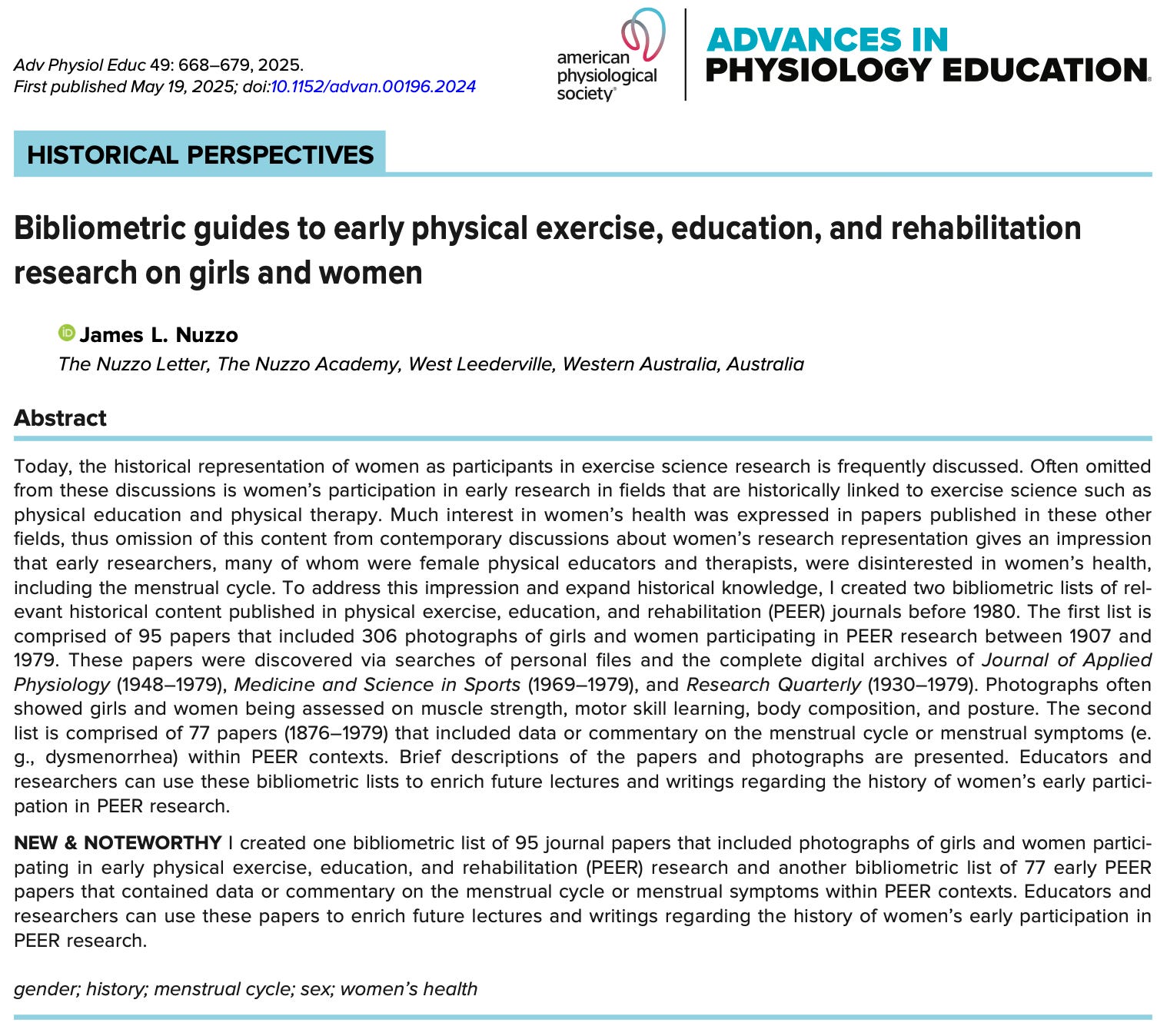 Early Exercise Researchers Did Not Ignore Women | On May 31, 2024, I published an essay titled, “History Didn’t Start at Title IX.” In the essay, I challenged the common assumption that women were historically excluded from early research about physical exercise. I explained that a reasonable degree of female participation can be expected in early physical exercise research because much early research on exercise would have been conducted in the fields of physical therapy and physical education. Those two fields pre-dated exercise science, had their own journals, and had large representations of female professors and students.In the essay, I included photographs from papers published in these journals that showed girls and women participating in this early research. Thus, the essay provided some initial evidence that girls and women were participants in early research studies that pertained to physical exercise. More recently, I made this analysis more formal, and I expanded upon it. The results were recently published in the journal Advances in Physiology Education in a paper titled “Bibliometric guides to early physical exercise, education, and rehabilitation research on girls and women.Here, my purpose is to briefly explain the methods and results of this new research and reiterate why the findings are important.My paper had two aims. The first aim was to create a bibliometric list of papers that included photographs of girls and women participating in physical exercise, education, and rehabilitation research prior to 1980. The second aim was to create a bibliometric list of papers that included data or commentary on the menstrual cycle within physical exercise, education, and rehabilitation contexts.To identify photographs of female participants, I searched the entire archives of three of the most important journals in exercise research history: Research Quarterly (from 1930 to 1979), Journal of Applied Physiology (from 1948 to 1979), and Medicine and Science in Sports (from 1969 to 1979). I then searched my own personal digital archives, which included papers published in other journals. These other journals were not searched entirely because their full archives were not accessible to me.The search for papers about the menstrual cycle and exercise was more lenient. These papers were noted and filed during the search for photographs and while conducting research for other historical projects.Both of these historical analyses are to be considered exploratory because not all journal archives were fully searched. Thus, more historical photographs and more data and commentary on the menstrual cycle and physical exercise exist beyond what I published in the two bibliometric lists.The first bibliometric list consists of 95 papers, published between 1907 and 1979, that included 306 photographs of girls and women participating in physical exercise research. These photographs depicted girls and women performing various tests, and descriptions of the photographs are provided in the paper. The girls and women were most commonly photographed performing or undergoing tests of muscle strength, motor skill learning, body composition, or posture. Example photographs can be seen in my previous post. A sample of the first 15 papers on the list is shown below.This list parallels the bibliometric list that I published in the Journal of Men’s Health regarding papers published before 1980 that included photographs of male research participants.The second bibliometric list consists of 77 papers, published between 1876 and 1979, that included data or commentary on the menstrual cycle or menstrual symptoms within physical exercise, education, and rehabilitation contexts. Of the 77 papers, 22 papers were “either reviews or commentaries about the menstrual cycle, consensus statements about women and exercise that included a comment or section about the menstrual cycle, or original papers or review papers that included brief ancillary comments about the menstrual cycle.” The other 55 papers were original research with new data related to the menstrual cycle. This included the following:1) menstrual symptoms in high school and university students as identified in physical examinations conducted as part of physical education class;2) menstrual symptoms in athletes and nonathletes as identified by questionnaires;3) relationships of menstrual symptoms and abdominal strength and other aspects of physicalfitness as measured by laboratory techniques;4) the impact of oral contraceptives on physical activity and physiological responses to exercise as measured via ecological or laboratory tests.A sample of the first 17 papers on this list is shown below.The two bibliometric lists further disprove claims that women were historically excluded from research and that early researchers were not interested in women’s health. Contemporary researchers who conduct audits of female representation typically do not examine journals that are historically linked to exercise science and published in the early- and mid-1900s. Consequently, the exact percentages of male and female participants in early research on exercise, health, and medicine is not known. Moreover, when papers published before 1980 are omitted from audits, and thus studies in the two bibliometric lists are not identified, this gives readers an impression that early researchers, many of whom were femalephysical educators and therapists, were disinterested in women’s health, including in the menstrual cycle. But this assumed disinterest is a myth.My latest pre-printed paper further challenges this myth. In the paper, I tallied the number of male and female participants in all studies published in Research Quarterly between 1930 and 1979. The results revealed that after two large military studies of male participants were excluded as outliers, girls and women comprised 40% of all research participants. That is hardly evidence “widespread exclusion” of women from research trials, disinterest in women’s health, or bias or discrimination against women.My hope is that these new historical analyses will be used by educators to teach themselves and their students about the history of male and female participation in early exercise and exercise-related research. This history is nuanced and is not explained by false blanket assertions such as women being historically excluded from research, or that early researchers were disinterested in women’s health issues. In fact, one interesting aspect of this nuanced history, which my latest pre-printed paper confirms, is that participant sex correlates with researcher sex. Thus, one reason why studies within some areas might show greater male than female participation is because of greater male than female researcher productivity. Consequently, if contemporary female exercise scientists are unhappy with the amount of data this is available on women, then they can resolve this by spending hours in the laboratory collecting and analysing data and then publishing the results, as that is what many men have been doing throughout the history of science.Related Content at The Nuzzo LetterSUPPORT THE NUZZO LETTERIf you appreciated this content, please consider supporting The Nuzzo Letter with a one-time or recurring donation. Your support is greatly appreciated. It helps me to continue to work on independent research projects and fight for my evidence-based discourse. To donate, click the DonorBox logo. In two simple steps, you can donate using ApplePay, PayPal, or another service. Thank you.Thanks for reading The Nuzzo Letter! Subscribe for free to receive new posts and support my work. This is a public episode. If you would like to discuss this with other subscribers or get access to bonus episodes, visit jameslnuzzo.substack.com | 9m 29s | ||||||
| 6/25/25 |  “Mankeeping” - Academia’s Latest Attack on Men | Just when you thought the unrelenting attacks on men from academia could not get any worse, they have.In the journal Psychology of Men & Masculinities, the concept “mankeeping” was recently introduced by Angelica Ferrara and Dylan Vergara of the Clayman Institute for Gender Research at Stanford University. The title of their paper was, “Theorizing Mankeeping: The Male Friendship Recession and Women’s Associated Labor as a Structural Component of Gender Inequality.”“Mankeeping” adds to the litany of words and concepts that academics have created to ridicule the male sex. Other examples include “toxic masculinity,” “male privilege,” “mansplaining,” “manels,” and “manferences.”Ferrara and Vergara defined “mankeeping” as “the labor that women take on to shore up losses in men’s social networks and reduce the burden of men’s isolation on families, the heterosexual bond, and on men.” And, they added:“[m]ankeeping is best conceived as a mechanism through which women support and bolster men’s levels of social support.”According to Ferrara and Vergara, “mankeeping” is a form of women’s unpaid and unequal emotional care work. Some examples of this “invisibilized labor” provided by the authors included the following:* A woman suggesting that her husband reconnect with old friends* A girlfriend facilitating a group outing to help her boyfriend bond with other men* A wife sending a husband on a “man date” with other men* A mother suggesting to her son that he contact his friends* A woman reminding a man to join a men’s group* A woman “checking in on her husband’s emotional state after learning he has had a stressful day at work”* A wife helping her husband “articulate his own feelings through a process of deciphering limited social and emotional cues”And what are the fundamental causes and final consequences of “mankeeping”? According to the authors, “mankeeping” is “a component of patriarchy’s persistence within the heterosexual bond, asserting that an unequal distribution of social support is part and parcel of the everyday social reproduction of gender inequality.”To summarize, the flow of ideas underlying Ferrara and Vergara’s concept of “mankeeping” goes as follows:* Increased numbers of men are lonely or social disconnected;* Women have to pick up the slack in men’s lack of social relationships;* Women perform unpaid labor when serving as social and emotional facilitators for men;* Women’s social and emotional labor is unpaid and unequal and therefore it reinforces the patriarchy and exacerbates gender inequality.Here, my purpose is to highlight various flaws with Ferrara and Vergara’s concept of “mankeeping.”Lack of Empathy for MenThe first issue with Ferrara and Vergara’s concept of “mankeeping” is that it lacks empathy for men. To the extent that men are lacking healthy social relationships, the focus of a paper in a “men and masculinities” journal ought to be the causes and solutions of men’s mental and emotional health issues. Yet, in predictable gynocentric fashion, the authors made the story about women.“Men and masculinities scholars must interrogate how the effects of these trends, while troubling for men themselves, may cascade beyond men.”In other words, men’s health is merely a launching pad for discussing additional ways that society can accommodate women.To further illustrate the degree to which the authors had no interest in discussing men’s health, one need only look at the incoherent sentence where the authors placed the phrase “male issue” in quotes. This was done, presumably, to mock or minimize the notion that men’s health, not gender inequality, be the main point of discussion.“To conceptualize men’s thinner social networks as a mere symptom of gender inequality, or a “male issue,” rather than a structural component of how patriarchy is upheld and reproduced, is to miss a critical avenue for social change. Our concept of mankeeping presents one mechanism through which men’s social isolation could reproduce existing inequalities…”Women as Social Beings and CarersAnother issue with Ferrara and Vergara’s concept of “mankeeping” is that it seems to assume that men and women would, if unchained from the restrictive patriarchy, exhibit near-identical social behaviors and indicators and that women would not be more inclined than men to want be emotional carers. But on what grounds are such assumptions made, given the substantial research literature on sex differences in preferences, interests, and behaviours?Sex differences in vocational interests is one example. Women are more likely than men to prefer working with people than things, whereas men are more likely than women to prefer working with things than people. This is why more women than men study and work in fields like psychology and social work. In fact, psychology and social work are also fields that involve providing emotional care to others (i.e., “mankeeping” or “womankeeping”) and thus also illustrate the greater female than male inclination for wanting to provide emotional care to both men and women.Other lines of evidence also point to women being naturally more social than men. The American Time Use Survey consistently shows that women spend more time than men “socializing and communicating,” including in face-to-face interactions, hosting or attending social events, and communicating with others via the telephone and internet. A recent Pew poll of over 6,000 American residents also found that women were more likely than men to keep in touch with friends by phone, text, and social media.Thus, women appear to acquire much value and meaning out of life from frequent social interactions. Many of these interactions will involve emotional care for others. These sex differences are likely biologically driven. Results from a study in hamsters suggest that the average female and male brain respond differently to social interactions, with oxytocin playing a key role in the heightened female response.Relationship Trade-OffsFerrara and Vergara’s failure to reference the biological basis of sex differences then leads to lack of acknowledgement of trade-offs in relationships. Their presentation of male-female relationships was one-sided: the woman does the vast majority of the care work and apparently the man offers very little in return.A man and a woman both bring unique attributes to a partnership. The man could be any number of things: funny, caring, rich, intelligent, a hard worker, physically attractive, friendly, reliable, the father of their children, good at fixing things around the house, good at making the woman feel safe and protected, etc. These characteristics would all be reasons why his female partner would want to care for him. It is in her self-interest to do so. Without him, she loses her greatest value.Yet, instead of discussing trade-offs in partnerships, and the unique currency that men bring to the relationship exchange, Ferrara and Vergara presented a story in which women’s emotional care work is presented independent of the larger context of the natural given and take of romantic partnerships. For example, whereas a wife might take on more of the unpaid household work, her husband might take on more of the paid work outside the home (often at risk to his health), such that when hours of all work are summed, men and women contribute roughly equally to the partnership. Thus, to the extent that women might be providing a disproportionate amount of emotional care, men are likely providing their own unique type of care at a disproportionate level. In fact, the husband’s job might be paying for all of his wife’s healthcare!Women’s Perceptions of Emotional CareFerrara and Vergara also do not account for women’s perception of how much “mankeeping” that they think they need to perform versus how much care a man actually needs or desires. A wife who is constantly worrying about some aspect of her husband’s life might be doing so unnecessarily. She might think that she needs to repeatedly call or text him, but the man might find this excessive. Compared to men, women worry more, experience greater levels of anxiety, and exhibit a greater overall neurotic profile. Thus, by seemingly taking women’s word for it, Ferrara and Vergara, have assumed that all female emotional labor is necessary. It may be; it may not be.Lesbians and Men Who Carry the Emotional LoadAnother issue with the concept of “mankeeping” is that “womankeeping” also exists. Ferrara and Vergara eventually admitted this when they said: “there are many relationships in which men carry out an outsized portion of emotion work on behalf of women and other genders.”Nevertheless, the authors did not explore the topic of “womankeeping” in any detail. One example that is familiar to me, based on previous research that I helped conduct, is Chronic Fatigue Syndrome. Chronic Fatigue Syndrome is a physically, mentally, and emotionally debilitating condition. Chronic Fatigue Syndrome is more prevalent in women than men. In the United States, approximately 1.7% of women and 0.9% of men have received a diagnosis of Chronic Fatigue Syndrome. Consequently, who serves as the primary physical and emotional carer for heterosexual women who live with this condition? Husbands.Ferrara and Vergara also conveniently ignored lesbian relationships. They did not explain if “mankeeping” exists in these relationships, and assuming that an imbalance of emotional care does exist between lesbians, the authors did not explain if this somehow also reinforces the patriarchy and gender inequality.Men’s Social Networks Must be Feminist-Approved or Else…According to Ferrara and Vergara, a root cause of “mankeeping” is men’s declining social networks. Therefore, a solution to “mankeeping” is men engaging in more social activities. However, men finding genuine fraternal connection through increased engagement with their own social networks is often viewed by feminists as a threat to feminism. Thus, Ferrara and Vergara’s support for the solution to “mankeeping” is highly conditional. The authors qualified their statement about increased funding for programs that “allow men to meet their social and emotional needs without creating new forms or emotion work for women” by stating that men’s programs must be feminist-approved:“This effort must be careful not to create male spaces that reproduce men’s social dominance in ways that university fraternities and other men’s social clubs have long helped facilitate.”Remarkably, Ferrara and Vergara even expressed hesitation regarding the largely successful Men’s Shed program, because the program brings men together through “the expectation of an explicit masculine activity.”Sadly, such disapproval of men’s spaces is not specific to Ferrara and Vergara’s paper. For example, UN Women, a feminist organization funded to the tune of hundreds of millions of dollars per year by the world’s taxpayers, recently condemned the “manosphere” for its supposedly dangerous influence on boys and men, though many boys and men find solace in reasonable discussions that occur within this male space.The message from all of this is clear: men are allowed to socialize only where, when, and with whom feminists permit. And if this guarantee cannot be met, women will simply demand access to male spaces. This has already occurred with Men’s Sheds in Australia and the United Kingdom, and one woman’s sense of entitlement to this space served as the headline to a recent BBC article on the topic: 'We put the pressure on to join Men in Sheds'. Other similar examples include girls demanding access to the Boy Scouts, (now called Scouting America) and women playing on men’s sports teams and entering male locker rooms.Feminist Contradiction Between Men’s Leisure and the Solution to “Mankeeping”Beyond women demanding control over, or access to male spaces, there is yet a greater irony in the solution to “mankeeping” being men expanding their social networks.Men spending time with other men is social leisure. This leisure can take many forms. It might involve a man playing on a recreational sports team, a man attending a sports event with work colleagues, or a man attending a concert with close mates. Yet, men participating in increased leisure is contradictory to other feminist demands. Historically, feminists have lambasted men for spending too much time participating leisure activities and not enough time at home helping with the dishes, the laundry, and the kids.Thus, Ferrara and Vergara’s concept of “mankeeping” is internally inconsistent. On one hand, it proposes that the solution to “mankeeping” is for men to become more socially engaged – that is, participate in more leisure activities. On the other hand, increased time in leisure activities means less time at home – that is, men contributing less to unpaid domestic labour. Thus, if men socialize with the boys, they are blamed for not doing enough work at home. If men stay at home to help around the house, then they are blamed for their lack of an independent social life.Blokes just can’t catch a break!ConclusionIn closing, Ferrara and Vergara’s concept of “mankeeping” has many flaws. It lacks empathy for men; it misunderstands the male and female experiences; it ignores sex differences in interests and behaviours; it overlooks relationship trade-offs; it desires to control men’s social connections; and it suffers from multiple internal inconsistencies. Consequently, Ferrara and Vergara’s concept of “mankeeping” should be rejected.However, Ferrara and Vergara’s paper should not be taken lightly. It is not a one-off. The authors allocated a significant chunk of their paper to describing a future research agenda. Moreover, their paper was published in a special journal issue that was described by the American Psychological Association as “Unchartered territory: the future of men and masculinities.”This future research agenda, which will consist of projects conducted largely at taxpayer expense, is likely to involve the development of a “mankeeping” questionnaire. This research is then likely to be supplemented with interview and focus group studies. All of this research will be rigged from the start. Items on a “mankeeping” questionnaire will be written in a way that forces respondents to confirm the researcher’s ideology, and interview and focus group responses will be shoved into the researcher’s pre-existing feminist framework rather than being contemplated and integrated inductively. Men will likely not be invited to participate in such research, and if they are, any comments that they make that run counter to feminist narrative are likely to be turned against them. Why do I suggest this? For one, we already have evidence that this is occurring in this area of “research.” And secondly, Ferrara and Vergara’s closing statement displays a high level of confidence that their conceptualization of “mankeeping” is indeed already correct, and thus, future research will merely fill in the gaps of knowledge pertaining to female disadvantage and gender inequality.“We look to a future where boys and men can create and sustain connection in ways that are unencumbered by rigid masculine norms, and where the meeting of men’s social and emotional needs does not depend on women’s unpaid and unequal care work.”For many of us, our vision of the world and for the future is much different than Ferrara’s, Vergara’s, and all their feminist allies’. In contrast to their position, many of us look forward to a future where boys and men create and sustain connection in ways that are unencumbered by rigid feminist theory, and where discussions of men’s social and emotional needs do not depend on ridicule and treating boys and men unfairly, and instead, involve empathy, understanding, and a rigorous examination of the facts of human nature.Related Content at The Nuzzo LetterSUPPORT THE NUZZO LETTERIf you appreciated this content, please consider supporting The Nuzzo Letter with a one-time or recurring donation. Your support is greatly appreciated. It helps me to continue to work on independent research projects and fight for my evidence-based discourse. To donate, click the DonorBox logo. In two simple steps, you can donate using ApplePay, PayPal, or another service. Thank you.Thanks for reading The Nuzzo Letter! Subscribe for free to receive new posts and support my work. This is a public episode. If you would like to discuss this with other subscribers or get access to bonus episodes, visit jameslnuzzo.substack.com | 20m 02s | ||||||
| 6/11/25 |  Men, Masculinity, and Movies: One Thing Kevin Sorbo Got Wrong | In September of 2023, actor Kevin Sorbo, famous for his starring role in the 1990s television show “Hercules,” wrote an article for Fox News titled, “Let’s make Hollywood manly again.”In his article, Sorbo argued that modern Hollywood poorly portrays men and masculinity and thus does not give boys positive role models to look up to.In addition to critiquing Hollywood for frequently portraying fathers as “bumbling, useless idiots,” who do not contribute to their families or communities in positive ways, and who are “the butt of every woke Hollywood jab,” Sorbo also criticized Hollywood for exposing audiences to a continuous stream of bold and confident women who “upstage passive men who recede quietly into the background.”I welcomed Sorbo’s article. Like many other movie watchers, I have grown tired of Hollywood’s trends over the past 5 to 10 years. Such trends include the push for diversity, equity, and inclusion (DEI) in casts and crews, the forced Woke messaging, the glorification of nihilism, the moral ambiguity in story lines, and the seemingly endless numbers of remakes of movies whose original versions were perfectly fine.Thus, I commend Kevin Sorbo for his article. It was a timely, thoughtful, and largely accurate critique of one of society’s most influential institutions.Nevertheless, I disagree with part of Sorbo’s position. In two sentences, Sorbo included the concept “sacrifice” as part of his definition of masculinity. Thus, Sorbo believes that Hollywood needs to show more male sacrifice.“America today needs warriors; protectors; responsible and committed fathers…We need men who will raise their kids, defend their homes, provide for their families, and serve self-sacrificially…”Then, Sorbo concluded his article by stating the following:“It’s time for the world’s entertainment capital to reintroduce good men: men who love their wives and children, protect them, fight for what’s right, and speak up for the powerless. Men who, above all, have overcome their own selfish desires and are free to put others first. After all, that’s the most masculine thing any man can do.”My purpose here is to highlight why Sorbo’s definition of masculinity based on the concept of “sacrifice” is flawed.Sorbo suggested that sacrifice and the ridding one’s selfish desires is peak masculinity. Sorbo implied that raising one’s kids, defending one’s home, and providing for one’s family are sacrifices. But why view fatherhood and masculinity in this way? Why frame these responsibilities and commitments as “sacrifices”? Does a man not receive any personal boost to his ego or self-esteem when he completes these acts successfully?To “sacrifice” something, according to novelist-philosopher Ayn Rand, means “the surrender of that which you value in favor of that which you don't” or “the surrender of a greater value for the sake of a lesser one or of a nonvalue.”Thus, Sorbo’s view – that “sacrifice” is fundamental to masculinity and that selfishness is counter to masculinity – is problematic. It teaches boys and men not to value their own needs – i.e., themselves. It tells them that their lives hold no intrinsic worth, and that their value is predicated on serving the needs and desires of others. The male sex is mere cannon fodder.The alternative to Sorbo’s framing of masculinity through the collectivist framework and the ethics of altruism is to frame it through the ethics of rational selfishness, which simply means to pursue one’s values in accordance with one’s long-term interests.Unfortunately, through much of history, the word “selfishness” has been battered and mischaracterized by writers, including Sorbo, who conflate the concept with disregard of others or narcissism, which is a sort of pathological version of selfishness.Ayn Rand explained this problematic framing of selfishness in her book, “The Virtue of Selfishness”:“The meaning ascribed in popular usage to the word "selfishness" is not merely wrong: it represents a devastating intellectual "package-deal," which is responsible, more than any other single factor, for the arrested moral development of mankind.In popular usage, the word "selfishness" is a synonym of evil; the image it conjures is of a murderous brute who tramples over piles of corpses to achieve his own ends, who cares for no living being and pursues nothing but the gratification of the mindless whims of any immediate moment.Yet the exact meaning and dictionary definition of the word "selfishness" is: concern with one's own interests.This concept does not include a moral evaluation; it does not tell us whether concern with one's own interests is good or evil; nor does it tell us what constitutes man's actual interests. It is the task of ethics to answer such questions.”Thus, acting selfishly simply means pursing one’s own rational values. These values can certainly include loving one’s family, as Rand also explained:“Concern for the welfare of those one loves is a rational part of one's selfish interests. If a man who is passionately in love with his wife spends a fortune to cure her of a dangerous illness, it would be absurd to claim that he does it as a "sacrifice" for her sake, not his own, and that it makes no difference to him, personally and selfishly, whether she lives or dies. Any action that a man undertakes for the benefit of those he loves is not a sacrifice.”In other words, Sorbo was incorrect to add “sacrifice” to his definition of masculinity, because all the other features of masculinity that he described generally constitute a man acting in his own selfish interest. For example, part of becoming a warrior and protector involves continually training one’s body and mind to take on life’s challenges. Such training is a selfish act because it aids in one’s own survival. Also, raising one’s kids is not a sacrifice if a father feels joy watching his sons or daughters develop into good citizens and pursue and achieve their own selfish values.Sorbo seems to have in mind the sort of man who consumes copious amounts of drugs or alcohol to feel momentary pleasure. Yet, such men are not selfish. They are not acting in their own rational, long-term interests. Truly selfish men value their lives too much to damage their health in such ways. In fact, part of what drives some men to participates in these problematic behaviors and short-term “solutions” to their problems is their own lack of self-esteem and self-worth.To understand that selfishness does not conflict with the healthy manifestation of masculinity, Sorbo might consider watching the movie Taken, starring Liam Neeson.In Taken, Neeson plays Bryan Mills – a former Green Beret and retired agent of the CIA. Mills is divorced from his wife, and he is trying to work on his relationship with his only child, Kim, who is 17 years old. Kim decides that she wants to visit Paris with one of her girlfriends. Mills, based on his years of knowledge and experience working in the military and CIA, expresses concerns about Kim going to Paris without supervision. Reluctantly, and after being pressured by both Kim and his ex-wife, Bryan agrees to let Kim travel overseas.Interestingly, this part of the movie depicts a father’s love through his protectiveness. However, this protectiveness was ridiculed by both the ex-wife and the daughter, and both characters suffered as a result of not listening to dad, because on the day that Kim and her friend arrive in Paris, they are kidnapped and sold into an Albanian sex trafficking ring. Upon learning of this devasting news, Bryan flies to Paris to search for his daughter, her friend, and the thugs who kidnapped them.During the search, Bryan risks his life many times, and Bryan took these risks because of his profound and selfish love of his daughter. Bryan knew that his life would be happy and more fulfilled if Kim were part of it. Thus, Saving Kim’s life was not only in Kim’s best interest, it was in Bryan’s best interest, too.Per romantic art, Bryan overcame many physical and mental challenges in warding off evil to save Kim. In doing so, Bryan reaffirmed his distinct role as Kim’s father, and we are led to believe that seeing her grow and flourish will bring Bryan many years of joy. As Ayn Rand said, “[c]oncern for the welfare of those one loves is a rational part of one's selfish interests.”To conclude, Kevin Sorbo deserves credit for writing an article that argues for the healthy and entertaining portrayal of men and masculinity. His concern that contemporary movies lack in positive role models for boys is correct, and if Hollywood adopted even a morsel of Sorbo’s suggested characterizations of men in films, we all would have more engaging and emotional-moving movies to watch.Nevertheless, Sorbo’s view that “sacrifice” is fundamental to masculinity is problematic. Perhaps this is a problem of semantics. Perhaps Sorbo agrees that boys should be taught to value their own lives and pursue their own values and interests. Perhaps Sorbo simply misused the term “sacrifice.” Either way, semantics are important, and Sorbo’s sloppy use of this language illustrates the ongoing confusion about “selfishness” and “sacrifice” that Ayn Rand highlighted decades ago.One reason why misuse of the term “sacrifice” is concerning is because it leads to the mislabelling of rationally selfish acts as sacrificial ones. The danger then is concept creep or concept realignment, wherein actual sacrifices – things that are detrimental to a man’s wellbeing – become justified, because they have been conceptually lumped together with things that are in a man’s best interest. In such cases, the concept “sacrifice” is given underserved credit, as it was in Sorbo’s article. Moreover, framing a man’s role in a relationship as a continuous stream of “sacrifice” probably does not sit well with many men when labelled as such, and use of this nomenclature coupled with the expectation of actual male sacrifice may in fact, underlie some of today’s relational and familial discord, with mom, the kids, and even dad not understanding what dad brings to the family qua his selfish masculine acts.The purpose of art ought to be to show audiences how man ought to be or could be. It ought to give people something to look up to or strive for. It should show man at his best; at his greatest potential. It should show characters pursuing their goals, making tough decisions, and overcoming challenges. It should not be centred around depravity and the worst in man, nor should it show what the world actually is (that is what documentaries are for). Instead, movies, when written in the romantic rather than naturalistic style, should be guides for living. The reintroduction of such romantic guides into Hollywood movies is key to the counterrevolution at the cinema. This counterrevolution will indeed require a Herculean effort. But the effort will be worth it, and boys deserve it. With their fathers often out of the home, movies are still one place where lonely and confused boys can escape to find the abstractions of the men that they one day want to be.Related Content at The Nuzzo LetterSUPPORT THE NUZZO LETTERIf you appreciated this content, please consider supporting The Nuzzo Letter with a one-time or recurring donation. Your support is greatly appreciated. It helps me to continue to work on independent research projects and fight for my evidence-based discourse. To donate, click the DonorBox logo. In two simple steps, you can donate using ApplePay, PayPal, or another service. Thank you.Thanks for reading The Nuzzo Letter! Subscribe for free to receive new posts and support my work. This is a public episode. If you would like to discuss this with other subscribers or get access to bonus episodes, visit jameslnuzzo.substack.com | 15m 45s | ||||||
| 4/9/25 |  Canada’s Sex Bias in Health Research Funding | “This is feminist economic policy in action.”Chrystia Freeland, Canadian Deputy PM, Minister of Finance (Budget 2022)Investigations into the way that government’s allocate money into health research is important, because taxpayers should know how their money is being used and if that use aligns with broader societal interest and medical need.At The Nuzzo Letter, I have previously shown that substantial differences exist in funding of men’s and women’s health research in Australia and the United States (U.S.). In Australia, the National Health and Medical Research Council (NHMRC) invests about five times more money into women’s than men’s health research (graph below). In the U.S., the National Institutes of Health (NIH) invests about 14% of its annual research budget into women’s health and 6% of its annual research budget into men’s health (graph below). Obtaining the funding data from Australia was not difficult, as the NHMRC publishes these data openly on its website in a small table. Obtaining the funding data from the U.S. was more cumbersome, as it required downloading annual reports published by the Office of Research on Women’s Health and extracting and organizing the relevant data. Nevertheless, so long as one was aware of the Office’s reports and where to find them, graphing the data was still possible. Canada is a different story.Canadian Institutes of Health ResearchCanada’s main government funding body for health research is the Canadian Institutes of Health Research. This government agency was established in 2000 and is similar to the NHMRC in Australia and the NIH in the U.S. It consists of 13 institutes that operate separate from Health Canada. One of the institutes is the Institute of Gender and Health. This institute is the Canadian equivalent of the NIH’s Office of Research on Women’s Health in the U.S.Here, my aim was to identify, extract, and summarize data from the Canadian Institutes of Health Research to explore whether the sex differences in health research funding that exist in the U.S and Australia also exist in Canada. However, in pursing this aim, I was unable to find annual reports from the Canadian Institutes of Health Research where financial allocations for men’s and women’s health research are itemized. Consequently, I was unable to generate a graph similar to those that I have created for the U.S. and Australia. Instead, to get a general sense of such funding allocations, I had to rely on a hodgepodge of spreadsheets, reports, and press releases scattered across websites of various agencies within the Canadian government.The National Women’s Health Research Initiative (NHWRI)Women and Gender Equality Canada (WAGE) is a department in the Canadian government and is separate from the Canadian Institutes of Health Research. However, in 2021, WAGE and the Canadian Institutes of Health Research joined forces to create the National Women's Health Research Initiative (NWHRI).According to the Canadian government, the aim of the Initiative is to “advance a coordinated research program that addresses under-researched and high-priority areas of women's health and to ensure new evidence improves women's, girls’, and gender-diverse people's care and health outcomes.”In 2021, the Canadian government announced it would invest $20 million over five years into the Initiative.The Initiative is composed of two funding streams. The first is the Pan-Canadian Women's Health Coalition, which has been described by the Canadian government as “virtual hubs across Canada linked through an overarching coordinating centre.” In October 2022, the Canadian government announced that $8.4 million was available for 10 grants that would create the Coalition. To receive one of these grants, applicants were required to incorporate the following themes into the hub’s activities: engagement of women with lived or living experience; inclusion of indigenous peoples; inclusion of the concepts equity, diversity, and inclusion; and inclusion of sex- and gender-based analysis. Ten hubs were subsequently created from these grants, and the projects undertaken by each hub are now listed online.In June 2023, another funding opportunity for one grant of up to $1.2 million was announced to create the Coordinating Centre that “together with hubs will work to mobilize new and existing knowledge in women's health into effective, gender-sensitive, and culturally appropriate women's health services across Canada.” This additional funding helped to finish the overall aim of the Coalition, which was to create a central source of scientific and clinical information regarding the latest developments in women’s health (but not men’s health).The second part of the National Women’s Health Research Initiative is the Innovation Fund. The Innovation Fund is split into Discovery Grants and Operating Grants. Discovery Grants support “biomedical research by teams proposing bold and innovative research questions in women's health.” Operating Grants support areas of women’s health such as translational research in healthcare diagnostics, therapeutics, and devices and healthcare implementation research to remove barriers to access to healthcare.Calls for up to 13 Discovery Grants totalling $2 million were announced as were 15 Operating Grants totalling $9 million. A total of 24 projects were awarded at an expense to taxpayers of $13.7 million. General themes of the funded research included reproductive care and pregnancy, polycystic ovary syndrome, endometriosis, cancer and HPV, heart health, mental health, eating disorders, and “gender-based violence.”WAGE as a Solo ActorIn addition to partial funding of the National Women’s Health Research Initiative, WAGE also invests a significant amount of taxpayer money into other initiatives and programs aimed at improving the well-being of girls and women. A spreadsheet on the government’s website lists all the grants funded by WAGE between 2017 and 2024. As shown in the graph below, grants from WAGE amounted to $1.7 billion over this eight-year period, with annual funds ranging from about $1 million in 2017 to nearly $700 million in 2023.Text analysis of WAGE’s spreadsheet reveals that the vast majority of the approximate 2,400 funded projects were designated to either women’s or LGBTQ causes. In the spreadsheet, the words “boy” and “men” appear in project titles 20 and 42 times, respectively (and not necessarily in male-positive ways). In contrast, the words “girl” and “women” appear in project titles 75 and 599 times, respectively, and the word “feminist” appears in 67 project titles, and the phrase “LGBTQ” appears in 153 project titles.The spreadsheet also reveals three broad funding streams that the projects were aligned with. Of the projects that had funding stream information listed, 1,475 projects were associated with the “Women’s Program.” According to WAGE, the purpose of the Women’s Program is to “advance equality for women in Canada by working to address or remove systemic barriers impeding women’s progress and advancement. The [Women’s Program] supports the Government of Canada’s goal of advancing gender equality in Canada. It is consistent with Government of Canada priorities related to economic prosperity, and supports Canada’s international commitments related to gender equality.”The next most popular funding stream, which accounted for 505 projects, was “Equality for Sex, Sexual Orientation, Gender Identity and Expression Program.” According to WAGE, the purpose of this funding stream is to “advance social, political and economic equality with respect to sex, sexual orientation, gender identity or expression. Advancement towards a greater understanding of the intersection of sex and gender with other identity factors that include race, national and ethnic origin, Indigenous origin or identity, age, sexual orientation, socio-economic condition, place of residence and disability are encouraged under the Program."Finally, 308 projects were associated with the “Gender-Based Violence Program.” According to WAGE, the purpose of this program is to “strengthen the [gender-based violence] sector to address gaps in supports for two groups of survivors: 1) Indigenous women and their communities, and 2) underserved populations (including women living with a disability, non-status/refugee/immigrant women, LGBTQ2S, gender non-conforming people and ethno-cultural women) in Canada. The Program provides grant and contribution funding to Canadian organizations to improve supports to help create long-term, comprehensive solutions at the national, regional, and local levels.”Women RISE InitiativeAnother component of the Canadian government’s investment into women’s wellbeing is the Women RISE initiative. This initiative, which was established in March 2022, was formed out of partnerships between the Canadian Institutes of Health Research and the International Development Research Centre (IDRC) and the Social Sciences and Humanities Research Council (SSHRC).According to the Canadian Institutes of Health Research, the Women RISE Initiative is a “ground-breaking $24 million partnership to support research to improve the health and socioeconomic well-being of women, particularly those from marginalized communities, as part of supporting the global recovery from COVID-19.”According to the government, the Initiative was created because “[a]round the world, women and girls have disproportionately suffered from the socio-economic impacts of COVID-19. Women have borne the brunt of layoffs and loss of livelihoods, sacrificed their own health at the frontlines of the pandemic response and disproportionately shouldered the burden of the additional caregiving associated with COVID-19.”In November of 2022, the 23 recipients of the Women RISE research initiative were announced at the Canadian Conference on Global Health in Toronto. Themes of the awarded projects included infectious diseases, sexually transmitted and blood-borne infections, and pandemics and other health emergencies. According to the Canadian government, the knowledge generated from these projects will “inform immediate and medium-term solutions for post-COVID-19 recovery that will improve gender equality and health equity outcomes in low- and middle-income communities in Canada and globally.”WAGE’s Menstrual Equity Fund PilotAnother development in the Canadian government’s funding of women’s health in recent years has been the Menstrual Equity Fund Pilot. The Menstrual Equity Fund Pilot was created out of Budget 2022, which was “committed to establishing a national pilot for the Menstrual Equity Fund (MEF) to address the barriers related to affordability and stigma that some Canadians face when accessing menstrual products.” In Budget 2022, $25 million was allocated over two years for this fund, with further commitments to the fund projected into the future. In November 2023, the Standing Committee on the Status of Women released a report titled “Let’s Talk About it, Period: Achieving Menstrual Equity in Canada.” In the report, the Committee provided future recommendations for achieving “menstrual equity” in Canada. One of these recommendations was making the Menstrual Equity Fund Pilot a permanent feature of Canadian society, if the pilot was deemed successful.Budget 2021 and MoreOne challenge in evaluating government spending on health research is where to draw the line on what is considered funding for health versus what is funding for things more indirectly linked to health. Sometimes, as was seen in the Australian federal budget of 2025-26, governments might not classify certain items as health funding, but those items might still have an obvious potential for improving quality of life. Because the Canadian Institutes of Health Research do not provide their own explicit break down of men’s and women’s health research funding, one is then left trying to piece together numbers from various government programs and websites to get some sense of sex differences in health funding. Inevitably, this leads one to include in their analysis programs that are not specifically labelled as health research funding but that are still likely to improve wellbeing.Budget 2021, which appears to have been a critical turning point for gynocentrism in Canadian health funding, contains many such examples. In fact, Budget 2021 was labelled by the Department of Finance as: “Budget 2021: Supporting Women.”Earlier, I mentioned that the National Women's Health Research Initiative stemmed from Budget 2021. But this is not exactly true. What the budget actually proposed was $20 million for a National Institute for Women’s Health Research. This suggests plans for a long-lasting physical presence. However, for reasons that are unclear, the Institute never materialized, and the final result of the $20 million was the National Women’s Health Research Initiative.Budget 2021 also included the following programs for women:* $601.3 million over five years, starting in 2021-22, to advance towards a new National Action Plan to End Gender-Based Violence* $158.5 million over five years to the Department of National Defence and Veteran Affairs, and $29.9 million per year from ongoing funding from existing resources, to expand the Department’s work to eliminate sexual misconduct and “gender-based violence” in the military and to support survivors* $315.4 million through the Canada Housing Benefit, to increase direct financial assistance for low-income women and children fleeing violence to help with their rent payments* $250 million in reallocated funding to support the construction, repair, and operating costs of an estimated 560 units of transitional housing and shelter spaces for women and children fleeing violence* $146.9 million over four years to strengthen the Women Entrepreneurship Strategy, which, since its launch in 2018, has involved $7 billion of “investments and commitments that are helping hundreds of thousands of women access the financing, networks and expertise they need to start up, scale up and expand into international markets.” Notably, the Women Entrepreneurship Strategy is comprised of the Women Entrepreneurship Loan Fund and the Women’s Enterprise Initiative. In Budget 2021, the Canadian Government committed $55 million to establish the Women Entrepreneurship Loan Fund, which provides women entrepreneurs with loans up to $50,000 to help them start or grow their business. In 2022–23, the Women Entrepreneurship Strategy helped women secure over 2,600 loans. Since 2018, the Women Entrepreneurship Strategy has provided over 25,000 total loans or non-repayable grants.Budget 2021 was not the only Canadian federal budget to include stockpiles of cash for women. In fact, in Budget 2022, Chrystia Freeland – the Canadian Deputy Prime Minister and Minister of Finance – was quoted as saying: “This is women’s liberation. It will mean more women no longer need to choose between motherhood and a career. And it will make life more affordable for middle class Canadian families.”Budget 2022 included some of the following items for women:* $539.3 million over five years to prevent “gender-based violence”* $180 million for the Generation Equality Forum to support the economic participation and higher education of women around the world* $31.6 million to expand the Canadian Armed Forces’ health services and physical fitness programs to be more responsive to women and gender-diverse military personnel* $25 million for the Menstrual Equity Fund PilotIn Budget 2023, $160 million was allocated over three years for programs that serve women and attempt to advance gender equality in Canada. And in Budget 2024, funding was allocated for leadership on women’s rights and gender equality in association with Canada’s Feminist International Assistance Policy.Men’s HealthThough a search of sex-specific funding in Canada shows a clear bias in favor of funding women’s health research, the Canadian government, to their credit, has also invested some money specifically into men’s health.In 2021, around the time that Canada was making a sharp gynocentric turn in the direction of its health funding, the Canadian Institutes of Health Research published a report on the well-being of Canadian boys and men titled, “Advancing Boys’ and Men’s Health: Outcomes From 11 Years of CIHR-IGH Funded Research.” According to the report’s introduction, in 2007, the Institute of Gender and Health instigated the Boys’ and Men’s Health Initiative to “address the urgent need to increased attention and research capacity in boys’ and men’s health. With an investment of over $15M, the initiative spanned 11 years…” Thus, the total amount of money invested into the Boys’ and Men’s Health Initiative was similar to the $13.7 million invested into the National Women's Health Research Initiative.The report summarized the following areas of boys’ and men’s health:* Mental health and wellness* Violence, risk taking, and resilience* Fertility and reproductive health* Sport and physical activityThe report included statistics on male life expectancy, suicide, alcohol use, motor vehicle accidents, sexual abuse, HIV/AIDS, cardiovascular health, and physical activity rates. It included summaries of studies and programs that were funded under the Initiative, which were attempting to improve or better understand some of these outcomes.The return on investment of these projects remains to be seen. Nevertheless, an explicit attempt was made by the Canadian government to generate new knowledge and programs pertaining to boys’ and men’s health, and for that, they deserve credit.However, one should also note that, after the Initiative was completed, the Institute of Gender and Health interpreted the findings under the lens of intersectionality and social determinism. This is evident from the final paragraph of the report:“Boys’ and men’s health is rooted in systemic and structural processes like racism, ableism, ageism, classism, discrimination, and stigma, and is shaped by social identities and positions like class, gender, geography, Indigeneity, race/ethnicity, sexual orientation, and additional intersecting factors. Projects in the Boys’ and Men’s Health Initiative have demonstrated that these factors are critical determinants of men’s health. Future research which applies an intersectional approach to men’s health research may further illuminate how intersecting social identity factors, positions and processes shape norms, attitudes, and practices in men’s health.”However, one should also note that this concluding statement is largely at odds with another note in the report which states that 30% of a man’s overall health is determined by his genetics, while the other 70% is determined by his lifestyle choices. Thus, the Institute of Gender and Health lacks a clear and consistent message regarding the factors that cause or correlate with a man’s health.ConclusionIn closing, my intention was to complete a simple project that involved extracting men’s and women’s health funding data from tables published by the Canadian government and then present these data in a precise yet basic graph. However, the project turned out to be a convoluted tour across various websites and reports to obtain only a general sense of Canada’s sex-specific research funding. From this convoluted tour, I have concluded that, in recent years, the Canadian government has invested significantly more funds into women’s than men’s health. Other than the 2021 report on the status of boys and men, which stemmed from research conducted between 2007 and 2020, the Canadian government has seemingly focused the vast majority of its sex-specific energy and money on girls and women. This includes, for example, the National Women’s Health Research Initiative, the Women RISE Initiative, the Women Entrepreneurship Strategy, all the programs associated with WAGE including the Menstrual Equity Fund Pilot, and likely a host of other programs and initiatives that I did not discoverer. This gynocentrism in Canadian health funding is perhaps of little surprise given that (a) the same trend exists in other western countries, (b) Justin Trudeau – the Canadian Prime Minister from 2015 to 2025 – is well known for his feminism, and (c) many academic articles thrown into the Rubbish Bin at The Nuzzo Letter over the past couple of years have been written by feminist academics who work at universities in Canada.Finally, to encapsulate the current state of gynocentrism in health funding in Canada and other western countries, I would now like to reveal one additional discovery that I made in this search for information on health funding. This discovery is a document published by the Canadian Institutes of Health Research titled, “The CIHR Institute of Gender and Health Listening Tour: What We Heard Report.”In the report, one learns that in 2023, the Institute of Gender and Health went on a "national listening tour" to "co-create" their new Research Priority Plan for 2024-2029. The tour was comprised of 19 townhall events that were held in Vancouver, Edmonton, Winnipeg, Toronto, and Montréal. A total of 511 Canadian researchers, trainees, and community partners participated in the events.During the listening sessions, the Institute asked attendees questions like:* “How can we best foster research excellence regarding the influence of sex and gender on health?”* “What is your vision for achieving health equity for women and girls, boys and men, and gender-diverse people?”If one scrolls down to the appendix of the Institute’s 10-page report, one will find a finer breakdown of the demographic characteristics of the individuals who participated in the “listening tour.” From the page, we learn that 80% of the 511 attendees were academics, 12% were individuals with disabilities, and 4% were adults over the age of 65 years. In the bottom left of the page, we also see another interesting aspect of the demographic breakdown.Only 19% of the “listening tour’s” demographic were men.The Canadian government cannot hear what it does not want to listen to.Related Content at The Nuzzo LetterSUPPORT THE NUZZO LETTERIf you appreciated this content, please consider supporting The Nuzzo Letter with a one-time or recurring donation. Your support is greatly appreciated. It helps me to continue to work on independent research projects and fight for my evidence-based discourse. To donate, click the DonorBox logo. In two simple steps, you can donate using ApplePay, PayPal, or another service. Thank you.If you prefer to donate to a specific project, please see the Go Fund Me page for my current research on sex differences in muscle strength in children. This is a public episode. If you would like to discuss this with other subscribers or get access to bonus episodes, visit jameslnuzzo.substack.com | 27m 36s | ||||||
| 4/2/25 |  Australia’s Federal Budget Forgets Men | On Tuesday, March 25th, the Australian Labor Party handed down the country’s federal budget for the 2025-26 financial year. Men’s health was not part of the budget. However, women’s health received its usual smorgasbord of government goodies, with Treasurer Jim Chalmers stating that women's health is a “national priority."According to government documents and Nine News, $793 million has been budgeted for women’s health. This money has been labelled “critical” and entails the following, according to Nine News:* $134.3 million for insertion and removal of long-acting reversible contraceptives by nurse practitioners* $109.1 million to fund two national trials related women’s access to contraceptives and treatment for urinary tract infections* $20.9 million to create 11 new clinics for treating endometriosis, pelvic pain, perimenopause, and menopause* $26.3 million for Medicare rebates for menopause health assessments* $277.7 million for 500 new community sector and frontline worker jobs in domestic violence* $70 million for existing services and for trialling new measures to support women and children experiencing violence* $21.4 million to improve victim and survivor engagement within the justice system* $21.8 million for First Nations women, children and communities for family, domestic and sexual violence services* $16.7 million to fund innovative approaches to address perpetrator behaviour* $606.3 million to deliver more doctors and nurses* $28 million to support the construction of the Nursing and Midwifery Academy in Victoria* $10.5 million to expand the Primary Care Nursing and Midwifery Scholarship program* $1.3 million to extend the Obstetrics and Gynaecology Education and Training Program by 12 months* $3.4 million for mentoring and coaching programs for First Nations women in business* $3.2 million to the Australian Sports Commission to help increase women and girls' participation in sports leadership through coaching, officiating and sports administrationOne might notice that these figures add up to significantly more than $793 million. This occurred, because, in an effort to show the Labor Party’s affection for its female voting bloc, Nine News revealed aspects of the federal budget that most people would consider beneficial for female wellbeing, but were not categorized by the government as “women’s health” funds. Information about these additional investments can be found in the government’s 64-page budget overview titled, “Building Australia’s Future,” and in the government’s 80-page “Women’s Budget Statement.”In the budget overview, the $793 million for women’s health is mentioned under “Strengthening Medicare” and “Better healthcare for women.” This is the part of the budget that includes funds allocated for contraceptive pills, menopause treatments, and the 11 clinics for treating endometriosis, pelvic pain, perimenopause, and menopause.Further down the budget overview, one finds a section titled “Progressing equality, supporting women.” This section describes some of the other goodies for women that were mentioned or alluded to in the Nine News report, including:* $2.6 billion for a further pay rise for aged care nurses* $3.9 billion to enhance access to legal services, including for people experiencing gender-based violence* $21.4 million to improve engagement with the justice system of victims of gender-based violence* $21.8 million to provide family, domestic and sexual violence services to First Nations women, children and communitiesHowever, for the most complete understanding of the federal budget’s allocation of funds for improving the lives of women, but not men, one needs to consult with the 80-page Women’s Budget Statement.This Statement is divided into five themes:* Gender-based violence* Unpaid and paid care* Economic equality and security* Health (i.e., the “women’s health” section)* Leadership, representation and decisionEach major theme is made of various subthemes that serve as targets of the new budget. These subthemes include but are not limited to:* Ending gender-based violence* Ensuring safe education and workplaces for women* Providing cost-of-living relief to women and families* Increasing women’s workforce participation* Narrowing the gender pay gap* Enhancing long-term economic equality and security for women* Women in leadership and decision-making* Women’s and girl’s representation and participation in sport* Building gender equality capability across government* Global leadership on gender equalityMany of the details of these subthemes were not described in the Nine News report or the budget overview, and they reveal the extent to which the budget has been underpinned by feminist ideology and a bias against men.On page 11, under the theme of “gender-based violence,” one learns that some portion of $534.5 million will go toward “break[ing] the cycle of violence and prevent[ing] further harm by developing national standards for men’s behaviour change…” [italics added]Neither the budget nor the Women’s Budget Statement mentioned funds for developing national standards for women’s behaviour change.On page 18, one learns of $925.2 million for the “Leaving Violence Program,” and on page 24 one learns of the development of the National Student Ombudsman whose function will be to allow university students to “escalate complaints about the actions of their higher education provider, including complaints about sexual harassment, assault and violence.” Regarding the Leaving Violence Program, the Women’s Budget Statement states that its purpose is to “empower people to leave violent relationships through financial support packages.” The program will provide financial support packages of up to $5,000 and be open to migrants regardless of visa status. The program is expected to support approximately 36,000 people each year.Neither the budget nor the Women’s Budget Statement mentioned the possibility that the Leaving Violence Program might incentive false allegations of intimate partner violence (likely against men). The extent to which the National Student Ombudsman might also increase false allegations, specifically of sexual violence among university students, is something else to keep an eye on in the coming months.On page 37, one learns of the budget goal of “building a stronger workforce pipeline” for unpaid and paid care work. Here, the Labor government seeks to pour money into the care sector to make care work “more attractive by supporting fair numeration.” They also state that they want to increase men’s participation in the care sector by “break[ing] down stereotypes that care is ‘women’s work.’”Yet, the Labor government reinforces this stereotype when it admits that the reason that it will provide the Commonwealth Prac Payment of $331 per week for education, social work, nursing, and midwifery students while they undertake their practicums is because most of those students are women. The Women’s Budget Statement states: “Many of these students will likely be women. In 2022, women made up 81 per cent of enrolments in teaching, nursing, midwifery, and social work higher education courses, and 84 per cent of 2022 commencements in the Diploma of Nursing.” The Statement continues: “Given women represent almost 90 per cent of the nursing and midwifery sector professions, women stand to benefit the most from this measure.”Thus, by examining the Women’s Budget Statement, one see that reports of $793 million for women’s health are somewhat misleading. Many of the items in the Women’s Budget Statement that were not designated as “women’s health” will undoubtedly still improve the quality of life for many women. Where to the draw the line on what is “health” funding versus other funding is a matter of debate, but that such a debate is possible is something to be aware of when reading government reports, press releases, and data tables, even from men’s health groups or researchers. For example, in my previous examinations of sex differences in funding, I have explored only the narrow topic of investment into men’s and women’s health research (see graph below).Similarly, in their response to the federal budget, the Australian Men’s Health Forum published a table (shown below) that lists annual budgeting for men’s and women’s health since 2022-23. The table clearly shows a consistent bias in investing millions more dollars into women’s than men’s health. Over the four-year period, the Australian government invested $1.3 billion into women’s health and $22.5 million into men’s health. Yet, in the table, the value listed for women’s health in 2025-26 is $793 million. Thus, as lopsided as the numbers in the table are, they do not reflect the full extent of bias in funding, as they do not account for all the other women’s programs that have been funded over the years and are more indirectly linked to health.Interestingly, had the Labor government wanted to talk about token funding for male wellbeing, they could have. For example, the budget includes $47.6 million for the Department of Veterans’ Affairs, with suggestions that the money be used for veteran suicide prevention and veteran compensation and rehabilitation claims. Men make up 79.4% of current members of the Australian Defence Forces and 86.6% of individuals who have previously served in the Australian Defence Forces. Thus, men stand to benefit the most from this budget item.The budget also includes $9.3 billion for homelessness. Men make up a 56% of the homeless population in Australia. Thus, many men also stand to benefit from this budget item.Why the Labor government chose not to frame such budget items in a male-supportive way is unclear. Doing so would have required explicit acknowledgment of male suffering and disadvantage, and this would be at odds with many other aspects of their feminist-influenced budget. That the budget was influenced by feminist ideology is evident from the following observations:* First, the budget was not simply disproportionate in its funding; it listed zero explicit concern over the wellbeing of boys and men. Thus, it explicitly allocated zero dollars toward male health and wellbeing. One should not have to search the fine print of budget items to identify a morsel of interest in male wellbeing. Those items should be bundled together and presented explicitly, just as they were for women.* Second, the budget for women’s health is largely based on the idea that women experience more chronic health conditions than men, but it fails to mention that the average Australian male dies four years earlier than the average Australian female. The budget seems to fail to consider that some men might prefer to live long enough to experience some chronic health conditions.* Third, the government budgeted for menopause but it did not budget for andropause, male hypogonadism, or low testosterone.* Fourth, the government budgeted for new centres to service women’s pelvic health. These new centres are in addition to the centres that currently exist for this purpose and the broader array of women’s health centres that exist throughout Australia. Why does the government not have an interest in men’s health centres?* Fifth, the funding for “gender-based violence” and legal counselling associated with such violence all appear to be directed toward helping women, but many Australian men are also victims of intimate partner violence, and one out of every four victims of intimate partner homicide in Australia is a male.* Sixth, the government budgeted for programs for developing “national standards for men’s behaviour change.” The government did not budget for programs aimed at developing national standards for girls’ and women’s behaviour change.In conclusion, the federal budget handed down by the Australian Labor government reveals that the party has little interest in improving male health and wellbeing. The very existence of the Women’s Budget Statement absent an equivalent Men’s Budget Statement is all the evidence one needs to know that this administration is heavily influenced by feminist ideology and lacks empathy and compassion for one half of the Australian population. Moreover, given that the summary of the budget was titled, “Building Australia’s Future,” the current government seems to subscribe to the view that “the future is female” and that boys and men are not an important part of Australia’s future – except, of course, when they can be useful allies for the feminist cause. How sad.For their sex-biased budget, the Labor government ought to be publicly ridiculed. Irrespective of how one crunches the numbers, funding for women’s health in Australia has far exceeded funding for men’s health for many years. Furthermore, given this disproportionate funding over the course of many years, government officials should be asked how prior funding has apparently been so ineffective at resolving women’s issues, given that each new budget seems to include both new and old female problems? For example, how could billions of dollars have been invested into women’s health over the past several years without anyone already addressing endometriosis or menopause? Importantly, this critique is not specific to women’s health. Instead, it is a critique of the widespread belief that increased government spending is the solution to all of society’s health problems.There is no good reason why the Labor government cannot simultaneously recognize the health statuses and needs of both sexes and produce separate Women’s and Men’s Budget Statements. In fact, one policy solution might be to mandategovernments to create both Women’s and Men’s Budget Statements.Labor’s feminist-minded budget is intended, in part, to appease their disproportionate female voting bloc, to virtue signal, and to allow the party to be viewed as progressive, empathetic, and morally superior. However, ignoring one half of the Australian population is quite the opposite of being caring, ethical, and advanced in one’s thinking.On May 3rd, Australian voters ought to hold the Labor Party accountable for its dismissal of our brothers, sons, fathers, grandfathers, and uncles. This dismissal was not accidental. It was part and parcel of the broader intersectional and collectivist worldview of the Labor Party.On May 3rd, Australians ought to vote for national representatives who care for all Australians equally.Related Content at The Nuzzo LetterSUPPORT THE NUZZO LETTERIf you appreciated this content, please consider supporting The Nuzzo Letter with a one-time or recurring donation. Your support is greatly appreciated. It helps me to continue to work on independent research projects and fight for my evidence-based discourse. To donate, click the DonorBox logo. In two simple steps, you can donate using ApplePay, PayPal, or another service. Thank you.If you prefer to donate to a specific project, please see the Go Fund Me page for my current research on sex differences in muscle strength in children.Thanks for reading The Nuzzo Letter! Subscribe for free to receive new posts and support my work. This is a public episode. If you would like to discuss this with other subscribers or get access to bonus episodes, visit jameslnuzzo.substack.com | 18m 54s | ||||||
| 3/24/25 | 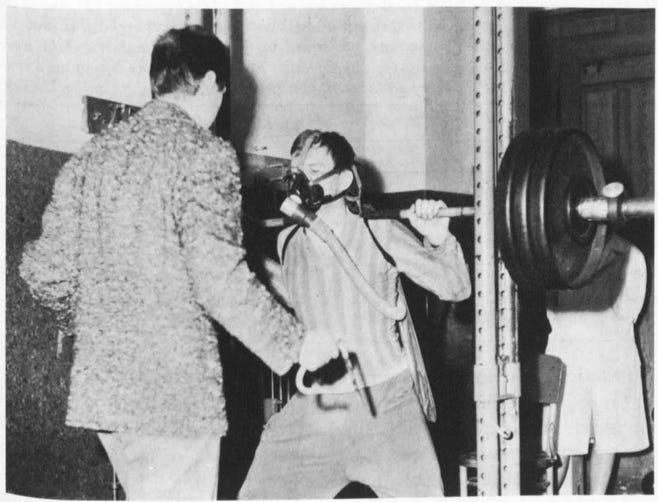 Brothers of the Barbell and the Blackout | (*Don’t forget to scroll to the end to see more interesting photographs!)Today, there exists much concern about women’s representation as participants in exercise research. I have covered this topic in essays such as “History Didn’t Start at Title IX,” “Men: The Martyrs of Medicine,” and “Is There a Bias Against Women in Research?”To the extent that women have been less frequent participants in certain types of research published in specific journals in certain years, this does not then necessitate a conclusion of discrimination against potential female participants. For one, participation in research is not always desired. Some research is boring, confronting, discomforting, invasive, or carries health risks. In fact, our survey revealed that men are generally less worried about such things when contemplating whether to participate in a study.Discussions about these aspects of research – the tests and interventions administered and how they are viewed by potential participants – are often lacking from papers that espouse gender bias or discrimination as the sole or primary cause of female participant “underrepresentation.” Yet, discussions about the nuisances of research procedures and processes are critical for understanding men’s participation in certain types of research and what their participation has meant for society, including for women. Counterfactuals, or mental simulations, can be useful for facilitating such an understanding.Consider what would be said today if the historical record were to show that women were 70% of participants in early medical research. Early medical research would have been the riskiest and the most likely to not involve ethics board approval or informed consent. Thus, one can reasonably predict that contemporary gynocentrists would not express glee at this 70% representation, though they should based on their current real-world frustrations about the supposed historical exclusion of women from research. Instead, they would reframe this counterfactual 70% female representation in a way that maintains female disadvantage or victimization. They would state that early researchers, under patriarchal influence, were using women’s bodies for experimentation. In academic papers and books, they would detail this traumatic history and say that these women were brave, heroic, and the martyrs of science.This mental simulation is intended to highlight an issue with the female underrepresentation narrative and to provoke thought about why we do not extend such considerations to the men who were often participants in the earliest and riskiest research. In part, this lack of consideration might stem from a lack of information available on the history of experimentation, particularly within the fields of exercise science, physical education, physical therapy, and applied physiology.I recently filled one of these information gaps with a paper published in the Journal of Men’s Health titled “Bibliometric guide to photographs of male participants in early exercise and physical medicine research.”The purpose of my research was to create a bibliometric list of papers that include photographs of boys and men participating in early exercise science, physical education, physical therapy, and applied physiology research. The list can then serve as a quick reference for educators and researchers who are trying to find photographs to be used in course lectures, university textbooks, and academic papers on the history of research participation. By showing audiences such photographs, educators and researchers can humanize men, showing their contributions to society via participation in early experimental research.MethodsFor the analysis, I searched the entire archives of three of the most historically relevant journals: Research Quarterly (1930-1979), Journal of Applied Physiology (1948-1979), and Medicine and Science in Sports (1969-1979). For these journals, I downloaded their digital archives and opened each individual paper to identify photographs of research participants. I also searched my own personal digital library of articles associated with my previous historical research. My analysis ended in the year 1979, in part, to coincide with my other historical research.ResultsI found a total of 304 papers published before 1980 that included photographs of boys and men participating in early studies on exercise and related topics. Forty-four percent of the papers were published in Research Quarterly. The papers included a total of 733 photographs of 46 boys and 475 men. The earliest paper was authored by Henry Beyer in 1894, and photographs from that paper are shown below.In my paper, I list all 304 papers in tables. The tables include descriptions of the experimental procedures depicted in the photographs and links to where the papers are located online. Often, photographs depicted boys and men performing tests of muscle strength, muscle endurance, and motor learning skills. Men were also frequently photographed having their oxygen consumption measured at rest, during physical exercise, and during exposure to altered environmental conditions. Another common type of photograph was that of male body build and posture. Sometimes, these men were photographed naked.Many of the procedures that men were shown performing or undergoing are similar to those that women of that era also performed or underwent, including being photographed naked. However, there also appear to be sex differences in the types of procedures completed during this era of science. Examples of such procedures can be found at the end of this post, where I show some of the most intriguing and informative photographs from my research. In my paper, I briefly explain the sex difference:“Photographs in the current bibliometric list illustrate what men’s historical participation in exercise physiology has entailed. These photographs show men participating in a range of physiological and medical procedures. It is difficult to imagine women being more likely than men to volunteer to undergo many of these procedures. Some examples include exposure to high gravitational forces or other environmental conditions that cause “blackouts” or increase the risk of losing consciousness [23, 37, 53, 324]; exposure to gasses that cause itchiness and damage to the skin of the face [87]; sitting on an apparatus designed to induce motion sickness [16]; and standing on one’s head while cardiorespiratory outcomes are measured [31, 35, 65]. In another study, men who were deaf or who had trouble hearing were dumped into a swimming pool to try to better understand human proprioception [172]. Finally, two papers on the bibliometric list include photographs of men sitting on moving cars, while holding gas collection bags, which are attached to a man who is running next to the moving car [79, 94].”ConclusionHistorical naivety and ideological bias are clouding interpretations of the history of male and female participation in exercise and physical medicine research. My recent paper in the Journal of Men’s Health is intended to help educators, researchers, and students see through these clouds. The discovered photographs show boys and men partaking in a range of experimental procedures, thus providing a basis for educating students about the nature of the type of research that men frequently participated in.Women also served as participants in much early research. Nevertheless, men completed many experimental procedures that are difficult to envision many women and many other men completing. Thus, the men who did participate in these experiments assumed much of the initial risk of early biological research. Men were often the first exposed to deadly agents, high gravitational forces, or resistance exercise with eccentric overload.Gynocentrists who write about women’s “historical exclusion” and “underrepresentation” as research participants conveniently ignore such historical nuance. They also fail to recognize that although men might have made up more than 50% of participants in specific types of research in certain years, this does not mean that women’s health and performance were completely ignored. Women were participants in much early research, and claims of their historical widespread exclusion have been debunked multiple times. Moreover, the current narrative of female participant “underrepresentation” is further flawed because it does not acknowledge that sex differences exist in interest and willingness to participate in research. Finally, as illustrated in the counterfactual presented earlier, even if women had been more than 50% of early research participants, contemporary gynocentrists would interpret that as representing female discrimination – in the form of the patriarchy’s use and abuse of the female body. There is simply never any winning against subjective feminist epistemology, which always try to squirm and wiggle its way around objective reality to maintain female victimization.My hope is that the promoters of the “historical exclusion” and “underrepresentation” narratives take a moment to come off their public soapboxes, which they were likely elevated to by some gender equity initiative, and print off a copy of my recent paper and read it. Then, assuming they have learned something from the paper, they ought to consider taking a figurative knee at the altar of masculinity, and say to the brothers of the barbell and the blackout: “Thank you.”“Buckle Up, Boys!” Measuring Oxygen Consumption Running OutdoorsSource: Daniels J. Portable respiratory gas collection equipment. Journal of Applied Physiology. 1971; 31: 164–167.Source: Daniels J, Oldridge N. The effects of alternate exposure to altitude and sea level on world-class middle-distance runners. Medicine & Science in Sports & Exercise. 1970; 2: 107–112.Blackouts and Exposure to High Gravitational ForcesSource: Duane TD, Lewis DH. Electroretinogram in man during blackout. Journal of Applied Physiology. 1956; 9: 105–110.Source: Wood EH, Lindberg EF, Code CF, Baldes EJ. Effect of partial immersion in water on response of healthy men to headward acceleration. Journal of Applied Physiology. 1963; 18: 1171–1179. Source: Hoppin FG Jr, York E, Kuhl DE, Hyde RW. Distribution of pulmonary blood flow as affected by transverse (+Gx) acceleration. Journal of Applied Physiology. 1967; 22: 469–474.“I’ve Got the Scars to Prove It!”Source: Lambertsen CJ, Idicula J. A new gas lesion syndrome in man, induced by “isobaric gas counterdiffusion.” Journal of Applied Physiology. 1975; 39: 434–443.Ice Man PlungeSource: Hall JF Jr, Polte JW, Kelley RL, Edwards J Jr. Skin and extremity cooling of clothed humans in cold water immersion. Journal of Applied Physiology. 1954; 7: 188–195.Deaf Man PlungePadden DA. Ability of deaf swimmers to orient themselves when submerged in water. Research Quarterly. 1959; 30: 214–226.Back in the Fight: Rehabilitation for World War I SoldiersMcKenzie RT. The treatment of nerve, muscle and joint injuries in soldiers by physical means. American Physical Education Review. 1918; 23: 355–366.Men at WorkMartin EG. Strength tests in industry. Public Health Reports. 1920; 35: 1895–1926.Just Hangin’ AroundGabbard C, Kirby T, Patterson P. Reliability of the straight-arm hang for testing muscular endurance among children 2 to 5. Research Quarterly. 1979; 50: 735–738.“Nauseous Yet?”: Study on Motion SicknessManning GW, Stewart GW. Effect of body position on incidence of motion sickness. Journal of Applied Physiology. 1949; 1: 619–628“Where Am I?”: Study on ProprioceptionSource: Christina RW. The side arm positional test of kinesthetic sense. Research Quarterly. 1967; 38: 177–183.Boy vs. Polio-induced Strength Loss: Boy WinsSource: Humphrey T, Rubin D. Comparative strength of neck flexor muscles in normal and postpoliomyelitis children: a preliminary study. Archives of Physical Medicine and Rehabilitation. 1958; 39: 572–576.Upside Down ScienceSource: Rao S. Cardiovascular responses to head-stand posture. Journal of Applied Physiology. 1963; 18: 987–990.AUM: Oxygen Consumption During YogaSource: Miles WR. Oxygen consumption during three yoga-type breathing patterns. Journal of Applied Physiology. 1964; 19: 75–82.“Ouch!”: Pain Tolerance TestingSource: Ellison K, Freischlag J. Pain tolerance, arousal, and personality relationships of athletes and nonathletes.Research Quarterly. 1975; 46: 250–255.“Boys Just Want to Have Fun” and Get Strong Wolbers CP. Development of strength in high school boys by static muscle contractions. Research Quarterly. 1956; 27: 446–450.Naked BlokesSources:Carter JE, Phillips WH. Structural changes in exercising middle-aged males during a 2-year period. Journal of Applied Physiology. 1969; 27: 787–794.Taylor WL, Behnke AR. Anthropometric comparison of muscular and obese men. Journal of Applied Physiology. 1961; 16: 955–959.Ashton TE, Singh M. Relationship between erectores spinae voltage and back-lift strength for isometric, concentric, and eccentric contractions. Research Quarterly. 1975; 46: 282–286.Dempsey JA, Reddan W, Balke B, Rankin J. Work capacity determinants and physiologic cost of weight-supported work in obesity. Journal of Applied Physiology. 1966; 21: 1815–1820.Beast ModeGallagher JR, De Lorme TL. The use of the technique of progressive- resistance exercise in adolescence. The Journal of Bone & Joint Surgery. 1949; 31: 847–858.Belka DE. Comparison of dynamic, static, and combination training on dominant wrist flexor muscles. Research Quarterly. 1968; 39: 244–250.Fisher AG, Ramey JS. Electronic squat monitor. Research Quarterly. 1977; 48: 213–216.Related Content at The Nuzzo LetterSUPPORT THE NUZZO LETTERIf you appreciated this content, please consider supporting The Nuzzo Letter with a one-time or recurring donation. Your support is greatly appreciated. It helps me to continue to work on independent research projects and fight for my evidence-based discourse. To donate, click the DonorBox logo. In two simple steps, you can donate using ApplePay, PayPal, or another service. Thank you.Thanks for reading The Nuzzo Letter! Subscribe for free to receive new posts and support my work. This is a public episode. If you would like to discuss this with other subscribers or get access to bonus episodes, visit jameslnuzzo.substack.com | 12m 23s | ||||||
| 3/20/25 |  Anti-Male Bias in Contemporary Academia | Recently, in a piece titled, Men Putting the Brakes on Exercise Science Degrees, I explained the results from my research on numbers of exercise physiology degrees earned in the United States (U.S.).For the research, I collated data on degrees earned in exercise science since 2002. I presented the data in a sex-segregated way such that separate trend lines are shown for male and female degree earners. The analysis revealed that the field has experienced substantial growth over the past 20 years and that the number of women earning bachelor’s degrees in the field has exceeded the number of men earning bachelor’s degrees every year since 2002. In the 2021-22 academic year, which was the last year from which data were available, women earned 59% of all bachelor’s degree in exercise science. Interestingly, across all academic majors in the U.S., the proportion of female degree earners is also 59%.One the most unique findings from the analysis was that around the 2016-17 academic year, the number of male exercise science graduates started to plateau and has remained the same since. On the other hand, the number of female graduates has continued to rise, such that the continued growth in the field is due to increased numbers of female not male graduates.In the Discussion of my paper, I put forward potential explanations for the significant difference in numbers of male and female graduates at U.S. universities. This list of explanations included males having lower high school grade point averages than females, males having higher high school dropout rates than females, males having poorer reading and writing skills than females, males having less access to financial aid and scholarships than females, and fewer initiatives designed to increase male enrolment in areas of study where they are less represented than females.I also mentioned that men might believe that they are better off financially by entering the workforce directly after high school and that perhaps they do not want to enter a feminized academic culture where they are bombarded with messages about gender identity, “male privilege,” and “toxic masculinity.”My paper was well-received by the two reviewers who assessed it. However, after the paper was published, a group of four authors wrote a letter to the journal’s editor challenging the conclusions that I reached about men and education. The four authors were Nisha Charkoudian of the U.S. Army Research Institute of Environmental Medicine, Jill Barnes of the University of Wisconsin, Sandra Hunter of Marquette University, and Michael Joyner of the Mayo Clinic. The full-text of their letter is shared below, and I encourage everyone to read it.Before I continue with my reply to the authors, I want to first say some positive things about two of the authors.In the current climate of academic cowardice, both Michael Joyner and Sandra Hunter deserve praise for many of the papers that they have published – often together. This includes reviews on the biological basis of sex differences in performance published in the Journal of Applied Physiology and Exercise and Sports Science Reviews. This also includes an important case study, which showed that after two years of taking feminizing hormones, a male swimmer’s relative ranking in the female category of sport was still higher than his previous relative ranking in the male category of sport.Michael Joyner also deserves credit for his legal battle against his employer, the Mayo Clinic, who suspended the doctor without pay based, apparently, on comments he made about transgender athletes and COVID-19. According to the Mayo Clinic, Joyner “failed to communicate in accordance with prescribed messaging,” which the institute said, “reflect[ed] poorly on Mayo Clinic’s brand and reputation.”Sandra Hunter, whose research interests significantly overlap with mine, also deserves kudos for her impressive scientific resume over many years, particularly her research on the neurophysiology of muscle strength and fatigue. Hunter has been one of only a handful of female exercise scientists who have had the courage to publish on the biological basis of sex differences in performance and their implications for men competing in women’s sports. For that, Hunter deserves a tip of the cap. However, Hunter has also been a part of the “female underrepresentation” movement in exercise science, whereby she and others suggest that the primary driver of fewer female than male participants in exercise studies is bias or discrimination against women. This view is problematic on a few different fronts, and I have rebutted it in academic papers and in essays on Substack.Regarding Charkoudian and Barnes, I had not heard of them prior to receiving their letter. So, I will not comment on them or their research.Before the letter from the four authors was published in the journal, I was sent a copy of it and invited by the editor to write a 500-word response. This is standard practice in academic publishing. A researcher whose ideas are challenged is given the opportunity to defend his work. The letter and letter reply are then published together, which allows readers to easily see the intellectual exchange of ideas.I accepted the editor’s invitation, and I submitted a letter reply titled “Anti-Male Bias in Contemporary Academia: A Reply to Charkoudian et al.”I was then surprised to receive an email from the editor a few weeks later informing me that my letter reply had been sent out for peer review, and based on the reviewers’ comments, would not be published.“What?!” I said to myself. “Are you joking? You invited me to submit a reply, then sent my reply out for peer review, and then rejected it? What the hell are you thinking?”So, that everyone can make their own judgments on this exchange, I have attached a copy of the editor’s and reviewer’s comments below.There are multiple reasons why the decision to reject my letter reply was inappropriate.First, I was invited to submit the reply.Second, there is no reason to send letters, particularly letter replies, out for peer review. Both letters and letter replies are addressed specifically to the editor (not peer reviewers), and a letter reply is an author’s only chance to defend their work. So long as the author’s reply is at least somewhat coherent and does not involve repeated cursing or personal attacks, then it should be accepted for publication.Third, letters and letter replies are largely opinion pieces. Thus, why is the reviewer’s opinion (of my work) given priority over my opinion? The fact that letters and letter replies are brief opinion pieces is why the threshold for accepting them for publication should always be lower than for original research articles.Fourth, even if a reviewer and editor identify issues with the opinions expressed in a letter reply, this does not necessitate a decision of rejection. By virtue of the context that letter reply was invited and is an opinion piece, the author should, at minimum, be given the opportunity to edit their work or tell the reviewers why their opinion is incorrect. I was afforded no such opportunity.Importantly, my views on letters – how they should be handled by editors and what their role is in science communication – is not simply the result of one bad experience at a journal. I have been involved in many letter exchanges over the years, including others on sex and gender issues that were handled poorly. I have also published four papers on the topic of letter exchanges and their importance in science. These papers have included examinations of sex differences in letter writing, assessments of the types of arguments made in letters, assignments for students to learn about letters, and an overview of the importance of letters in scientific communication and how letters should be indexed more consistently in PubMed.So, given this background, what did I say in my letter reply that made the editor decide, against editorial norms, to reject my reply?Here, I present the full text of my unpublished reply. You can be the judge.Anti-Male Bias in Contemporary Academia: A Reply to Charkoudian et al.Dear Editor,Each year, about 300,000 fewer men than women graduate from United States (U.S.) postsecondary institutions (see Figure 1). I previously discussed factors that might be contributing to this potentially concerning trend in men’s educational attainment (8). Oddly, Charkoudian et al. (3) shifted the focus to women, who already comprise over 50% of graduates, professors, and administrative staff (6-8). Here, I address three of their problematic comments.1. “…the author appeared to suggest that the increase in women’s participation represents a negative impact on young men...”I suggested little discussion has occurred regarding the reasons underlying men’s lower educational attainment. Men’s well-being warrants attention.2. “Many academic faculties in exercise physiology departments (and in departments across STEM fields) are still made up of mostly men”The authors prejudicially imply that greater male than female representation is problematic qua men/maleness. They also make no equivalent statements about departments comprised mostly of women (e.g., education, nursing, occupational therapy). Therefore, their application of representation importance based on faculty member sex is asymmetrical and insinuates gamma bias (12) or sexism (i.e., misandry).3. “Both men and women suffer negative physical and mental health consequences from the existence of a set of behaviors that have been labeled toxic masculinity (10). To suggest that these behaviors don’t exist is to promote continued harm to all the people who are affected by them (10).”First, I never said that problematic behaviors do not exist among some men.Second, the “toxic masculinity” movement within academia is disreputable. The American Psychological Association revised its original guidelines on male psychotherapy after receiving criticism that the guidelines framed masculinity in a negative and unscientific way (2). A new Toxic Masculinity Scale (11) is also biased, unscientific, and clinically useless.Third, the authors’ greater focus on “toxic masculinity” than men’s education is strange considering that education presumably improves choices and behaviors. Moreover, education correlates with mortality (5), and life expectancy is 5.8 years shorter for U.S males than females (1).Fourth, why do the authors associate toxic behavior only with masculinity, when women commit domestic violence at roughly equal rates (9) and partake in other problematic behaviors – some of which profoundly impact college men? For example, a few days after receiving the authors’ letter, a notorious campus sexual assault case, the 2006 Duke lacrosse case, was confirmed to be fabricated. Crystal Mangum, the woman who accused the male athletes of raping her, admitted she lied (13).I wonder: when exercise physiology students are taught about “toxic masculinity” and “gender-based violence” (9), will they be told of Mangum’s false rape allegations and her later guilty convictions for abusing her child and murdering her boyfriend (4, 13)? Will the students be introduced to the inappropriate behavior of the 88 Duke professors who signed the newspaper advertisement that implied the male athletes were guilty?Ironically, the authors’ letter exemplifies reasons why some men likely feel disconnected from universities. Academia continues to dismiss and mischaracterize men’s experiences.We would know more if universities cared to ask.James L. Nuzzo, PhDReferences1. Arias E, Xu J, and Kochanek K. United States Life Tables, 2021. Natl Vit Stat Rep 72: 1-64, 2023.2. Barry J. The APA has changed its view of masculinity. Male Psychology Magazine 2003.3. Charkoudian N, Barnes JN, Hunter S, and Joyner MJ. Regarding “Exercise physiology degrees in the United States: an update on secular trends” by J. Nuzzo. Adv Physiol Educ 2025.4. Dalesia EP. Duke lacrosse accuser convicted of child abuse. NBC News Dec. 18, 2010.5. Hummer RA, and Hernandez EM. The Effect of Educational Attainment on Adult Mortality in the United States. Popul Bull 68: 1-16, 2013.6. National Center for Education Statistics. Digest of Education Statistics, Table 314.30. Employees in degree-granting postsecondary institutions, by employment status, sex, control and level of institution, and primary occupation: Fall 2021. 2022.7. National Center for Education Statistics. Digest of Education Statistics, Table 318.10. Degrees conferred by postsecondary institutions, by level of degree and sex of student: Selected years, 1869-70 through 2031-32. 2023.8. Nuzzo JL. Exercise physiology degrees in the United States: an update on secular trends. Adv Physiol Educ 48: 923-929, 2024.9. Nuzzo JL, Powney D, and Barry J. Comment on: "Gender-Based Violence is a Blind Spot for Sports and Exercise Medicine Professionals". Sports Med 53: 1495-1497, 2023.10. Parent MC, Gobble TD, and Rochlen A. Social Media Behavior, Toxic Masculinity, and Depression. Psychology of Men and Masculinity 20: 277-287, 2019.11. Sanders SM, Garcia-Aguilera C, Borgogna NC, Sy JRT, Comoglio G, Schultz OAM, and Goldman J. The Toxic Masculinity Scale: Development and Initial Validation. Behav Sci 14: 2024.12. Seager M, and Barry JA. Cognitive distortion in thinking about gender issues: gamma bias and the gender distortion matrix. In: The Palgrave Handbook of Male Psychology and Mental Health, edited by Barry JA, Kingerlee R, Seager M, and Sullivan L. Cham, Switzerland: Palgrave Macmillan, 2019, p. 87-104.13. Seminera M. Woman who falsely accused college students of rape in 2006 admits she lied. Associated Press Dec. 14, 2024.Related Content at The Nuzzo LetterSUPPORT THE NUZZO LETTERIf you appreciated this content, please consider supporting The Nuzzo Letter with a one-time or recurring donation. Your support is greatly appreciated. It helps me to continue to work on independent research projects and fight for my evidence-based discourse. To donate, click the DonorBox logo. In two simple steps, you can donate using ApplePay, PayPal, or another service. Thank you.If you prefer to donate to a specific project, please see the Go Fund Me page for my current research on sex differences in muscle strength in children.Thanks for reading The Nuzzo Letter! Subscribe for free to receive new posts and support my work. This is a public episode. If you would like to discuss this with other subscribers or get access to bonus episodes, visit jameslnuzzo.substack.com | 15m 05s | ||||||
| 3/7/25 |  Women’s Viewership of Women’s Sports | A significant amount of data on sex differences exists. Over several decades of research on human psychology and physiology, thousands of studies have been conducted regarding men’s and women’s unique and overlapping preferences, behaviors, and abilities. Moreover, in recent years, government agencies and academic journals have advised that data, when acquired in studies that include both male and female participants, be segregated by sex. Fair enough.Given this long history of sex differences research, and the continued and proper emphasis on segregating future scientific data by sex, I have remained perplexed at the difficulty in tracking down sex-segregated results on one topic in particular: viewership of women’s sports.I say “perplexed” because the world consists of thousands of researchers and data scientists, thousands of academic journals, a vast array of online survey platforms, and millions of people willing to participate in survey research. Yet, with all the focus on women’s sports in recent years, and with university researchers and professors writing about every piece of academic minutia imaginable, one is hard pressed to find a simple survey study, published in an academic journal, that presents data on the proportion of men and women who watch women’s sports.Normally, studies of this type, fall into one’s lap during daily browsing on social media. If such incidental discoveries do not occur, then relevant keyword searches in Google Scholar will almost certainly discover the data that one is looking for. Yet, data on sex differences in viewership of women’s sports has historically escaped me both in terms of casual browsing on social media and in active searching within scholarly databases. However, earlier this week, this changed. I was motivated to have another look for such data after listening to a segment on The Bryan Madigan Show that focused on sports journalist Roz Kelly’s comments about female athletes not being paid enough money. I encourage you to watch Madigan’s segment. Unlike my previous attempts at tracking down sex-segregated data on women’s sports viewership, this time I expanded my search to include any survey online, including those published by data analytics companies or by think tanks or other non-profit organizations.Here is what I found:YouGov PollIn 2023, YouGov published results of a nationally representative online survey in the United States about sports viewership. One of the questions asked to the survey takers was: “In the last month, have you watched any professional women’s sports, either broadcast or in person?” Over 10,000 men and women who were 18 years of age or older responded to that question.The percent of men who responded that they had watched professional women’s sports in the past month was 31%. The percent of women who responded that they had watched professional women’s sports in the past month was 22%. Thus, women were found to be less likely than men to watch women’s sports.Parity PollA second survey, published in 2024 by an organization called Parity, also found that women are less likely than men to watch women’s sports. Survey respondents included 14,000 persons living in Australia, Canada, Germany, France, Spain, the United Kingdom, and the United States. In each of the seven countries, more men than women reported watching women’s sports “at least a few times a year.”In the United States, 73% of men and 70% of women reporting watching women’s sports a few times a year. In Australia, 82% of men and 78% of women reporting watching women’s sports a few times a year. In France, the country with the largest sex difference in women’s sports viewership, 80% of men and 69% of women reported watching women’s sports a few times a year.The Parity poll also included a second question that asked about daily and weekly consumption of women’s sports. Here, the sex difference in women’s sports viewership widens. Across all countries, 23% of men and 15% of women said that they watch women’s sports daily or weekly. The country with the largest sex difference in daily and weekly viewership was Australia, where 28% of men and 15% of women say they watch women’s sports daily or weekly.A Potential Feminist ReframeIf the data from the YouGov and Parity surveys would have shown that fewer men than women watch women’s sports, I have little doubt that feminists would endorse a shaming campaign against men for their lack of appreciation of women’s athletic skills. This shaming campaign would then probably coincide with school programs designed to encourage young boys to like girls’ and women’s sports more.Unfortunately for feminists, and thankfully for the rest of us, the data have simply reflected objective reality: women, not men, are the ones least interested in watching women’s sports.This result puts feminists in an intellectual quagmire. Because they largely believe that women are social constructions of their environments, lacking agency or free will, they must then misconstrue the results in some way to ensure that women are not held accountable for choosing to pass on watching women’s sports.The first way that this might be accomplished is by simply refraining from conducting such research in the future. This strategy would prevent results like those from the YouGov and Parity polls from ever entering the public consciousness, allowing doubt to be cast toward anyone who suggests that there might be a sex difference in viewership of women’s sports.A second strategy might involve aggregating male and female responses to mask sex differences in viewership. This data processing practice would run contrary to recent calls for more sex-segregated data made by the Office of Research on Women’s Health and many other researchers. However, feminism operates from a standpoint of “By whatever means necessary,” and thus does not mind throwing out its own previous recommendations if doing so helps to advance the moment’s female cause and relieve women of responsibility for their actions.That so little data are available on women’s sports viewership, and that even fewer data are available in a sex-segregated format, suggests that these first two strategies of hiding the realities of women’s disinterest in watching women’s sports are already being practiced to some degree.A third way that feminists might attempt to distract from female viewer accountability is to present results in a sex-segregated manner but thenreframethe results to look unfavourably uponmaleviewers. For example, in the YouGov survey, respondents were also asked about their viewership ofmen’ssports. The results showed that 58% of men said that they had watched professional men’s sports in the past month, whereas 31% of men responded this way for viewership of women’s sports. This represents a 46.5% drop in male viewership from men’s to women’s sports. The drop for female viewers from men’s to women’s sports was not as big. For the female survey takers, 33% said that they had watched professional men’s sports in the past month, whereas 22% responded this way for viewership of women’s sports. This represents a 33% drop in viewership from men’s to women’s sports for female viewers. Thus, because the drop in viewership from men’s to women’s sports was greater for male than female viewers, feminists could attempt to hide women’s disinterest in watching women’s sports by presenting sex-segregated data in relative change terms rather than absolute terms.ConclusionIn 2019, a male journalist, Skye Merida, published a piece at CNN titled, “Men who don’t watch women’s sports don’t know what they’re missing.” At the end of the piece, after reflecting on his own endeavour into watching women’s sports, Merida concluded: “So, if you’re one of those guys who hasn’t been interested in women’s athletics, it’s time to reconsider.”What we have learned from the YouGov and Parity polls is that if Mr. Merida is going to call out only one sex for not watching women’s sports, he should call out women.The YouGov and Parity polls show that approximately 10% fewer women than men watch women’s sports on a monthly, weekly, or daily basis. These results are due to men’s greater overall passion for sports, irrespective of the sex of the athlete playing. This great male passion for sports is well known and was confirmed in Merida’s own reflections: “I think the main reason I'm a fan of women's athletics is simple: I love sports so much that I don't really care who's playing -- as long as they're playing well.”For me, the surprise in the surveys was not that women are less likely than men to watch women’s sports. The surprise has always been the odd absence of such research from the academic literature, given the large academic push behind women’s sports and the ease and low costs associated with conducting population surveys. That such research has not been carried out more regularly, with results presented in a sex-segregated way, suggests that some researchers know that the data are likely to show low female viewership of women’s sports, so the researchers conduct qualitative rather than quantitative research.Nevertheless, the data from the YouGov and Parity polls do exist, and they are a godsend for men who have grown tired of implicit assumptions that they are somehow to blame for women’s sports not being more popular or lucrative. The data are a shield against men’s unearned guilt.If women want women’s sports to be a knockout success, the solution is simple. More women should start watching women’s sports.Related Content at The Nuzzo LetterSUPPORT THE NUZZO LETTERIf you appreciated this content, please consider supporting The Nuzzo Letter with a one-time or recurring donation. Your support is greatly appreciated. It helps me to continue to work on independent research projects and fight for my evidence-based discourse. To donate, click the DonorBox logo. In two simple steps, you can donate using ApplePay, PayPal, or another service. Thank you.Thanks for reading The Nuzzo Letter! Subscribe for free to receive new posts and support my work. This is a public episode. If you would like to discuss this with other subscribers or get access to bonus episodes, visit jameslnuzzo.substack.com | 13m 20s | ||||||
| 2/24/25 |  Men Putting the Brakes on Exercise Science Degrees | In December of last year, I wrote a paper titled, “Exercise physiology degrees in the United States: an update on secular trends.” The paper, which is an update of my previous analysis from 2020, was published in the journal Advances in Physiology Education. Advances in Physiology Education is the education journal associated with American Physiological Society.The reason I examined the number of degrees earned in exercise science is because such information is not monitored by professional exercise science organizations in the U.S. Consequently, whether the exercise science field is growing, stagnating, or retracting remains unclear.For the research, I acquired data on degrees earned from spreadsheets published annually by the National Center for Education Statistics. The spreadsheets contain data on degrees earned for all academic majors. Two of the majors listed in the spreadsheets are “exercise physiology” and “kinesiology and exercise science.” Little difference exists between these two majors, so I summed them to represent the field of exercise science or exercise physiology. I examined the data by student sex and by academic school year. Relevant data were available from the 2002 to 2021 academic school years.The data show that the number of bachelor’s degrees awarded in exercise science plateaued starting in 2017 before increasing again in 2020. In the 2021-22 school year, over 31,000 bachelor’s degrees were awarded in exercise science, representing the highest yearly total on record. In 2021, exercise science degrees amounted to 1.5% of all bachelor’s degrees awarded in the U.S.The data also show that the increase in the number of degrees awarded in exercise science has been driven by increased numbers of female graduates. In the 2021-22 school year, women were 59% of bachelor’s degree earners in exercise science. The number of male graduates plateaued starting in 2016.For master’s degrees, the number of degrees awarded in exercise science has increased fairly linearly over the past 20 years. Record highs in numbers of master’s degrees earned in the field were established in 2020 and 2021. In the 2021-22 school year, women made up 51.6% of master’s degree earners in the U.S.For doctorate degrees, the number of degrees awarded started to plateau in 2013. The annual numbers of doctorate degrees earned in exercise science since 2013 has ranged between 245 to 300. In the 2021-22 school year, women made up 52% of doctorate degrees earners in exercise science in the U.S.The results of greater percentages of female than male degree earners in exercise science are roughly consistent with sex differences in degrees earned across all academic fields combined. In the U.S., across all academic majors combined, women make up a greater proportion of degree earners at all levels. In the 2021-22 school year, women earned 59% of all bachelor’s degrees, 63% of all master’s degrees, and 57% of all doctorate degrees.Men’s educationIn the original version of the paper that I submitted to the journal, I provided minimal interpretation of the reasons whysubstantially fewer men than women are now earning university degrees, including in exercise science. In my minimal interpretation, I wrote one sentence about men potentially distancing themselves from higher education because university staff sometimes depict men in inaccurate and demeaning ways, such as when they teach or publish on topics such as “male privilege” or “toxic masculinity.”One of the peer reviewers of my paper found my interpretation interesting, stating that they believed such factors might be “fairly important.” However, the reviewer felt that my comment “came out of nowhere.” They wanted more information.So, in the revised and final version of my paper, I expanded on this point. I mentioned that concepts like “male privilege” and “toxic masculinity” are largely inaccurate and do not reflect the lives that most men live. I also explained that the field of exercise science is not immune to these misguided ideas. For example, followers of The Nuzzo Letter might recall that last year, we challenged a group of academics in Australia who claimed that “men’s socially determined privilege” is a cause of violence against women and that exercise science students should be taught about this supposed “gender-based violence” in their courses. In our letter exchange with the Australian authors, we summarized results from numerous studies on violence in intimate partner relationships and in sporting environments. We showed that not only was the Australian authors’ story full of holes, it was missing an entire half of the abuse and violence pie. In sports environments, for example, results across 12 studies have shown that men and women are roughly equally likely to be victims of physical, psychological, and sexual abuse. What man would want to sit through an exercise science course where his professor lies about such realities and attempts to indoctrinate him into the idea of the original sin of being born male?Thus, the point that I made in the discussion of my paper was that some men are likely rejecting the zeitgeist of the contemporary Woke, therapeutic, and feminised university system.Nevertheless, this is not the only reason why fewer men than women are now entering higher education and completing university degrees. In my paper, I listed some of the other potential reasons that might help to explain this societal trend:1. Males have lower high school grade point averages than do females, and this will negatively impact the ability of males to get admitted into a university2. Males have higher high school dropout rates than do females, and this will negatively impact the ability of males to get admitted into a university3. Males have poorer readings skills than females4. Males have poorer writing abilities than females5. Fewer initiatives exist for increasing male university enrolment. For example, “women in STEM” initiatives are common, but initiatives for “men in psychology,” “men in nursing,” “men in occupational therapy,” and “men in early childhood education” are practically non-existent6. Less financial aid and sex-specific scholarships are offered to men than women7. Men might believe that they are better off financially by entering the workforce directly after high school rather than spending money on a postsecondary educationTo summarize, the primary aim of my research was to update information on degrees earned in exercise science in the U.S. over the past few years. Embarrassingly, professional exercise science organizations in the U.S. do not monitor degrees earned in the field nor do they generate large-scale graduate destination reports. There is also currently little understanding of whether the thousands of exercise science students churned out by universities each year aligns with market demand for the services they can provide with their knowledge and skills. My hope is that my research in this area will motivate professional exercise science organizations to monitor and report such information in the future.Along the way of describing the number of degrees earned in the field, I also discovered that men are putting the brakes on exercise science degrees while women pushing the accelerator. These findings in exercise science are broadly similar to those observed across higher education, whereby women now constitute a substantially larger percentage of degree earners. Remarkably, university officials and policymakers continue to express little concern about the trend of men’s relative disengagement from the universities.Many factors likely contribute to fewer male than female degree earners in the U.S. If one of these factors is that young men are choosing not to participate in the university system because they would rather invest their time and money where their lives are better understood and appreciated, then good on those men. Their self-esteem will be better for it.In closing, I would like to inform everyone that I had finished writing this post several weeks ago. However, I did not publish the post, because as I was completing the final edits, I received an email from the editor of Advances in Physiology Education. The editor informed that a group of researchers – some of whom are big names in the study of sex differences in human physiology – submitted a letter to the journal challenging the comments that I had made about men’s education in my paper. The details of their comments, and my response to them, will be the subject a future post at The Nuzzo Letter.Related Content at The Nuzzo LetterSUPPORT THE NUZZO LETTERIf you appreciated this content, please consider supporting The Nuzzo Letter with a one-time or recurring donation. Your support is greatly appreciated. It helps me to continue to work on independent research projects and fight for my evidence-based discourse. To donate, click the DonorBox logo. In two simple steps, you can donate using ApplePay, PayPal, or another service. Thank you.If you prefer to donate to a specific project, please see the Go Fund Me page for my current research on sex differences in muscle strength in children. This is a public episode. If you would like to discuss this with other subscribers or get access to bonus episodes, visit jameslnuzzo.substack.com | 12m 34s | ||||||
| 1/20/25 |  Gender Equity at Curtin University | Curtin University is one of 42 universities in Australia. It is a public university located in Perth – the city where I reside. Total student enrolment at Curtin University is approximately 60,000.Earlier this year, Curtin University advertised a job titled STEM Outreach Officer. According to the job advertisement:“The Faculty of Science and Engineering at Curtin University is excited to be expanding the Girls Engineering Tomorrow program, and we are looking for a dedicated and passionate STEM Outreach Officer to join our team and help inspire the next generation of STEM superstars! This role is all about connecting and empowering girls and non-binary students in their early high school years and inspiring them to explore study and career pathways in STEM disciplines, particularly engineering.”In the advertisement, the university listed responsibilities of the prospective STEM Outreach Officer. Some of these responsibilities include:• “Assisting with the delivery of the Girls Engineering Tomorrow program…”• “Mentoring students, advocating for gender equity in STEM and inspiring future STEM superstars.”• “Promoting STEM pathways for school-aged students, particularly girls, through outreach initiatives.”In the advertisement, the university states that to be hired for the position the applicant must have a “strong commitment to gender equity and creating equal opportunities for all students in STEM.” Sex discriminationThe purpose of the STEM Outreach Officer at Curtin University is to increase the number of students of only one sex: females. Curtin University does not appear to have positions or initiatives dedicated to increasing the number of male students in programs where men are fewer in number, such as psychology, education, nursing, and occupational therapy. Therefore, Curtin University is engaging in sex discrimination.When I posted about this discrimination on X, an astute follower responded with a link to the website of Curtin University’s Gender Equity and Inclusion team. According to the team’s website, their mission is to “build and nurture inclusive, socially just, culturally responsive and safe values driven communities within the University.” An additional aim of the team is said to be to “eliminate gender-based discrimination and identify and challenge cultural, social and institutional norms and barriers to achieving gender equity.”According to the website, the leads of the team are Associate Professor Samantha Owen and Ms. Elizabeth Baca, and they are advised by a group of individuals who are shown in the photograph below. This advisory group appears to consist of 10 women and one token male ally. Ironically, the university’s Gender Equity and Inclusion team states that one of its aims is to “eliminate gender-based discrimination.” Yet, the team, and the university more broadly, regularly engages in gender-based discrimination against men. The STEM Outreach Officer embodies such discrimination. What’s more, Curtin University already enrols significantly more female than male students. As shown below in the university’s publicly available data table, there were 34,987 female students enrolled at Curtin University in 2023 compared to 25,910 male students.The data from 2023 are not an aberration. As the data table shows, each year between 2019 and 2023, there were 7,000 – 10,000 fewer men than women enrolled at Curtin University. Over this five-year period, the number of male students enrolled was fairly constant, whereas the number of female students steadily increased. The STEM Outreach Officer will cause the size of this sex difference to widen further. Curtin University’s lack of explicit interest in male students is not new. Followers of The Nuzzo Letter might recall my piece from September 2023 titled, “Australian research grant for equity in higher education ignores men.” In the piece, I discussed a call for grant applications advertised by Curtin University’s National Centre for Student Equity in Higher Education. Recipients of the competitive grants could use the funds to “address equity issues across the entire higher education student lifecycle.” However, projects that received funds were to target at least one of six target groups. One of the target groups was “women in non-traditional areas” (code for women in STEM). Neither men in non-traditional areas nor men broadly speaking were considered a target group, though men comprise 42% of the student body at Curtin.So much for “gender equity.”Shaming Curtin University for its selective equityIn 2024, there was a campaign in Australia, organized by the federal government’s gynocentric Workplace Gender Equality Agency, to publicly shame Australian businesses who had the highest “gender pay gaps.” This shaming appeared in pieces published at major news outlets including The Guardian, Australia’s ABC News, and The Western Australian. If, by the gynocentrist’s own standard, shaming is an acceptable strategy for inducing societal change, then perhaps it is time to give them a taste of their own medicine. Perhaps universities that institutionalize discriminatory “gender equity” practices, and express little interest in men, should be publicly shamed for their biases. During this process, Curtin University would be called out for its philosophical inconsistency, when it says that the STEM Outreach Office will be “committed to gender equity and creating equal opportunities for all students.” Equity and equal opportunity are incompatible. They reflect two different beliefs about how humans ought to be treated. Equal opportunity, which is already enshrined in Australian law, says that all persons are to be treated the same under the law. Equity, on the other hand, says that equal opportunity laws and policies should be circumvented to achieve equal results between demographic groups via social engineering.Curtin University clearly does not fully embrace equal opportunity yet saying that is a stalwart of equity is also somewhat misleading. Curtin University is not trying to achieve equity full stop. Curtin University, like many other universities in Australia, is instituting selective equity. Its policies and initiatives are aimed at improving results for specific groups of people, namely any group that is not white heterosexual men. Little evidence exists to suggest that once equity proponents achieve their aims of equal outcomes that they will stop the momentum associated with their unidirectional reshaping of society. If equality of outcome were indeed the true guiding principle of the equity movement, then institutions like Curtin University would take action to increase male enrolments. But the equity and inclusion apparatchik do not do that because their aims are to dismantle laws, rules, and traditions; make themselves look and feel important; and gain as much power as possible. ConclusionIn conclusion, Curtin University is engaging in sex discrimination. It is purposely recruiting female students and not male students, and this is occurring over a consistent backdrop of approximately 10,000 fewer male than female enrolments each year. To my knowledge, no initiatives exist at Curtin University for attempting to increase the size of its male student body.One might think that some man in the Curtin University professoriate or administrative hierarchy – such as the token male on the Gender Equity and Inclusion committee – might say something about the university’s biased and unethical behavior. You might think that such a man would tell the university that they could simply take the excessive $85,000 salary for the STEM Outreach Officer and divvy it out each year in the form of student scholarships, which would incentive enrolment of talented students who are in financial need, including the female students who the University so desperately wants to enrol.You might also think that such a man would speak up on behalf of himself and the boys and men in his life.Unfortunately, this is not happening, nor should we expect it to happen given the trace amounts of masculinity remaining on Australia’s university campuses. Token males on university gender equity committees are not there to say anything meaningful about men’s educational outcomes or to question their universities’ obsessive gynocentric policies. Men like this have already been castrated (figuratively speaking). They are dedicated allies to the matriarchal university.Suggested CitationNuzzo JL. Gender Equity at Curtin University. The Nuzzo Letter. January 21, 2025.Related Content at The Nuzzo LetterSUPPORT THE NUZZO LETTERIf you appreciated this content, please consider supporting The Nuzzo Letter with a one-time or recurring donation. Your support is greatly appreciated. It helps me to continue to work on independent research projects and fight for my evidence-based discourse. To donate, click the DonorBox logo. In two simple steps, you can donate using ApplePay, PayPal, or another service. Thank you!If you prefer to donate to a specific project, please see the Go Fund Me page for my current research on sex differences in muscle strength in children.Thanks for reading The Nuzzo Letter! Subscribe for free to receive new posts and support my work. This is a public episode. If you would like to discuss this with other subscribers or get access to bonus episodes, visit jameslnuzzo.substack.com | 11m 55s | ||||||
Showing 25 of 66
Pitch Fit is a Pro feature
See how bookable this show is for guests, which brands already advertise, the per-episode ad value, and the best-fit guest and sponsor profile. The numbers are blurred on the free plan.
How readily this show books outside guests like you.
How proven this show is for host-read sponsorships.
For Guests
ProFor Advertisers
ProUpgrade to Pro to unlock guest cadence, sponsor categories, fit scores, and per-episode ad value for this show.