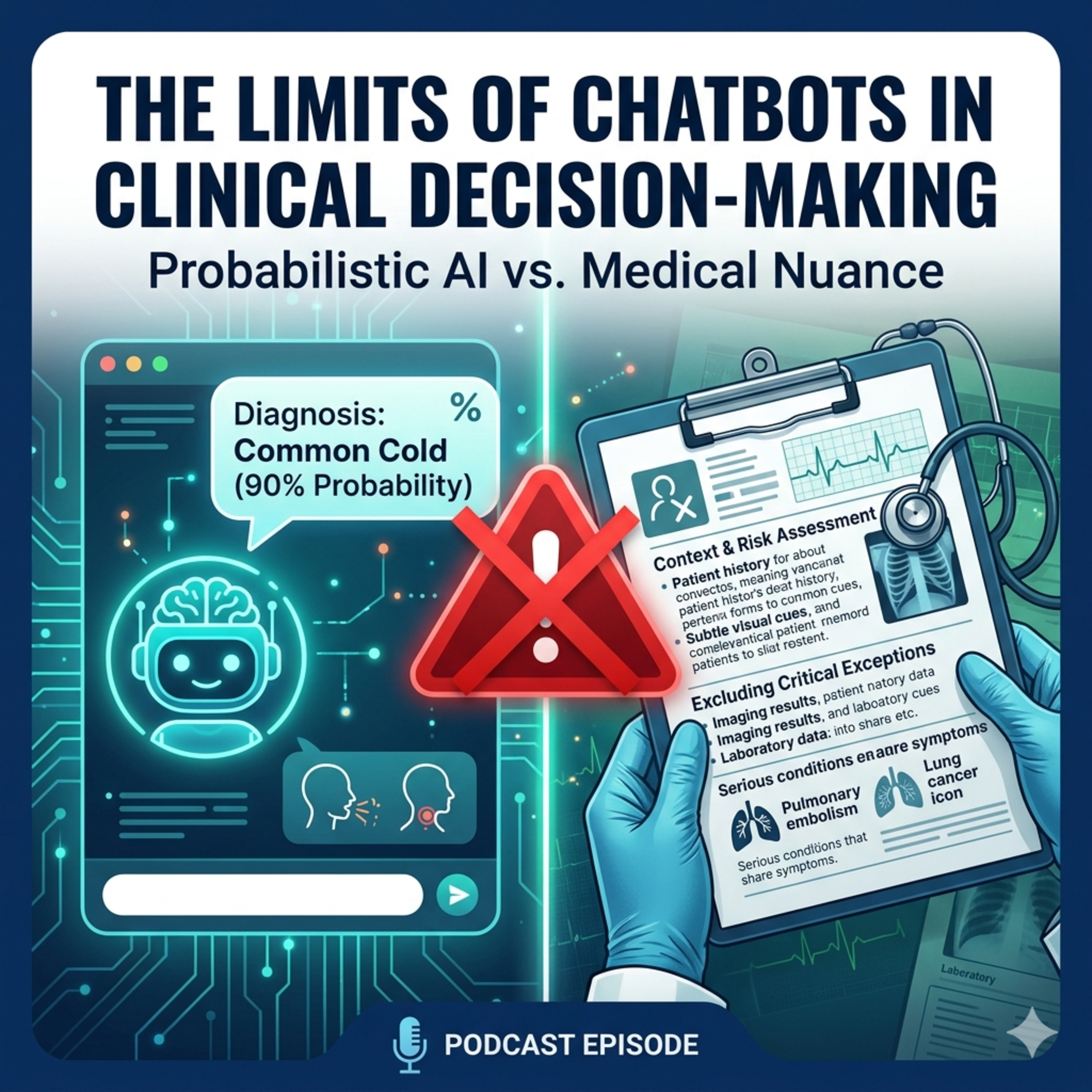
The Limits of Chatbots in Clinical Decision‑Making
From The Psychology of Health by Milan Toma
May 7, 2026 · 8 min · Season 2 · Episode 7
About this episode
This episode discusses the complexities and dangers of using chatbots and AI systems in clinical decision-making.
Chatbots and large language models are becoming increasingly common in everyday life, but their growing presence in healthcare has raised an important question: Should probabilistic AI systems be used to help make medical decisions? This episode takes a clear, grounded look at why the answer is far more complicated—and potentially far more dangerous—than many people realize. Modern chatbots work by predicting the most statistically likely response based on patterns found in massive amounts of text. That makes them great for conversation, brainstorming, and general information, but not for something as complex and high‑stakes as medical diagnosis. In clinical settings, symptoms like persistent cough and chest pain can point to a wide range of possible conditions. A probabilistic model might default to the most common explanation, but medicine doesn’t work on majority statistics—it works on understanding nuance, context, risk, and rare but critical exceptions. This episode explores how relying on “most likely” answers can lead to missed diagnoses, delayed treatments, and dangerous oversights. You’ll hear how serious conditions such as pulmonary embolism or early lung cancer can…
People in this episode
Host: Milan Toma
Topics covered
- chatbots
- clinical decision-making
- healthcare
- AI in medicine
- diagnosis
- medical risks
Keywords
- chatbots
- AI
- clinical decision-making
- medical diagnosis
- healthcare risks
- probabilistic models
- accuracy paradox
Mentioned in this episode
Organizations: Chatbots, AI systems, pulmonary embolism, lung cancer, respiratory infections
More episodes of The Psychology of Health
- AI Can't Replace Your Doctor: Why the Headlines Are Lying to You · May 23, 2026 · 10 min
- Viral AI-Beats-Doctors Study · May 4, 2026 · 8 min
- Medical Education Must Teach AI Differently · April 14, 2026 · 37 min
- The Overfitting Trap · April 2, 2026 · 23 min
- Understanding the Trust Gap in Medical AI · March 18, 2026 · 9 min
- Algorithmic Shortcuts That Undermine Medical AI · March 13, 2026 · 18 min
Explore listener stats, chart rankings, contacts and more on the The Psychology of Health podcast page.