
Astronomy Daily: Latest Space News
by bitesz.com
Is this your podcast?On the show
From 47 epsHosts
Recent guests
Recent episodes
Martian Mystery: Unveiling the Secrets of Arsia Mons' Elusive Clouds
Oct 16, 2026
25m 11s
Cosmic Revelations: Artemis 2's Historic Observations and the Case of Hypernovae
Oct 15, 2026
25m 01s
HERA's Grand Maneuver: Braking for Didymos and the Future of Planetary Defence
Oct 14, 2026
25m 24s
Cloudy with a Chance of Water: The Mysteries of WISE 0855 Unveiled
Oct 13, 2026
25m 16s
A Nobel in Ice: Unveiling the Secrets of the IceCube Neutrino Observatory
Oct 9, 2026
24m 28s
Insights from recent episode analysis
Audience Interest
Podcast Focus
Publishing Consistency
Platform Reach
Insights are generated by CastFox AI using publicly available data, episode content, and proprietary models.
Most discussed topics
Brands & references
Total monthly reach
Estimated from 16 chart positions in 16 markets.
By chart position
- 🇦🇺AU · Astronomy#10300K to 1M
- 🇺🇸US · Astronomy#19300K to 1M
- 🇨🇦CA · Astronomy#29100K to 300K
- 🇰🇷KR · Astronomy#16100K to 300K
- 🇯🇵JP · Astronomy#3630K to 100K
- Per-Episode Audience
Est. listeners per new episode within ~30 days
322K to 1.1M🎙 Daily cadence·891 episodes·Last published today - Monthly Reach
Unique listeners across all episodes (30 days)
1.1M to 3.5M🇦🇺29%🇺🇸29%🇨🇦9%+13 more - Active Followers
Loyal subscribers who consistently listen
429K to 1.4M
Market Insights
Platform Distribution
Reach across major podcast platforms, updated hourly
Total Followers
—
Total Plays
—
Total Reviews
—
* Data sourced directly from platform APIs and aggregated hourly across all major podcast directories.
Social Links & Contact
Official channels & resources
Official Website
Login
RSS Feed
Login
| Date | Episode | Topics | Guests | Brands | Places | Keywords | Sponsor | Length | |
|---|---|---|---|---|---|---|---|---|---|
| 10/16/26 | 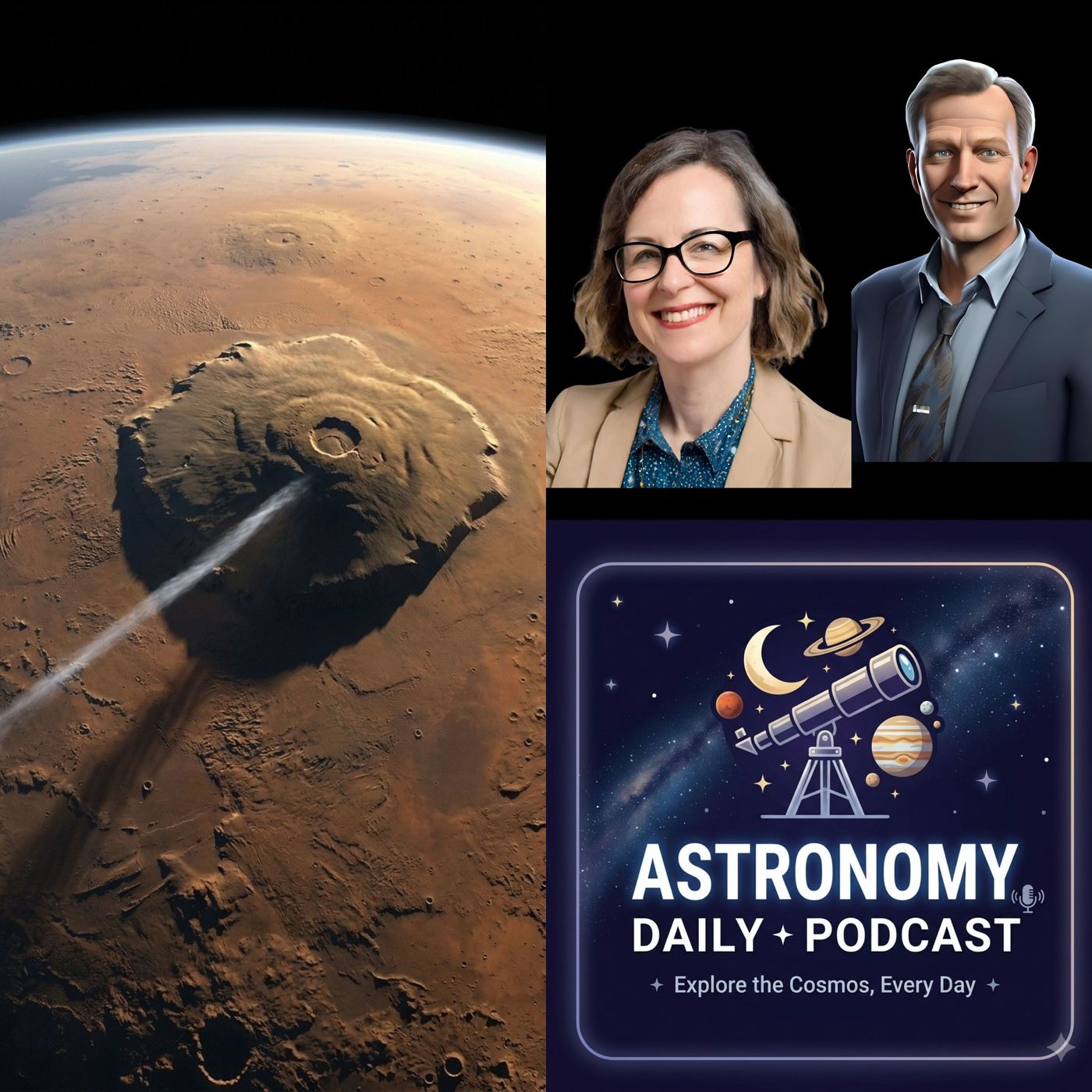 Martian Mystery: Unveiling the Secrets of Arsia Mons' Elusive Clouds | Show notes A cloud on Mars that forms only if textbook-theoretical physics really happens; Webb maps a hot Jupiter's edge angle by angle; multi-planet systems turn out to come in two families tied to their stars; and the Sagittarius dwarf galaxy's original disc is rebuilt from its own debris. Plus Hera's first braking burn, the station's final solar arrays, NASA ADS hands over to SciX, and a both-hemispheres skywatch. The Cloud That Shouldn't Exist Every morning in Mars's southern spring and summer, the Arsia Mons Elongated Cloud stretches up to 1,800 km from the 20 km volcano and vanishes within the day. A team led by Jorge Hernández-Bernal (LMD/CNRS/Sorbonne Université) could only reproduce it by adding homogeneous nucleation, in which vapour freezes with no dust seed, at supersaturation more than 100,000 times everyday Earth levels. A model result: sufficient, not yet observed directly. Nature Geoscience, 7 October 2026. A Map Around a Hot Jupiter's Edge Using JWST's NIRISS, NIRSpec and MIRI and the transmission strings method, Lili Alderson, Hannah Wakeford and colleagues mapped WASP-17 b's limb in 20° steps: ~860 K at the morning edge, ~1,520 K at the evening edge, the largest limb contrast yet. Data from March 2023. Nature Astronomy, 14 October 2026. Planetary Systems Come in Two Families Diego Turrini (INAF), Camilla Danielski and colleagues find 298 well-measured multi-planet systems split into a calm, compact low-mass family and a heavyweight family around metal-rich stars with about ten times more dynamical excitation. Nature Astronomy, 13 October 2026. Rewinding a Shredded Galaxy Zixi Guo, Xiang-Xiang Xue (NAOC) and colleagues reproduce a vertical metallicity gradient across the Sagittarius streams only if the dwarf began as a disc with an inverted-V metallicity profile, seen in 3 of 217 MaNGA dwarfs. Nature Astronomy, 13 October 2026. Quick hit Hera's 93-minute braking burn (BRM-1); CRS-35 and the ISS's final roll-out solar arrays; NASA ADS closes in November and becomes SciX. Skywatch Mercury and Venus in the southern evening sky; Venus inferior conjunction 24 Oct; crescent Moon in Ophiuchus; Sagittarius and WASP-17 high from Australia; Saturn all night; Mars and Jupiter closing pre-dawn toward 1.2° on 16 Nov; Orionids peak 21–22 Oct. Links · ESA: Mars's oddest cloud may be even odder than we thought (7 Oct 2026): https://www.esa.int/Science_Exploration/Space_Science/Mars_Express/Mars_s_oddest_cloud_may_be_even_odder_than_we_thought · Hernández-Bernal et al., Nature Geoscience (2026), DOI 10.1038/s41561-026-02089-9: https://doi.org/10.1038/s41561-026-02089-9 · Preprint: arXiv 2609.37259: https://arxiv.org/abs/2609.37259 · Alderson et al., A spatial map of the atmospheric limb of a hot Jupiter, Nature Astronomy (2026): https://www.nature.com/articles/s41550-026-02986-4 · Turrini, Danielski et al., Two families of multi-planet systems, Nature Astronomy (2026): https://www.nature.com/articles/s41550-026-02990-8 · INAF Media: Due famiglie di sistemi planetari (13 Oct 2026): https://www.media.inaf.it/2026/10/13/famiglie-esopianeti-stella-madre/ · Guo, Xue et al., A ∧-like metallicity profile in the disk of the Sagittarius dwarf galaxy, Nature Astronomy (2026): https://www.nature.com/articles/s41550-026-02996-2 · ESA: Brake! Time for ESA's Hera asteroid mission to go slow (7 Oct 2026): https://www.esa.int/Space_Safety/Hera/Brake!_Time_for_ESA_s_Hera_asteroid_mission_to_go_slow · Spaceflight Now: CRS-35 launch (13 Oct 2026): https://spaceflightnow.com/?p=74541 · Nature Astronomy editorial: Farewell NASA ADS (12 Oct 2026): https://www.nature.com/articles/s41550-026-03009-y astronomydaily.io · @AstroDailyPod · Bitesz.com Podcast NetworkBecome a supporter of this podcast: https://www.spreaker.com/podcast/astronomy-daily-latest-space-news--5648921/support.Sponsor Details:Ensure your online privacy by using NordVPN. To get our special listener deal and save a lot of money, visit www.astronomydaily.io/nordvpn. You'll be glad you did!Get the best secure and private email on the planet. Stop your Government, google and who knows who else spying on every email you write. Do what we did and use ProtonMail. They beleive in privacy and there are no ads in their business model...yet they still provide a free forever service. Check them out and get out special deal at www.astronomydaily.io/protonmailBecome a supporter of Astronomy Daily by joining our Supporters Club. Commercial free episodes daily are only a click way... Click HereThis episode includes AI-generated content. | 25m 11s | ||||||
| 10/15/26 | 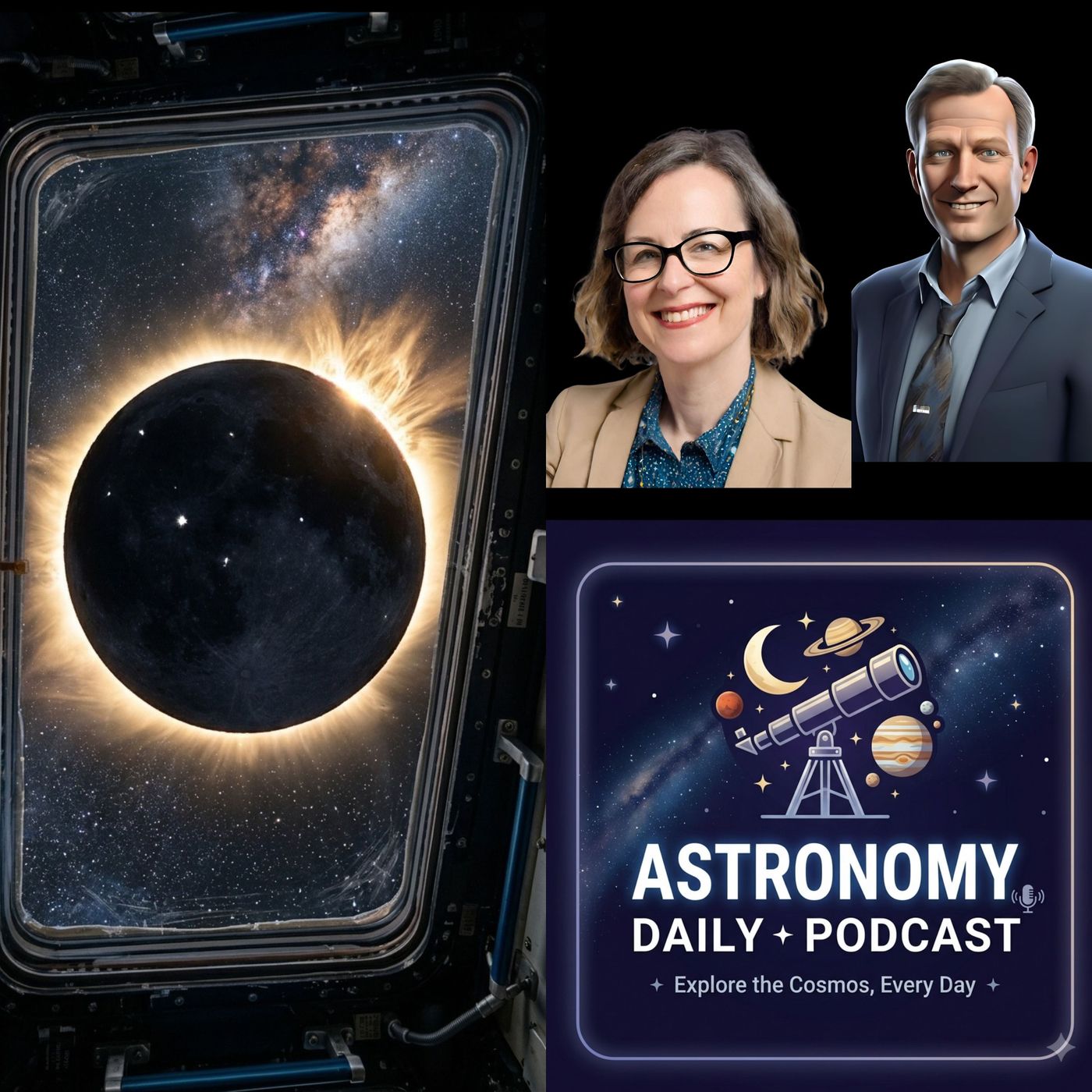 Cosmic Revelations: Artemis 2's Historic Observations and the Case of Hypernovae | Show notes Six months after Artemis II swung around the far side of the Moon, NASA has published what the crew saw, said and sketched — including five faint impact flashes spotted during a 54-minute eclipse. Plus: two UCL papers that take apart the chemical evidence for hypernovae, Juno finds Jupiter's magnetodisk crumpled into ripples, and IISc simulations suggest magnetised white dwarfs could grow well past the Chandrasekhar limit. Skywatch: the crescent Moon meets Antares, Mercury and Venus favour the south, Mars leaves the Beehive, and Vesta at opposition. Artemis II Preliminary Lunar Science Report · Crew: Reid Wiseman, Victor Glover, Christina Koch (NASA) and Jeremy Hansen (CSA); lunar flyby 6 April 2026. · Five extremely faint impact flashes seen from ~74,000 km during a 54-minute eclipse behind the Moon; impactors estimated at no more than ~5 cm. · Crew-reported colours (blue = titanium-rich volcanic rock, brown = iron, green = glass); terminator observations as a proxy for south-pole lighting. · 'Hello, World' Earth image lit by moonlight; labelled southern Milky Way image (Crux, Carina, LMC). · Source: NASA Science, 'Artemis II: Sights & Sounds of Science', 7 Oct 2026 — science.nasa.gov/feature/artemis-ii-preliminary-lunar-science-report/ Hypernovae: the evidence that wasn't · Anmol Aggarwal & Ralph Schoenrich (Mullard Space Science Laboratory, UCL), two MNRAS papers; UCL release 5 Oct 2026. · Uneven ('stochastic') supernova enrichment explains three of four supposed hypernova-enriched stars; the fourth (silver- and uranium-rich halo giant) fits a neutron-star merger plus one ordinary supernova. · Source: ucl.ac.uk/news/2026/oct/ultra-powerful-star-explosions-might-not-have-occurred-after-all ; DOI 10.1093/mnras/stag610 Juno: Jupiter's rippling magnetodisk · Ruilong Guo (Shandong University) et al., Science China Earth Sciences 69(10), 2026; release 6 Oct 2026. · Repeated current-sheet crossings — four in ten minutes in one case — with reconnection signatures; a rotating, rippled sheet rather than a smooth flapping one. · Source: doi.org/10.1007/s11430-025-1870-9 White dwarfs beyond the Chandrasekhar limit · Zenia Zuraiq, Banibrata Mukhopadhyay (IISc) and collaborators incl. Christopher Tout, ApJL 2026; IISc release 9 Oct 2026. · Modified STARS code: a magnetised accreting white dwarf reaches ~2.4 solar masses vs ~1.4 without the field. · Source: iisc.ac.in/events/strong-magnetic-fields-could-allow-white-dwarfs-to-grow-beyond-the-chandrasekhar-limit/ Quick hit: Hera and MMX · ESA: Hera BRM-1, 93-minute braking burn early Thu 15 Oct; BRM-2 on 22 Oct. esa.int (Hera) · JAXA: MMX launch on H3 F10, 20 Oct 2026 04:41:03 JST from Tanegashima; samples to South Australia in 2031. Skywatch (computed for Sydney, LA, New York, London) · Tonight: crescent Moon near Antares — 1.3° from New York, 2.3° from LA and London (very low), 7° from Sydney. · Evening Mercury (24° up at sunset from Sydney) and Venus (heading to inferior conjunction ~24 Oct) favour the south. · Pre-dawn: Mars ~2° from the Beehive, Mars–Jupiter closing to ~1.2° on 16 Nov; Saturn in the evening; Southern Taurids; Vesta at opposition (mag 6.5, Cetus). · Solar safety: never view the Sun except through certified ISO 12312-2 filters.Become a supporter of this podcast: https://www.spreaker.com/podcast/astronomy-daily-latest-space-news--5648921/support.Sponsor Details:Ensure your online privacy by using NordVPN. To get our special listener deal and save a lot of money, visit www.astronomydaily.io/nordvpn. You'll be glad you did!Get the best secure and private email on the planet. Stop your Government, google and who knows who else spying on every email you write. Do what we did and use ProtonMail. They beleive in privacy and there are no ads in their business model...yet they still provide a free forever service. Check them out and get out special deal at www.astronomydaily.io/protonmailBecome a supporter of Astronomy Daily by joining our Supporters Club. Commercial free episodes daily are only a click way... Click HereThis episode includes AI-generated content. | 25m 01s | ||||||
| 10/14/26 | 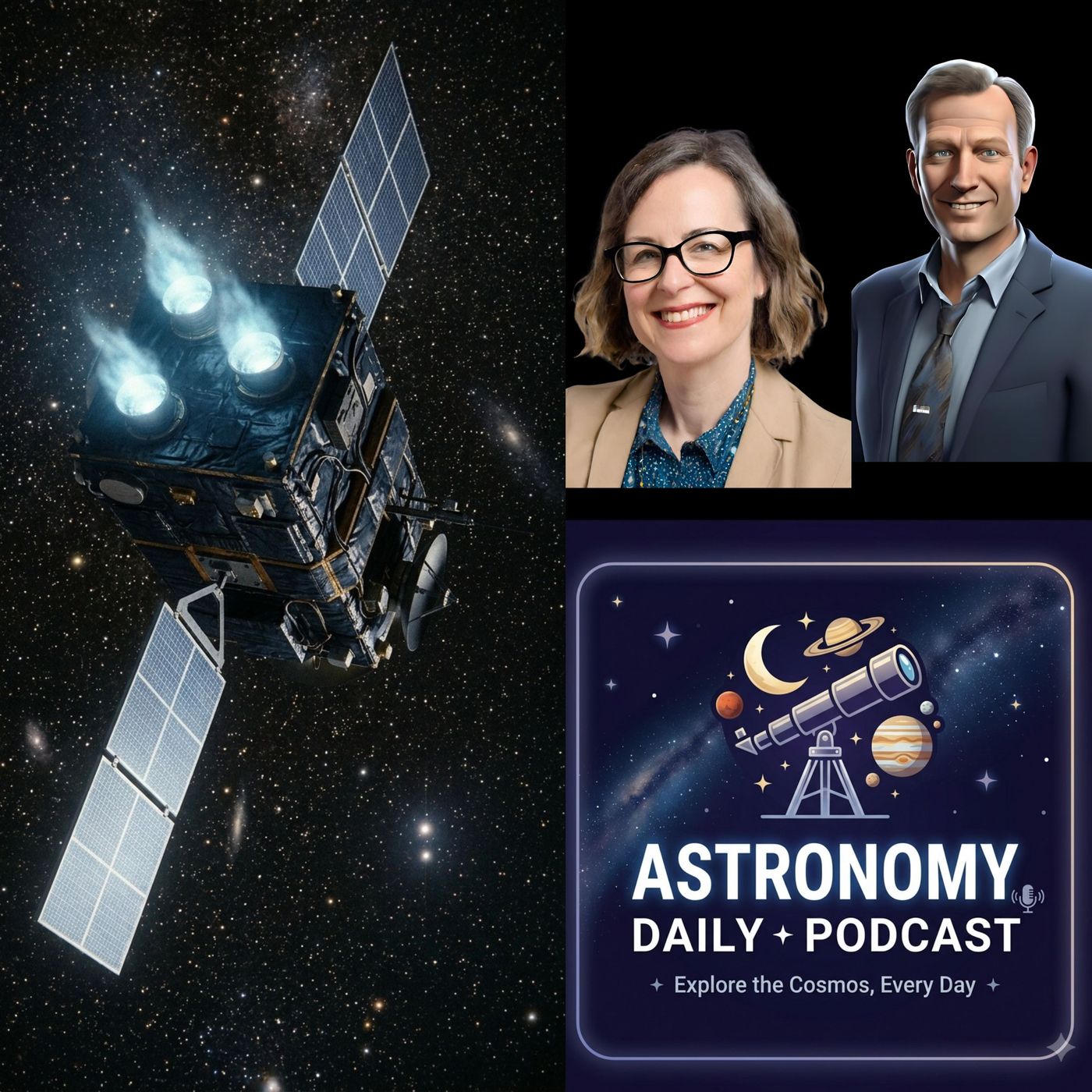 HERA's Grand Maneuver: Braking for Didymos and the Future of Planetary Defence | Show notes Hera Hits the Brakes ESA's Hera spotted its target asteroid for the first time last week and fires its first braking burn on Thursday — 93 minutes of thrust to start stopping at Didymos and Dimorphos, the asteroid pair NASA's DART hit in 2022. Plus: Solar Orbiter traces a solar-wind switchback back to the Sun, Gemini North finds chains of giant knots in the remnant of the supernova of 1181, Webb reads the dust of Mars-sized worlds colliding, and Perseverance becomes the farthest-driving vehicle on another world. In the skywatch: the Moon meets Antares, Venus bows out, Mars and Jupiter rule the northern dawn, and the Orionids are a week away. Hera Hits the Brakes Two years after launch, Hera caught its first glimpse of Didymos from about 236,500 km away — a sub-pixel dot. On Thursday 15 October three hydrazine thrusters fire for 93 minutes (BRM-1), taking a few hundred metres per second off its approach speed; BRM-2 (~31 min) follows on 22 October, then three small transition burns. The first signal after the burn comes through ESA's New Norcia antennas in Western Australia. Hera will measure the mass of Dimorphos so DART's single orbital-period result can become a repeatable deflection technique; its CubeSats Milani and Juventas will study dust, composition and the interior. Solar Orbiter traces a switchback home Coburn et al. (Nature Astronomy, 8 Oct) used heavy-ion charge states measured inside a large switchback crossed on 2 March 2022 to show it formed by interchange reconnection in hot closed loops at the Sun's surface — with waves and turbulence taking over once it left. Both leading theories are right, at different stages. The supernova of 1181 is strung with pearls Cunningham, Caiazzo et al. (ApJ, 6 Oct) used Gemini North/GMOS to show that Pa 30's radial filaments are chains of knots ~100 billion km across. Pa 30 is the Milky Way's only known Type Iax remnant, with a surviving 'zombie' star. The knots constrain models but don't yet settle what formed them. Webb reads the wreckage of colliding worlds Su et al. (ApJ, 1 Oct) studied 21 extreme debris disks with Webb and Spitzer. About a third are silica-rich, consistent with collisions between Mars-sized planetary embryos; older systems should be silica-poor. Quick hit: Perseverance's driving record On 11 October (sol 2,006) Perseverance reached 45.22 km, passing Opportunity's 45.16 km. More than 90% of the distance was driven on AutoNav. Sources · Hera braking campaign (ESA, 7 Oct 2026) — https://www.esa.int/Space_Safety/Hera/Brake!_Time_for_ESA_s_Hera_asteroid_mission_to_go_slow · Hera's first glimpse of Didymos (ESA, 7 Oct 2026) — https://www.esa.int/ESA_Multimedia/Images/2026/10/Destination_sighted_Hera_s_first_glimpse_of_Didymos · Finding Hera's way: Flight Dynamics team in action (ESA, 7 Oct 2026) — https://www.esa.int/Space_Safety/Hera/Finding_Hera_s_way_Flight_Dynamics_team_in_action · Solar Orbiter tracks origin of magnetic switchbacks (ESA, 8 Oct 2026) — https://www.esa.int/Science_Exploration/Space_Science/Solar_Orbiter/Solar_Orbiter_tracks_origin_of_mysterious_magnetic_switchbacks · Coburn et al., Nature Astronomy, DOI 10.1038/s41550-026-02928-0 — https://www.nature.com/articles/s41550-026-02928-0 · Gemini North reveals pearl-like knots in Pa 30 (NOIRLab, 6 Oct 2026) — https://noirlab.edu/public/news/noirlab2624/ · NASA's Webb provides crash course on planet-shattering collisions (NASA) — https://science.nasa.gov/missions/webb/nasas-webb-provides-crash-course-on-planet-shattering-collisions/ · Su et al., ApJ 1010:1, DOI 10.3847/1538-4357/ae88fe — https://doi.org/10.3847/1538-4357/ae88fe · Perseverance sets off-world record for total distance driven (JPL, 12 Oct 2026) — https://www.jpl.nasa.gov/news/nasas-perseverance-sets-off-world-record-for-total-distance-driven/Become a supporter of this podcast: https://www.spreaker.com/podcast/astronomy-daily-latest-space-news--5648921/support.Sponsor Details:Ensure your online privacy by using NordVPN. To get our special listener deal and save a lot of money, visit www.astronomydaily.io/nordvpn. You'll be glad you did!Get the best secure and private email on the planet. Stop your Government, google and who knows who else spying on every email you write. Do what we did and use ProtonMail. They beleive in privacy and there are no ads in their business model...yet they still provide a free forever service. Check them out and get out special deal at www.astronomydaily.io/protonmailBecome a supporter of Astronomy Daily by joining our Supporters Club. Commercial free episodes daily are only a click way... Click HereThis episode includes AI-generated content. | 25m 24s | ||||||
| 10/13/26 | 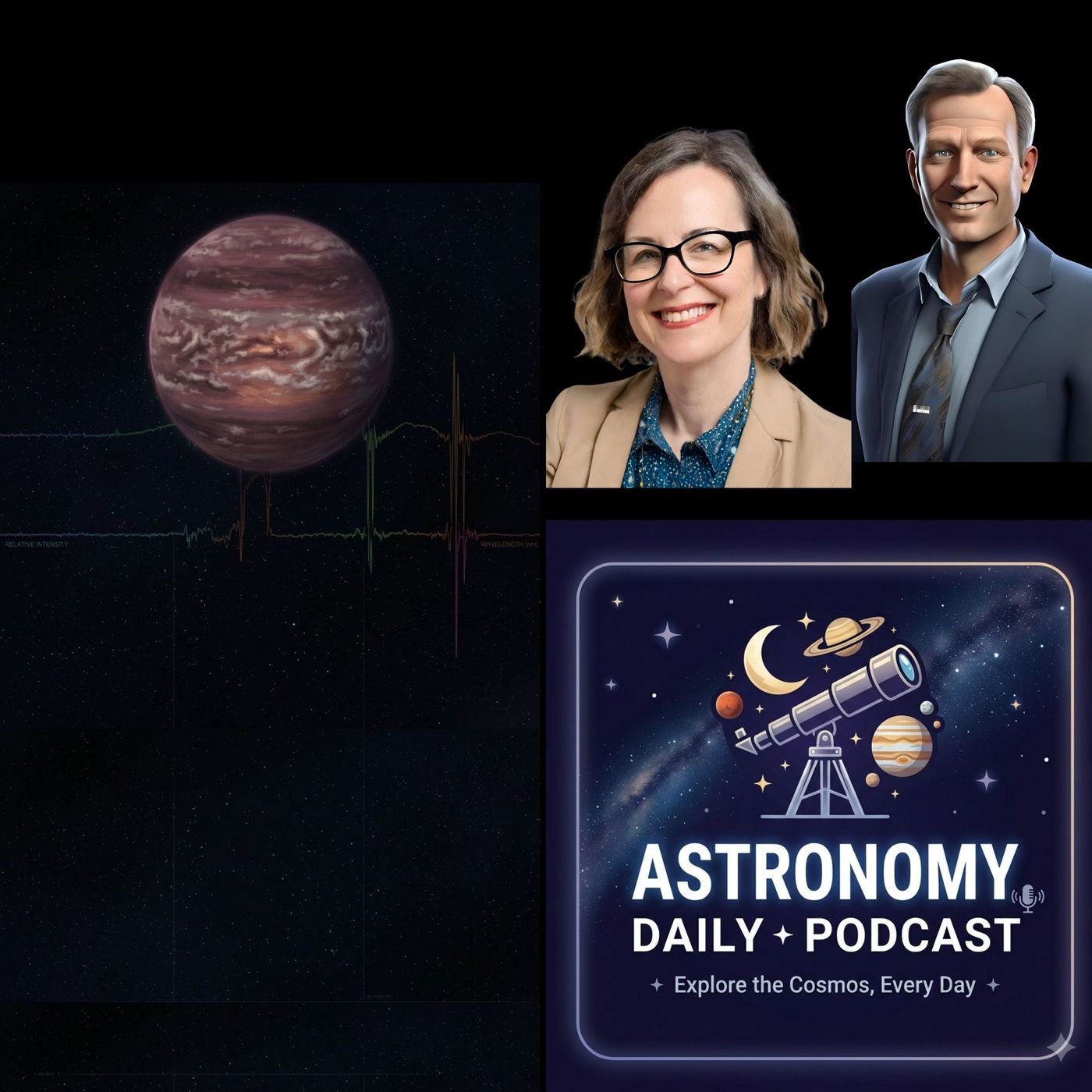 Cloudy with a Chance of Water: The Mysteries of WISE 0855 Unveiled | The coldest brown dwarf we know has weather. JWST watched water clouds thicken and thin on WISE 0855, a sunless world seven and a half light-years away — plus a star slowly eating a brown dwarf, ten minutes of X-rays after a half-second burst, a Soviet satellite breaking up over Western Australia, NASA's lunar cave hunt, and Mercury's best evening show of the year for the south. Stories Weather on a World Without a Sun Miles et al. used JWST NIRSpec to take a spectrum of WISE 0855 every 15 minutes for 11 hours. Carbon monoxide and phosphine rise and fall together as convection dredges deep gas upward, while patchy water clouds thicken and thin higher up — the first variable water clouds seen outside the Solar System. Source: University of Arizona release, 9 Oct 2026; arXiv:2609.20664 The Star That Eats Slowly ZTF J0440+2325: a red dwarf drawing gas from a 25-Jupiter-mass brown dwarf on an 87-minute orbit — the first confirmed stable mass transfer from a substellar object onto a star. Householder, Burdge et al., Nature Astronomy, 5 Oct 2026. Source: Nature Astronomy (2026); arXiv:2603.17039 Ten Minutes After Half a Second Einstein Probe caught ~560 s of soft X-rays after the 0.37 s GRB 250704B, at redshift 0.661 with no supernova — pointing to a compact-object merger and possibly a newborn magnetar. Science Bulletin, 2026. Source: DOI 10.1016/j.scib.2026.08.021; arXiv:2601.14137 A Dead Satellite Comes Apart Soviet weather satellite Meteor 2-7 (launched 1981) fragmented on 5 Oct at ~850 km, detected by LeoLabs' Western Australian radar. Cause unknown. Source: EarthSky, 9 Oct 2026; Space.com Quick hit: NASA Goes Caving on the Moon NASA's PRISM picks for the Moon Base program include GIMLI, which will probe the Marius Hills Pit for a lava tube, plus LEMS-SP and DISCO. Source: NASA RELEASE26-080, 30 Sept 2026 Skywatch Mercury at greatest eastern elongation — 24° up at sunset from Sydney vs 10° LA, 7.5° NY, 3° London. Crescent Moon near Venus and Mercury, Venus heading to inferior conjunction on the 24th, pre-dawn Mars and Jupiter for the north (Mars through the Beehive), Orionids 21–22 Oct. Source: Computed with PyEphem Sources · https://astrobiology.com/2026/10/09/first-detection-of-variable-water-clouds-outside-of-our-solar-system/ · https://arxiv.org/abs/2609.20664 · https://dspace.mit.edu/handle/1721.1/175765 · https://arxiv.org/abs/2603.17039 · https://www.arxiv.org/abs/2601.14137 · https://earthsky.org/?p=560313 · https://www.space.com/space-exploration/satellites/a-dead-soviet-satellite-just-broke-apart-in-orbit-again-experts-say-its-part-of-a-worrying-trend · https://nasa.gov/news-release/nasa-adds-new-science-investigations-for-moon-baseBecome a supporter of this podcast: https://www.spreaker.com/podcast/astronomy-daily-latest-space-news--5648921/support.Sponsor Details:Ensure your online privacy by using NordVPN. To get our special listener deal and save a lot of money, visit www.astronomydaily.io/nordvpn. You'll be glad you did!Get the best secure and private email on the planet. Stop your Government, google and who knows who else spying on every email you write. Do what we did and use ProtonMail. They beleive in privacy and there are no ads in their business model...yet they still provide a free forever service. Check them out and get out special deal at www.astronomydaily.io/protonmailBecome a supporter of Astronomy Daily by joining our Supporters Club. Commercial free episodes daily are only a click way... Click HereThis episode includes AI-generated content. | 25m 16s | ||||||
| 10/9/26 | 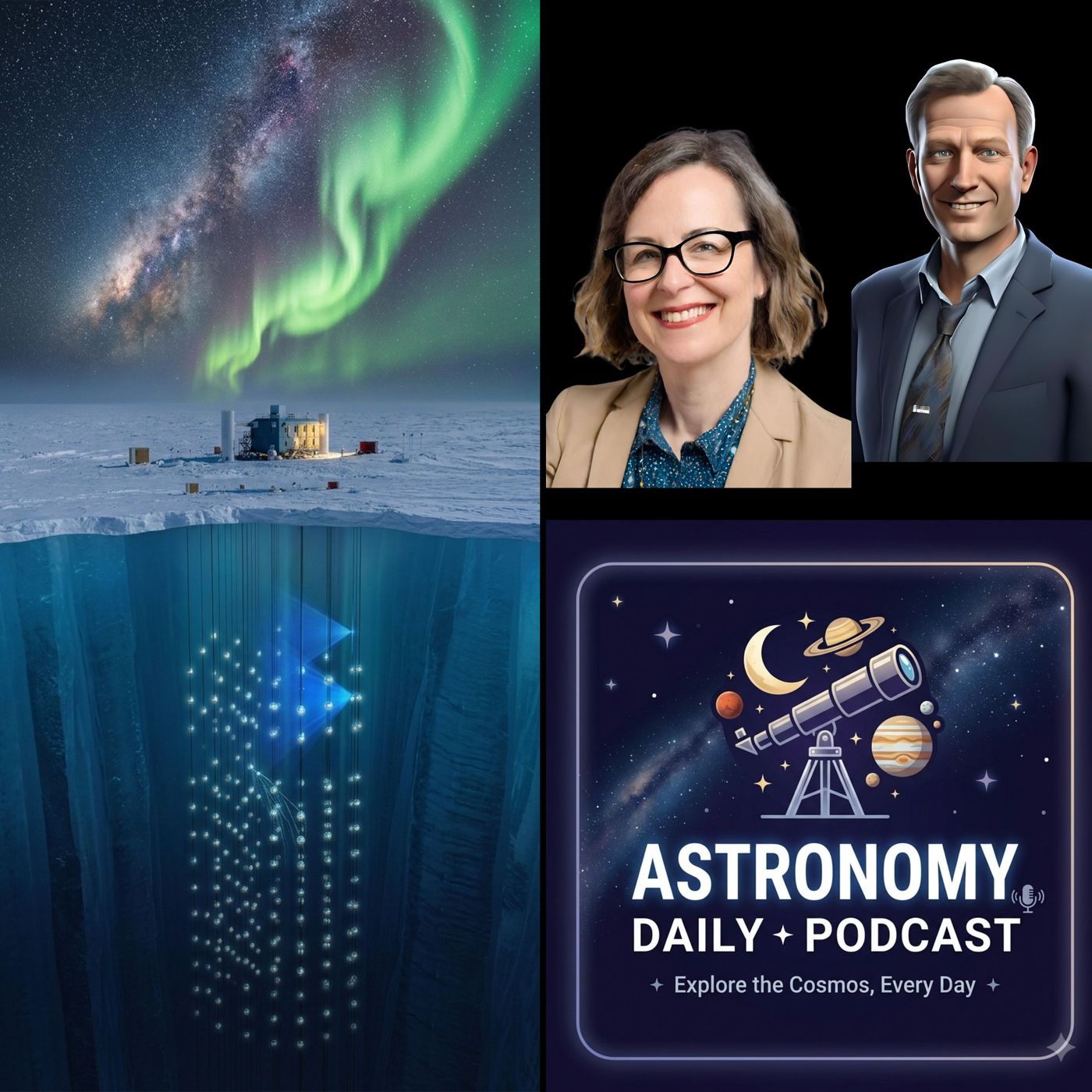 A Nobel in Ice: Unveiling the Secrets of the IceCube Neutrino Observatory | Show notes We're back after a short break! Today: the 2026 Nobel Prize in Physics goes to Francis Halzen for the IceCube Neutrino Observatory — a cubic kilometre of Antarctic ice turned into a telescope. Then a Sydney-led team publishes the most distant fast radio burst yet, from a dwarf galaxy just 3 billion years after the big bang; Hubble's archive yields a possible second-generation planet around a white dwarf; and we catch up on Starship's first orbit, Crew-13, Juice's Earth flyby and the end of the LINK/Swift story. Skywatch: zodiacal light at both ends of the day, Mercury above Venus in southern twilight, and Mars in the Beehive for the north. Segment 1 — LEAD: The Telescope Made of Ice · Nobel Prize in Physics 2026 — nobelprize.org/prizes/physics/2026 (6 Oct 2026) · Royal Swedish Academy of Sciences press release, 6 Oct 2026 · AIP congratulations release, Newswise, 6 Oct 2026 · University of Wisconsin–Madison / IceCube background (via Interesting Engineering, 6 Oct 2026) Segment 2 — The Most Distant Fast Radio Burst · NASA: 'Webb Measures Distance to Farthest Fast Radio Burst, Suggesting Origin', 8 Oct 2026 · Caleb et al., Science, 8 Oct 2026, DOI 10.1126/science.adz2675 · Preprint: arXiv 2508.01648, 3 Aug 2025 (14-month gap disclosed) Segment 3 — A Planet Built From a Dead Star · NASA: 'Suspected Second-generation Planet Solves NASA Hubble Cold Case', 5 Oct 2026 · Williams et al., Nature Astronomy, 5 Oct 2026, DOI 10.1038/s41550-026-02983-7 · ESA/Hubble heic2613; poster, UK White Dwarf meeting, Durham, July 2025 (disclosed) Segment 4 — While We Were Away · SpaceX Starship Flight 14 overview (via leonarddavid.com, 29 Sept 2026) · NASA: 'NASA's SpaceX Crew-13 Launches', 1 Oct 2026 · ESA: 'Successful Earth flyby improves Juice's course to Jupiter', 28–30 Sept 2026 · AP (Marcia Dunn): 'Private spacecraft falls back to Earth...', 25 Sept 2026 · JAXA: MMX launch schedule aboard H3 F10, 20 Aug 2026 Segment 5 — Skywatch: Both Hemispheres · PyEphem 4.2.1 computations, Sydney / Los Angeles / New York / London · BBC Sky at Night: Vesta and Pallas at opposition, Oct 2026 · NASA: What's Up, October 2026Become a supporter of this podcast: https://www.spreaker.com/podcast/astronomy-daily-latest-space-news--5648921/support.Sponsor Details:Ensure your online privacy by using NordVPN. To get our special listener deal and save a lot of money, visit www.astronomydaily.io/nordvpn. You'll be glad you did!Get the best secure and private email on the planet. Stop your Government, google and who knows who else spying on every email you write. Do what we did and use ProtonMail. They beleive in privacy and there are no ads in their business model...yet they still provide a free forever service. Check them out and get out special deal at www.astronomydaily.io/protonmailBecome a supporter of Astronomy Daily by joining our Supporters Club. Commercial free episodes daily are only a click way... Click HereThis episode includes AI-generated content. | 24m 28s | ||||||
| 9/23/26 |  The Great Water Mystery: Jezero Crater and the Hunt for Mars' Hidden History | Perseverance drove to the edge of an ancient Martian lake expecting a beach and found the inside of a volcano — rock that water has been through at least three separate times. Europe's Jupiter probe comes home on Monday night and crosses Australia in a fully dark sky. Two teams, using two completely different techniques, both find something hiding inside the most famous planetary system we have ever photographed — and an Australian instrument is in the middle of one of them. Plus: heavy water in an interstellar comet, and what it says about the star that made it. In this episode · LEAD — Three floods at the crater's edge. Candice Bedford (Purdue) and colleagues publish in Communications Earth & Environment: the Margin Unit at Jezero is igneous, not sedimentary, and records at least three distinct episodes of water — CO₂-rich groundwater making carbonate ridges, then silica associated with the lake, then a later hot-water event leaving fluorite veins. Habitability context, not a biosignature. · Juice returns. ESA confirms the third Earth gravity assist for 28 September — closest approach 11:45 UTC over the Indian Ocean, bending the trajectory ~20° and adding ~3.5 km/s. The spacecraft crosses Australia north-east to north-west 15–30 minutes earlier, in full darkness. · HR 8799. Two preprints in two weeks point at a fifth, inner planet — one from archival JWST aperture-masking data (~7 au, a few Jupiter masses), one from Gaia astrometry (2–3 au, 10–14 Jupiter masses). They do not obviously describe the same object. Neither is peer-reviewed. · 3I/ATLAS. A modelling paper explains the high deuterium-to-hydrogen ratio measured in March as consistent with formation around a low-metallicity — meaning old — star. · Quick hit: Starship Flight 14 still targeting 28 September; Crew-13 still 'no earlier than early October' on NASA's own page; Albania signs the Artemis Accords as the 73rd country. · Skywatch: the equinox as an instant rather than a date, the Juice pass over Australia, Venus and Mercury for the south, Mars and Jupiter before dawn for the north, and Saturn heading into opposition. Sources and further reading · Bedford, C. C. et al., 'Lake- and groundwater-associated alteration of the olivine-rich Margin unit in Jezero crater, Mars', Communications Earth & Environment (2026). DOI 10.1038/s43247-026-03997-9 · NASA/JPL, 'NASA Discovery Reveals Complex Water Systems on Early Mars', 21 September 2026. · ESA, 'Juice to fly past Earth for third gravity assist', 21 September 2026. · Nguyen, J. S. et al., 'A Candidate Innermost Fifth Planet In the HR 8799 System Revealed By JWST NIRISS Aperture Masking Interferometry', arXiv:2609.10507. · Lagrange, A.-M. et al., 'A fifth companion in the HR 8799 system revealed by Gaia', arXiv:2609.20996 (submitted to Nature Astronomy). · Furuya, K., Cordiner, M., Bockelée-Morvan, D. et al., arXiv:2609.12370. · NASA OIIR, 'NASA Welcomes Albania as Newest Artemis Accords Signatory', 21 September 2026. Skywatch figures computed in-session with PyEphem 4.2.1 for Sydney, Los Angeles, New York and London. Times are local unless marked UTC.Become a supporter of this podcast: https://www.spreaker.com/podcast/astronomy-daily-latest-space-news--5648921/support.Sponsor Details:Ensure your online privacy by using NordVPN. To get our special listener deal and save a lot of money, visit www.astronomydaily.io/nordvpn. You'll be glad you did!Get the best secure and private email on the planet. Stop your Government, google and who knows who else spying on every email you write. Do what we did and use ProtonMail. They beleive in privacy and there are no ads in their business model...yet they still provide a free forever service. Check them out and get out special deal at www.astronomydaily.io/protonmailBecome a supporter of Astronomy Daily by joining our Supporters Club. Commercial free episodes daily are only a click way... Click HereThis episode includes AI-generated content. | 26m 38s | ||||||
| 9/22/26 | 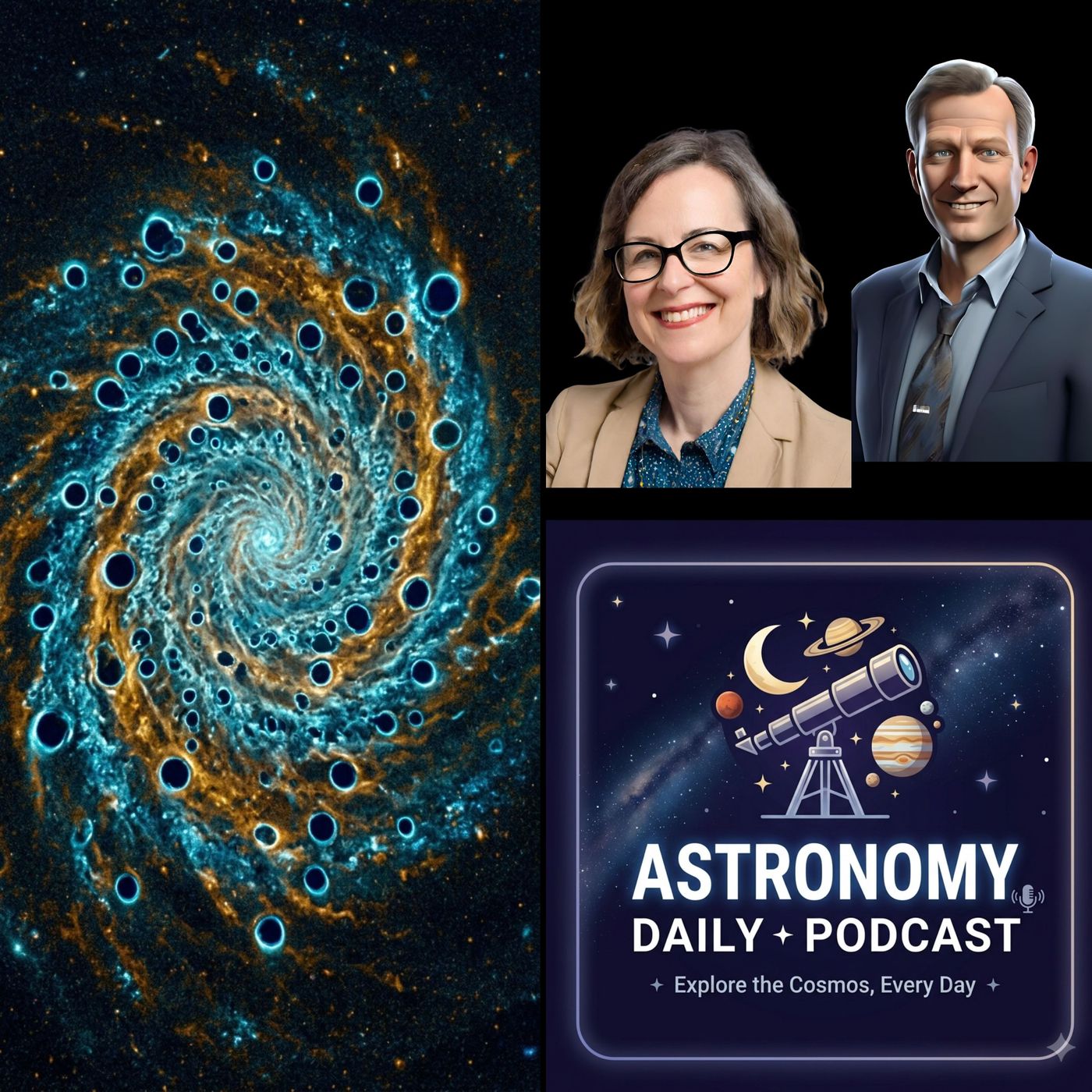 What Keeps a Galaxy Churning: Andromeda's Supernova Secrets Revealed | Supernovae keep galaxies churning A new study led by Fan Yi Meng from Tsinghua University provides the first comprehensive census of superbubbles in the Andromeda Galaxy, revealing that clustered supernova feedback is sufficient to sustain galactic-scale turbulence. This finding helps to explain why galaxies remain active over billions of years, with turbulence playing a crucial role in regulating star formation rates. The research, published in Nature Astronomy, highlights the energy balance between supernovae and the turbulence they create.Neutrinos may dictate stellar explosions A paper from Mariam Gogilashvili and Irene Tambora at the Niels Bohr Institute explores the role of neutrinos in determining which massive stars explode as supernovae. Their findings suggest that neutrino oscillations could lead to a significant number of stars collapsing into black holes, particularly those in the 16 to 30 solar mass range, addressing the long-standing red supergiant problem.TOI 1355b: A planet with an expiry date Researchers from the University of Tokyo have discovered TOI 1355b, a hot Jupiter with a unique eccentric orbit around an A-type star. This planet will stop transiting its host star by 2033 due to nodal precession, providing a rare opportunity to study its characteristics before it disappears from view.SpaceX Crew Missions Update NASA has contracted SpaceX for three additional crew rotation missions to the International Space Station, extending their partnership and ensuring continued access to the station. Crew 13 is currently in quarantine, with a launch targeted for early October.The Sun goes blank For the first time since February, the Sun has gone completely spotless, marking a significant moment in the solar cycle. As solar activity declines, a coronal hole is set to rotate into position, potentially leading to minor geomagnetic storms and auroras.1. Supernovae keep galaxies churning2. Neutrinos may dictate stellar explosions3. TOI 1355b: A planet with an expiry date4. SpaceX Crew Missions Update5. The Sun goes blankBecome a supporter of this podcast: https://www.spreaker.com/podcast/astronomy-daily-latest-space-news--5648921/support.Sponsor Details:Ensure your online privacy by using NordVPN. To get our special listener deal and save a lot of money, visit www.astronomydaily.io/nordvpn. You've been glad you did!Get the best secure and private email on the planet. Stop your Government, Google and who knows who else spying on every email you write. Do what we did and use ProtonMail. They believe in privacy and there are no ads in their business model... yet they still provide a free forever service. Check them out and get our special deal at www.astronomydaily.io/protonmailBecome a supporter of Astronomy AstroDailyPod by joining our Supporters Club. Commercial-free episodes daily are only a click away... Click HereSponsor Details:Ensure your online privacy by using NordVPN. To get our special listener deal and save a lot of money, visit www.astronomydaily.io/nordvpn. You'll be glad you did!Get the best secure and private email on the planet. Stop your Government, google and who knows who else spying on every email you write. Do what we did and use ProtonMail. They beleive in privacy and there are no ads in their business model...yet they still provide a free forever service. Check them out and get out special deal at www.astronomydaily.io/protonmailBecome a supporter of Astronomy Daily by joining our Supporters Club. Commercial free episodes daily are only a click way... Click HereThis episode includes AI-generated content. | 28m 02s | ||||||
| 9/19/26 | 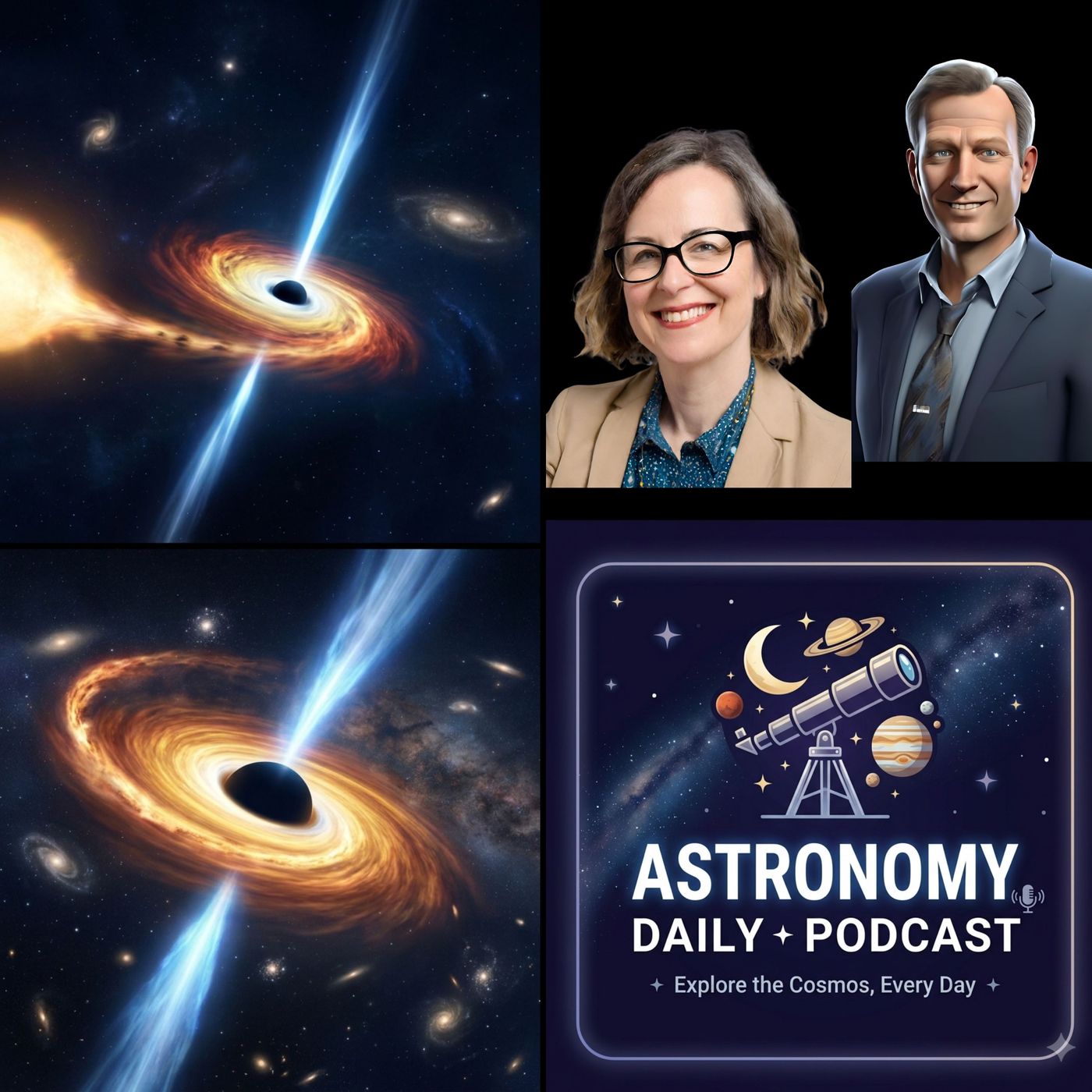 The Unifying Mystery of Black Hole Jets: Stellar and Supermassive Connections | SHOW NOTES Black hole jets follow one universal rule Adelle Goodwin (Curtin University / ICRAR, Forrest Research Foundation Fellow) and Andrew Mummery (Institute for Advanced Study, Princeton) show that supermassive black holes launch their outflows at the same critical accretion rate as stellar-mass black holes — about 2% of the Eddington limit — making accretion-outflow coupling scale-invariant across seven orders of magnitude in mass. Nature Astronomy, 17 September 2026. DOI: 10.1038/s41550-026-02951-1 JWST's Little Red Dots are black hole seeds caught mid-growth Sunmyon Chon, Shingo Hirano, Tomoaki Ishiyama, Seok-Jun Chang and Volker Springel ran fully cosmological radiation-hydrodynamic simulations on Japan's ATERUI III supercomputer and produced heavy black hole seeds of about a million solar masses, whose optically thick discs generate exactly the broad hydrogen emission seen in Little Red Dots. Nature 657, 621-625, 16 September 2026. DOI: 10.1038/s41586-026-10985-8 Earth's centre of mass moves about half as far as we thought Donald Argus, Felix Landerer and colleagues at NASA's Jet Propulsion Laboratory, with the University of Nevada, the University of Montana and the Helmholtz Centre for Geosciences, revise the annual oscillation between Earth's centre of mass and its centre of figure down from roughly 11 millimetres to about 4 to 5.5. Geophysical Journal International, ggag314. DOI: 10.1093/gji/ggag314 Two numbers explain the weather on a world 20 light-years away Merle Schrader and colleagues at Trinity College Dublin applied principal component analysis to one rotation of JWST spectroscopy of the brown dwarf SIMP 0136 and found two components — temperature and vertical cloud structure — account for all the detectable variability. Astronomy & Astrophysics, open access. DOI: 10.1051/0004-6361/202660109 The Sun goes blank With only active region AR4528 left on the Earth-facing disc and rotating out of view, the Sun was on the verge of its first spotless day since 24 February 2026 — which itself ended a 1,335-day run of continuous sunspot activity stretching back to June 2022. Skywatch: Venus at greatest brilliancy, first quarter Moon, Observe the Moon Night Venus reaches greatest brilliancy on 18 September at magnitude -4.8; the Moon reaches exact first quarter at 20:43 UTC the same day, setting up International Observe the Moon Night on Saturday 19 September. All times and altitudes in this segment were computed for Sydney, Los Angeles, New York and London. SKYWATCH — COMPUTED REFERENCE Computed in-session with PyEphem 4.2.1. Local times. Sydney on AEST (UTC+10); Los Angeles PDT; New York EDT; London BST. City Sunset Venus alt Venus sets Mercury Mars pre-dawn Sydney 17:45 39.2 deg 20:58 (3h13m) 16.4 deg (sets 1h20m) 20.4 deg Los Angeles 18:52 14.3 deg 20:10 (1h19m) 8.8 deg (sets 0h43m) 48.4 deg New York 18:56 10.3 deg 19:59 (1h03m) 7.0 deg (sets 0h38m) 46.1 deg London 19:04 3.6 deg 19:32 (0h28m) 3.9 deg (sets 0h26m) 40.6 deg · Venus greatest brilliancy: 18 September 2026, magnitude -4.8. Disc 39.6 arcsec, 26% illuminated. · By 22 September the disc has grown to 42.3 arcsec but the lit fraction has fallen to 22.7% — the two changes nearly cancel, which is why listings disagree on the date. The peak is genuinely flat. · Moon reaches exact first quarter 18 September at 20:43 UTC = 06:43 AEST Sat 19 Sep / 16:43 EDT Fri 18 / 13:43 PDT Fri 18 / 21:43 BST Fri 18. · Moon altitude at sunset: Sydney 81.6 deg (near overhead), Los Angeles 27.1 deg, New York 20.4 deg, London 9.4 deg. · International Observe the Moon Night: Saturday 19 September 2026. NASA event at the U.S. Space & Rocket Center, Huntsville, 5:30-8:00pm CST. · Pre-dawn Sat 19 Sep at nautical dawn — Jupiter: Los Angeles 26.4 deg, New York 25.1 deg, London 21.9 deg, Sydney 8.9 deg. · Mars-Jupiter separation: 22.9 deg on 18 Sep, 12.0 deg mid-October, 1.2 deg mid-November 2026. · Saturn is up essentially all night; sets 06:47 Sydney, 07:55 Los Angeles. Opposition 4 October 2026, disc 19.6 arcsec, rings approx 7 deg open. · September equinox: a single instant, 00:05:09 UTC on 23 September 2026 — evening of the 22nd in the Americas, mid-morning of the 23rd in Australia. · All figures computed in-session with PyEphem 4.2.1 for the four reference cities. Sydney is on AEST (UTC+10); daylight saving begins 4 October. Become a supporter of this podcast: https://www.spreaker.com/podcast/astronomy-daily-latest-space-news--5648921/support.Sponsor Details:Ensure your online privacy by using NordVPN. To get our special listener deal and save a lot of money, visit www.astronomydaily.io/nordvpn. You'll be glad you did!Get the best secure and private email on the planet. Stop your Government, google and who knows who else spying on every email you write. Do what we did and use ProtonMail. They beleive in privacy and there are no ads in their business model...yet they still provide a free forever service. Check them out and get out special deal at www.astronomydaily.io/protonmailBecome a supporter of Astronomy Daily by joining our Supporters Club. Commercial free episodes daily are only a click way... Click HereThis episode includes AI-generated content. | 33m 37s | ||||||
| 9/18/26 | 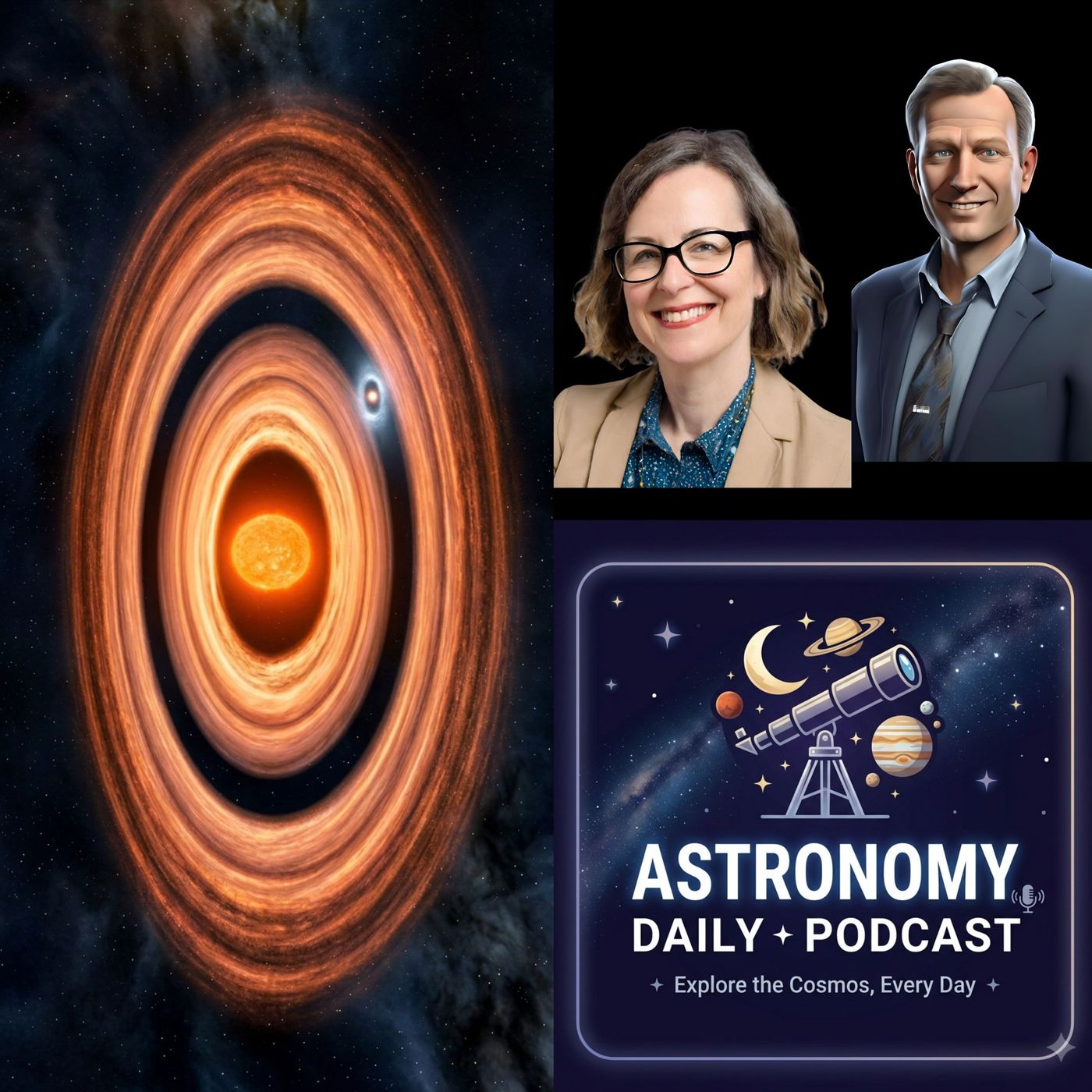 The Youngest Planet Ever Found | Astronomers have confirmed the youngest planet ever found - Elias 2-24 b, less than a million years old, sitting inside a gap it is carving in its own birth disc 450 light-years away. Plus: the Lunar Reconnaissance Orbiter finds a 222-metre crater that was not there in 2024, a 178-year-old space weather record gets corrected by seven years, and Sakurai's Object - a star that came back from the dead - has become six times hotter in thirty years.SOURCES Newfound 'Baby' Planet Smashes Record for Youngest Known World NASA Science, 16 September 2026 - https://science.nasa.gov/universe/newfound-baby-planet-smashes-record-for-youngest-known-world/ Elias 2-24 b discovery paper Bernardi, Cieza et al., The Astrophysical Journal Letters, 16 September 2026, DOI 10.3847/2041-8213/ae9bb6 - https://doi.org/10.3847/2041-8213/ae9bb6 ALMA Observations of Elias 2-24: A Protoplanetary Disk with Multiple Gaps (background) Cieza et al., ApJL 851 L23, 2017, DOI 10.3847/2041-8213/aa9b7b - https://doi.org/10.3847/2041-8213/aa9b7b NASA's Moon Orbiter Spots New, 'Once-in-Century' Moon Crater NASA Science, 16 September 2026 - https://science.nasa.gov/solar-system/moon/nasas-moon-orbiter-spots-new-once-in-century-moon-crater/ New 222-metre lunar crater - mission release W. M. Keck / Intuitive Machines / NASA LROC, 16 September 2026; two papers in Science Advances (Robinson et al., morphology and ejecta; Powell et al., Diviner thermal signature) - https://www.prnewswire.com/news-releases/nasas-lunar-reconnaissance-orbiter-discovers-a-new-222-m-diameter-lunar-crater-302880555.html Mystery of one of the earliest recorded space weather impacts solved Lancaster University / RMIT University, 16 September 2026; Wild, Carter, Hapgood et al., Space Weather (AGU), DOI 10.1029/2026SW005239 - https://doi.org/10.1029/2026SW005239 'Born-again' star offers rare chance to watch stellar evolution in real time The University of Manchester, 16 September 2026; Zijlstra, van Hoof et al., 'The emergence of a [WC] star in Sakurai's object', MNRAS, DOI 10.1093/mnras/stag1533 - https://doi.org/10.1093/mnras/stag1533 Cargo Mission and Crew-13 Updates; Station Research, Maintenance Continue NASA Space Station Blog, 16 September 2026 - https://www.nasa.gov/blogs/spacestation/2026/09/16/cargo-mission-and-crew-13-updates-station-research-maintenance-continue/ International Observe the Moon Night 2026 NASA, Saturday 19 September 2026 - https://science.nasa.gov/moon/observe-the-moon-night/overview Skywatch ephemerides Computed in-session with PyEphem for Sydney, Los Angeles, New York and London, 17-18 September 2026Become a supporter of this podcast: https://www.spreaker.com/podcast/astronomy-daily-latest-space-news--5648921/support.Sponsor Details:Ensure your online privacy by using NordVPN. To get our special listener deal and save a lot of money, visit www.astronomydaily.io/nordvpn. You'll be glad you did!Get the best secure and private email on the planet. Stop your Government, google and who knows who else spying on every email you write. Do what we did and use ProtonMail. They beleive in privacy and there are no ads in their business model...yet they still provide a free forever service. Check them out and get out special deal at www.astronomydaily.io/protonmailBecome a supporter of Astronomy Daily by joining our Supporters Club. Commercial free episodes daily are only a click way... Click HereThis episode includes AI-generated content. | 33m 40s | ||||||
| 9/17/26 | 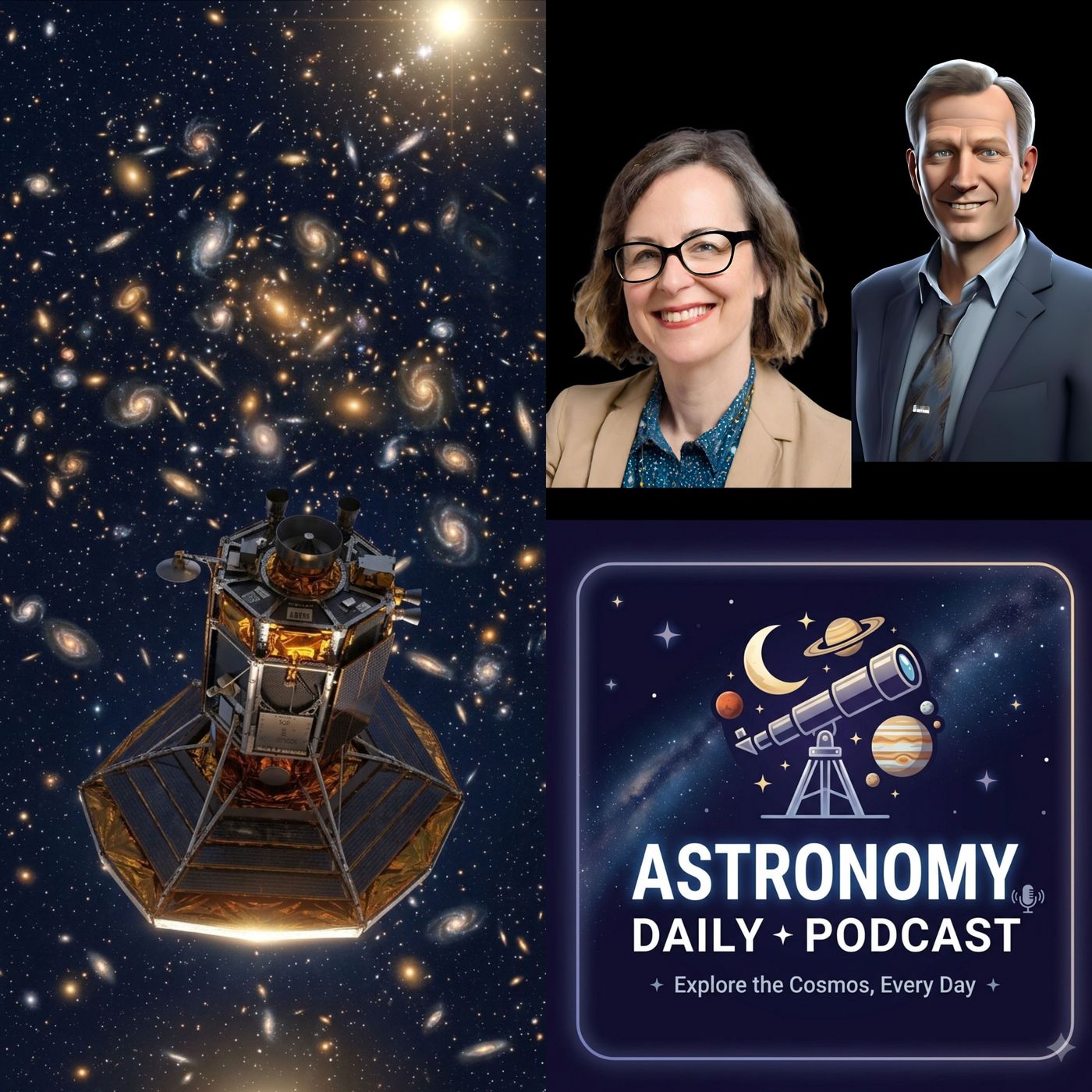 Roman Opens Its Eye | First starlight from Roman, a shorter fuse on the Solar System, weapons in orbit, and a globular cluster hiding behind the dust Roman opens its eye — and finds it has twice as long to look NASA has activated the Nancy Grace Roman Space Telescope's Wide Field Instrument, a 300-megapixel infrared camera built around eighteen detectors, with a field of view at least a hundred times larger than Hubble's infrared field — a patch of sky bigger than the full Moon in a single exposure, at Hubble-comparable sharpness. The instrument reached its operating temperature of −143 °C on 11 September; detectors and the calibration system came up across the 11th and 12th; the element wheel turned in microgravity for the first time on the 12th; the focus mechanism was verified on the 13th. Roman then took its first starlight image — deliberately out of focus, and exactly as intended: a baseline diagnostic that proves the optical path is clear and every detector is live. Sharp science images are expected by early 2027. The Coronagraph Instrument has completed initial communications checkout from Caltech/IPAC and is running 30-day decontamination cycles at room temperature. Separately, NASA published the numbers from Roman's first mid-course correction: better than 99% accurate, using about 18 kg of a 200 kg propellant budget, on a spacecraft that launched lighter than its allowance. Jamie Dunn (Goddard): Roman has fuel for at least 22 years of potential science operations, against a design life of ten. Caveat kept on air: that is a fuel figure, not a funding or hardware figure. Why it matters: Roman's High-Latitude Time-Domain Survey measures cosmic expansion with Type Ia supernovae, and its High-Latitude Wide-Area Survey probes cosmic acceleration across more than 5,000 square degrees through weak lensing and galaxy clustering — two independent handles on the dark energy question that Monday's Australian-led supernova compilation sharpened but could not settle. A doubled mission means a longer lever arm in time, which in this measurement is everything. Caltech: the Solar System's dynamical fuse is far shorter than we thought Konstantin Batygin, Jim Fuller and Fred Adams (Caltech), 'Terminal instability of the Solar System triggered by stochastic solar mass loss', arXiv:2609.12494, posted 11 September and accepted to the Astrophysical Journal Letters. The standard estimate for how long the giant planets hold their architecture — about 10¹⁸ years — assumes the dying Sun sheds mass smoothly. Observations of white-dwarf recoil indicate mass is instead lost in discrete, independently directed ejections, so planetary orbits take a random walk. In simulations, roughly 40% of systems are disrupted or violently scattered before white dwarf formation and about 90% within ~3 billion years after, cutting the outer Solar System's dynamical lifetime to around a gigayear past white dwarf formation. Framed on air as a prediction to test — planetary systems around old white dwarfs should be rarer and more chaotic — with the granularity of the mass loss named as the number to go and measure. The United States says, for the first time, that it has weapons in orbit Secretary of the Air Force Troy Meink, speaking on the opening day of the Air & Space Forces Association's Air, Space & Cyber Conference at National Harbor, Maryland on Monday 14 September: the United States now has 'on-orbit space control weapons capable of defending the joint force against hostile adversary actions'. It is the first public US acknowledgement of offensive capability in orbit. No systems, numbers, locations or timelines were disclosed. A Space Force spokesperson defined space control as employing 'kinetic and non-kinetic means to affect adversary capabilities through disruption, degradation and even destruction, if necessary'. Gen. Douglas Schiess, Chief of Space Operations, said the following day that 'it was time' to talk about it, citing Chinese and Russian anti-satellite advances. Covered factually, with both the deterrence and the arms-control readings presented, and with orbital debris as the physical consequence that outlasts any dispute. Australian context: Operation Olympic Defender and Defence Space Command. Rubin finds a globular cluster hiding behind the dust Aashay Pai, William Cerny, Andrew Pace, Alex Drlica-Wagner and colleagues, 'Rubin Observatory Reveals a Dust-Shrouded Halo Globular Cluster in Ophiuchus', arXiv:2609.15872, posted 14 September. Rubin-GC1 was found in Rubin's Early Data Preview 2 — not the survey proper — in the direction of the galactic bulge, behind heavy dust and a crowded foreground. It sits about 31 kiloparsecs away, roughly 100,000 light-years, out in the Milky Way's halo. Half-light radius ~5 pc, absolute magnitude ≈ −2.4, placing it in the faint tail of the globular cluster luminosity function; age ≈ 9.2 billion years; moderately metal-poor. Gaia DR3 proper motions and phase-space modelling point to an origin in the Sagittarius dwarf spheroidal — an accreted cluster, not one of our own. Spectroscopy is the confirming next step. Reusable framing, now used four times in a month: catalogues are detection limits, not censuses. Quick hit — Starship Flight 14 has a firm date SpaceX has published and the FAA has cleared Flight 14 for Tuesday 22 September, a 75-minute window opening 08:15 EDT / 12:15 UTC (22:15 AEST on the 22nd). This is the first orbital attempt: six orbits at about 275 km, then a Pacific splashdown west of Chile roughly ten hours after launch. The payload is 26 Starlink V3 satellites — the first flight of the next-generation satellites designed for Starship — three of them carrying cameras to photograph the ship's heat shield during re-entry. Super Heavy splashes down in the Gulf about seven minutes after liftoff. No tower catches on this flight, for either stage, confirming the correction we carried on 12 September. Skywatch — both hemispheres Tonight: a five-day-old waxing crescent Moon beside Antares — 2.5° apart and 60° up from Sydney, 5.5° apart and 18° up from Los Angeles, nearly 7° apart and 12° up from New York. The September ecliptic tilt again. Friday 18 September: Venus at greatest brilliancy, about magnitude −4.8 — brightest not when fullest but when the product of a thinning crescent (~26% lit) and a swelling disc (~39 arcsec) peaks. Steadied binoculars will show the crescent. Venus sets ~3h15m after the Sun from Sydney, ~1h20m from Los Angeles, ~1h05m from New York; northern listeners should look low in the west 20–45 minutes after sunset with a clear horizon. Mercury is a southern-only bonus at magnitude −0.4 but only 16° from the Sun: 15° up at sunset from Sydney, 3° from London. Saturn rises within about an hour of sunset everywhere and is up all night, heading for opposition on 4 October with the rings ~7° open. First quarter falls on 18 September at 20:43 UTC, setting up International Observe the Moon Night on Saturday 19 September — timed near first quarter because that is when the terminator throws long shadows. Pre-dawn belongs to the north: Mars 45–47° up at nautical dawn from Los Angeles and New York against 20° from Sydney, with Jupiter below it, and the pair closing to about 2° by mid-November. Zodiacal light returns after the 26th — false dusk in the west from the south, false dawn in the east from the north. The September equinox is a single instant, 00:05 UTC on 23 September: the evening of the 22nd in the Americas, mid-morning on the 23rd in Australia. Eye safety: never sweep the daytime sky with binoculars or a telescope while hunting Venus. Block the Sun behind a building or wall first. Eclipse glasses must carry the ISO 12312-2 certification and be undamaged, and are for looking at the Sun only. Never use optics on the Sun without proper solar filtration fitted at the front. Sources and further reading · NASA Roman blog — 'NASA Activates Roman's Primary Instrument, Checks Out Coronagraph' (15 Sept 2026) · NASA Roman blog — 'Fuel Savings Double Potential Lifetime for NASA's Roman Mission' (14 Sept 2026) · NASA — Roman Core Community Surveys · arXiv:2609.12494 — Batygin, Fuller & Adams, 'Terminal instability of the Solar System triggered by stochastic solar mass loss' (accepted, ApJL) · arXiv:2609.15872 — Pai et al., 'Rubin Observatory Reveals a Dust-Shrouded Halo Globular Cluster in Ophiuchus' · AFA Air, Space & Cyber Conference 2026 — remarks by Secretary of the Air Force Troy Meink, 14 September 2026 · SpaceX — Starship Flight 14 mission page · Astronomy Daily S05E193 — 'The Universe Changes Its Mind' (the dark energy lead this episode calls back to) · Astronomy Daily S05E187 — stellar streams (Nora Shipp co-author callback)Become a supporter of this podcast: https://www.spreaker.com/podcast/astronomy-daily-latest-space-news--5648921/support.Sponsor Details:Ensure your online privacy by using NordVPN. To get our special listener deal and save a lot of money, visit www.astronomydaily.io/nordvpn. You'll be glad you did!Get the best secure and private email on the planet. Stop your Government, google and who knows who else spying on every email you write. Do what we did and use ProtonMail. They beleive in privacy and there are no ads in their business model...yet they still provide a free forever service. Check them out and get out special deal at www.astronomydaily.io/protonmailBecome a supporter of Astronomy Daily by joining our Supporters Club. Commercial free episodes daily are only a click way... Click HereThis episode includes AI-generated content. | 31m 49s | ||||||
Want analysis for the episodes below?Free for Pro Submit a request, we'll have your selected episodes analyzed within an hour. Free, at no cost to you, for Pro users. | |||||||||
| 9/14/26 | 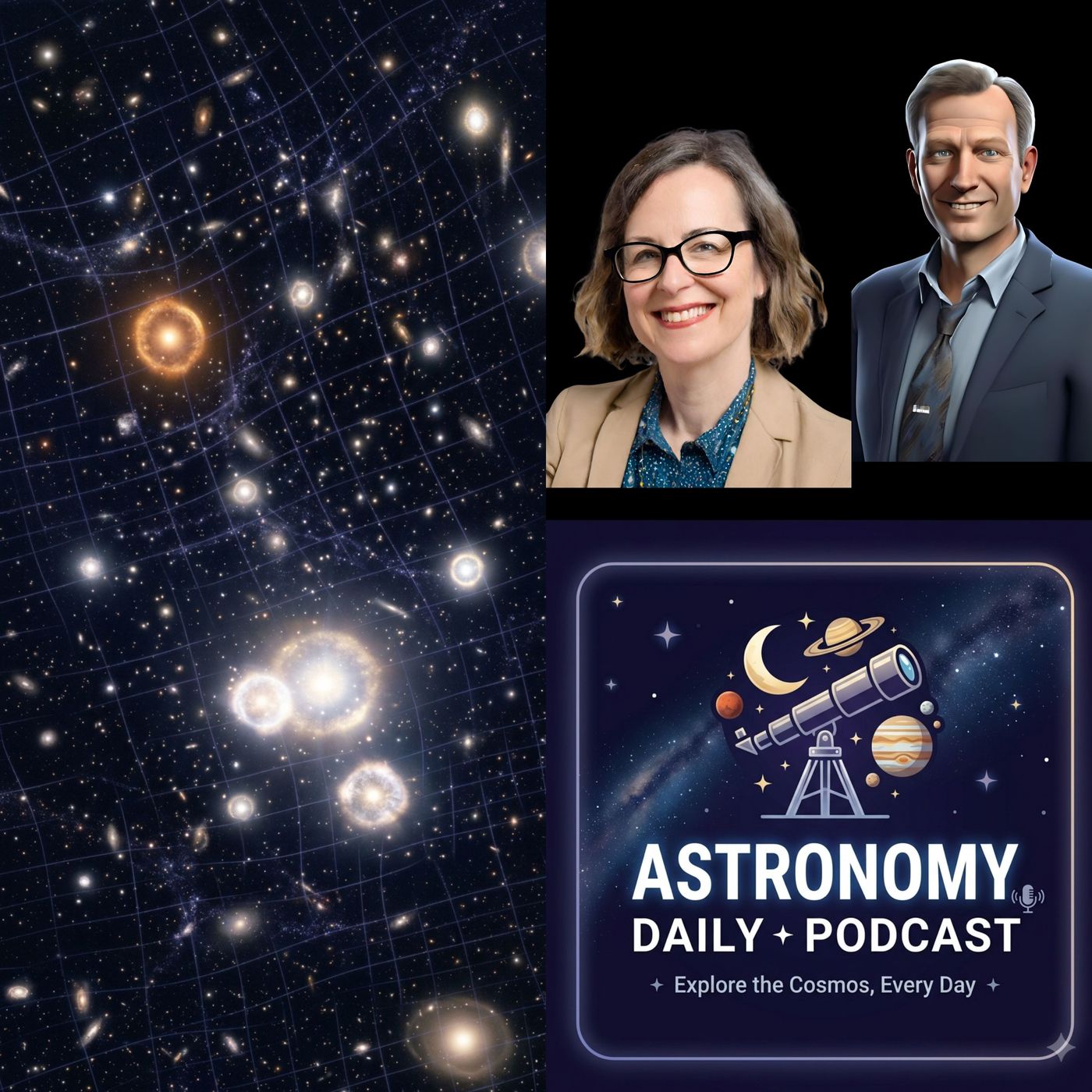 The Evolving Enigma of Dark Energy and the Sun's Mysterious Past | An Australian-led team has rebuilt thirty years of supernova observations into one consistent catalogue — and it adds fresh weight to the idea that dark energy is not constant. We also ask whether the young Sun swallowed a super-Earth, find out why a quiet Sun is bad news at thirty-five thousand feet, and watch JWST run the most sensitive exomoon search ever attempted. Plus a Crew-13 update and a skywatch with a live aurora alert for both hemispheres. In this episode · Two thousand, eight hundred and eighty-four Type Ia supernovae, rebuilt from Pantheon+ and the Dark Energy Survey's full five-year sample into a single internally consistent catalogue by Ryan Camilleri and Professor Tamara Davis at the University of Queensland, with ANU, Swinburne and international colleagues. · On their own the supernovae give a matter density of 0.310 for flat ΛCDM. Combined with the CMB and baryon acoustic oscillations, a tension appears under constant dark energy — and eases when dark energy is allowed to evolve. Preference: 2.5–3.1 sigma. · Why that is interesting but not a discovery, and why a second independent line of evidence pointing the same way as DESI changes the shape of the argument. · Professor Mutlu Yildiz (Ege University) on whether the young Sun engulfed a planet of 5–10 Earth masses — and whether that single event explains both the solar sound-speed discrepancy and the Sun's missing lithium. · Yaniv, Yair and Price on six balloon flights to 35 km: cosmic radiation at cruising altitude runs 40–60% higher at solar minimum, with an anticorrelation of r = −0.71 against solar activity. · David Kipping stacks twelve JWST transits of LP 890-9c and excludes moons down to 0.1 Earth radii across the entire Hill region — the most sensitive exomoon search on record. · Crew-13 now targeting no earlier than late September after an oxidiser leak in Dragon's propulsion system. · Skywatch: a coronal-hole stream arriving today with aurora chances at both ends of the planet, Venus at greatest brilliancy on 18 September, Mars past Pollux, Saturn towards opposition, International Observe the Moon Night on the 19th, and the equinox on the 22nd. Sources · University of Queensland — 'Big supernova dataset challenges dark energy theory', 8 September 2026 · Camilleri, Lee, Davis, Rubin, Shah, Scolnic, Lidman et al., 'Supernovae Unite: Combining Pantheon+ and DES-SN5YR', Publications of the Astronomical Society of Australia — arXiv:2609.05053; companion host-mass paper arXiv:2609.05321 · Royal Astronomical Society — ''Fingerprints' inside the Sun could reveal if it once swallowed a planet', 10 September 2026. Yildiz, MNRAS, DOI 10.1093/mnras/stag1527 · Yaniv, Yair & Price, Journal of Geophysical Research: Atmospheres, September 2026 — cosmic radiation at aviation altitudes across the solar cycle · Kipping, 'JWST Excludes Exomoons Down to 0.1 Earth Radii Around a Rocky, Temperate Exoplanet', arXiv:2609.05301, 4 September 2026 · NASA Space Station blog — 'NASA, SpaceX Adjust Crew-13 Launch Date', 29 August 2026; Canadian Space Agency update, September 2026 · EarthSky sun news and NOAA Space Weather Prediction Center outlooks, 12–14 September 2026 · NASA Science — 'What's Up: September 2026 Skywatching Tips'Become a supporter of this podcast: https://www.spreaker.com/podcast/astronomy-daily-latest-space-news--5648921/support.Sponsor Details:Ensure your online privacy by using NordVPN. To get our special listener deal and save a lot of money, visit www.astronomydaily.io/nordvpn. You'll be glad you did!Get the best secure and private email on the planet. Stop your Government, google and who knows who else spying on every email you write. Do what we did and use ProtonMail. They beleive in privacy and there are no ads in their business model...yet they still provide a free forever service. Check them out and get out special deal at www.astronomydaily.io/protonmailBecome a supporter of Astronomy Daily by joining our Supporters Club. Commercial free episodes daily are only a click way... Click HereThis episode includes AI-generated content. | 29m 54s | ||||||
| 9/12/26 | 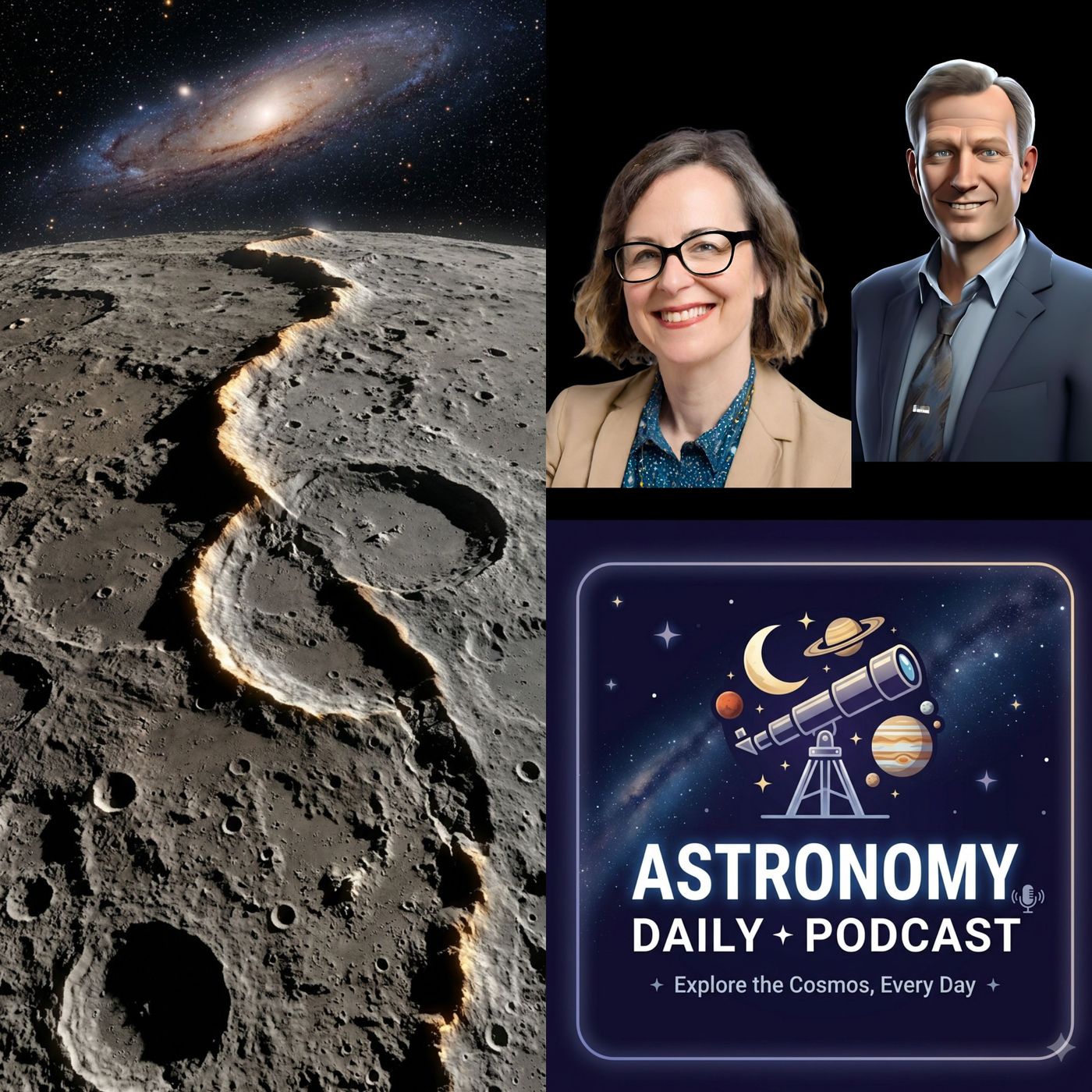 The Planet That Keeps Shrinking plus the Weekend Wrap | Today's episode — The Weekend Wrap, Saturday 12 September 2026: OUR LEAD: A SMALLER MERCURY Mercury has been contracting for four and a half billion years as its huge iron core cools, and it writes the record on its own surface — in long lobe-fronted cliffs called lobate scarps, where one slab of crust has ridden up over another. Add up all that shortening and you get the total contraction. The trouble was that the surface record always gave a smaller number than thermal models predicted. New work led by Gaku Nishiyama at the German Aerospace Center in Berlin, published in Geophysical Research Letters and released by the American Geophysical Union on 10 September, explains the gap — and the explanation is beautifully simple. Impact debris buries the cliffs. Using MESSENGER imagery reworked with stereophotogrammetry, the team showed that the rougher the terrain, the fewer shortening structures you can find per unit area. Since faults don't know what the surface above them looks like, that correlation isn't geology — it's a detection limit. Correct for it and Mercury's total loss of diameter rises by 10–30%, from a range topping out near 16 km to as much as 23 km. That points to a larger metal core, fewer light elements in it, or a hotter start — and it closes the long-standing mismatch with the physics. BepiColombo is about ten weeks from gravity capture at Mercury, carrying a far better laser altimeter and a much less eccentric orbit. If Nishiyama is right, it should find the missing small scarps in exactly the rough ground where today's maps look suspiciously empty. Some of that data will come home through ESA's New Norcia station in Western Australia, run in partnership with CSIRO. THE WEEK THAT WAS · Monday — Isar Aerospace's Spectrum reached orbit from Andøya Spaceport in Norway on 5 September, the first vehicle ever to do it from Western European soil, carrying five university cubesats. · Tuesday — giant-impact simulations including temperature-dependent rock strength can produce an intact Moon in about five hours rather than a slowly accreting debris disc. A sensitivity result, not a new origin story. · Wednesday — Hubble and Webb together found 27 previously unknown trans-Neptunian objects down to about 5 km, and the small ones keep the colours of their birth population rather than looking like collision fragments. · Thursday — 109 localised fast radio bursts were used to measure how far galactic feedback has smoothed the clumpiness of matter, finding more cool gas in big haloes than X-ray surveys see. · Friday — population synthesis suggests magnetars are roughly half of all neutron stars at birth, not one in a hundred, which doubles the Galactic supernova rate and makes magnetar central engines affordable. ALSO IN THIS EPISODE · The Sun's superflare potential — new work from the Max Planck Institute for Solar System Research with the University of Colorado, released 10 September. Scaling the 300 strongest modern solar flares against the size of their active regions, then applying that relation to the giant sunspot group of 1947 — the largest in four centuries of observation — gives a region with enough stored magnetic energy to power a superflare. Potential, not prediction: the caveats are covered properly on air. · Rocket Lab has filed a protest with the US Government Accountability Office over NASA's ~$700M Mars Telecommunications Network award to Blue Origin, on eligibility and technical-evaluation grounds. A GAO decision is due around mid-December. · Starship Flight 14 has slipped to no earlier than 18 September — and the tower catch of the ship is deferred to a later flight, which corrects how we framed it earlier this month. SKYWATCH — BOTH HEMISPHERES · The Moon and Venus about half a degree apart in front of Spica on the evenings of 13–14 September — Southern Hemisphere observers get the better geometry. · Venus reaches greatest brilliancy on 18 September at magnitude −4.8. · SN 2026aaiv, a Type Ia supernova in NGC 7331 in Pegasus, around magnitude 12 — the week's best observing target, and far easier from North America than from Sydney. · Saturn building towards its 4 October opposition, with Dione and Tethys events in the small hours for northern telescope owners. · Mars passing 6° south of Pollux pre-dawn on 18 September. · The zodiacal light — an evening object in the west from the Southern Hemisphere, a pre-dawn object in the east from the Northern. Best chance until early October. · Eye safety: never point binoculars or a telescope near the Sun when hunting daylight Venus or twilight Mercury. Solar filters must be certified to ISO 12312-2, fitted over the front of the instrument, and inspected every time. Links & sources · Mercury contraction — Geophysical Research Letters: https://agupubs.onlinelibrary.wiley.com/doi/10.1029/2026GL124067 · Mercury contraction — AGU Newsroom release: https://news.agu.org/press-release/mercury-is-shrinking-more-than-we-thought · Superflares — Max Planck Institute for Solar System Research: https://www.mps.mpg.de/news · Superflares — release summary: https://www.eurekalert.org/news-releases/1143231 · Rocket Lab GAO protest: https://www.space.com/space-exploration/missions/rocket-lab-protests-nasas-decision-to-award-blue-origin-usd700-million-mars-orbiter-contract · Starship Flight 14 schedule: https://www.spacelaunchschedule.com/launch/starship-flight-14/ · SN 2026aaiv in NGC 7331: https://www.rochesterastronomy.org/sn2026/sn2026aaiv.html · Magnetar fraction — Nature Astronomy: https://www.nature.com/natastron/articles?year=2026 · Sky this week: https://www.astronomy.com/the-sky-this-week/the-sky-this-week-from-september-11-to-18-2026/ · ESA deep space ground stations: https://www.esa.int/Enabling_Support/Operations/New_era_for_New_Norcia_deep_space_antenna More at astronomydaily.io — full back catalogue, news feed, newsletter sign-up and listener contact form. Follow us: @AstroDailyPodBecome a supporter of this podcast: https://www.spreaker.com/podcast/astronomy-daily-latest-space-news--5648921/support.Sponsor Details:Ensure your online privacy by using NordVPN. To get our special listener deal and save a lot of money, visit www.astronomydaily.io/nordvpn. You'll be glad you did!Get the best secure and private email on the planet. Stop your Government, google and who knows who else spying on every email you write. Do what we did and use ProtonMail. They beleive in privacy and there are no ads in their business model...yet they still provide a free forever service. Check them out and get out special deal at www.astronomydaily.io/protonmailBecome a supporter of Astronomy Daily by joining our Supporters Club. Commercial free episodes daily are only a click way... Click HereThis episode includes AI-generated content. | 37m 22s | ||||||
| 9/11/26 | neutron starsmagnetars+4 | — | Institute of Space Sciences, ICE-CSICASTRON+2 | Large Magellanic CloudMurchison Widefield Array | neutron starsmagnetars+5 | — | 31m 06s | ||
| 9/10/26 | fast radio burstsgalactic feedback+3 | — | CaltechUniversity of Arizona+3 | — | fast radio burstsgalactic feedback+7 | — | 28m 11s | ||
| 9/9/26 | trans-Neptunian objectsKuiper Belt+3 | — | NASANorthern Arizona University+1 | NeptuneKuiper Belt+2 | trans-NeptunianKuiper Belt+7 | — | 27m 51s | ||
| 9/8/26 | Moon formationblack holes+3 | — | Southwest Research InstituteSpace.com+3 | EarthTitan | Moon formationblack holes+3 | — | 26m 40s | ||
| 9/7/26 | rocket launchwhite dwarfs+3 | — | Isar AerospaceESA+4 | GermanyArctic island | rocket launchwhite dwarfs+6 | — | 28m 47s | ||
| 9/5/26 | hydrogen signalradio telescope+5 | — | South Africa's MeerKATSquare Kilometre Array+5 | — | hydrogen mapradio telescope+5 | — | 27m 38s | ||
| 9/4/26 | 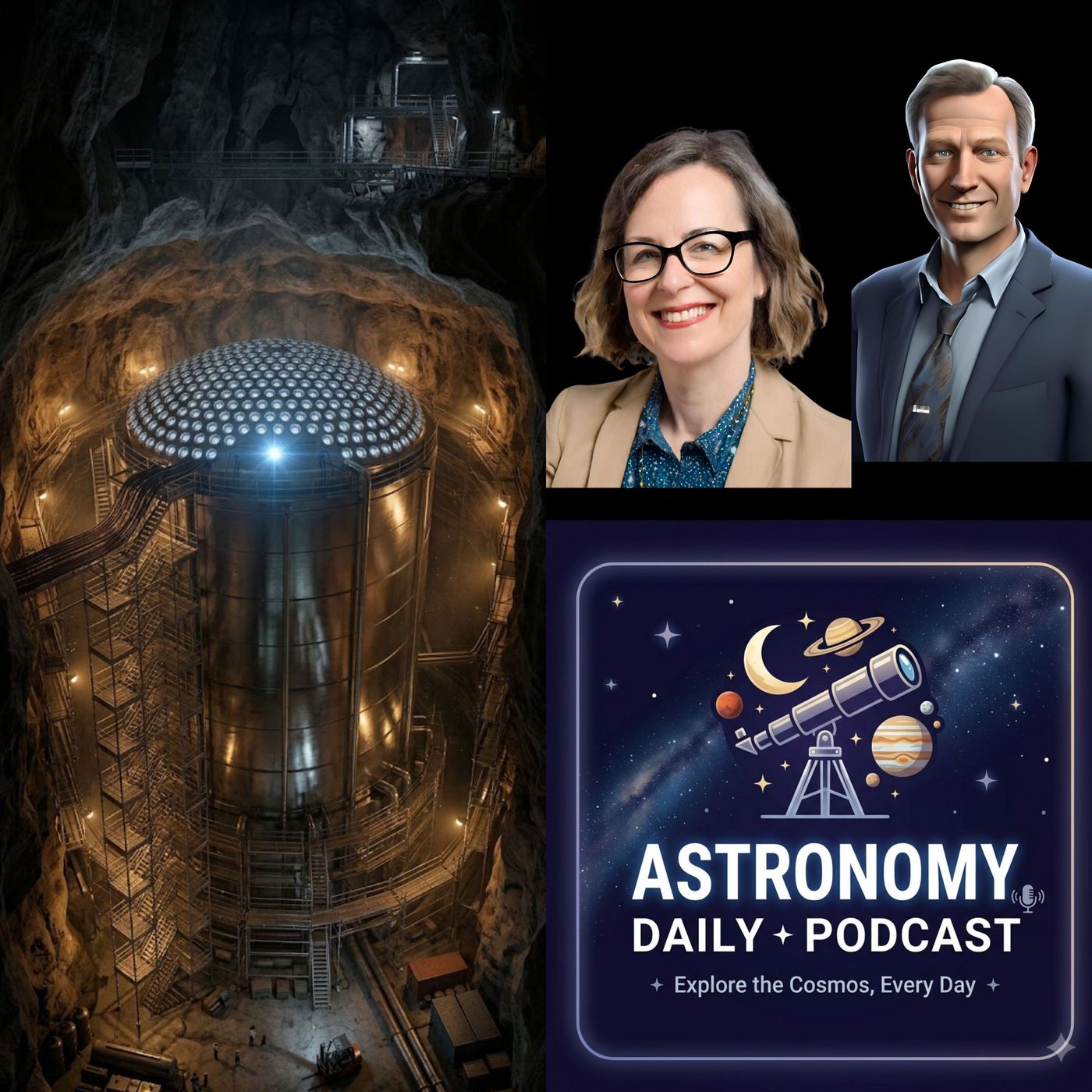 One Flash in the Xenon: The Dark Matter Event Nobody Can Explain | Links & sources Brown University — LZ experiment sees surprising result in search for dark matter — https://www.brown.edu/news/2026-09-01/lz-dark-matter-results US Department of Energy — LZ Sees Surprising Result in Search for Dark Matter — https://www.energy.gov/science/articles/lz-sees-surprising-result-search-dark-matter Imperial College London — Dark matter hunt takes unexpected turn after puzzling signal spotted in LZ detector — https://www.imperial.ac.uk/news/articles/natural-sciences/physics/2026/dark-matter-hunt-takes-unexpected-turn-after-puzzling-signal-spotted-in-lz-detector/ TeVPA 2026 — Search for high-energy dark matter interactions with the LUX-ZEPLIN experiment — https://indico-icehap.phys.s.chiba-u.ac.jp/event/3/contributions/471/ The LZ Dark Matter Experiment — collaboration site — https://lz.lbl.gov/ Space.com — Scientists may have detected the 1st direct evidence of dark matter — https://www.space.com/astronomy/dark-universe/scientists-may-have-detected-the-1st-direct-evidence-of-dark-matter ARC Centre of Excellence for Dark Matter Particle Physics — Stawell Underground Physics Laboratory — https://www.centredarkmatter.org/supl SABRE South — dark matter direct-detection experiment — https://www.sabre-experiment.org.au/ Phys.org — Underground lab clears crucial hurdle for dark matter hunt — https://phys.org/news/2026-04-underground-lab-crucial-hurdle-dark.html Space.com — India sends Earth-imaging satellite toward geosynchronous orbit in milestone launch — https://www.space.com/space-exploration/launches-spacecraft/gslv-mark-ii-eos-05-launch-first-indian-geo-earth-observing-satellite Outlook India — 'Successfully and precisely injected': ISRO chairman hails GSLV-F17 launch — https://www.outlookindia.com/national/successfully-and-precisely-injected-isro-chairman-hails-gslv-f17-launch-eos-05-reaches-orbit Business Standard — ISRO launches India's first imaging satellite in geostationary orbit — https://www.business-standard.com/india-news/isro-launches-india-s-first-imaging-satellite-in-geostationary-orbit-126090400054_1.html Space.com — Rocket issues delay 1st-ever private mission to Venus — https://www.space.com/astronomy/venus/rocket-issues-delay-1st-ever-private-mission-to-venus-we-are-awaiting-neutron-readiness Syracuse University — The Spin Behind Fading Black Hole Flares — https://news.syr.edu/2026/09/01/the-spin-behind-fading-black-hole-flares/ arXiv — The Role of Stellar Spin in Repeating Partial Tidal Disruption Events (2606.02692) — https://arxiv.org/abs/2606.02692 NASA Science — What's Up: September 2026 Skywatching Tips — https://science.nasa.gov/solar-system/skywatching/whats-up-september-2026-skywatching-tips-from-nasa/ Universe Today — Lunar occultations of Jupiter, Venus and more in September — https://www.universetoday.com/articles/penultimate-lunar-occultations-inbound-for-jupiter-venus-and-more-in-september In-The-Sky.org — Lunar occultation of Jupiter, 8 September 2026 — https://in-the-sky.org/news.php?id=20260908_16_100 EarthSky — Sun news: flare, CME and aurora updates — https://earthsky.org/sun/sun-news-activity-solar-flare-cme-aurora-updates/ Space.com — Night sky September 2026: the best things to see this month — https://www.space.com/stargazing/what-to-see-night-sky-september-2026 Follow us: @AstroDailyPod · astronomydaily.ioBecome a supporter of this podcast: https://www.spreaker.com/podcast/astronomy-daily-latest-space-news--5648921/support.Sponsor Details:Ensure your online privacy by using NordVPN. To get our special listener deal and save a lot of money, visit www.astronomydaily.io/nordvpn. You'll be glad you did!Get the best secure and private email on the planet. Stop your Government, google and who knows who else spying on every email you write. Do what we did and use ProtonMail. They beleive in privacy and there are no ads in their business model...yet they still provide a free forever service. Check them out and get out special deal at www.astronomydaily.io/protonmailBecome a supporter of Astronomy Daily by joining our Supporters Club. Commercial free episodes daily are only a click way... Click HereThis episode includes AI-generated content. | 25m 50s | ||||||
| 9/3/26 | BepiColomboMercury+5 | — | ESAJAXA+4 | New South Wales | BepiColomboMercury+6 | NordVPNCODE | 24m 59s | ||
| 9/2/26 | Marsthermal anomaly+3 | — | CaltechUniversity of Arizona+10 | Mars | Marsthermal anomaly+3 | — | 23m 42s | ||
| 9/1/26 | SpaceXStarship+4 | — | StarshipBooster 21+1 | StarbaseMassey's Test Site+2 | SpaceXStarship+8 | — | 18m 42s | ||
| 8/31/26 |  Roman Launches: A Telescope's Countdown Ends | 🚀 The Nancy Grace Roman Space Telescope is safely away — Anna and Avery recap Sunday's clean Falcon Heavy launch, what happens next on the road to L2, and a surprise Australian link in the mission. Then: Elon Musk signals the eventual retirement of Falcon 9, two Nobel laureates defend an accelerating universe against a slowing-expansion claim, a single ancient asteroid strike solves two mysteries on Mars's moon Deimos, and everything worth looking up at tonight, wherever you are. Chapters / topics: Roman Space Telescope's clean launch • What happens next (L2 cruise & commissioning) • Roman's science mission explained • SpaceX signals Falcon 9's eventual retirement • The universe is still speeding up (dark energy rebuttal) • One asteroid strike solves two Deimos mysteries • Tonight's sky (both hemispheres) 🔔 Subscribe for daily space and astronomy news. Full show notes and links at astronomydaily.io. #AstronomyDaily Links & sources: Space.com — Liftoff! NASA's Roman Space Telescope soars to the stars on a SpaceX Falcon Heavy rocket in spectacular launch (video) NASA Science (Roman blog) — NASA's Roman Space Telescope Launches NASA Science (Roman blog) — NASA Concludes Roman Space Telescope Launch Coverage Space.com — What time will SpaceX launch NASA's Roman Space Telescope? (Full mission timeline) Space.com — Goodbye, Falcon 9: SpaceX planning to retire workhorse launcher when Starship is up and running Teslarati — Elon Musk just set a condition that could end Falcon 9 as we know it ScienceDaily — The universe is still speeding up, but nobody knows why University of Bern (media relations) — Asteroid impact shaped the appearance of Mars' moon Deimos Nature Astronomy — Raducan, Agrusa, Asphaug et al. (2026), DOI 10.1038/s41550-026-02956-w When The Curves Line Up — 2026, August 31: Venus Nears Spica TelescopeAdvisor — Night Sky in September 2026: Saturn Approaching Opposition Follow us: @AstroDailyPodBecome a supporter of this podcast: https://www.spreaker.com/podcast/astronomy-daily-latest-space-news--5648921/support.Sponsor Details:Ensure your online privacy by using NordVPN. To get our special listener deal and save a lot of money, visit www.astronomydaily.io/nordvpn. You'll be glad you did!Get the best secure and private email on the planet. Stop your Government, google and who knows who else spying on every email you write. Do what we did and use ProtonMail. They beleive in privacy and there are no ads in their business model...yet they still provide a free forever service. Check them out and get out special deal at www.astronomydaily.io/protonmailBecome a supporter of Astronomy Daily by joining our Supporters Club. Commercial free episodes daily are only a click way... Click HereThis episode includes AI-generated content. | 17m 05s | ||||||
| 8/29/26 |  The Weekend Wrap, August 29: Roman's Countdown Begins | Today's episode — S05E180, Saturday August 29, 2026, The Weekend Wrap: Main story: The Nancy Grace Roman Space Telescope launches tomorrow, Sunday August 30, with a primary window opening 7:26am EDT (11:26 UTC / 9:26pm AEST Sunday night in Sydney) on a SpaceX Falcon Heavy from LC-39A, Kennedy Space Center; backup window Monday August 31 at 7:22am EDT. Total ascent to spacecraft deployment is about 31 minutes 31 seconds, with Falcon Heavy's side boosters landing back at Cape Canaveral roughly 7 minutes 40 seconds after liftoff. Named for NASA's first chief astronomer Nancy Grace Roman (the "mother of Hubble"), the telescope shares Hubble's 2.4-metre primary mirror but pairs it with a Wide Field Instrument boasting a field of view roughly 100 times larger at similar resolution. Its major science campaigns: the High Latitude Wide Area Survey, mapping ~2 billion galaxies to probe dark matter and dark energy; a companion supernova time-domain survey; and the Galactic Bulge Time Domain Survey, a gravitational-microlensing exoplanet hunt expected to find on the order of 100,000 new worlds, including free-floating rogue planets. A Coronagraph Instrument will demonstrate direct exoplanet imaging technology. After deployment, Roman heads for the Sun-Earth L2 point (~1.5 million km out), a month-long cruise followed by months of commissioning. The mission closes out three threads covered this week: its clearance for launch nine months early (S05E176), its Cold War spy-satellite origin story (S05E178), and its narrow escape from budget cancellation (S05E179). The week in review: ● Chang'e-7's delay, revisited: Monday's episode (S05E175) reported China's Chang'e-7 lunar south pole mission scrubbing on August 24 due to Tropical Storm Narra, with the next window estimated at about a month out. Since then, reporting has split — some outlets still cite a mid-September window, while others report a slip to February or March 2027, citing the mission's roughly 100-days-per-year favorable lighting geometry at Shackleton Crater. China's Manned Space Agency has not issued a firm new date as of this recording; we're flagging the uncertainty rather than picking a side. ● Betelgeuse's bubbling surface: ALMA's most detailed image yet of the red supergiant's actual surface shows a corrugated, hot-spotted texture, with one hot spot persisting for over seven years — possibly stirred by a newly confirmed companion star (S05E177). ● Diamond rain, decoded: A Lawrence Livermore experiment recreated Neptune- and Uranus-like interior pressures, settling a 20-year dispute over diamond's melting point and pointing toward roughly triple the energy gain in certain fusion reactor configurations (S05E178). ● The space-mirror fight: US startup Reflect Orbital has FCC approval for its first demonstration mirror satellite; a new peer-reviewed study (Kocifaj, Bakos & Kundracik) finds the planned full-scale mirrors would appear roughly 40 times brighter than the full Moon to anyone in their beam — "worse than big cities like London," per Princeton's Gáspár Bakos (S05E179). ● Starship's Ship 40 is actually heading home: hours after Friday's episode aired, Ship 40 was loaded onto the heavy-lift vessel Forte and departed Christmas Island on the ~20,000km voyage back to Starbase, Texas, expected to take several weeks. Flight 14 remains targeted no-earlier-than September 15, with Booster 21's static-fire testing now complete. Links & sources: ● Space.com — What time will SpaceX launch NASA's Roman Space Telescope on Aug. 30? (Full mission timeline) ● NASA Science — Roman Launch Countdown ● Engadget — How to watch the Nancy Grace Roman Space Telescope's launch ● Scientific American — China delays ambitious Chang'e 7 moon mission until 2027 ● SpaceNews — China delays Chang'e-7 lunar south pole landing mission launch ● CGTN — Explainer: Why Chang'e-7 can't simply launch a few days later ● Space.com — The bubbling surface of doomed supergiant star Betelgeuse has been revealed like never before ● ScienceDaily — Scientists crushed diamond beyond Neptune-like pressures — and solved a 20-year mystery ● Gizmodo — Scientists recreate the melting "diamond rain" of Neptune and Uranus. It may help fusion power ● Space.com — Massive space mirrors could be 40 times brighter than the full moon, astronomers warn ● ABC News (Australia) — SpaceX rocket begins journey back to Texas from Christmas Island ● NASASpaceFlight.com — Ship 40 arrives at Christmas Island, plans return to Starbase Follow us: @AstroDailyPodBecome a supporter of this podcast: https://www.spreaker.com/podcast/astronomy-daily-latest-space-news--5648921/support.Sponsor Details:Ensure your online privacy by using NordVPN. To get our special listener deal and save a lot of money, visit www.astronomydaily.io/nordvpn. You'll be glad you did!Get the best secure and private email on the planet. Stop your Government, google and who knows who else spying on every email you write. Do what we did and use ProtonMail. They beleive in privacy and there are no ads in their business model...yet they still provide a free forever service. Check them out and get out special deal at www.astronomydaily.io/protonmailBecome a supporter of Astronomy Daily by joining our Supporters Club. Commercial free episodes daily are only a click way... Click HereThis episode includes AI-generated content. | 18m 01s | ||||||
| 8/28/26 |  Forty Times Brighter Than the Full Moon: Inside the Space-Mirror Fight | Today's episode — S05E179, Friday August 28, 2026: Feature story: US startup Reflect Orbital has FCC approval for Eärendil-1, a demonstration satellite carrying a 60-foot mirror, the first step toward a planned constellation of 50,000-plus orbital mirrors beaming reflected sunlight to Earth on demand. A new peer-reviewed study (Kocifaj, Bakos and Kundracik, accepted at The Astrophysical Journal Letters) finds a full-scale, 174-foot operational mirror would appear about 40 times brighter than the full Moon to anyone standing in its roughly 3.4-mile beam, with measurable sky-glow extending 20-34 km further — astronomer Gáspár Bakos says it would be "worse than big cities like London," warning "you would not see any stars if you were in the beam." The rest of the news: Starship update: Ship 40 — the Flight 13 upper stage that survived an intact splashdown on July 24 — has been loaded onto a heavy-lift transport vessel off Christmas Island and is now heading home to Starbase, Texas, a journey expected to take several months. Meanwhile Flight 14 has quietly slipped to no-earlier-than September 15, per internal SpaceX/FAA planning documents, with Booster 21's static fire testing now the pacing item. A hot, watery world on borrowed time: astronomers led by Sylvain Breton (INAF) have characterised HD 176071 b, an exoplanet 335 light-years away that's roughly 50% water by mass, orbiting so close to its star (a 14-hour year) that it's expected to eventually be consumed by tidal forces. Found via a reflected-light technique applied to archival Kepler data. Roman Space Telescope: two days from its Sunday, August 30 launch (7:26am ET, Falcon Heavy), with today's Launch Readiness Review still underway as we record. We trace the mission's near-cancellation in leaked 2025 budget documents proposing a 24% NASA funding cut — and how Roman's team responded to Congress restoring funding by pulling the launch forward eight months, finishing under budget. Tonight's Sky: the G2 geomagnetic storm NOAA forecast for today is playing out now — aurora chances improve at northern latitudes, unlikely to reach much past Tasmania locally. Venus and Saturn remain the reliable local targets, under a near-full Moon. Links & sources: Space.com — Massive space mirrors could be 40 times brighter than the full moon, astronomers warn arXiv — Atmospheric Light Pollution by Proposed Reflect Orbital Space Mirrors (Kocifaj, Bakos & Kundracik) Space.com — The FCC just gave Reflect Orbital permission to launch its 1st space mirror to orbit Space.com — Starship is coming home: SpaceX loads floating spacecraft onto huge ship in the Indian Ocean Space.com — Astronomers discover hot watery exoplanet destined to be swallowed by its star Space.com — Trump tried to scrap NASA's Roman Space Telescope last year. Now it's ready to launch Watchers.news — M6.9 solar flare produces Earth-directed CME, G2 geomagnetic storm watch issued for August 28 Follow us: @AstronomyDailyPodBecome a supporter of this podcast: https://www.spreaker.com/podcast/astronomy-daily-latest-space-news--5648921/support.Sponsor Details:Ensure your online privacy by using NordVPN. To get our special listener deal and save a lot of money, visit www.astronomydaily.io/nordvpn. You'll be glad you did!Get the best secure and private email on the planet. Stop your Government, google and who knows who else spying on every email you write. Do what we did and use ProtonMail. They beleive in privacy and there are no ads in their business model...yet they still provide a free forever service. Check them out and get out special deal at www.astronomydaily.io/protonmailBecome a supporter of Astronomy Daily by joining our Supporters Club. Commercial free episodes daily are only a click way... Click HereThis episode includes AI-generated content. | 17m 03s | ||||||
| 7/21/26 | Mars explorationNASA missions+3 | — | PsychePlato+4 | MarsSun-Earth L2+1 | Psyche probeMars flyby+4 | — | 16m 35s | ||
| 7/20/26 | India's private space launchMars exploration+3 | — | Skyroot AerospaceNASA/JPL+1 | MarsJezero+1 | IndiaMars+5 | — | 15m 38s | ||
| 7/18/26 | solar stormsspace news+5 | — | International Space StationSouth African Rooibos Council+11 | South Africa | solar stormsatmosphere+5 | NordVPNCODE | 14m 19s | ||
| 7/17/26 | exoplanetsatmosphere detection+5 | — | ScienceScience Advances+1 | New JerseyLHS 1140 b | rocky exoplanetatmosphere+7 | — | 16m 29s | ||
| 7/16/26 | exoplanetsradio astronomy+4 | — | James Webb Space TelescopeNew Horizons+2 | PictorCentaurus Cluster+2 | Beta Pictoris dVLASS+5 | — | 19m 24s | ||
| 7/15/26 | SpaceXBlack Holes+4 | — | NASASpaceX+1 | Omega Centauri | StarshipBlack Hole+7 | — | 15m 24s | ||
| 7/14/26 | space mirrorshidden space junk+5 | — | Eärendil-1Reflect Orbital+5 | Chile | space mirrorsEärendil-1+5 | — | 21m 44s | ||
| 7/13/26 | SpaceXreusable rockets+4 | — | Starlink V3 satellitesGen3 constellation+10 | Indian OceanCanada | StarshipSpaceX+8 | — | 19m 14s | ||
| 7/11/26 | rocket recoveryspace exploration+4 | — | ChinaEuclid+2 | Queensland | rocket recoveryWally Funk+5 | NordVPNnone | 14m 24s | ||
| 7/10/26 | ancient quasarsasteroid research+3 | — | Euclid ConsortiumESA+5 | Kennedy Space CenterChina+1 | quasarsRoman Space Telescope+3 | NordVPNCODE | 11m 46s | ||
| 6/9/26 | NASA Artemis IIIRoman Space Telescope+4 | — | NASARoman Space Telescope+3 | — | NASAArtemis III+6 | — | 16m 01s | ||
| 6/3/26 | Blue Originexoplanets+4 | — | Blue OriginNASA+2 | — | Blue Originexoplanets+6 | — | 17m 49s | ||
| 6/2/26 | NASA lunar plansChina's space advancements+4 | — | New GlennLong March 12B+7 | Moon Base 1Virgo Cluster | NASABlue Origin+7 | — | 16m 17s | ||
| 5/26/26 | NASA lunar baseSpaceX Starship launch+4 | — | NASASpaceX+1 | lunar south poleIndian Ocean+1 | NASAlunar base+8 | — | 20m 43s | ||
| 5/25/26 | space explorationsolar phenomena+4 | — | ChinaNASA+10 | — | Shenzhou-23Psyche probe+5 | — | 16m 02s | ||
| 5/23/26 | SpaceXBlue Origin+4 | — | SpaceXBlue Origin+4 | — | Starship V3New Glenn+6 | NordVPN | 15m 57s | ||
| 5/22/26 | SpaceXStarship+4 | — | Starship V3SpaceX+2 | New Zealand | SpaceXStarship V3+5 | NordVPNCODE | 13m 23s | ||
| 5/21/26 | SpaceXNeptune+5 | — | SpaceX | Neptune | Starship V3SpaceX+5 | NordVPNCODE | 17m 15s | ||
| 5/20/26 | Starship launchLunar navigation+3 | — | Starship V3NIST+3 | Indian OceanWestern Australia+1 | Starship V3NIST+7 | NordVPN | 20m 08s | ||
| 5/19/26 | space weathersatellite launch+3 | — | ESAChina+3 | Antarctic | SMILE satelliteStarship V3+3 | NordVPNCODE | 20m 35s | ||
| 5/18/26 | asteroid flybySpaceX Starship+4 | — | — | EarthTexas+1 | asteroid 2026 JH2SpaceX+6 | NordVPNCODE | 18m 13s | ||
| 5/16/26 | Mars gravity assistSpaceX Dragon launch+5 | — | Psyche spacecraftCuriosity rover+5 | MarsRed Planet+2 | MarsSpaceX+7 | NordVPNCODE | 14m 54s | ||
| 5/15/26 | Mars flybySETI results+5 | — | NASASETI+3 | Marssouthern hemisphere | Psyche spacecraftMars flyby+7 | NordVPN | 20m 31s | ||
| 5/6/26 | atmosphere discoveryArtemis II mission+3 | — | NASANational Astronomical Observatory of Japan | — | Kuiper Beltcryovolcanism+3 | NordVPN | 13m 01s | ||
| 5/5/26 | James Webb Space Telescopeexoplanet geology+5 | — | JWSTFLAMINGO | LHS 3844 bIo | JWSTexoplanet+6 | NordVPN | 18m 12s | ||
| 5/4/26 | Artemis AccordsMars missions+4 | — | IrelandNASA+5 | Kennedy Space CenterNew Orleans | Artemis Coalitionnuclear Mars mission+7 | NordVPNCODE | 16m 17s | ||
| 5/2/26 | space newsSoyuz 5+3 | — | Roscosmos | Baikonur Cosmodrome | Soyuz 5Artemis II+3 | NordVPNCODE | 17m 26s | ||
| 5/1/26 | black hole starsArtemis missions+4 | — | Falcon HeavyChandra X-ray Observatory+4 | — | black hole starsJWST+5 | NordVPN | 18m 50s | ||
| 4/24/26 | interstellar cometsblack holes+4 | — | ALMAJapan's MMX+1 | Southern Hemisphere | interstellar cometblack hole+6 | NordVPN | 19m 40s | ||
| 4/23/26 | NASARoman Space Telescope+5 | — | NASAHubble+4 | Jordan | Roman Space TelescopeUranus+6 | NordVPNCODE | 18m 32s | ||
| 4/22/26 | Voyager 1Mars+4 | — | NASANASA JPL+2 | — | Voyager 1Mars+7 | NordVPNCODE | 19m 59s | ||
| 4/21/26 | NASA telescopeMars ocean evidence+4 | — | Nancy Grace Roman Space TelescopeNASA+4 | Milky WayMars | NASAMars+7 | NordVPNCODE | 16m 08s | ||
| 4/20/26 | rocket launchessatellite deployment+4 | — | New GlennBlueBird 7+9 | Titan | Blue OriginNew Glenn+7 | — | 15m 43s | ||
| 4/18/26 | cometsspace exploration+4 | — | NASAJWST+3 | New Orleans | Comet MAPSArtemis III+6 | — | 16m 08s | ||
| 4/17/26 | Artemis IIBlue Origin+4 | Reid WisemanVictor Glover+2 | NASABlue Origin+1 | Chile | Artemis IIBlue Origin+5 | NordVPNCODE | 16m 42s | ||
| 4/9/26 | Artemis IIlunar science+5 | Reid WisemanVictor Glover+2 | NASAISTA | San DiegoMoon+1 | Artemis IIlunar flyby+6 | NordVPNCODE | 15m 42s | ||
| 4/9/26 | Artemis IIMars mission+4 | — | NASAESA | EarthSolar System+2 | Artemis IIMars 96+7 | NordVPNCODE | 26m 31s | ||
| 4/7/26 | Artemis IIlunar flyby+4 | — | NASABlue Origin+2 | MoonPacific | Artemis IIlunar flyby+6 | — | 17m 45s | ||

















Showing 63 of 891
Pitch Fit is a Pro feature
See how bookable this show is for guests, which brands already advertise, the per-episode ad value, and the best-fit guest and sponsor profile. The numbers are blurred on the free plan.
How readily this show books outside guests like you.
How proven this show is for host-read sponsorships.
For Guests
ProFor Advertisers
ProUpgrade to Pro to unlock guest cadence, sponsor categories, fit scores, and per-episode ad value for this show.
Similar Audience Demographics
Podcasts that attract a similar listener profile

Space Nuts: Astronomy Insights & Cosmic Discoveries
Professor Fred Watson and Andrew Dunkley

SpaceTime with Stuart Gary
Stuart Gary

Universe Today Podcast
Fraser Cain
The 365 Days of Astronomy
365DaysOfAstronomy.org

Bedtime Astronomy
Synthetic Universe

The Supermassive Podcast
The Royal Astronomical Society
The Astrophysics Podcast
Paul Duffell
Chart history for Astronomy Daily: Latest Space News
Peaked at #8 in PH, top 10 in 4 of 19 tracked markets, currently #8 in PH.
| Market | Genre | Peak | Current | Trend |
|---|---|---|---|---|
| PH | — | #8 | #8 | — |
| Australia | — | #10 | #10 | — |
| SA | — | #10 | #10 | — |
| TH | — | #10 | #10 | — |
| South Africa | — | #15 | #15 | — |
| NG | — | #15 | #15 | — |
| New Zealand | — | #16 | #16 | — |
| South Korea | — | #16 | #16 | — |
| SG | — | #18 | #18 | — |
| United States | — | #19 | #19 | — |
| HK | — | #25 | #25 | — |
| Canada | — | #29 | #29 | — |
| VN | — | #29 | #29 | — |
| IL | — | #34 | #34 | — |
| Japan | — | #36 | #36 | — |
| AT | — | #74 | #74 | — |
| TH | — | #163 | #163 | — |
| Australia | — | #166 | #166 | — |
| PH | — | #182 | #182 | — |
Chart Positions
19 placements across 16 markets.
Chart Positions
19 placements across 16 markets.