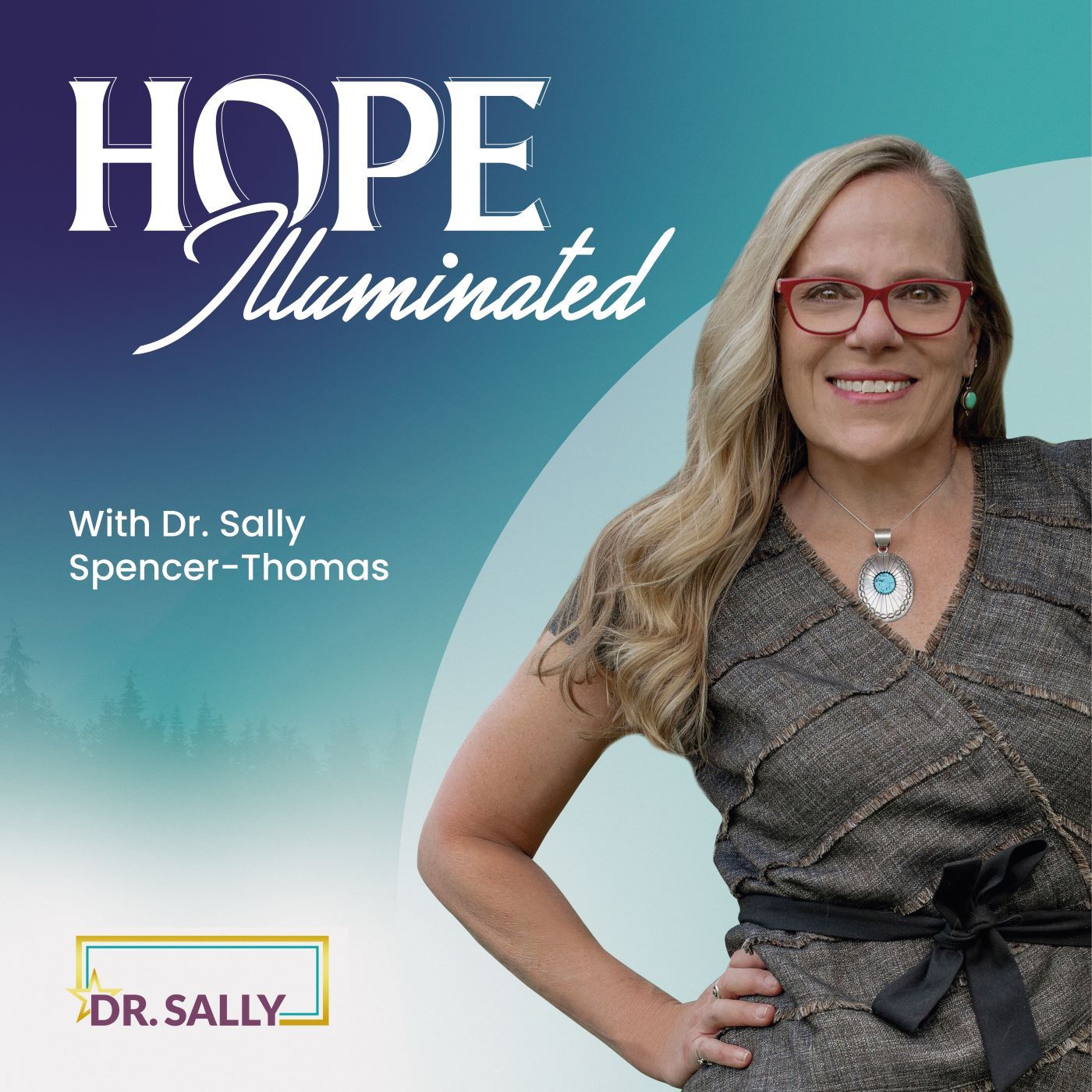
Hope Illuminated Podcast: Helping the Helpers Bring Light to Life’s Darkest Moments
Welcome to the Hope Illuminated Podcast, your source for the stories, science and strategy of suicide prevention, mental health promotion and resilience where we live, learn, and work. I’m your host, Dr. Sally Spencer-Th...
Insights from recent episode analysis
On the show
- Dr John Gaal2 eps
- Julia Hassall1 ep
- Rabbi Baruch Halevi1 ep
Also: Jeff Gorter, Kim Burdett Bartlett, Ryan Abramowitz, Monica Kramer McConkey, Alex Willis, Laura Putnam, Brandon Wilcox, John Brown, Nick Freud, Mitch Wallis, Aaron Witt
Audience Interest
Podcast Focus
Publishing Consistency
Insights are generated by CastFox AI using publicly available data, episode content, and proprietary models.
Most discussed topics
Brands & references
Total monthly reach
Based on the show's feed history.
Built from
- Per-Episode Audience
Est. listeners per new episode within ~30 days
16K to 196K🎙 Biweekly cadence·169 episodes·Last published 1w ago - Monthly Reach
Unique listeners across all episodes (30 days)
23K to 280K🇺🇸100% - Active Followers
Loyal subscribers who consistently listen
9.1K to 112K
Market Insights
Platform Distribution
Reach across major podcast platforms, updated hourly
Total Followers
—
Total Plays
—
Total Reviews
—
* Data sourced directly from platform APIs and aggregated hourly across all major podcast directories.
| Date | Episode | Topics | Guests | Brands | Places | Keywords | Sponsor | Length | |
|---|---|---|---|---|---|---|---|---|---|
| 11/9/26 | Attention Management - Why "Do I Have Time for That?" Is the Wrong Question with Abby Medcalf | You know that feeling. You have answered 47 emails, bounced from meeting to meeting, put out fires, and crossed a dozen things off your list. And yet, at the end of the day, you are exhausted and wondering: what did I actually accomplish? And more importantly, did I give any energy to the things and the people who matter most?My guest today, Dr. Abby Medcalf, has a reframe for burnout that stopped me in my tracks the moment I heard her keynote at the Employee Assistance Professionals Conference in San Francisco. She says we have been asking ourselves the wrong question. Instead of asking "Do I have time for that?" we need to start asking "Do I have the mind for that?" Because it is our attention -- not just our time -- that is one of our most precious resources. And when we are constantly giving it away, there is not much left for creativity, connection, or the things that give our lives meaning.Dr. Abby Medcalf is a straight-talking psychologist, number one Amazon bestselling author, speaker, and host of two top-rated podcasts -- Relationships Made Easy and Workplace Therapy with Dr. Abby Medcalf -- heard in over 190 countries. With over 35 years of experience and a background in both counseling psychology and organizational psychology, she brings the science to life in a way that is immediately useful.In this episode, Abby and I talk about the science of attention, why willpower is an exhaustible resource, the critical difference between rest and real recovery, and the specific habits that actually rebuild your mental bandwidth. This conversation is as much about reclaiming your life as it is about preventing burnout. I took so many notes. I think you will too. For more information on this episode go to https://www.sallyspencerthomas.com/hope-illuminated-podcast/174 | 41m 41s | ||||||
| 10/28/26 | The Wounded Healer: Why Clinician Healing Is an Ethical Imperative with Sarah Buino | There is something we do not say out loud nearly enough in the mental health field: we ask clinicians to sit beside trauma, addiction, suicide, and despair and then train them as though they should be unaffected by it. We tell ourselves we have it together. We have the knowledge, the frameworks, the coping strategies. It is, as I have come to see it, a big fat lie we tell ourselves as a field and one that has real consequences for the people we serve.Sarah Buino has built her career around naming this openly. She grew up in an alcoholic family system, experienced chronic suicidal ideation from a young age, and entered the mental health field -- as so many of us do -- partly to understand her own story. She went on to become a licensed clinical social worker, built and sold a successful group practice, won recognition for her writing on the wounded healer concept, hosts the podcast Conversations with a Wounded Healer, and is now writing a book on the topic for NASW Press.In this episode, Sarah and I go into the real conversation -- the one the training programs are not having. What does it mean to be a wounded healer versus an impaired professional? What happens when a clinician hits a personal crisis mid-career and has nowhere safe to turn? Why do we keep applying individual solutions to what are fundamentally systemic problems? And what would it look like if graduate programs treated clinicians' own healing work as foundational to the training -- not optional, not shameful, but expected?Sarah's mic drop moment at the end of this episode is one I have been thinking about ever since: "If you feel a barrier to doing your own work, that is a signal to do the work." If you work in mental health, counseling, social work, psychology, or any helping profession, this episode is for you. For more information on this episode go to https://www.sallyspencerthomas.com/hope-illuminated-podcast/173 | 39m 46s | ||||||
| 10/21/26 | Beyond Recovery: What Mental Health Can Learn from the Disability Rights Movement with Dr. Mark Salzer | I first heard about Mark Salzer from a cluster of colleagues I deeply trust. We were all at a conference in Vermont, and more than one person pulled me aside and said, "You have to go listen to him -- he's got it going on." They were absolutely right. I left that presentation with my mind buzzing, and I immediately thought: I have to bring him to Hope Illuminated.Mark is a psychologist and professor at Temple University in Philadelphia. He comes from a family steeped in mental health -- his mother was a psychiatric nurse, his brother is a psychologist, and his grandfather was actually co-credited with coining the term "antidepressant." But what drives Mark is not legacy. It is social justice. He believes that people who experience significant mental health challenges are among the most disenfranchised, stigmatized, and discriminated against people in our society -- and that much of the mental health system, despite good intentions, perpetuates that problem.In this episode, we dig into the concept of recovery and why Mark -- who calls himself a "recovery baby," shaped by the movement from its earliest days -- has grown concerned that the term has gone off the rails. We explore what the disability rights movement figured out long before mental health did: that inclusion, participation, and the opportunity to live a full life in community are not the rewards of getting better. They are the measure of getting better.This is one of those conversations that will change how you think about your work -- whether you are a provider, a researcher, an advocate, or someone navigating your own mental health journey. For more information on this episode go to https://www.sallyspencerthomas.com/hope-illuminated-podcast/172 | 45m 54s | ||||||
| 10/14/26 | The Addiction No One Saw: Gambling, Suicide Risk, and Finding a Way Back with Saul Malek | I have seen gambling addiction up close in my own family, and I know how hidden, how isolating, and how dangerous it can become. That is exactly why I was so grateful when our mutual friend Cal Beyer introduced me to Saul Malek. Saul is a nationally recognized gambling-harm prevention speaker and a young man in long-term recovery - more than five years abstinent from gambling - who now devotes his full-time professional life to educating young people, schools, behavioral health organizations, and communities about what gambling addiction actually looks like from the inside.What Saul has lived through is not a story about bad luck or poor impulse control. It is a story about a kind of addiction that hides beautifully behind sports fandom, financial ambition, intelligence, and an outwardly normal college life. It is a story about how secrecy and shame can spiral into suicidal despair. And it is a story about how recovery becomes possible when the truth finally has somewhere safe to land.In this episode, we go through his full journey - from fantasy baseball at age 11, to sports betting in college, to the escalation that consumed his finances, his relationships, and nearly his life. We talk about what the science is now telling us about gambling and suicide risk, about the explosion of online sports betting, and about what recovery actually requires beyond just "stopping." We talk about Gamblers Anonymous, about the families who are harmed alongside the person gambling, and about what clinicians, pediatricians, schools, and communities can do differently starting now.Gambling has been called the next opioid epidemic in America. After this conversation, I think you will understand why - and what we can do about it. For more information on this episode go to https://www.sallyspencerthomas.com/hope-illuminated-podcast/171 | 1h 07m 13s | ||||||
| 10/8/26 | Zero Overdose: Why Overdose Safety Planning Needs to Become the Standard of Care with Dr. Virna Little | When I think about the parallels between suicide prevention and overdose prevention, nobody articulates them better than my guest in this episode. I first met Dr. Virna Little at the IASP Asia Pacific conference in Tokyo -- we were both there as Zero Suicide faculty -- and her work immediately struck me as something every mental health and substance use professional needs to hear about.Virna is the co-founder and CEO of Zero Overdose, a national nonprofit bringing the same rigorous, system-wide thinking we apply to suicide prevention directly into overdose prevention. She is also co-founder of Concert Health, a behavioral health medical group delivering Collaborative Care across 21 states. Her credentials span a doctorate in psychology and a master's in social work, and she has presented on suicide prevention at the White House.In this conversation, we talk about what it actually means to build an overdose safety plan -- not just hand someone a Narcan kit and send them home, but sit with them, understand their specific risks, identify their trusted people, and create a living document they can return to. We discuss the populations at highest risk (including people leaving incarceration, new mothers, and workers in trades like construction), the critical importance of EHR integration, and what it looks like when first responders in Massachusetts started using overdose safety planning in the field.If you work in healthcare, behavioral health, public health, or policy -- this episode will change how you think about overdose prevention. For more information about this episode go to https://www.sallyspencerthomas.com/hope-illuminated-podcast/170 | 37m 08s | ||||||
| 10/1/26 | The Invisible Veteran: Why "Thank You for Your Service" Is Not Enough | In this episode of Hope Illuminated, I'm joined by Alicia Scovill, Air Force veteran and founder of Scovill Consulting, whose work sits at the intersection of veteran well-being, construction industry culture, and suicide prevention. Alicia brings something rare to this conversation: not just lived experience of military service and transition, but years of intentional research into the veterans who are most at risk, and most often overlooked.The episode opens with a framing I find both urgent and underappreciated: veterans are dying by suicide at higher rates than the general population, and the ones who surprise us most are not the ones carrying visible wounds of war. They are the invisible veterans, those who served without combat deployment, without visible injury, without a story that matches the Hollywood version of military service, and who carry a quiet, corrosive belief that their struggle is not legitimate because their sacrifice was not dramatic enough.Alicia unpacks three root causes she has identified through her research and her community: veteran imposter syndrome, the belief that one's service was not significant enough to warrant recognition or support; unfulfilled mission, the grief that emerges when a veteran has lost a friend or colleague to suicide and carries a painful sense of personal responsibility; and failure to adapt, the underacknowledged brutality of learning to operate in a civilian world that makes no sense after years of structured, mission-driven military life. The paradox of choice, the absence of hierarchy, the relentless smallness of daily civilian decisions after years of high-stakes clarity: all of it can be profoundly disorienting.The conversation turns to the construction industry, where veterans are heavily represented and where the cultural overlap with military values, toughness, mission, hierarchy, and loyalty, makes it both a natural fit and a particular risk environment. Alicia offers specific, practical guidance on how to engage veterans with authentic gratitude and curiosity: what questions open doors, what questions close them, and why a brief but meaningful acknowledgment of the oath itself, not just the service, can change how an invisible veteran experiences their own worth. for more information on this episode go to https://www.sallyspencerthomas.com/hope-illuminated-podcast/169 | 44m 34s | ||||||
| 9/8/26 | mental healthhuman connection+4 | Nick Freud | Fellow Humans | — | depressionmental health crisis+5 | — | 46m 19s | ||
| 8/25/26 | mental healthco-regulation+3 | Mitch Wallis | Columbia | — | mental illnessself-regulation+3 | — | 1h 03m 34s | ||
| 7/28/26 | mental healthconstruction industry+4 | Aaron Witt | Buildwitt | — | mental healthconstruction+5 | — | 42m 29s | ||
| 6/30/26 | identityburnout+3 | John Brown | Apple | OhioSilicon Valley | identityburnout+5 | — | 42m 32s | ||
Want analysis for the episodes below?Free for Pro Submit a request, we'll have your selected episodes analyzed within an hour. Free, at no cost to you, for Pro users. | |||||||||
| 6/2/26 | suicide preventionpeer support+3 | Brandon Wilcox | Rocky Mountain Crisis Partners | — | suicide preventioncaring contacts+5 | — | 59m 17s | ||
| 5/5/26 | mental healthworkplace culture+3 | Laura Putnam | Motion InfusionGallup | — | mental health culturewell-being multipliers+3 | — | 30m 15s | ||
| 3/30/26 | healingtrauma+3 | Julia Hassall | Hope IlluminatedHealing Trauma Beyond Words | — | brainspottingsomatic work+2 | — | 47m 19s | ||
| 3/6/26 | men's mental healthgrief+5 | Rabbi Baruch Halevi | Hope Illuminated | — | men's groupspurpose+3 | — | 33m 09s | ||
| 2/24/26 | leadershippolarization+2 | Jeff Gorter | R3 ContinuumHope Illuminated+1 | — | emotional demandtargeted violence+2 | — | 34m 22s | ||
| 1/13/26 | suicide preventiondigital clues+3 | Kim Burdett Bartlett | digital devicesBlack Box Project White Paper+5 | — | Black Box Projectsuicide warning signs+3 | — | 44m 56s | ||
| 1/6/26 | workplace suicidepostvention+3 | Dr John Gaal | After the Unthinkable | — | EAPsmental health first responders+2 | — | 33m 34s | ||
| 12/30/25 | mental healthhealing+9 | — | Headspace for the WorkplaceHope Illuminated | — | impact metricstools developed+4 | — | 19m 06s | ||
| 12/16/25 | CTEsuicide risk+3 | Dr John Gaal | Hope Illuminated | — | Chronic Traumatic Encephalopathydepression+3 | — | 55m 16s | ||
| 11/4/25 | griefchildren+3 | Ryan Abramowitz | Elegy for an ElephantHope Illuminated+1 | — | Elegy for an Elephantwatercolor+2 | — | 46m 02s | ||
| 10/28/25 | farm mental healthrural communities+3 | Monica Kramer McConkey | Sowing Hope in Rural America: Tackling the Farm Mental Health Crisis | AmericaMinnesota | resilienceconnection+3 | — | 45m 49s | ||
| 9/30/25 | AI toolsmental health+3 | Alex Willis | AI-powered toolsNFL+2 | — | NFLdepression+2 | — | 46m 40s | ||
| 9/9/25 | Healing the Healers: Moral Injury, Privacy, and Pathways to Hope with Corey Feist | Healthcare workers give their all, but too often, the system gives little back when it comes to protecting their mental health. In this Hope Illuminated episode, I sit down with Corey Feist, Co-Founder & CEO of the Dr. Lorna Breen Heroes’ Foundation, to talk about moral injury, systemic solutions, and the strategies that actually work.Together, we unpack how confidential peer support, equal privacy protections in mental health care, and humane re-entry pathways can restore dignity and safety to those who care for us. Corey’s work has helped drive landmark federal legislation, shift national culture, and spark movements that reach over 1.5 million healthcare workers.This episode isn’t just for healthcare leaders. If you care about building psychologically safe workplaces —in medicine or beyond — you’ll walk away with actionable strategies for protecting wellbeing, reducing stigma, and honoring the humanity of workers everywhere. For more information on this episode go to https://www.sallyspencerthomas.com/hope-illuminated-podcast/153 | 1h 01m 15s | ||||||
| 7/29/25 | The Youth Suicide Prevention Breakthrough We’ve Been Waiting For: The Sources of Strength Story | In this powerful episode, Scott LoMurray, TIME100 Health honoree and CEO of Sources of Strength, shares how his organization has transformed youth suicide prevention through peer leadership, strength-based storytelling, and community-driven culture change. We unpack the evidence, the vision, and the movement that’s shifting suicide prevention from reaction to resilience. for mor einformation on this episode go to https://www.sallyspencerthomas.com/hope-illuminated-podcast/152 | 44m 50s | ||||||
| 7/8/25 | The Power of Time -- Slowing Down to Save Lives in Suicide Prevention with Gergö Hadlaczky | What if the most powerful suicide prevention tool we have… is time?In this groundbreaking episode, suicide prevention expert Dr. Gergö Hadlaczky shares insights from science, strategy, and lived experience about how creating time—even just a few minutes—can change the trajectory of a suicidal crisis.We explore the rapidity of suicidal crises, how emotional intensity and suicidal thoughts often pass with time, and why time-buying can often help people win the internal debate around living or dying.Time gives people a second chance at life and a fighting chance to survive. For mre information on this episode go to https://www.sallyspencerthomas.com/hope-illuminated-podcast/151 | 44m 21s | ||||||
Showing 25 of 169
Pitch Fit is a Pro feature
See how bookable this show is for guests, which brands already advertise, the per-episode ad value, and the best-fit guest and sponsor profile. The numbers are blurred on the free plan.
How readily this show books outside guests like you.
How proven this show is for host-read sponsorships.
For Guests
ProFor Advertisers
ProUpgrade to Pro to unlock guest cadence, sponsor categories, fit scores, and per-episode ad value for this show.