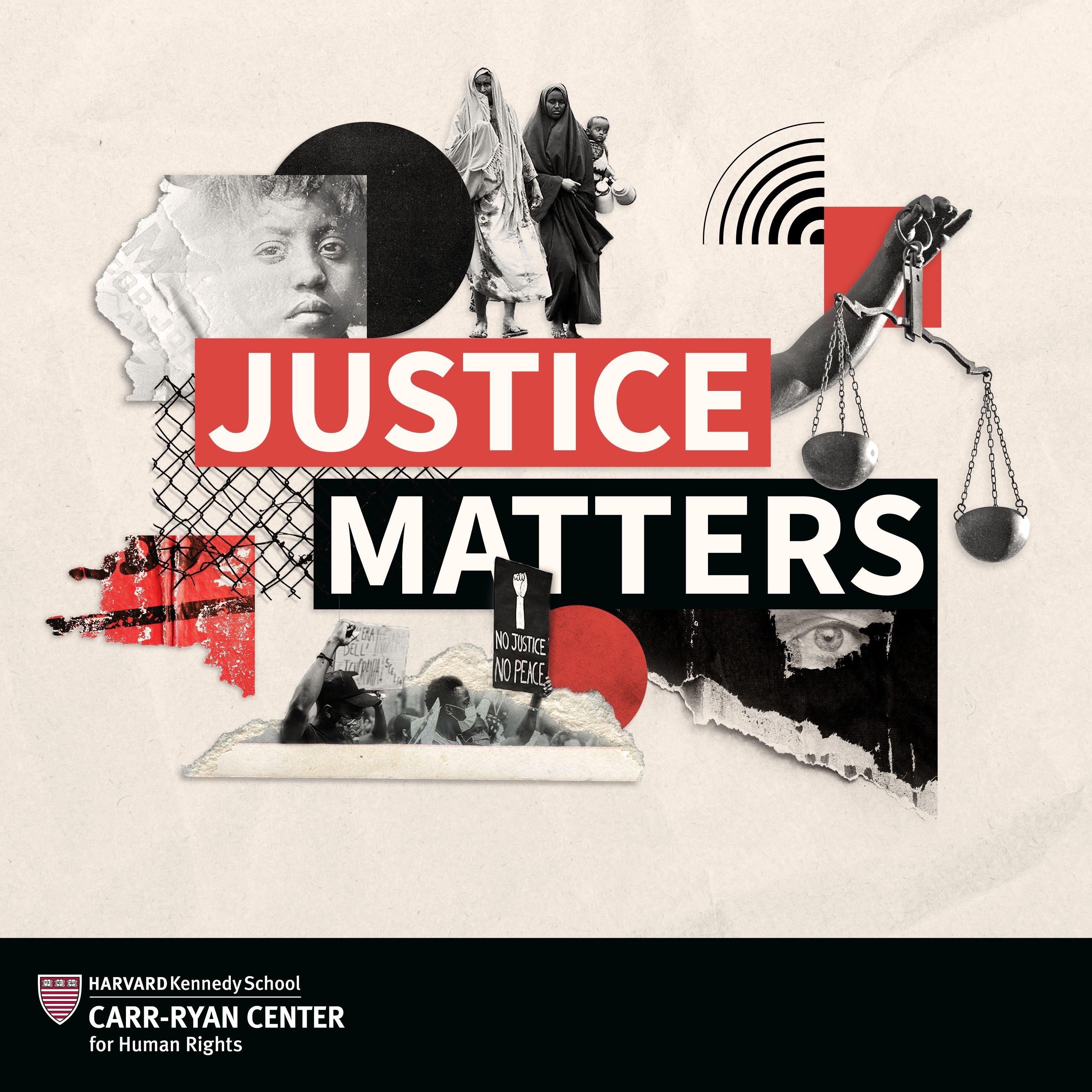
Justice Matters
by Carr Center for Human Rights Policy, Harvard Kennedy School
Last updated Nov 16, 2026Is this your podcast?Investigating matters of human rights at home and abroad. Listen to the podcast by the Carr-Ryan Center for Human Rights at the Harvard Kennedy School, hosted by Executive Director Maggie Gates, Mathias Risse, Aminta Oss...
AI overview.The Carr Center for Human Rights Policy at Harvard Kennedy School is renowned for its commitment to advancing human rights through interdisciplinary research an…
Insights from recent episode analysis
On the show
- Dr. Eileen Carter1 ep
- Miryam Kabakov1 ep
- Tshepo Madlingozi1 ep
Also: Astrid Puentes Riaño, Reid Jewett Smith, Zoë Hitzig, Neha Sanghrajka, Tirza Leibowitz, Omer Shem Tov, Leat Corinne Unger
Audience Interest
- human rights issues
- government policies
Podcast Focus
- investigating human rights matters
- domestic and international issues
Publishing Consistency
- 115 episodes released
- active for 8 years
Insights are generated by CastFox AI using publicly available data, episode content, and proprietary models.
Most discussed topics
Brands & references
Total monthly reach
Based on 2 signals.
Built from
- Per-Episode Audience
Est. listeners per new episode within ~30 days
1.7K to 4.9K🎙 Biweekly cadence·125 episodes·Last published 1w ago - Monthly Reach
Unique listeners across all episodes (30 days)
2.4K to 6.9K🇺🇸100% - Active Followers
Loyal subscribers who consistently listen
960 to 2.8K202 real followers tracked across platforms
Market Insights
Platform Distribution
Reach across major podcast platforms, updated hourly
Total Followers
—
Total Plays
—
Total Reviews
—
* Data sourced directly from platform APIs and aggregated hourly across all major podcast directories.
| Date | Episode | Topics | Guests | Brands | Places | Keywords | Sponsor | Length | |
|---|---|---|---|---|---|---|---|---|---|
| 11/16/26 | What does it mean to be an authentic political candidate? | On today’s episode of Justice Matters, co-host Maggie Gates talks with political strategist Maya Rupert about the ways in which we view political candidates as “authentic”. Maya’s new book, “The Real Ones: How to Disrupt the Hidden Ways Racism Makes Us Less Authentic” (2026), explores how conditional acceptance in America takes a toll on people of color, making authenticity a privilege the marginalized can’t afford. In 2020, Maya served as campaign manager for Julián Castro’s presidential campaign, becoming the third black woman ever to manage a major presidential campaign. She went on to serve as a senior advisor to Elizabeth Warren’s campaign. In 2021, she managed Maya Wiley’s New York City mayoral campaign. After the Dobbs decision, she served as senior advisor to the president at the Center for Reproductive Rights, and was a resident fellow at the Harvard Institute of Politics. She sits on the board of the National Women’s Law Center and hosts “When We Win with Maya Rupert”, a limited series podcast that earned an NAACP Image Award nomination for Outstanding Podcast Limited Series. In today’s conversation they discuss: Maya’s unexpected pathway into politics, what we mean by authenticity for political candidates, how women and people of color are viewed differently, who we allow to code switch and what that reveals, comparing the examples of Kamala Harris and JD Vance, running in solidarity with other candidates versus a zero-sum political strategy, who gets to decide if a candidate is viable, Hilary Clinton, “likability” in male versus female campaigns, developing a strategy for Julián Castro’s presidential campaign, what we can learn from the diversity of candidates who won at the recent midterms, rethinking a new commitment to inclusion and belonging beyond DEI, why the campaign of Abdul El-Sayed resonated with people, the importance of Keisha Lance-Bottoms’ victory in Georgia, how we view the political strategy of Stacey Abrams, and how to think about a new political coalition for the Democratic party. | 1h 01m 15s | ||||||
| 11/2/26 | Building Green Businesses | On today’s episode of Justice Matters, co-host Maggie Gates speaks with climate entrepreneur Josh Dorfman about his more than two decades building sustainable businesses. Josh Dorfman is co-founder and CMO of Plantd, a carbon-negative building materials company named to Fast Company’s 2024 list of the World’s Most Innovative Companies. Prior to this, he founded Vivavi, a modern sustainable furniture company; launched and led Vine.com, Amazon’s business unit for natural, organic, and sustainable products; and created and hosted The Lazy Environmentalist, which expanded into television, radio, books, and national brand partnerships. He currently hosts the podcast Supercool that explores the companies, technologies, and ideas shaping the low-carbon economy. In this conversation they discuss: building sustainable businesses, carbon negative building materials, challenges and innovations to creating a sustainable supply chain, the importance of product performance, transparency in environmentalism, the challenges of consumer culture in adopting sustainable practices, the role of AI in developing climate solutions, the need for individuals to engage in local climate justice efforts, and Josh’s personal evolution as an environmentalist. | 41m 37s | ||||||
| 10/19/26 | Gender Equality on the Eve of the Midterms | On today’s episode of Justice Matters, co-host Timothy Patrick McCarthy speaks with Jamie Keene—former Special Assistant to the President for Equality and Opportunity in the Biden-Harris White House—about the state of gender equality in America on the eve of the midterm elections. Topics they discuss include: federal policy on racial justice and equity, the power and limits of executive orders, authoritarian consolidation, the role of elections, congress and the courts, public resistance, white christian nationalism, anti-LGBTQ+ policy in America, global anti-gender movements, federal vs. state power in protecting civil rights, identity politics and multiracial democracy, corporate DEI, the midterms, rebuilding public institutions, the power of community resistance and the example of Minneapolis, and hope as a discipline. Jamie Keene is a policy leader on civil rights, democracy, and racial and economic justice. She served in the Biden-Harris White House as Special Assistant to the President for Equality and Opportunity, where she was the first commissioned officer appointed to advance LGBTQI+ equality. She was also one of the architects and implementers of the administration’s historic equity agenda. Jamie has been an advisor on presidential transitions and campaigns on a range of policy issues, and has served in local government for the cities of DC and LA. Jamie is a fellow at the Roosevelt Institute and Economic Security Project, as well as the Carr-Ryan Center, where her research explores how escalating attacks on queer and trans communities in the United States are linked with rising authoritarianism at home and around the world. | 51m 06s | ||||||
| 10/5/26 | Saving Lives in North Korea | On today’s episode of Justice Matters, co-host Mathias Risse speaks with Kathi Zellweger and Mike Chinoy about the recent book they co-authored, “Miss Kathi: Saving Lives in North Korea”. Kathi Zellweger is a Swiss aid worker who gained unprecedented access to North Korea over her decades of work in the country. Between 1995 and 2019, she made over seventy five trips to North Korea, including living in Pyongyang for five years as the country director for the Swiss government's development agency. Mike Chinoy is a CNN foreign correspondent who has also spent significant time in the country making over seventeen trips to North Korea in his reporting of several books, including “Meltdown: The Inside Story of the North Korean Nuclear Crisis”. In this conversation the discuss: how Kathi came to spend so much time as an aid worker in North Korea, Mike and Kathi’s collaboration on the memoir, the impact of the famine on North Korean society, Mike’s reporting trips to the country, challenges to aid delivery in a secrecy driven regime, the evolution of North Korean society, and their personal reflections on the book's purpose and message. https://www.simonandschuster.com/books/Miss-Kathi/Kathi-Zellweger/9798895656716 | 34m 23s | ||||||
| 9/21/26 | Protecting Native Land in Hawaii | On today’s episode of Justice Matters, co-host Maggie Gates speaks with journalist Sara Kehaulani Goo about her new book, Kuleana, a memoir about her ancestral land in Hawaii that touches on themes of indigenous rights, land loss, and the generational responsibility of honoring the land. Sara is a journalist and senior news executive who has led several national news organizations including Axios, NPR and The Washington Post. She is now serving as President of the WP Creator network at The Washington Post, a new business outside the newsroom focused on content partnerships with independent creators. She formerly served as editor-in-chief at Axios, where she launched the company’s editorial expansion into national and local newsletters, podcasts and live journalism. Before Axios, she led online audience growth as a managing editor at NPR, overseeing the newsroom's digital news operation. Goo started her career as a reporter for The Washington Post and The Wall Street Journal. On today’s episode they discuss: the crisis of land loss in Hawaii, the native Hawaiian concept of Kuleana or generational responsibility, honoring the place you’re from through land stewardship, clashes with western capitalism, the effect of wealth disparity on native Hawaiians, the impact of tax policy on land ownership, parallels of land loss across cultures, and the wider meanings of ancestral responsibility. https://www.saragoo.com/ | 40m 00s | ||||||
| 9/8/26 | race relationshuman rights+5 | Dr. Eileen Carter | South African Human Rights CommissionUniversity of Pretoria | South AfricaEastern Cape | human rightsrace relations+7 | — | 41m 01s | ||
| 8/24/26 | LGBTQ+ inclusionOrthodox Judaism+4 | Miryam Kabakov | EshelAVODAH: The Jewish Service Corps+4 | — | LGBTQ+Orthodox Judaism+7 | — | 36m 47s | ||
| 8/10/26 | post-apartheid South Africaliberation narrative+4 | Tshepo Madlingozi | South African Human Rights CommissionCentre for Applied Legal Studies+2 | — | South Africahuman rights+5 | — | 41m 22s | ||
| 7/27/26 | LGBTQI+ rightsclimate change+3 | Astrid Puentes Riaño | Harvard Law SchoolUnited Nations+1 | — | LGBTQI+ rightsclimate+5 | — | 55m 32s | ||
| 7/13/26 | disability inclusioncorporate sustainability+4 | Reid Jewett Smith | Disability:INCarr Center for Human Rights Policy+4 | — | disabilitycorporate workplace+5 | — | 47m 05s | ||
Want analysis for the episodes below?Free for Pro Submit a request, we'll have your selected episodes analyzed within an hour. Free, at no cost to you, for Pro users. | |||||||||
| 6/29/26 | AI ethicsadvertising strategy+5 | Zoë Hitzig | ChatGPTOpen AI+3 | — | AI ethicsOpen AI+6 | — | 34m 08s | ||
| 6/15/26 | The Rebirth of White Rage | On today’s episode of Justice Matters, co-host Mathias Risse speaks with Heather Ann Thompson- Pulitzer Prize winning author and Professor of History at the University of Michigan - about her new book “Fear and Fury: The Reagan Eighties, the Bernie Goetz Shootings, and the Rebirth of White Rage”. In their conversation they discuss: the 1984 subway shooting of four black boys - Barry Allen, Darrell Cabey, Troy Canty, and James Ramseur - by a white gunman, Bernie Goetz, what the media narratives and public perception of the event tell us about that time in the country, Ruport Murdoch’s role and motivations in influencing the public narrative, how the politics of the Reagan era speak to today’s political landscape, and the legacy of the Goetz trial. Heather Ann Thompson is a historian and the author of “Blood in the Water: The Attica Prison Uprising of 1971 and Its Legacy”, which won the Pulitzer Prize and the Bancroft Prize. Thompson has written about the criminal justice system for myriad publications, including The New York Times, The Washington Post, Time, Rolling Stone, The Atlantic, and The New Yorker. She has served on the National Academy of Sciences blue ribbon panel that studied the causes and consequences of mass incarceration in the United States, co-runs the Carceral State Project at the University of Michigan, and has been the recipient of numerous honors including a Guggenheim Fellowship, a Whiting Creative Nonfiction Grant, and a Racial Justice Fellowship from the Carr-Ryan Center for Human Rights at Harvard University. She is currently a Professor of History at the University of Michigan. | 34m 41s | ||||||
| 6/1/26 | mediationconflict resolution+4 | Neha Sanghrajka | UNOPSKofi Annan Foundation+4 | KenyaMozambique | mediationconflict resolution+7 | — | 45m 56s | ||
| 5/18/26 | human rightsmedical services+4 | Tirza Leibowitz | Physicians for Human Rights IsraelPhysicians for Human Rights | Israel-PalestineGaza | Physicians for Human RightsIsrael-Palestine+7 | — | 38m 21s | ||
| 5/4/26 | hostage advocacysurvivor experience+4 | Omer Shem TovLeat Corinne Unger | Hamas | IsraelUS | hostageadvocacy+7 | — | 1h 06m 25s | ||
| 4/20/26 | How a Humanitarian Aid Organization Navigates Political Conflicts | On today’s episode of Justice Matters, co-host Mathias Risse speaks with Dr. Christos Christou, outgoing president of Doctors Without Borders (Médecins Sans Frontières or MSF) a medical humanitarian organization that coordinates tens of thousands of medical staff to provide emergency aid to people in crisis in over 75 countries. Together they discuss: Dr. Christou’s background that led him to humanitarian medical work, his early days working as a physician in Sub-Saharan Africa during the HIV pandemic and with migrant communities, how he thinks about the concept of humanity as a practical commitment, the changing environment of humanitarian aid, the practicalities of the extensive work MSF has done in Gaza, how MSF navigates the political terrain of this conflict as an organization committed to humanitarian aid, and what lessons he’s learned that give him hope. Dr. Christos Christou graduated from Aristotle University’s medical school and has a PhD in surgery from the Kapodistrian University of Athens. After serving as a surgeon at Evangelismos Hospital in Athens, he became a senior clinical fellow at King’s College Hospital in London and was later awarded a fellowship from the European Board of Surgery in Coloproctology. Dr. Christou joined MSF in 2002 and has held several roles. His first assignment was in Greece as a field doctor, working with migrants and refugees. He then worked as a doctor in an HIV/AIDS project in Zambia in 2004 and 2005. He later served in a number of conflict zones and insecure contexts, including South Sudan, Iraq, and, most recently, Cameroon, as an emergency and trauma surgeon. With MSF he has held roles including general secretary, vice-president, and president of MSF Greece's Board of Directors, and finally, as MSF international president from 2019 to 2025. | 35m 26s | ||||||
| 4/6/26 | Uncovering Forced Labor | On today’s episode of Justice Matters, guest host Timothy Patrick McCarthy - faculty chair of the Global LGBTQI plus Human Rights Program - speaks with Laura Murphy, about forced labor and human rights. Laura Murphy is a professor at Sheffield Hallam University in the UK and one of the leading global experts on forced labor. Together they discuss: what led Laura to this work, the role of storytelling in human rights work, the complexity of violence in freedom movements, the terminology and uses of “forced labor” and “modern slavery”, forced labor among the Uyghur population in China, difficulties faced by academics and activists in addressing human rights abuses, and hope amidst the backlash. Laura Murphy is a Professor of Human Rights at Sheffield Hallam University in the UK, and was recently a Biden administration appointee at the Department of Homeland Security, working on implementation of the Uyghur Forced Labor Prevention Act. Her research currently focuses on forced labor in China and in international supply chains. She has written several books on forced labor globally including Freedomville (Columbia Global Reports, 2021) and The New Slave Narrative (Columbia University Press, 2019). | 1h 10m 25s | ||||||
| 3/16/26 | Shattered Dreams, Infinite Hope: A Tragic Vision of the Civil Rights Movement | On today’s episode of Justice Matters, co-host Mathias Risse speaks with Brandon Terry, a political theorist at Harvard University whose work seeks to reshape how we understand African-American political thought, especially the memory and meaning of the civil rights movement. Today they discuss topics related to his recently published book, “Shattered Dreams, Infinite Hope: A Tragic Vision of the Civil Rights Movement.” Together they discuss: why Brandon wrote the book, his reasons for choosing the title, different interpretations of Martin Luther King Jr’s role., the different narratives of the Civil Rights movement including the romantic view, the afro-pessimist view, and Brandon’s tragic vision that he lays out in the book, and Brandon’s reflections on the current state of politics in the United States. Brandon M. Terry is John L. Loeb Associate Professor of the Social Sciences at Harvard University and Co-director of the Institute on Policing, Incarceration, and Public Safety at the Hutchins Center for African and African American Research. He is the coeditor, with Tommie Shelby, of “To Shape a New World: Essays on the Political Philosophy of Martin Luther King, Jr.” and editor of “Fifty Years Since MLK.” Terry has published work in Modern Intellectual History, Political Theory, The New York Review of Books, Time, The Los Angeles Review of Books, Boston Review, Dissent, The Point, and New Labor Forum and been interviewed by The Ezra Klein Show, Vox, the New York Times, and other media outlets. “Shattered Dreams, Infinite Hope: A Tragic Vision of the Civil Rights Movement” is available from Harvard University Press: https://www.hup.harvard.edu/books/9780674271289 | 40m 39s | ||||||
| 3/2/26 | An International AI BIll of Human Rights | On today's episode of Justice Matters, co-host Mathias Risse speaks with Yuval Shany, fellow at the Ethics in AI Institute at the University of Oxford. They discuss his recent white paper, “The Need for and Feasibility of an International AI Bill of Human Rights,” and the topics it touches on around AI’s profound impact on the understanding and implementation of rights. Other topics they discuss include: the impact of AI on society, opportunities and challenges the technology poses for human rights, why the need for a new International AI Bill of Human Rights, what the new bill would entail, the political liability of an international bill, the future of AI regulation, and the importance of integrating human rights principles into AI development and deployment. Yuval Shany is the Hersch Lauterpacht Chair in International Law and former Dean of the Law Faculty of the Hebrew University of Jerusalem. He was a member of the UN Human Rights Committee from 2013 to 2020, and served for one year during that time as Chair of the Committee. Professor Shany also serves as a Senior Research Fellow at the Israel Democracy Institute, and a Visiting Professor in the Center for Transnational Legal Studies (CTLS) at King’s College, London and the Graduate Institute of International Studies in Geneva. His current research focuses on international human rights law and new technology and he leads a European Research Council group of researchers investigating the three generations of digital human rights (3GDR). White Paper: The Need for and Feasibility of an International AI Bill of Human Rights By Professor Yuval Shany | 34m 54s | ||||||
| 2/16/26 | Indigenous Water Justice | On today's episode of Justice Matters, co-host Mathias Risse speaks with Dr. Kelsey Leonard, a water scientist and legal scholar from the Shinnecock Indian Nation. They discuss the fundamental role of water in life, ecosystems, and human rights, particularly focusing on Indigenous perspectives on water justice. Dr. Kelsey Leonard is a water scientist, legal scholar, policy expert, writer, and enrolled citizen of the Shinnecock Nation. Her work focuses on Indigenous water justice and its climatic, territorial, and governance underpinnings for our shared sustainable future. Dr. Leonard represents the Shinnecock Nation on the Mid-Atlantic Committee on the Ocean, which is charged with protecting America's ocean ecosystems and coastlines. She also serves as a member of the Great Lakes Water Quality Board of the International Joint Commission. Dr. Leonard has been instrumental in safeguarding the interests of Indigenous Nations for environmental planning, and builds Indigenous science and knowledge into new solutions for sustainable water and ocean governance. On today’s episode they discuss: water as an essential part of life, the Shinnecock Indian Nation, Indigenous led water justice movements, current challenges facing water defenders, how a human rights frameworks can be applied to water protection, Indigenous knowledge as integral for effective water management, the Great Lakes and indigenous governance, and Dr. Leonard’s current research. | 33m 14s | ||||||
| 2/2/26 | Advocating for Prisoners of Conscience | On today's episode of Justice Matters, co-host Maggie Gates speaks with Judith Abitan, international human rights advocate and the executive director of the Raoul Wallenberg Centre for Human Rights, about her work in fighting for the freedom of political prisoners in entrenched systems of oppression. Judith has been at the forefront of some of the most pressing human rights issues of our time, immersed in the pursuit of justice internationally, the promotion and protection of human rights, and the betterment of the human condition. She has made representations to international bodies and governments in relation to the rescue and resettlement of some of the most vulnerable and at-risk populations, political prisoner cases, and asylum seeker applications. Judith’s advocacy work has encompassed, inter alia, the case and cause of Biram Dah Abeid, leader of the international anti-slavery movement and president of the Initiative for the Resurgence of the Abolitionist Movement in Mauritania; Dawit Isaak, dual Eritrean-Swedish citizen known to be, with his colleagues, the longest detained journalists in the world; and a series of Burundian journalists and human rights defenders convicted on trumped-up charges for criticizing the government. Judith has also written for major publications including the National Post, the Globe and Mail, the Times of Israel, the Washington Post, and Time. On today’s episode they discuss: how Judith came to be involved in such a wide range of geopolitical contexts, the case of journalist Dawit Isaak who has been detained since 2001 in an Eritrean prison and what it says about the state of press freedom globally, what levers of accountability are most effective in working for release of political prisoners, the Islamic Republic of Iran’s imprisonment of Dr. Ahmadreza Jalal, the issue of modern slavery and why it persists despite international law, the balance of moral urgency and pragmatic strategy in human rights work, and Judith’s personal reflections on cultivating resilience in an increasingly restrictive world. | 50m 41s | ||||||
| 1/19/26 | The Future of Tibet | On today's episode of Justice Matters, co-host Mathias Risse speaks with Lobsang Sangay - political leader of the Tibetan administration in exile from 2011 to 2021 - about Tibet’s future. His Holiness the 14th Dalai Lama turned 90 earlier this year, which has brought renewed attention to the question of how the succession would be handled in the country that has been occupied by China since 1950. Lobsang Sangay is a Senior Visiting Fellow at the East Asian Legal Studies Program at Harvard Law School. He was the democratically elected Sikyong (President) of the Central Tibetan Administration and served two terms (2011-21). He completed his BA and LLB from Delhi University and did his LLM ’95 and SJD ‘04 from Harvard Law School where he received the Yong K. Kim’ 95 Memorial Prize for excellence. He has spoken at international conferences such as Forum 2000, Halifax Security Forum, and Oxford Union and has written numerous Op-eds in major newspapers including The New York Times, The Washington Post, The Wall Street Journal, and appeared on many international TV networks like BBC and CNN. He was awarded the Gold Medal for Outstanding Contribution to Public Discourse by Trinity College, Dublin (2014) and the Salisbury University Presidential Medal for Distinguished Community Leadership (2015). On today’s episode they discuss: why China occupied Tibet in 1950, the role of rare earth minerals in the occupation, what occupation and exile has meant for Tibetans, the role of the Dalai Lama and the naming of his successor, how reincarnation comes into play in finding the next Dalai Lama, China’s attempt to seize control of the process, Lobsang’s own role in the Tibetan government in exile in India, the interplay between the diaspora and those remaining in Tibet, the relationship between the exiled Tibetan government and the government of India, and the Dalai Lama’s aspiration towards a middle path for negotiations with China. | 28m 01s | ||||||
| 1/5/26 | Attacks on Education Around the Globe | On today’s episode of Justice Matters, host Phuong Pham - associate professor at the Harvard Medical School, T.H. Chan School of Public Health, affiliated faculty member of the Carr-Ryan Center, and co-principal investigator at the Transitional Justice Evaluation Team (TJET) - speaks with Lisa Chung Binder, Siraj Khan, and Jerome Marston about attacks on education around the world. Lisa Chung Binder is the executive director of the Global Coalition to Protect Education from Attack. She has worked for the UN and the international NGOs in children’s rights and humanitarian response. Siraj Khan is the law and policy manager at the Education Above All Foundation. He is an international lawyer and was formerly a fellow at the Max Planck Foundation for International Peace and the Rule of Law. Jerome Marston is the head of research at KoboToolBox–a data collection, management, and visualization platform used globally for research and social good–where he oversees surveys and research projects about human rights, humanitarian response, and the protection of civilians. Together they discuss: why attacks on education are occurring, the impact on victims and survivors of these attacks, the frequency and geographic location of these attacks, what factors contribute to the increase in these attacks, what international enforcement mechanisms exist and are they meeting the problem, what other initiatives are taking place to confront this issue, what are the legal resources in this area, accountability, the response from educators, what does justice look like for victims, concrete ways to make schools more safe, and what resources can provide more information on this topic. | 47m 39s | ||||||
| 12/10/25 | Human Rights Day 2025: Rethinking Rights for a New Era | On today’s episode of Justice Matters, we’re marking Human Rights Day, observed every year on December 10th to commemorate the adoption of the Universal Declaration of Human Rights by the UN General Assembly in 1948. To mark the occasion Co-host Mathias Risse speaks with four of our Human Rights and U.S. Foreign Policy Fellows to share their perspectives on why human rights still matter and why they may be more important now than at any point in the 77 years since the Declaration was adopted. Together they discuss: what Human Rights Day means in our current moment globally, the most pressing human rights issues today, misinformation and state repression, whether the international system can constrain abusive states, the state of global legal structures and local grassroots movements, designing a human rights system to meet our present challenges, the impact of the Trump administration globally, what advice they have for young people entering the field today, and a lighting round of questions including their recommendations for articles and books they think everyone should read. Today’s guests include: Desirée Cormier Smith, a seasoned U.S. diplomat and former Foreign Service Officer who served as the inaugural Special Representative for Racial Equity and Justice at the State Department, leading global efforts to advance racial, ethnic, and Indigenous rights in foreign-policy contexts. Maggie Dougherty, former Senior Director for International Organizations at the White House National Security Council, where she coordinated U.S. engagement with the UN and other multilateral institutions on human rights, democracy, and global governance. She has also served as a policy advisor to both UN Ambassador Nikki Haley and Senator Marco Rubio. Kelly Fay Rodríguez, previously the U.S. Special Representative for International Labor Affairs, working to embed labor rights, supply-chain accountability, and inclusive economic justice into American foreign-policy and trade frameworks. And Jessica Stern, the first, and thus far only, U.S. Special Envoy to Advance the Human Rights of LGBTQI+ Persons, who led the State Department’s diplomatic efforts to protect and promote LGBTQI+ rights around the world. | 41m 27s | ||||||
| 12/1/25 | How Alaskan Communities are Meeting the Climate Crisis | On today’s episode of Justice Matters, co-host Mathias Risse speaks with Robin Bronen, co-founder of the Alaska Institute for Justice (AIJ) about the pressing effects of climate change on communities in Alaska - the fastest warming region in the United States - and the implications for human rights. A human rights attorney and interdisciplinary social scientist on the issue of climate-forced displacement, Robin Bronen retired from AIJ in 2024 after 19 years as co-founder and Executive Director. Established in 2005, AIJ originally sought to serve an unmet need for legal services for immigrant individuals and families in Alaska and now serves over 7,000 clients living in Alaska from countries around the world. Since the time of the organization’s founding, AIJ expanded to launch the Alaska Climate Justice Program that works with Alaska Native communities on climate adaptation and resilience, including assisting clients and communities as they advocate for state and national policy-level changes. Bronen has worked with the White House Council on Environmental Quality to implement President Obama’s Climate Change Task Force recommendation to address climate displacement as well as the UN High Commissioner for Refugees Climate Change Office. The Federal Bureau of Investigation awarded AIJ the 2012 FBI Director’s Community Service award for its work with human trafficking victims, and the International Soroptimist’s awarded Bronen the 2012 Advancing the Rights of Women award. Bronen was named one of USA Today’s Women of the Year. On this episode they discuss: the recent increase in climate effects on Alaskan communities, Robin’s background that led her to co-founding AIJ, an overview of the immigrant and refugee communities that are a central part of Alaska, how she and her team managed to sustain the non-profit over multiple decades, why translation services are crucial to opening access to public services, Robin’s research on forced climate relocation that led AIJ to expand its focus to the impacts of the climate crisis, the status and make up of Native Alaskan communities, how has the connection between human rights and climate change became central to AIJ’s work, how the institute fairing under the current Trump administration, what actions individuals and communities can take to protect themselves, and why climate forced relocation is the most intense human rights challenge related to the climate crisis. | 30m 39s | ||||||
Showing 25 of 125
Pitch Fit is a Pro feature
See how bookable this show is for guests, which brands already advertise, the per-episode ad value, and the best-fit guest and sponsor profile. The numbers are blurred on the free plan.
How readily this show books outside guests like you.
How proven this show is for host-read sponsorships.
For Guests
ProFor Advertisers
ProUpgrade to Pro to unlock guest cadence, sponsor categories, fit scores, and per-episode ad value for this show.
Similar Audience Demographics
Podcasts that attract a similar listener profile


Distribution & Reach
About the show, platforms, and key insights.
Distribution & Reach
About the show, platforms, and key insights.
The Carr Center for Human Rights Policy at Harvard Kennedy School is renowned for its commitment to advancing human rights through interdisciplinary research and education. It serves as a hub for scholars and practitioners working to address pressing global and domestic human rights issues. "Justice Matters" stands out for its in-depth exploration of human rights challenges both in the U.S. and internationally. The podcast features discussions led by Executive Director Maggie Gates and other experts, delving into topics such as social justice, policy implications, and educational initiatives, all while supporting the principles of free speech and democratic discourse. Listeners of "Justice Matters" include academics, students, and advocates interested in human rights, policy, and social justice. They gain valuable insights into contemporary issues, fostering a deeper understanding of the complexities surrounding human rights and the importance of advocacy in promoting justice.
By the numbers
- Total followers: 4.4K
- Total plays: 671K
- Total reviews: 22
Platforms
TuneIn
- Followers: 31
Castbox
- Followers: 149
- Plays: 1.4K
YouTube
- Subscribers: 4.2K
- Views: 669K
- Videos: 305
Podcast App
- Followers: 22
- Reviews: 22
Find them online
Audience
family, general
Key insights
What the show covers
- investigating human rights matters
- domestic and international issues
- fostering open debate
- free speech advocacy
Audience interests
- human rights issues
- government policies
- educational content
- current news events
Platform reach
- available on multiple platforms
- unknown specific platforms
- growing audience potential
- no follower count available
Publishing consistency
- 115 episodes released
- active for 8 years
- weekly or more often
- reliable content schedule
Chart history for Justice Matters
Peaked at #109 in CO, currently #109 in CO.
| Market | Genre | Peak | Current | Trend |
|---|---|---|---|---|
| CO | — | #109 | #109 | — |
Chart Positions
1 placement across 1 market.
Chart Positions
1 placement across 1 market.