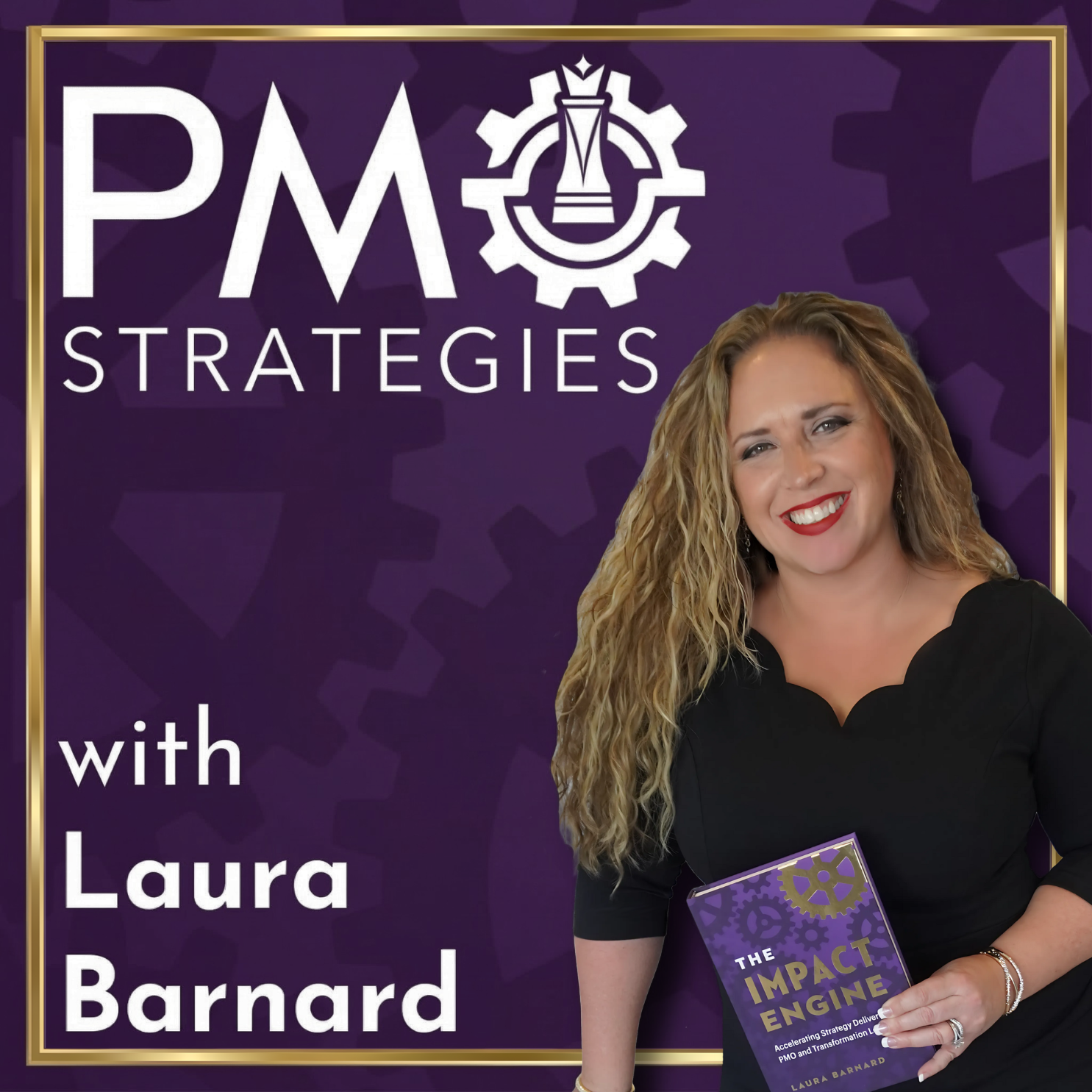
PMO Strategies
by Laura Barnard
Is this your podcast?Insights from recent episode analysis
Audience Interest
Podcast Focus
Publishing Consistency
Platform Reach
Insights are generated by CastFox AI using publicly available data, episode content, and proprietary models.
Most discussed topics
Brands & references
Total monthly reach
Estimated from 12 chart positions in 12 markets.
By chart position
- 🇰🇷KR · Management#9100K to 300K
- 🇧🇷BR · Management#9010K to 30K
- 🇲🇽MX · Management#1411K to 10K
- 🇪🇸ES · Management#1521K to 10K
- 🇦🇪AE · Management#1930K to 100K
- Per-Episode Audience
Est. listeners per new episode within ~30 days
46K to 148K🎙 Daily cadence·357 episodes·Last published 4d ago - Monthly Reach
Unique listeners across all episodes (30 days)
153K to 492K🇰🇷61%🇦🇪20%🇧🇷6%+9 more - Active Followers
Loyal subscribers who consistently listen
46K to 148K
Market Insights
Platform Distribution
Reach across major podcast platforms, updated hourly
Total Followers
—
Total Plays
—
Total Reviews
—
* Data sourced directly from platform APIs and aggregated hourly across all major podcast directories.
On the show
From 17 epsHost
Recent guests
Recent episodes
375: The Question That Breaks Decision Paralysis
Aug 30, 2026
Unknown duration
374: Are We Repeating Agile Transformation Mistakes with AI? with Jim Highsmith
Aug 23, 2026
Unknown duration
373: Moneyball in Projectland with Grayson Barnard and Dawn Mahan
Aug 16, 2026
Unknown duration
372: How PMOs Can Cut Through AI Chaos with Paul McNamara
Aug 9, 2026
Unknown duration
371: 50 Years of Project Management: Lessons for What Comes Next with Lee Lambert
Jul 31, 2026
Unknown duration
Social Links & Contact
Official channels & resources
Official Website
Login
RSS Feed
Login
| Date | Episode | Topics | Guests | Brands | Places | Keywords | Sponsor | Length | |
|---|---|---|---|---|---|---|---|---|---|
| 8/30/26 | 375: The Question That Breaks Decision Paralysis | Welcome to the PMO Strategies Podcast + Blog, where PMO leaders become IMPACT Drivers!PMI Talent Triangle: Power SkillsSome of the most expensive words I hear inside an organization are, “We’re waiting for more clarity.” Sometimes that is exactly the right call. The organization may be missing information it truly needs to act responsibly. But sometimes “we need more information” is a hiding place. The team already has a recommendation, but nobody wants to own it. Every decision moves up the chain while strategy waits. In this episode, I’m showing you how to separate a real information gap from false uncertainty and use one question to surface the thinking already in the room: “If you did know, what would you do?” You will hear how this changes the PMO’s role, what executives need instead of another unresolved escalation, and how to create movement without confusing responsible action with reckless speed. 🔹 How to recognize when “we need more clarity” is masking decision avoidance 🔹 Why a recommendation builds more executive trust than an unresolved escalation 🔹 How to distinguish a reversible learning step from a decision that requires stronger evidence 🔹 The three questions that turn uncertainty into a responsible next move 🔹 Why creating clarity is strategic decision support, not project administration Press play to learn how to help your team move forward without pretending the path is perfectly clear. P.S. Join me live for a FREE live workshop, Six Moves to Build a High-IMPACT PMO, on Thursday, September 10, from 11:00 a.m. to 1:00 p.m. Eastern. Bring one real strategy delivery challenge, and you'll leave knowing where to focus first and what to do next. Register now to claim your free seat and join us live. Thanks for taking the time to check out the podcast!I welcome your feedback and insights! I’d love to know what you think and if you love it, please leave a rating and review in your favorite podcast player. Please leave a comment below to share your thoughts. See you online!Warmly,Laura BarnardGET NOTIFIED ABOUT NEW EPISODES | TELL US WHAT YOU WANT TO LEARN | PDU REPORTING INSTRUCTIONS | — | ||||||
| 8/23/26 | 374: Are We Repeating Agile Transformation Mistakes with AI? with Jim Highsmith | Welcome to the PMO Strategies Podcast + Blog, where PMO leaders become IMPACT Drivers!PMI Talent Triangle: Business AcumenOrganizations are moving quickly to deploy AI. But are they building the adaptability, judgment, and decision systems required to use it well, or repeating the same mistakes that weakened so many Agile transformations?AI can analyze more data, generate more options, and move work faster. None of that guarantees the organization is asking the right question, assigning the decision to the right person, or protecting the human judgment it will need when the consequences rise.In this episode, I am joined by Jim Highsmith, Agile Manifesto co-author and a pioneering voice in adaptive leadership, to connect the original purpose of Agile with the decisions organizations are making about AI right now.Jim explains how Agile was designed to help organizations respond to uncertainty, why too many implementations became rigid and process-driven, and how the same pattern is beginning to appear in AI transformation. Together, we explore the shift from process-oriented management to judgment-oriented management and the role PMO and transformation leaders can play in designing stronger human-AI decision systems.This is not a conversation about choosing the newest AI tool. It is about deciding what should be automated, where people must remain accountable, how judgment develops, and whether the organization is becoming more capable or simply producing more output.When you press play, you will hear:🔹 What Agile was created to solve and why its mindset became diluted as it spread.🔹 Why doing Agile is not the same as building an adaptable organization.🔹 How AI transformation can repeat the same process-over-mindset mistake at greater speed.🔹 How to distinguish automation that removes activity from augmentation that strengthens human capability.🔹 Why removing easy decisions can erode the experience people need for harder decisions later.🔹 How PMO and transformation leaders can move forward before introducing more AI.🔹 Why leaders need enough hands-on AI experience to guide implementation credibly.🔹 What it means to move from process-oriented management toward judgment-oriented management.Press play to learn how your PMO or transformation office can help the organization move faster without surrendering the judgment, adaptability, and accountability required to create measurable business IMPACT.Connect with Jim Highsmith and Keep Exploring Connect with Jim Highsmith on LinkedInSkills Build Teams. Judgment Builds Enterprises.Your AI Is Working. Is Your Team Getting Better?What the Dashboard Cannot SeeThe Next Ethical Frontier: Why AI Can’t Replace JudgmentStop Picking Sides: Manage the Tension Between Adaptation and OptimizationP.S. Join me live for a FREE live workshop, Six Moves to Build a High-IMPACT PMO, on Thursday, September 10, from 11:00 a.m. to 1:00 p.m. Eastern. Bring one real strategy delivery challenge, and you'll leave knowing where to focus first and what to do next. Register now to claim your free seat and join us live.Thanks for taking the time to check out the podcast!I welcome your feedback and insights! I’d love to know what you think and if you love it, please leave a rating and review in your favorite podcast player. Please leave a comment below to share your thoughts. See you online!Warmly,Laura BarnardGET NOTIFIED ABOUT NEW EPISODES | TELL US WHAT YOU WANT TO LEARN | PDU REPORTING INSTRUCTIONS | — | ||||||
| 8/16/26 | 373: Moneyball in Projectland with Grayson Barnard and Dawn Mahan | Welcome to the PMO Strategies Podcast + Blog, where PMO leaders become IMPACT Drivers!PMI Talent Triangle: Power SkillsThis episode is personal for me in a way most podcast conversations are not.For the first time, my son and co-author, Grayson Barnard, joins me on the PMO Strategies podcast. One of my closest friends, Dawn Mahan, is here too. The three of us talk about Projectland, baseball, the books we created together, and a leadership lesson PMO and transformation leaders cannot afford to miss.You can do everything that looks like good project management and still fail to help the team win.Your tool may be sophisticated. Your templates may be complete. Your governance process may be consistent. Your report may contain 85 metrics. None of that matters if leaders still cannot see the decision, the team is protecting activity that does not advance the outcome, or the project finishes without creating the business value it was funded to produce.Grayson recognized that lesson immediately in Moneyball. The goal was not to replace star players with people who looked like star players. The goal was to find what produced wins and organize the team around it.That is the question at the center of this episode: What is your team's version of getting on base?In this episode, you will learn: ✅ Why Grayson believed Moneyball was the obvious story for our chapter.✅ How to distinguish work that looks professional from work that advances the business outcome.✅ Why individual performance measures can pull people away from the team win.✅ How Dawn's Projectland characters help teams understand roles, sponsors, stakeholders, and saboteurs.✅ How both Projectland books make serious leadership lessons more engaging and easier to apply.✅ Why fun is not the opposite of disciplined performance.✅ How to prepare a team for the moment the plan stops matching reality.Connect with Grayson Barnard and Dawn Mahan Grayson Barnard on LinkedInDawn Mahan on LinkedInExplore Projectland Read the free Moneyball sample chapterExplore Projectland Goes to the MoviesExplore Meet the Players in ProjectlandBrowse the Projectland movie list on IMDbContinue with the Executive Perspective Continue the baseball connection and watch What Baseball Teaches Us About Project ManagementP.S. Join me live for a FREE live workshop, Six Moves to Build a High-IMPACT PMO, on Thursday, September 10, from 11:00 a.m. to 1:00 p.m. Eastern. Bring one real strategy delivery challenge, and you'll leave knowing where to focus first and what to do next. Register now to claim your free seat and join us live.Thanks for taking the time to check out the podcast!I welcome your feedback and insights! I’d love to know what you think and if you love it, please leave a rating and review in your favorite podcast player. Please leave a comment below to share your thoughts. See you online!Warmly,Laura BarnardGET NOTIFIED ABOUT NEW EPISODES | TELL US WHAT YOU WANT TO LEARN | PDU REPORTING INSTRUCTIONS | — | ||||||
| 8/9/26 | 372: How PMOs Can Cut Through AI Chaos with Paul McNamara | Welcome to the PMO Strategies Podcast + Blog, where PMO leaders become IMPACT Drivers!PMI Talent Triangle: Business AcumenA lot of PMOs are being asked to lead AI and agile transformation while still operating as reporting, governance, and oversight functions.That is where things start to break.Instead of simplifying work, AI can add more coordination, more noise, more duplicated effort, and more complexity.The tools may be faster.The organization may not be clearer.And that is exactly why PMO and transformation leaders need to pay attention.In this episode, I am joined by Paul McNamara, CEO and co-founder of Adaptovate, to talk about how PMOs can help organizations cut through AI chaos, redesign workflows, and move beyond pilots that never scale.Paul has led business transformation across global organizations and works with executive teams to build the operating models, transformation capabilities, and human performance systems required to make change stick. His background spans product management, engineering, marketing, sales, leadership roles at Boston Consulting Group, and experience as a SaaS CFO.That mix gives him a practical view of AI transformation: the business case, the operating model, the human side of change, and the delivery reality.Together, we explore why many AI conversations are still stuck at the surface level, why measuring AI success by logins or usage can create the wrong behaviors, and why organizations risk repeating the same mistakes they made during Agile transformation.What you’ll learn:Why AI adoption metrics can create the wrong behaviors.How duplicated agents can increase cost and confusion.What Agile transformation teaches us about AI pilots that do not scale.Why PMOs should focus on business enablement, not just process efficiency.How to start with one workflow people hate and build from there.Press play and learn how PMO and transformation leaders can bring sanity to AI chaos and help their organizations turn AI activity into measurable business IMPACT.Connect with Paul McNamara:Visit AdaptovateTake the AI DiagnosticConnect with Paul on LinkedInP.S. Join me live for a FREE live workshop, Six Moves to Build a High-IMPACT PMO, on Thursday, September 10, from 11:00 a.m. to 1:00 p.m. Eastern. Bring one real strategy delivery challenge, and you'll leave knowing where to focus first and what to do next. Register now to claim your free seat and join us live.Already own the book on Audible, Kindle, or in print? Use the same page to upload your proof and join me live on August 20.Thanks for taking the time to check out the podcast!I welcome your feedback and insights! I’d love to know what you think and if you love it, please leave a rating and review in your favorite podcast player. Please leave a comment below to share your thoughts. See you online!Warmly,Laura BarnardGET NOTIFIED ABOUT NEW EPISODES | TELL US WHAT YOU WANT TO LEARN | PDU REPORTING INSTRUCTIONS | — | ||||||
| 7/31/26 | 371: 50 Years of Project Management: Lessons for What Comes Next with Lee Lambert | Welcome to the PMO Strategies Podcast + Blog, where PMO leaders become IMPACT Drivers!PMI Talent Triangle: Ways of WorkingProject management has more technology, training, certifications, and information than at any other point in the profession’s history.But a better tool cannot rescue a plan the team never built together. AI cannot manage a risk nobody is actively addressing. A credential cannot replace the judgment that comes from applying the work inside a real organization.That is the tension at the center of this special episode with my longtime friend and mentor Lee Lambert. Lee is a PMP, PMI Fellow, project management pioneer, and one of five people invited in 1981 to help create and implement the PMP certification program. We recorded this conversation as he approached his 80th birthday and reflected on more than 50 years of watching the profession change.Lee shares what project management looked like before the modern tools and standards, what technology has made possible, and what still gets missed when teams use automation without understanding planning, dependencies, risk, people, and outcomes.For PMO and transformation leaders, this is not a history lesson for nostalgia’s sake. It is a warning and an opportunity. The future will not reward the team with the most software. It will reward the leaders who know what must remain human, where discipline matters, and how to connect every delivery practice to the business outcome it is meant to create.When you press play, you will hear:🔹 Why automation can make weak information move faster when the planning underneath it is incomplete🔹 What team-built work breakdown structures, dependencies, and critical-path thinking still reveal that a screen can hide🔹 Why a risk register is not the same thing as active risk management🔹 How AI can strengthen project work when leaders know what to ask and how to quality-check the answer🔹 Why credentials and training must be paired with applied practice, mentoring, and continuous learning🔹 What Lee’s medical diagnostic project taught him about the difference between delivering an output and creating the intended outcome🔹 The two things Lee wants the next generation of project and PMO leaders to prioritize nowPress play above to hear the lessons Lee believes the profession must carry forward and decide which fundamentals your PMO needs to strengthen before the next wave of technology arrives.Connect with Lee Lambert Connect with Lee on LinkedInP.S. Join me live for a FREE live workshop, Six Moves to Build a High-IMPACT PMO, on Thursday, September 10, from 11:00 a.m. to 1:00 p.m. Eastern. Bring one real strategy delivery challenge, and you'll leave knowing where to focus first and what to do next. Register now to claim your free seat and join us live.Thanks for taking the time to check out the podcast!I welcome your feedback and insights! I’d love to know what you think and if you love it, please leave a rating and review in your favorite podcast player. Please leave a comment below to share your thoughts. See you online!Warmly,Laura BarnardGET NOTIFIED ABOUT NEW EPISODES | TELL US WHAT YOU WANT TO LEARN | PDU REPORTING INSTRUCTIONS | — | ||||||
| 7/26/26 | 370: How to Crush Your Authority Without Realizing It | Welcome to the PMO Strategies Podcast + Blog, where PMO leaders become IMPACT Drivers!PMI Talent Triangle: Power SkillsOne of the fastest ways to weaken your influence as a PMO, project, or transformation leader is also one of the most common.It sounds responsible. It sounds like alignment. It sounds like you are reinforcing executive support.But every time you lead with “the sponsor said,” “the boss wants,” or “executives told me to,” you may be training the organization to look past you for the real decision maker.That is how capable leaders accidentally become messengers.In this episode, I share how delivery leaders dilute their own authority without realizing it and what to say instead. Because sponsors matter. Executive support matters. But hiding behind borrowed authority is not leadership. It positions you as the person passing along instructions instead of the leader responsible for helping the organization deliver outcomes.What you’ll learn:🔹 Why “the boss said so” quietly damages your credibility and authority🔹 The difference between borrowed authority, positional authority, and business authority🔹 How to use sponsor influence strategically without hiding behind it🔹 What to say when you need resources, decisions, or support from another leader🔹 How to connect requests to business outcomes instead of hierarchy🔹 Why executives want leaders who can drive progress when they are not in the roomPress play and learn how to stop sounding like the messenger and start communicating like the leader responsible for the outcome.P.S. Join me live for a FREE live workshop, Six Moves to Build a High-IMPACT PMO, on Thursday, September 10, from 11:00 a.m. to 1:00 p.m. Eastern. Bring one real strategy delivery challenge, and you'll leave knowing where to focus first and what to do next. Register now to claim your free seat and join us live.Thanks for taking the time to check out the podcast!I welcome your feedback and insights! I’d love to know what you think and if you love it, please leave a rating and review in your favorite podcast player. Please leave a comment below to share your thoughts. See you online!Warmly,Laura BarnardGET NOTIFIED ABOUT NEW EPISODES | TELL US WHAT YOU WANT TO LEARN | PDU REPORTING INSTRUCTIONS | — | ||||||
| 7/19/26 | AIwork processes+3 | David Dean | An Inbox Between Us | — | AIorganizational behavior+5 | — | 37m 01s | ||
| 7/12/26 | scarcity mindsetleadership+4 | — | — | — | scarcity mindsetleadership+5 | — | 39m 47s | ||
| 7/5/26 | PMO effectivenessexecutive perspectives+3 | Rich Smith | PMO StrategiesPMI | — | PMOexecutives+5 | — | 49m 40s | ||
| 6/28/26 | multiple PMOsorganizational strategy+3 | — | PMO StrategiesPMI | — | PMOstrategy+3 | — | 42m 23s | ||
Want analysis for the episodes below?Free for Pro Submit a request, we'll have your selected episodes analyzed within an hour. Free, at no cost to you, for Pro users. | |||||||||
| 6/21/26 | data-driven decisionsfragmented data+4 | Scott Ambler | PMINot Just Data: How to Deliver Continuous Enterprise Data | — | data-driven decisionsfragmented data+5 | — | 40m 43s | ||
| 6/14/26 | PMO credibilityorganizational trust+3 | — | PMO StrategiesPMI | — | PMOcredibility+5 | — | 42m 09s | ||
| 6/7/26 | AI adoptionchange management+4 | Tracey Lovejoy | MicrosoftCatalyst Constellations | — | AI adoptionchange resistance+5 | — | 29m 45s | ||
| 5/31/26 | PMOstrategy delivery+4 | — | PMO StrategiesPMI | — | PMOexecutive trust+7 | — | 38m 12s | ||
| 5/24/26 | entrepreneurial mindsetPMO leadership+3 | Eddie Monroe | CCE Business SolutionsYour Career Will... | — | PMOleadership+3 | — | 40m 43s | ||
| 5/17/26 | PMO valuegovernance+3 | — | PMO StrategiesPMI | — | PMO mistakesdemonstrating value+5 | — | 46m 06s | ||
| 5/10/26 | trustalignment+4 | Dr. Kimberly Strickland | SAS Institute | — | trustalignment+4 | — | 38m 00s | ||
| 5/3/26 | PMO services expansionstrategic influence+3 | — | PMI | — | PMOservices expansion+6 | — | 32m 08s | ||
| 4/26/26 | leadershipsustainability+4 | Mita Broca | PMI Norway ChapterUnilever+3 | Oslo, Norway | sustainabilityleadership+5 | — | 39m 41s | ||
| 4/19/26 | executive decision makingPMO advisory role+3 | — | PMO StrategiesPMI | — | PMOexecutives+6 | — | 33m 57s | ||
| 4/12/26 | strategic planningPMO leadership+3 | — | PMIThe IMPACT Engine Book | — | PMOstrategy gap+5 | — | 32m 25s | ||
| 4/5/26 | meeting cultureproductivity+3 | — | — | — | meetingsproductivity+3 | — | 29m 51s | ||
| 3/29/26 | risk managementproject management+4 | Russ Parker | 44 Risk PMPMI+1 | — | risk managementPMO+7 | — | 45m 49s | ||
| 3/22/26 | 352: 5 Ways to Turn Failure Into Strategic Feedback | Welcome to the PMO Strategies Podcast + Blog, where PMO leaders become IMPACT Drivers!PMI Talent Triangle: Power SkillsFailure hits differently when you lead transformation. When governance fails to stick. When prioritization gets ignored. When a roadmap stalls. It feels personal. But what if it's not failure? What if it's feedback? In this episode, I challenge the belief that setbacks are verdicts. We reframe them as data that sharpens strategy and design. What You'll Learn: • Why transformation setbacks feel personal for PMO leaders • The difference between failure thinking and feedback thinking • How governance breakdowns expose executive misalignment • The early career lesson that led to The IMPACT Engine • What failing forward looks like in disciplined PMO leadership 🎧 Press play to shift from protecting credibility to strengthening your system. P.S. Is your PMO seen as overhead instead of strategic? Most PMOs don't fail because of people or tools. They fail because of positioning. Watch the free Rescue Your PMO webinar to assess what's going wrong and fix it fast. Learn more and register now. Thanks for taking the time to check out the podcast!I welcome your feedback and insights! I’d love to know what you think and if you love it, please leave a rating and review in your favorite podcast player. Please leave a comment below to share your thoughts. See you online!Warmly,Laura BarnardGET NOTIFIED ABOUT NEW EPISODES | TELL US WHAT YOU WANT TO LEARN | PDU REPORTING INSTRUCTIONS | — | ||||||
| 3/15/26 | 351: From Releases to Results with Egil Østhus | Welcome to the PMO Strategies Podcast + Blog, where PMO leaders become IMPACT Drivers!PMI Talent Triangle: Ways of WorkingChallenge a common belief: moving faster means accepting more risk. That tradeoff is outdated. My guest this week is Egil Østhus, Co-founder and CEO of Unleash, a leading open-source feature management platform helping enterprises reduce innovation risk and connect software delivery directly to measurable business outcomes. Egil brings experience from both engineering and PMO leadership roles, giving him a rare perspective that bridges strategy, delivery, and real-world execution. Together, we explore how PMO and transformation leaders can go fast and stay in control by shifting from celebrating releases to measuring real business outcomes. Traditional delivery metrics like on-time and on-budget are not enough. Senior leaders don’t care that software was deployed. They care whether it improved customer experience, reduced risk, or increased revenue. What You’ll Learn: Why shipping to production is not the same as delivering business value How controlled feature releases create faster learning cycles Why small experiments outperform large scope commitments How to measure success through stakeholder-defined outcomes If you are ready to accelerate strategy delivery without creating operational chaos, this episode will reshape how you think about speed, risk, and IMPACT. 👉 Press play and start iterating your way to measurable business value. Connect with Egil: Follow him on LinkedIn Learn more about Unleash P.S. If leadership keeps questioning the value of your PMO, the problem is probably not your team. It may be your starting point. Join me on Tuesday, June 2 at 12:00 PM EDT | 5:00 PM BST for a free House of PMO webinar on how PMOs can become seen, trusted, and valued for the IMPACT they create. This is also a great opportunity to ask questions if you’ve been curious about IMPACT Engine Fundamentals, IMPACT Engine Practitioner, or the full IMPACT Engine System. Register for the free webinar here.I welcome your feedback and insights! I’d love to know what you think and if you love it, please leave a rating and review in your favorite podcast player. Please leave a comment below to share your thoughts. See you online!Warmly,Laura BarnardGET NOTIFIED ABOUT NEW EPISODES | TELL US WHAT YOU WANT TO LEARN | PDU REPORTING INSTRUCTIONS | — | ||||||
Showing 25 of 377
Pitch Fit is a Pro feature
See how bookable this show is for guests, which brands already advertise, the per-episode ad value, and the best-fit guest and sponsor profile. The numbers are blurred on the free plan.
How readily this show books outside guests like you.
How proven this show is for host-read sponsorships.
For Guests
ProFor Advertisers
ProUpgrade to Pro to unlock guest cadence, sponsor categories, fit scores, and per-episode ad value for this show.
Chart history for PMO Strategies
Peaked at #9 in South Korea, top 10 in 1 of 14 tracked markets, currently #9 in South Korea.
| Market | Genre | Peak | Current | Trend |
|---|---|---|---|---|
| South Korea | — | #9 | #9 | — |
| AE | — | #19 | #19 | — |
| SA | — | #56 | #56 | — |
| PL | — | #63 | #63 | — |
| KE | — | #70 | #70 | — |
| Brazil | — | #90 | #90 | — |
| South Korea | — | #107 | #107 | — |
| Denmark | — | #120 | #120 | — |
| New Zealand | — | #124 | #124 | — |
| Mexico | — | #141 | #141 | — |
| VN | — | #151 | #151 | — |
| Spain | — | #152 | #152 | — |
| PT | — | #158 | #158 | — |
| AE | — | #186 | #186 | — |
Chart Positions
14 placements across 12 markets.
Chart Positions
14 placements across 12 markets.