
The Behavioral Observations Podcast with Matt Cicoria
The Behavioral Observations Podcast with Matt Cicoria is an interview-based show that features conversations with innovative scientists and practitioners in the field of Behavior Analysis. The podcast covers topics such ...
Insights from recent episode analysis
On the show
- Janet Enriquez1 ep
- Kristina Montgomery1 ep
- Emily Beal Wilkinson1 ep
Also: Sarah Richling, Dan Fienup, Dr. Jenny Demark, Conrad Leung, Dr. Linda Reinstein, Dr. Ben Seifert, Brandon May, Maggie Pavone, Kate Heersink, Dr. Nick Green, Dr. Daniel Fienup, Dr. Kate Loomis, Lilian Morales, Alejandro León, Cory Whelan, Kathleen Oppenheimer, Jason Travers
Audience Interest
Podcast Focus
Publishing Consistency
Insights are generated by CastFox AI using publicly available data, episode content, and proprietary models.
Most discussed topics
Brands & references
Total monthly reach
Based on 1 signal.
Built from
By chart position
- 🇺🇸United States · Social SciencesHOME#25159K to 843K
- 🇹🇭TH · Social Sciences#84.3K to 23K
- 🇵🇭PH · Social Sciences#211.5K to 8.1K
- 🇰🇷South Korea · Social Sciences#471.3K to 7.0K
- 🇨🇦Canada · Social Sciences#791.2K to 6.1K
- Per-Episode Audience
Est. listeners per new episode within ~30 days
173K to 916K🎙 Weekly cadence·340 episodes·Last published 1w ago - Monthly Reach
Unique listeners across all episodes (30 days)
346K to 1.8M🇺🇸92%🇹🇭3%🇵🇭1%+3 more - Active Followers
Loyal subscribers who consistently listen
190K to 1.0M
Market Insights
Platform Distribution
Reach across major podcast platforms, updated hourly
Total Followers
—
Total Plays
—
Total Reviews
—
* Data sourced directly from platform APIs and aggregated hourly across all major podcast directories.
| Date | Episode | Topics | Guests | Brands | Places | Keywords | Sponsor | Length | |
|---|---|---|---|---|---|---|---|---|---|
| 10/14/26 |  Less Pressure, More Productivity: Rethinking BCBA Billable Hours | Session 340 with Matt Linder | What happens when an organization responds to a productivity problem by lowering its billable-hour requirement? In Session 340 the Behavioral Observations Podcast, Matt Linder, Chief Operating Officer of First Children's Services, and Founder and CEO of Desired Effect Coaching Solutions, joins me to discuss an organizational challenge that will be familiar to many ABA providers: high BCBA turnover, low morale, and a compensation system built around demanding billable-hour expectations. Matt describes how the existing system required BCBAs to average 28 billable hours per week and included consequences for falling short of those expectations. At the same time, the organization was experiencing substantial BCBA turnover, with 31 BCBAs leaving over an 18-month period. Rather than simply increasing pressure to meet productivity expectations, Matt helped redesign the system. The organization lowered required billable hours by approximately four hours per week while maintaining salaries, and introduced a positive reinforcement-based bonus system that allowed BCBAs to earn additional compensation for exceeding their targets and supervising behavior technicians. How did this all work out? Tune in to hear how making these somewhat counterintuitive changes substantially reduced turnover and increased productivity. During our conversation, Matt and I discuss: Why the original compensation and productivity system was creating problems. How turnover costs helped make the business case for changing the system. The decision to lower billable-hour requirements while maintaining BCBA salaries. Shifting from punitive contingencies to a bonus system based on positive reinforcement. Creating a transparent compensation calculator so employees could see how the new system would affect their earnings. The importance of employee feedback and trust during organizational change. Monitoring for unintended consequences when changing performance contingencies. Why financial and productivity measures aren't sufficient without meaningful measures of clinical outcomes. Developing career ladders and leadership opportunities for RBTs. Lessons for behavior analysts who want to begin doing OBM work. Matt also discusses several initiatives currently underway at First Children's Services, including improved measurement of clinical outcomes, an RBT career ladder and mentorship system, and the integration of newly acquired private schools. Toward the end of the conversation, Matt offers a useful starting point for behavior analysts interested in OBM: identify clearly what you're trying to accomplish, determine how you're going to measure it, and then use behavioral principles to evaluate whether the changes you make are actually producing the outcomes you want. Resources: First Children's Services: firstchildrenservices.com Careers at First Children's Services Matt Linder: [email protected] Abernathy (2009): Walden Two Revisited: Optimizing Behavioral Systems Abernathy (1996): The Sin of Wages: Where the Conventional Pay System has Led Us, and How to Find a Way Out Binder (2024): The Value in Focusing on Work Outputs Sponsor shoutouts! Behavior University. Their mission is to provide university quality professional development for the busy Behavior Analyst. Learn about their CEU offerings, including their 8-hour Supervision Course, as well as their RBT offerings over at behavioruniversity.com/observations. Don't forget to use the coupon code, PODCAST to save at checkout! Learn from your favorite podcast guests while you're commuting, walking the dog, or whatever else you do while listening to podcasts. New events are being added all the time, so check them out here. HRIC Recruting. Cut out the middleman and speak directly with Barbara Voss, who's been placing BCBAs in great jobs all across the US for 15 years. Rethinking Resilience: Join The Behavioral Toolbox International on November 10th for a one-day virtual conference focused on building schools where students and staff can adapt, recover, and thrive. Featuring Adithyan Rajaraman, Steven Ward, Paulie Gavoni, and more, this event offers practical strategies for supporting students, educators, and school systems, along with 7 BACB CEUs. Register on BehaviorLive and use promo code BEHAVIORNAV15 to save $15! | 1h 17m 46s | ||||||
| 9/21/26 |  Are we thinking about prompts all wrong? Session 339 with Andy Bondy | What exactly do we mean when we say we're "fading" a prompt? Is a physical prompt inherently more intrusive—or more difficult to eliminate—than a gestural or verbal prompt? And what does "errorless learning" actually tell us about the teaching procedures we're using? Dr. Andy Bondy returns to the podcast to tackle these questions through the lens of gradualism: the idea that meaningful behavioral change often emerges through small changes that accumulate over time. Andy has recently been presenting on gradualism to behavior analysts and other professionals, and in this conversation we explore what the concept might contribute to the way we think about teaching, prompting, generalization, and skill development. We begin by discussing gradualism across fields such as biology, geology, and psychology before turning to its implications for behavior analysis. Andy contrasts the traditional tendency to examine discrete behavioral units with an approach that considers the flow of behavior across longer periods of time. From there, we take a closer look at prompts. Andy distinguishes prompts from cues and argues that prompts should be defined functionally—by whether they actually improve performance—rather than simply by their form. We also examine some familiar language surrounding prompt hierarchies. In particular, Andy questions terms such as "intrusiveness" and "restrictiveness" when those properties aren't tied to directly measurable dimensions. If we're fading a prompt, he argues, we should be able to say what we're actually changing: distance, force, volume, time, or another measurable property. This leads to a larger question: Is there evidence that particular types of prompts are universally easier or harder to fade? We discuss the implications of that question for commonly used least-to-most and most-to-least prompting systems, as well as what it might look like to assess prompt effectiveness at the level of the individual learner and skill rather than relying exclusively on predetermined hierarchies. Later in the conversation, we broaden the discussion to generalization and fluency. Andy argues that programming for generalization shouldn't begin only after a skill reaches mastery and that behavior analysts should attend not only to stimulus generalization, but also to important dimensions of the response itself—including rate, duration, speed, and fluency. Finally, we discuss "errorless learning." Andy questions whether the term provides enough information about what an instructor is actually doing and suggests that minimizing errors—while naming the specific procedures being used, such as fading or time delay—may be a more useful way to describe our teaching. Topics discussed include: What gradualism means in behavior analysis Prompts versus cues What makes a prompt a prompt Prompt fading versus changing prompt types Problems with terms such as "intrusiveness" and "restrictiveness" Whether prompt hierarchies should be individualized Assessing prompt effectiveness Stimulus and response generalization Accuracy versus fluency Programming for rate and speed Why generalization should be considered from the beginning of instruction "Errorless learning" versus minimizing errors The importance of describing teaching procedures in measurable, observable terms This conversation offers a useful challenge to several pieces of behavior-analytic terminology that can become so familiar that we stop asking exactly what they mean—and whether our language accurately describes what we're doing. If you want to hear more from Andy, you can join him, along with Lori Frost and other invited speakers from around the world on October 20th for the Pyramid FUNctional Conference 2026: Learning That Lasts. Explore practical strategies for supporting communication, independence, safety, access, and meaningful outcomes across the lifespan. This episode is brought to you by the following sponsors: Behavior University. Their mission is to provide university quality professional development for the busy Behavior Analyst. Learn about their CEU offerings, including their 8-hour Supervision Course, as well as their RBT offerings over at behavioruniversity.com/observations. Don't forget to use the coupon code, PODCAST to save at checkout! Safety-Care is a crisis prevention and de-escalation training program designed for professionals who support individuals with challenging behavior. More than 300,000 professionals have been trained in Safety-Care's evidence-based approach to recognizing early warning signs and responding with confidence. To learn more, visit QBS.com/podcast. Learn from your favorite podcast guests while you're commuting, walking the dog, or whatever else you do while listening to podcasts. New events are being added all the time, so check them out here. HRIC Recruting. Cut out the middleman and speak directly with Barbara Voss, who's been placing BCBAs in great jobs all across the US for 15 years. | 55m 03s | ||||||
| 8/27/26 | severe problem behaviorskills based treatment+4 | Cory Whelan | Seasons Behavioral ServicesWestern New England University | Washington, D.C. | problem behaviorsafety+5 | — | 1h 25m 02s | ||
| 8/12/26 | Gestalt Language ProcessingNatural Language Acquisition+5 | Kathleen Oppenheimer | speech-language pathologylanguage science+1 | — | Gestalt Language ProcessingNatural Language Acquisition+6 | — | 1h 14m 40s | ||
| 7/24/26 | Facilitated Communicationautism+3 | Jason Travers | Facilitated CommunicationRapid Prompting Method+1 | — | Facilitated Communicationautistic communication+3 | — | 1h 13m 03s | ||
| 7/14/26 | conducta verbalanálisis de conducta+5 | Janet Enriquez | SkinnerAmérica Latina | — | conducta verbalanálisis de conducta+8 | — | 1h 23m 29s | ||
| 6/30/26 | behavior analysisEssential for Living+3 | Kristina MontgomeryEmily Beal Wilkinson | Victory Academy | — | behavior analysisEssential for Living+5 | — | 1h 24m 22s | ||
| 6/12/26 | mastery criteriabehavior analysis+3 | Sarah RichlingDan Fienup | Applied Behavior Analysis | — | masterybehavior analysis+5 | — | 1h 12m 40s | ||
| 5/27/26 | behavioral parentingchild resilience+4 | Dr. Jenny DemarkConrad Leung+1 | Complex Kids, Simple Solutions: How to Raise Resilient, Confident, Likable Kids | — | behavioral strategiesparenting approaches+5 | — | 1h 09m 31s | ||
| 5/14/26 | applied behavior analysissevere problem behavior+3 | Dr. Ben Seifert | Lindamood-BellBACA | — | behavior analysisproblem behavior+3 | — | 1h 03m 32s | ||
Want analysis for the episodes below?Free for Pro Submit a request, we'll have your selected episodes analyzed within an hour. Free, at no cost to you, for Pro users. | |||||||||
| 4/25/26 | health and wellnessdevelopmental disabilities+3 | Brandon MayMaggie Pavone+1 | — | — | developmental disabilitieshealth+3 | — | 1h 13m 49s | ||
| 4/8/26 | heart rate trainingVO2 max+3 | Dr. Nick Green | Norwegian 4x4 protocol | — | heart rate zonesVO2 max+5 | — | 1h 01m 14s | ||
| 4/2/26 | reinforcementreading engagement+3 | Dr. Daniel FienupDr. Kate Loomis+1 | JABA | — | reinforcersbooks+5 | — | 1h 07m 18s | ||
| 3/20/26 | comportamientoespacio+4 | Alejandro León | — | — | comportamientoespacio+5 | — | 1h 09m 55s | ||
| 3/11/26 | Verbal Behavior Conferencepanel discussion+3 | — | — | — | Verbal Behavior Conferencepanel discussion+3 | — | 59m 43s | ||
| 2/23/26 |  Developing Rapport and Sustaining Motivation in Autism Treatment: Session 325 with Alice Shillingsburg | In this episode, I talk with Dr. Alice Shillingsburg about her work on rapport building and pairing procedures in applied behavior analysis for children with autism. We explore how building therapeutic rapport goes beyond simply "liking someone," emphasizing the importance of establishing trust and engagement to facilitate learning, especially when tasks are challenging. Alice explains the nine-stage pairing protocol she developed and highlights how careful timing, observation, and reinforcement choices can make pairing effective. We discuss the significance of observing children's approach behaviors to understand their preferences and keep therapy engaging, as well as how instructional fading can gradually increase task difficulty without creating aversive experiences. During our conversation, we took a quick sidebar to talk about the upcoming Verbal Behavior Conference. This is a conference like none other. Whether you participate online or make the short drive to Austin, you'll be treated to very in-depth talks about generative learning for individuals with Autism and related disabilities. Learn more and register here. We also dive into practical applications — how pairing and instructional procedures can be adapted in real-world therapy settings, while still maintaining their effectiveness. Alice talks about data collection strategies for engagement and behavior, including the importance of tracking approach behaviors, avoidance, and other signals of a child's readiness. Finally, we consider the sustainability of pairing procedures over time and potential directions for future research, including investigating methods of instructional fading and tracking gestural communication development in children with autism. Resources Mentioned Shillingsburg, et al. (2019). Rapport Building and Instructional Fading Prior to Discrete Trial Instruction: Moving From Child-Led Play to Intensive Teaching Cariveau, et al. (2020). A Structured Intervention to Increase Response Allocation to Instructional Settings for Children with Autism Spectrum Disorder Shillingsburg, et al. (2014). Increasing social approach and decreasing social avoidance in children with autism spectrum disorder during discrete trial training Sponsor Shoutouts The School Behavioral Solutions for Special Educators & Behavior Analysts. The Behavior Toolbox Conference is a one-day, high-impact professional convening that brings together experienced practitioners and leaders from across education and behavior science to share what actually works in schools. It's taking place virtually through BehaviorLive on March 5th, 2026, and will be available on-demand for those who can't make it on the day of the event. CEUs from Behavioral Observations. Learn from your favorite podcast guests while you're commuting, walking the dog, or whatever else you do while listening to podcasts. New events are being added all the time, so check them out here. The 2026 Verbal Behavior Conference! Taking place March 26–27, 2026, in Austin, Texas, or livestream and on-demand on BehaviorLive. Presenters will include Drs. Mark Sundberg, Patrick McGreevy, Caio Miguel, Alice Shillingsburg, Sarah Frampton, Andresa De Souza, and Danielle LaFrance will share how Skinner's analysis of verbal behavior can guide the assessment and treatment of generative learning challenges in children with autism and other developmental disabilities. And don't miss the special pre-conference workshop on Wednesday, March 25. | 1h 05m 36s | ||||||
| 2/13/26 |  Resilience Is a Skill — Raising Capable Kids in a Fragile World: Session 324 with Paulie Gavoni and Steve Ward | In Session 324, Dr. Paulie Gavoni and Steve Ward join me to discuss what resilience actually looks like from a behavior science perspective — and why many well-intentioned adult responses can unintentionally teach avoidance instead of persistence. We center our conversation around their book, S.H.I.T. Happens: Building Resilient Children in a Fragile World, which reframes resilience not as a personality trait or motivational slogan, but as a set of learnable repertoires shaped by the environments adults design We talk about: Why resilience is a behavioral repertoire, not a mindset or personality trait The hidden ways adult anxiety shapes children's learning environments How overprotection and pressure both undermine skill development Designing "successful struggle" so kids contact reinforcement for effort Everyday moments — homework, sports, emotional setbacks — as resilience practice The adult's role as guide, not rescuer or drill sergeant Teaching recovery instead of avoidance Scaling challenges to build confidence and persistence Why discomfort is information, not danger This discussion emphasizes practical decision-making: how small changes in adult behavior can create conditions where children learn to try again, persist longer, and experience the satisfaction of overcoming something difficult. Whether you're a practitioner, educator, or parent, this episode highlights how resilience is built through repeated opportunities to struggle safely — and why those opportunities matter more than we often realize. Resources mentioned: Paulie and Steve's book Assent & Trauma Informed Care: A Call for Nuance in Behavior Analysis Motivational Interviewing: Getting Educator Buy-In (course) Adaptive Intelligence: The Evolution of Emotional Intelligence Through the Proven Power of Behavior Science Paulie's other books Kind Extinction: A Procedural Variation on Traditional Extinction The Four Leadership Hats: Applying Behavioral Science to Leadership and Supervision (Session 321 with John Guercio) The ACT Matrix: A New Approach to Building Psychological Flexibility Across Settings and Population Session 313: Client Assent in Behavior Analysis: Balancing Autonomy and Clinical Progress (Ethics CE available) Sponsor shoutouts The School Behavioral Solutions for Special Educators & Behavior Analysts. The Behavior Toolbox Conference is a one-day, high-impact professional convening that brings together experienced practitioners and leaders from across education and behavior science to share what actually works in schools. It's taking place virtually through BehaviorLive on March 5th, 2026, and will be available on-demand for those who can't make it on the day of the event. Behavior University. Their mission is to provide university quality professional development for the busy Behavior Analyst. Learn about their CEU offerings, including their 8-hour Supervision Course, as well as their RBT offerings over at behavioruniversity.com/observations. Don't forget to use the coupon code, PODCAST to save at checkout! CEUs from Behavioral Observations. Learn from your favorite podcast guests while you're commuting, walking the dog, or whatever else you do while listening to podcasts. New events are being added all the time, so check them out here. HRIC Recruting. Cut out the middleman and speak directly with Barbara Voss, who's been placing BCBAs in great jobs all across the US for 15 years. | 1h 21m 14s | ||||||
| 1/30/26 | 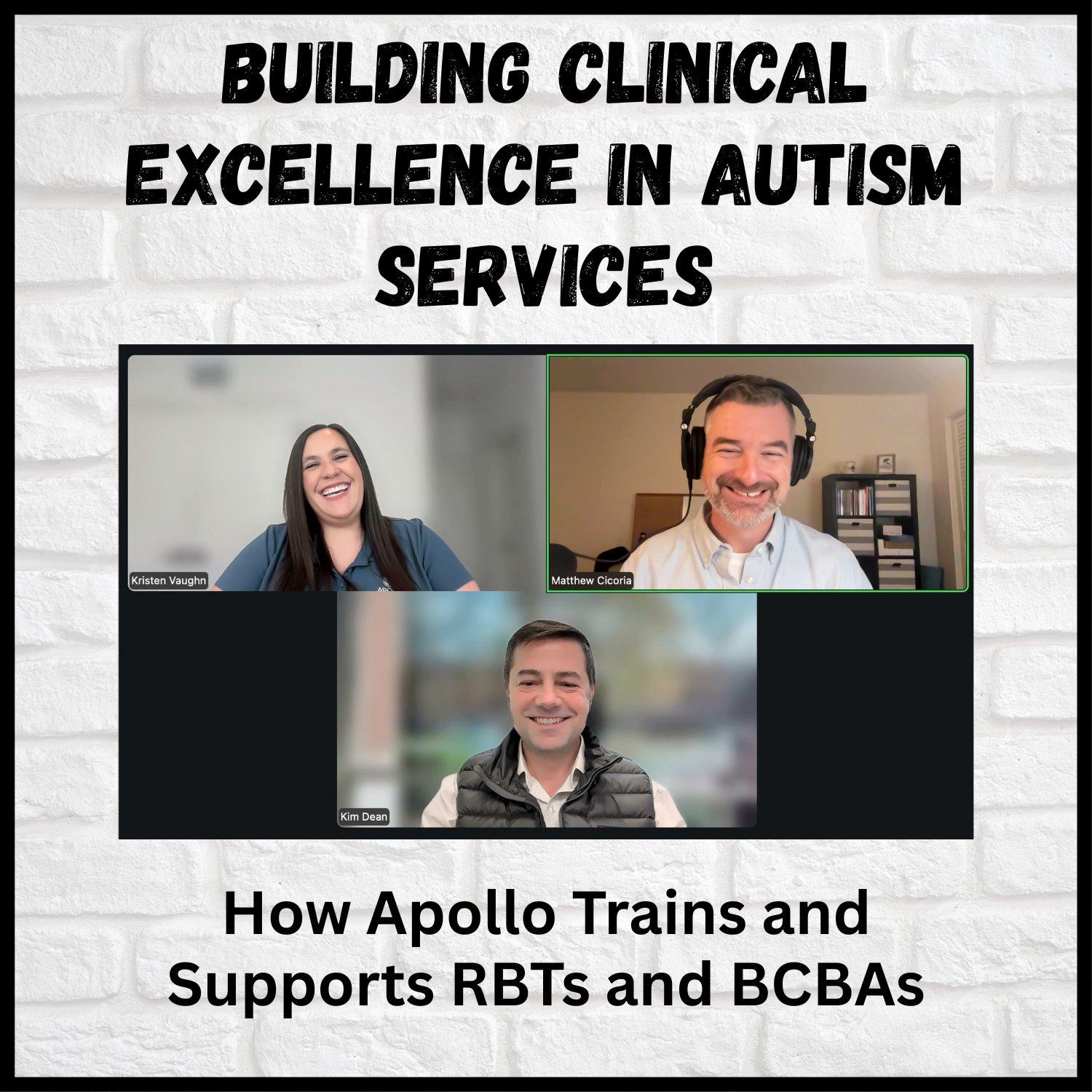 Building Clinical Excellence in Autism Services: How Apollo Trains and Supports RBTs and BCBAs - Session 322 | In this episode of the Behavioral Observations Podcast, I'm joined by Kim Dean, founder of Apollo Behavior, and Kristen Vaughn, Vice President of Clinical Operations, to talk about what it really takes to build and sustain clinical excellence in autism services. We discuss Apollo's decision to launch in Georgia, their highly selective hiring process, and how values alignment plays a central role in building their culture. Kim and Kristen share how Apollo approaches training differently — including a four-week RBT onboarding program that exceeds certification requirements and a structured mentorship model for BCBAs. The results are notable, with 99% of Apollo's RBTs passing their exams on the first attempt! Even more impressive is that 84% of Apollo-trained BCBAs pass their exam on the first attempt too. Compared to the current average pass rate that hovers around 52-54%, that's simply amazing! We also dig into how Apollo defines and measures clinical excellence, including the use of norm-referenced assessments, family feedback, progress toward less restrictive environments, and ongoing data analysis to improve training and service delivery. This conversation is especially relevant for BCBAs, clinical leaders, and practice owners who are thinking seriously about how to scale services without sacrificing quality — and how to design systems that support clinicians, families, and long-term outcomes. If this sounds like a great work environment to you, and you'd like to learn more, click here. Related BOP Episodes: From Clinician to Leader: Apollo CSS 8 with Kristen Vaughn All previous Apollo Series BOP episodes This podcast is brought to you by: The School Behavioral Solutions for Special Educators & Behavior Analysts. The Behavior Toolbox Conference is a one-day, high-impact professional convening that brings together experienced practitioners and leaders from across education and behavior science to share what actually works in schools. Rather than relying on theory divorced from practice, this conference features presenters who actively operate within classrooms, districts, research settings, and state-level systems. Behavior analysts, educators, researchers, and system leaders come together to examine behavior change from multiple levels of impact — adult behavior, decision-making, values, and the systems that shape outcomes. It's taking place virtually through BehaviorLive on March 5th, 2026, and will be available on-demand for those who can't make it on the day of the event. Office Puzzle: A thriving ABA practice depends on systems that actually support your team, not slow them down. If you've struggled with software that's buggy, hard to navigate, or offers little support when you need it most, you're not alone. That's why so many practices are switching to Office Puzzle. Go to officepuzzle.com/bop to learn more! The 2026 Verbal Behavior Conference! Taking place March 26–27, 2026, in Austin, Texas, or livestream and on-demand on BehaviorLive. Presenters will include Drs. Mark Sundberg, Patrick McGreevy, Caio Miguel, Alice Shillingsburg, Sarah Frampton, Andresa De Souza, and Danielle LaFrance will share how Skinner's analysis of verbal behavior can guide the assessment and treatment of generative learning challenges in children with autism and other developmental disabilities. And don't miss the special pre-conference workshop on Wednesday, March 25. CEUs from Behavioral Observations. Learn from your favorite podcast guests while you're commuting, walking the dog, or whatever else you do while listening to podcasts. New events are being added all the time, so check them out here. | 1h 01m 01s | ||||||
| 1/27/26 |  Entrenamiento de Habilidades Conductuales: BOP en Español 16 con Maria Sanchez | En este episodio, Miguel conversa con María Sánchez, una profesional con un impacto notable en la formación de analistas de conducta en España y Latinoamérica. La charla gira en torno al Behavioral Skills Training (BST) o Entrenamiento de Habilidades Conductuales: qué es, cómo se aplica en la práctica y por qué sigue siendo una de las herramientas más efectivas para entrenar tanto a profesionales como a familias. María comparte su recorrido profesional, que comienza en Inglaterra en un centro para niños con autismo y evoluciona hacia su trabajo en PECS, donde encontró su vocación inesperada en la supervisión y formación de otros profesionales. Trabajó en la capacitación de profesionales en Argentina, Uruguay, Chile, Costa Rica y España, observando de primera mano el poder transformador de la comunicación aumentativa, especialmente en niños no verbales que comienzan a desarrollar estructuras de lenguaje más complejas. Durante la pandemia, y tras el cierre inicial en Italia, María reinventó su práctica y creó 360 Online, un proyecto de formación remota para garantizar que profesionales en regiones aisladas pudieran acceder a entrenamientos RBT e IBT de calidad. Desde entonces, ha formado a cientos de estudiantes a través de clases sincrónicas, colaboraciones con centros en Latinoamérica y sesiones a distancia altamente prácticas. Miguel y María profundizan en el procedimiento BST —instrucciones, modelado, juego de roles y retroalimentación—, explorando cómo implementarlo eficazmente con adultos, cómo dar feedback específico sin sobrecargar, y cómo equilibrar correcciones con reconocimiento positivo. También dialogan sobre las ventajas y desafíos de entrenar a distancia, la importancia ética de proteger la privacidad de clientes y familias, la necesidad de fomentar ambientes de aprendizaje seguros y empoderadores, el rol del telehealth en la generalización de habilidades y las demandas formativas reales en España y Latinoamérica, donde muchos profesionales tienen apenas una o dos horas semanales para cumplir con las 40 horas requeridas. Antes de cerrar, María ofrece consejos esenciales para quienes están en el campo del análisis de conducta, subrayando la importancia del trabajo en equipo, la práctica deliberada y la humildad profesional. BOP in English: BST with María Sánchez In this episode, Miguel speaks with María Sánchez, a professional with a remarkable impact on the training of behavior analysts across Spain and Latin America. The conversation centers on Behavioral Skills Training (BST)—what it is, how it is applied in practice, and why it remains one of the most effective tools for training both professionals and families. María shares her professional journey, which began in England at a center for children with autism and later led her to her work with PECS, where she unexpectedly discovered her passion for supervision and professional training. She provided training to professionals in Argentina, Uruguay, Chile, Costa Rica, and Spain, witnessing firsthand the transformative power of augmentative communication, especially in nonverbal children who begin developing more complex language structures. During the pandemic—and after the initial shutdown in Italy—María reinvented her practice and created 360 Online, a remote training project designed to ensure that professionals in isolated regions could access high-quality RBT and IBT training. Since then, she has trained hundreds of students through synchronous classes, collaborations with centers across Latin America, and highly practical remote sessions. Miguel and María dive into the *BST procedure—instructions, modeling, role play, and feedback—*discussing how to implement it effectively with adults, how to provide specific feedback without overwhelming, and how to balance corrections with positive reinforcement. They also explore the advantages and challenges of remote training, the ethical importance of protecting client and family privacy, the need to foster safe and empowering learning environments, the role of telehealth in skill generalization, and the training demands faced in Spain and Latin America, where many practitioners have only one or two hours per week to complete the required 40 hours. Before wrapping up, María shares essential advice for those in the field of behavior analysis, emphasizing teamwork, deliberate practice, and professional humility. | 43m 34s | ||||||
| 1/15/26 | 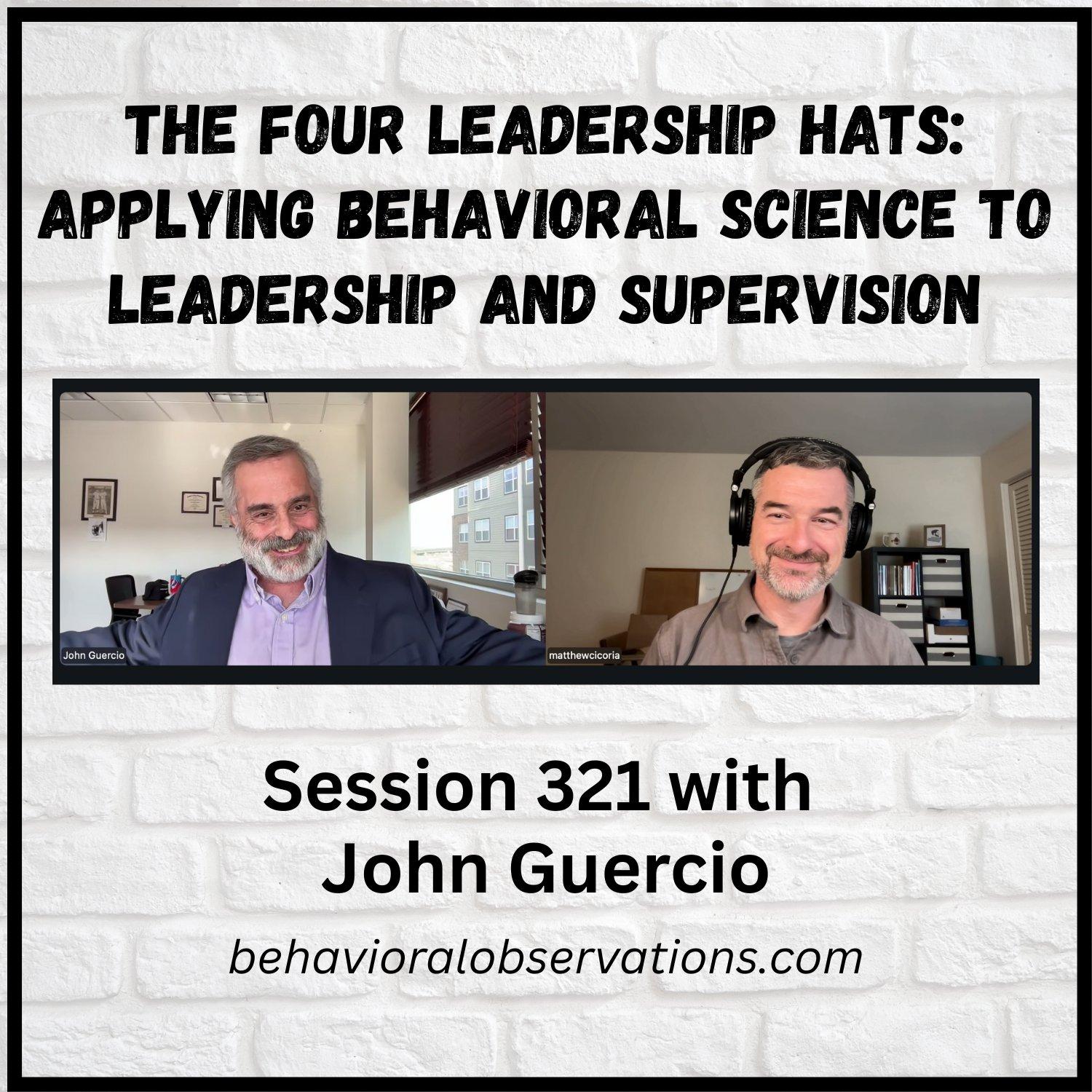 The Four Leadership Hats: Applying Behavioral Science to Leadership and Supervision — Session 321 with John Guercio | In this episode, I'm joined by John Guercio for a wide-ranging and practical conversation about leadership through a behavioral lens. John and I dig into what it actually means to lead in applied behavior analysis, especially when so much of the existing leadership literature is vague, mentalistic, or disconnected from observable behavior. We start by talking about the need to operationalize leadership in behavioral terms and explore the four leadership hats developed by Dr. Paulie Gavoni: leading, training, coaching, and managing. We break down what each of these roles looks like behaviorally, how they function across time, and why effective leaders need to move flexibly between them rather than relying on a single style. A major theme of the episode is the role of positive reinforcement in leadership. John shares real-world examples from his OBM coursework and his work at Cornerstone Behavioral Services, highlighting how difficult—but necessary—it can be to shift away from punitive and avoidance-based management strategies. We discuss why punishment often "works" in the short term, why leaders continue to rely on it, and how reinforcement-based leadership creates better outcomes for both staff and organizations. We also spend time unpacking the distinction between leadership and management. John reflects on his own strengths and limitations, describing how he focuses on vision and direction while intentionally surrounding himself with strong managers who excel at systems, logistics, and follow-through. This leads to a powerful discussion about positional authority, seniority, and the myth that leadership status entitles people to treat others poorly. Throughout the episode, we return to the importance of psychological safety, consistent feedback, and emotional regulation in leadership roles. John shares practical strategies for navigating tough conversations, including how to balance empathy with accountability, how to manage staff expectations, and how to avoid letting emotion drive professional communication (including when not to send that email). We also talk through concrete tools and exercises for improving leadership practice, such as symbolic problem-solving activities to surface unspoken team issues, written acknowledgment systems, and using assessment tools like the Performance Diagnostic Checklist to guide supervision and coaching. John closes by sharing future directions for developing empirically grounded management assessment tools, along with a preview of his upcoming work and conference presentations. This is a practical, honest conversation for anyone supervising staff, leading teams, or trying to build reinforcing, values-consistent organizations in human services. Resources & Links Mentioned in This Episode RBT Course for Adult Services (the 'bridge' course too!) Sims and Szilagyi (1975). Leader reward behavior and subordinate satisfaction and performance Stone Soup Conference Registration (use code PODCAST26 at checkout) Carr and Wilder (2015). The Performance Diagnostic Checklist—Human Services John's previous BOP appearances Session 274: Psychological Safety in the Workplace (Supervision CEU!) Additional Books, Articles, and Ideas Discussed John's books on Amazon Komaki (1998). Leadership from an Operant Perspective McGregor (1960). The Human Side of Enterprise Daniels and Daniels (2023). The Measure of a Leader Elliot (2012). Leading Apple With Steve Jobs: Management Lessons From a Controversial Genius Covey (2020). The 7 Habits of Highly Effective People, 30th Anniversary Edition Harley (2013). How to Say Anything to Anyone Grenny et al. (2021). Crucial Conversations (Third Edition): Tools for Talking When Stakes Are High Sponsor shoutouts! Office Puzzle: A thriving ABA practice depends on systems that actually support your team, not slow them down. If you've struggled with software that's buggy, hard to navigate, or offers little support when you need it most, you're not alone. That's why so many practices are switching to Office Puzzle. Go to officepuzzle.com/bop to learn more! HRIC Recruting. Cut out the middleman and speak directly with Barbara Voss, who's been placing BCBAs in great jobs all across the US for 15 years. The 2026 Stone Soup Conference! This is one of the best values in the online conference space. I'm actually going to be one of the speakers at this year's event, along with a great cast of other characters you're probably familiar with. Save on your registration by using promo code PODCAST26 Behavior University. Their mission is to provide university quality professional development for the busy Behavior Analyst. Learn about their CEU offerings, including their 8-hour Supervision Course, as well as their RBT offerings over at behavioruniversity.com/observations. Don't forget to use the coupon code, PODCAST to save at checkout! The 2026 Verbal Behavior Conference! Taking place March 26–27, 2026, in Austin, Texas, or livestream and on-demand on BehaviorLive. Presenters will include Drs. Mark Sundberg, Patrick McGreevy, Caio Miguel, Alice Shillingsburg, Sarah Frampton, Andresa De Souza, and Danielle LaFrance will share how Skinner's analysis of verbal behavior can guide the assessment and treatment of generative learning challenges in children with autism and other developmental disabilities. And don't miss the special pre-conference workshop on Wednesday, March 25. CEUs from Behavioral Observations. Learn from your favorite podcast guests while you're commuting, walking the dog, or whatever else you do while listening to podcasts. New events are being added all the time, so check them out here. | 1h 30m 32s | ||||||
| 1/7/26 | 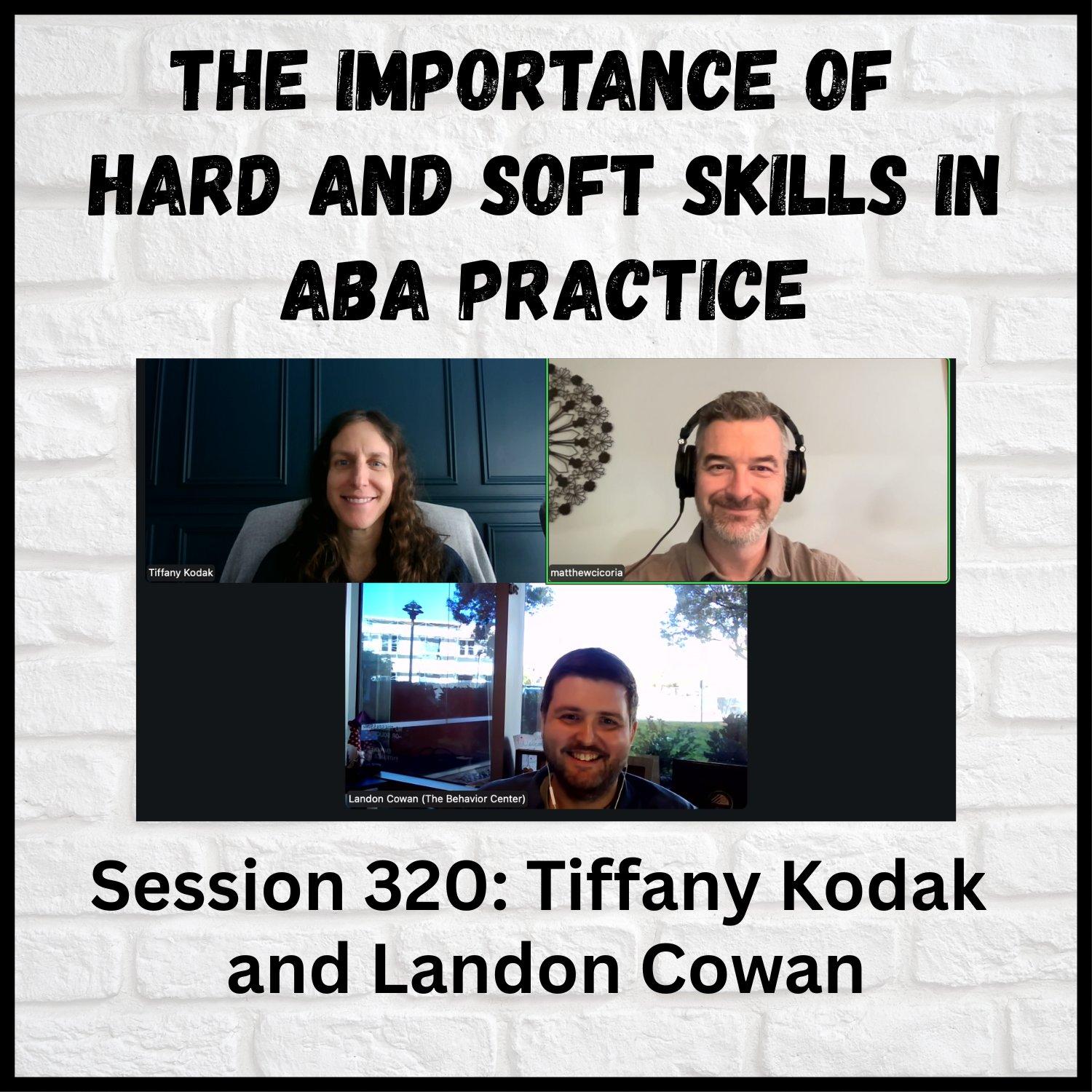 The Importance of Hard and Soft Skills in ABA Practice: Session 320 with Tiffany Kodak and Landon Cowan | In Session 320, I sit down with Landon Cowan and Tiffany Kodak to talk about an area of behavior analysis that doesn't get nearly enough attention: professional (or "soft") skills. We spend a lot of time in our field teaching and refining technical, clinical, or "hard" skills—and for good reason. But far less time is devoted to the interpersonal, communication, and problem-solving skills that ultimately determine how effective we are as clinicians, supervisors, and collaborators. In this conversation, Landon and Tiffany share their research aimed at identifying, defining, and measuring these professional skills, along with some eye-opening findings about where skill gaps exist. 🔍 What We Cover in This Episode How hard skills differ from professional (soft) skills in behavior analysis Why professional skills are so difficult to define, measure, and systematically teach How Landon and Tiffany developed a comprehensive professional skills survey for behavior analysts The challenges of survey design, including question format, length, readability, and pilot testing Results from a survey completed by 189 ABA supervisors, including: Which skills supervisees demonstrate most frequently Which skills supervisors rate as most important for career advancement A significant gap between the importance of problem-solving skills and how often they're actually demonstrated Why solution-based problem identification and independent problem solving emerged as key areas for improvement A surprising finding that many supervisors report feeling confident teaching these skills despite identifying major skill deficits How Behavioral Skills Training (BST) can be used to effectively teach professional skills Why the field needs clearer operational definitions and better data collection to build a stronger literature base Practical advice for BCBA trainees and early-career BCBAs around self-assessment, feedback, and ongoing professional development 🎯 Key Takeaways This episode reinforces something many of us already suspect: professional skills matter—a lot. In many cases, they're just as important (if not more important) than technical expertise when it comes to supervision, leadership, and long-term success in the field. Developing these skills requires intentional training, honest self-reflection, and a commitment to continuous learning. My hope is that this conversation helps push our field toward doing a better job of teaching, measuring, and valuing the skills that make behavior analysts more effective in the real world. Resources and Links Dr. Kodak's faculty page at Marquette University. Dr. Cowan's LinkedIn page. Cowan and Kodak (2024). Professional Skills for Behavior Analysts: A Survey on the Proficiency and Importance of Hard and Soft Skills. LeBlanc, Taylor, and Marchese (2019). The Training Experiences of Behavior Analysts: Compassionate Care and Therapeutic Relationships with Caregivers. Taylor, LeBlanc, and Nosik (2018). Compassionate Care in Behavior Analytic Treatment: Can Outcomes be Enhanced by Attending to Relationships with Caregivers? The Stone Soup Conference (use promo code PODCAST26 to save at registration). Sommers-Flanagan and Sommers-Flanagan (2023). Clinical Interviewing. Carroll, Preas, and Paden (2022). Training supervisors to provide performance feedback using video modeling with voiceover instructions: A replication. Sponsor shoutouts! Office Puzzle: A thriving ABA practice depends on systems that actually support your team, not slow them down. If you've struggled with software that's buggy, hard to navigate, or offers little support when you need it most, you're not alone. That's why so many practices are switching to Office Puzzle. Go to officepuzzle.com/bop to learn more! Frontera. Consider taking a demo of Frontera's Assessment Builder and see how the ethical application of AI technologies can help you serve clients and save you time! Your first assessment report is free. And if you use code BOP25 you'll get an additional five assessments for just $100. So head to fronterahealth.com to check it out! The 2026 Stone Soup Conference! This is one of the best values in the online conference space. I'm actually going to be one of the speakers at this year's event, along with a great cast of other characters you're probably familiar with. Save on your registration by using promo code PODCAST26! The 2026 Verbal Behavior Conference! Taking place March 26–27, 2026, in Austin, Texas, or livestream and on-demand on BehaviorLive. Presenters will include Drs. Mark Sundberg, Patrick McGreevy, Caio Miguel, Alice Shillingsburg, Sarah Frampton, Andresa De Souza, and Danielle LaFrance will share how Skinner's analysis of verbal behavior can guide the assessment and treatment of generative learning challenges in children with autism and other developmental disabilities. And don't miss the special pre-conference workshop on Wednesday, March 25. CEUs from Behavioral Observations. Learn from your favorite podcast guests while you're commuting, walking the dog, or whatever else you do while listening to podcasts. New events are being added all the time, so check them out here. | 1h 14m 31s | ||||||
| 12/31/25 | 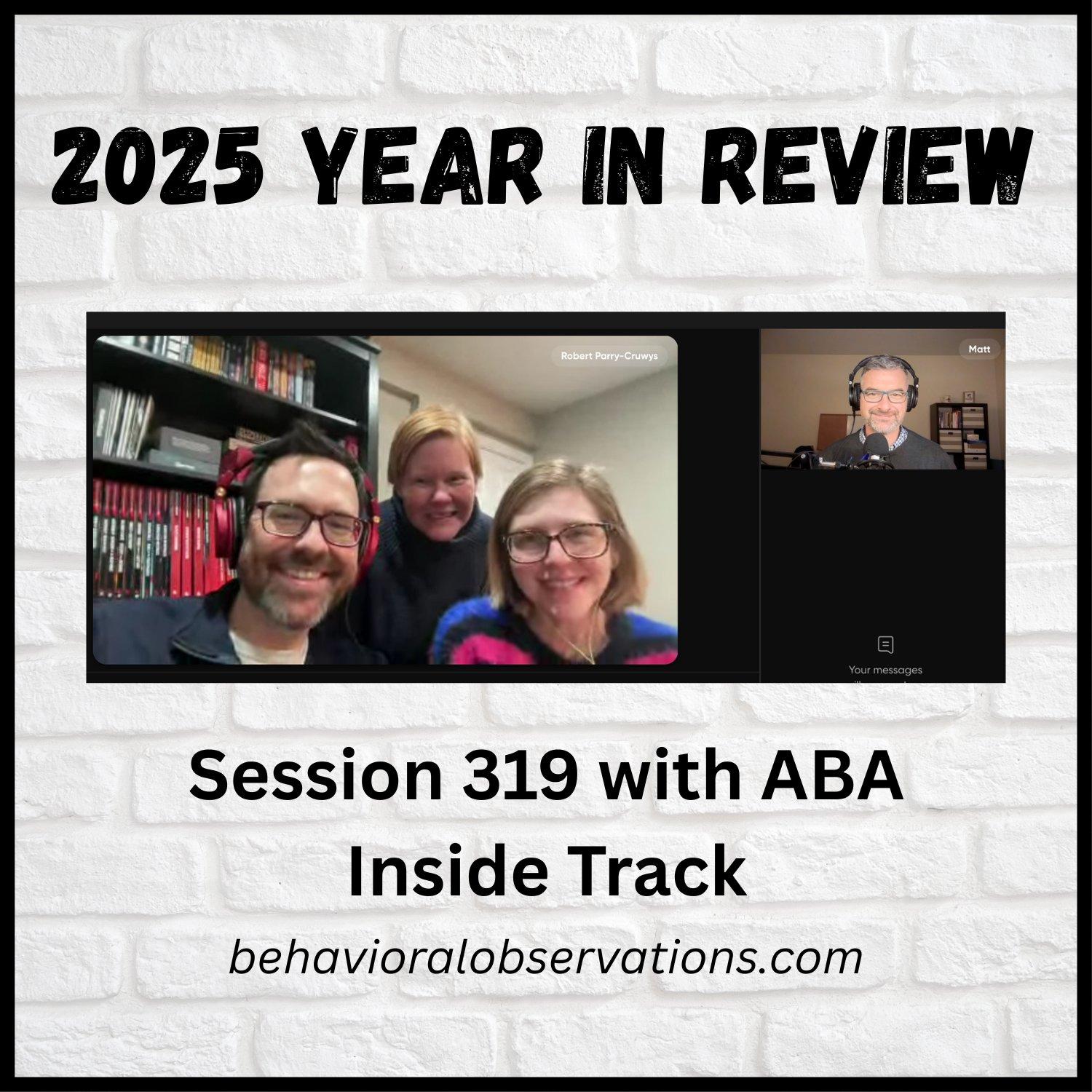 2025 Year in Review: Session 319 with ABA Inside Track | Don't adjust your podcast player folks, you have the right show. Welcome to Session 319 of the Behavioral Observations Podcast. If you've been listening for a bit, you know what's coming. If you're new to the show however, first, welcome and thanks for listening. Every year, I team up with my friends from the ABA Inside Track Podcast to do a Year In Review episode. We've tinkered with the format over time, but for this one, we talk briefly about the trends and issues that we thought were important in 2025. From there, we discussed some of the most downloaded shows from our podcasts this year and speculate as to why these ones resonated so much. We close the show talking about how both of our shows are turning 10 years old very soon. So we look back on what we've learned over a decade of podcasting! Today's episode is brought to you by, · Frontera. Consider taking a demo of Frontera's Assessment Builder and see how the ethical application of AI technologies can help you serve clients and save you time! Your first assessment report is free. And if you use code BOP25 you'll get an additional five assessments for just $100. So head to fronterahealth.com to check it out! · HRIC Recruting. Cut out the middleman and speak directly with Barbara Voss, who's been placing BCBAs in great jobs all across the US for 15 years. · The 2026 Stone Soup Conference! This is one of the best values in the online conference space. I'm actually going to be one of the speakers at this year's event, along with a great cast of other characters you're probably familiar with. Save on your registration by using promo code PODCAST26! · Behavior University. Their mission is to provide university quality professional development for the busy Behavior Analyst. Learn about their CEU offerings, including their 8-hour Supervision Course, as well as their RBT offerings over at behavioruniversity.com/observations. Don't forget to use the coupon code, PODCAST to save at checkout! | 1h 14m 09s | ||||||
| 12/10/25 | 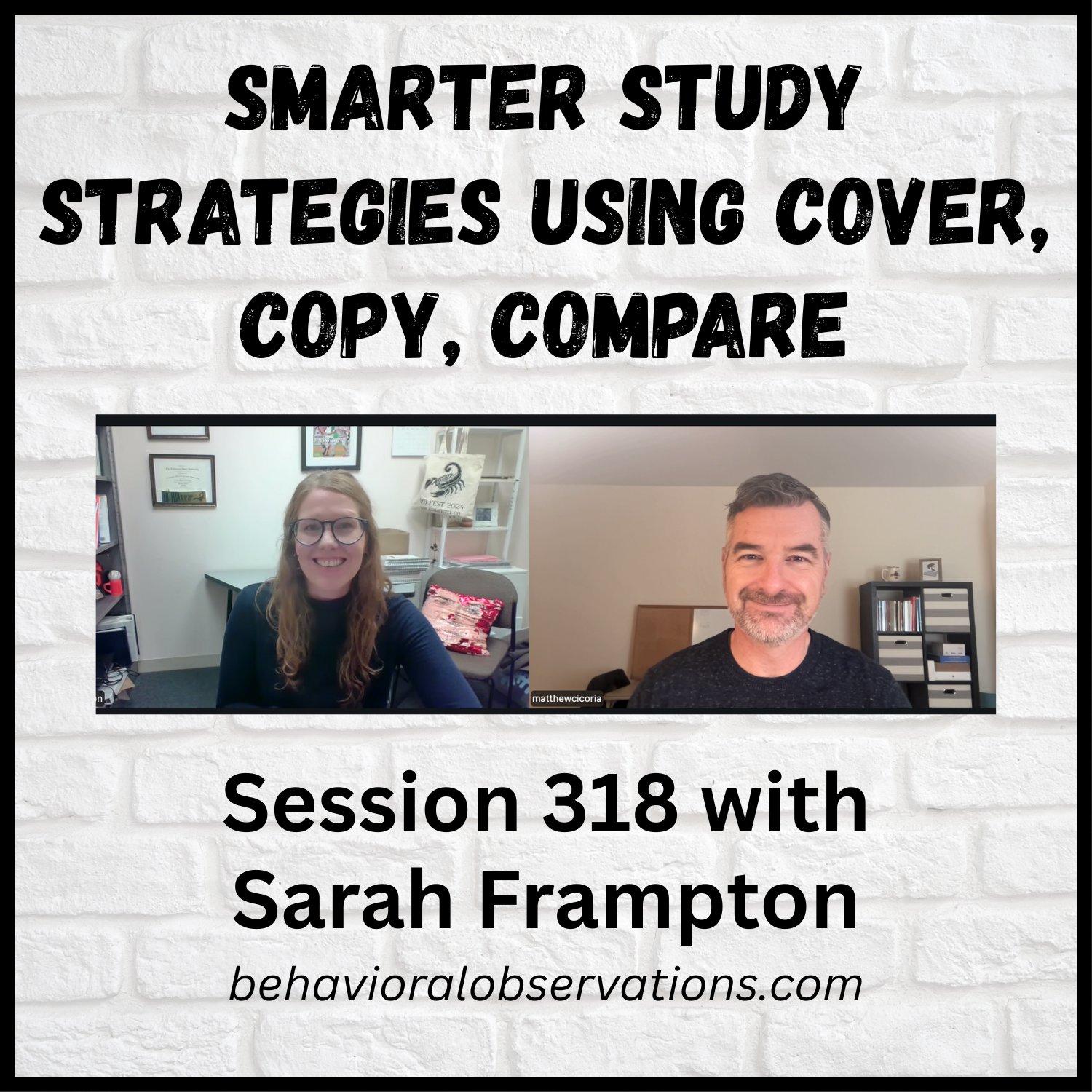 Smarter Study Strategies Using Cover, Copy, and Compare: Session 318 with Sarah Frampton | In this episode, I sit down with Dr. Sarah Frampton, who conducts research on, amongst other things, improving how we teach, learn, and organize information using behavior-analytic strategies. We explore her career journey, her research on graphic organizers and the Cover, Copy, Compare (CCC) strategy, and the broader implications for stimulus equivalence, educational technology, and effective teaching. In This Episode, You'll Learn: How Sarah's unconventional path led her from economics and psychology into Applied Behavior Analysis (ABA). Why note-taking and structured learning strategies, like CCC, matter for retaining and applying complex information. How stimulus equivalence principles can enhance learning beyond direct instruction. Insights from Sarah's research combining CCC with graphic organizers, including practical takeaways for educators and learners (see Frampton, Vesely and Jackson, 2025). How visual learning tools and educational technology can improve engagement and retention. Strategies for training learners to use these approaches independently and effectively. Highlights From Our Conversation: Sarah's Path Into ABA Sarah shares how a thesis requirement and a Craigslist job posting led her to ABA, including formative experiences working with Dr. Alice Shillingsburg at the Marcus Autism Center. These experiences sparked her interest in efficient, broadly applicable learning strategies. Why Note-Taking Strategies Matter We discuss the value of graphic organizers and the Cover, Copy, Compare (CCC) strategy: Graphic organizers visually display relationships between concepts. CCC is a structured, active-response method that strengthens memory, similar to flashcards. Sarah emphasizes how behavior-analytic techniques can support higher-order thinking processes often considered "cognitive." CCC and Stimulus Equivalence Sarah walks through stimulus equivalence with clear examples, showing how teaching certain relations can produce broader learning without direct instruction. She also highlights a study where CCC and graphic organizers helped learners prepare for tests—even under intentionally challenging conditions. Graphic Organizers in Action Key findings from Sarah's research: Learners who drew more structured organizers performed better. Teaching organizer use during test conditions did not hinder performance. Visualizing relationships among stimuli predicted task success. Training Learners to Use These Strategies Sarah outlines her training sequence, including pre-tests, video instruction, practice with familiar material, and application to abstract stimuli. A core goal was strategy generalization—ensuring learners could apply CCC to new material independently. Fig. 1 from Frampton, et al. (2025) Fig. 2 from Frampton, et al. (2025) Research Findings Most participants quickly mastered abstract relations and passed post-tests after brief training. Notably, all participants used the CCC strategy—some even more meticulously than required. Educational Technology, Engagement, and Mediation Participants reported the educational technology intervention was easy to use and helpful, contrasting with high dropout rates in similar studies. Sarah also describes how participants naturally used private verbal behavior, such as naming stimuli or creating stories, to aid learning. Visual Learning Tools in ABA We discuss the broader application of visual supports—graphic organizers, flashcards, handwriting—and their role in enhancing learning efficiency for both adults and children with autism. Looking Ahead Sarah previews her upcoming presentation at the Verbal Behavior Conference, covering generative learning and assessment tools. We also explore how collaboration and community can reduce burnout and increase long-term job satisfaction in ABA in the "advice for the newly-minted" segment. Resources & Links Session 287: BiDirectional Naming with Caio Miguel. Session 80: Verbal Behavior and Relational Frame Theory, with David Palmer and Josh Pritchard. Shillingsburg, et al. (2016). A Preliminary Procedure for Teaching Children with Autism to Mand for Social Information. Frampton and Linehan (2024). The effects of a training package to teach note taking on the formation of equivalence classes. Sponsor shoutouts! Office Puzzle: A thriving ABA practice depends on systems that actually support your team, not slow them down. If you've struggled with software that's buggy, hard to navigate, or offers little support when you need it most, you're not alone. That's why so many practices are switching to Office Puzzle. Go to officepuzzle.com/bop to learn more! Frontera. Consider taking a demo of Frontera's Assessment Builder and see how the ethical application of AI technologies can help you serve clients and save you time! Your first assessment report is free. And if you use code BOP25 you'll get an additional five assessments for just $100. So head to fronterahealth.com to check it out! MindBodyBehavior's Certified Health Coach Program. If you're a BCBA looking to use your ABA skills to help people live healthier lifestyles, learn how to do it the right way, with expert instruction, mentoring, and guidance from Sarah Burby. Better still, podcast listeners can save $$$ by using the code BOP10 at check out. Click here to learn more! The 2026 Stone Soup Conference! This is one of the best values in the online conference space. I'm actually going to be one of the speakers at this year's event, along with a great cast of other characters you're probably familiar with. Save on your registration by using promo code PODCAST26! The 2026 Verbal Behavior Conference! Taking place March 26–27, 2026, in Austin, Texas, or livestream and on-demand on BehaviorLive. Presenters will include Drs. Mark Sundberg, Patrick McGreevy, Caio Miguel, Alice Shillingsburg, Sarah Frampton, Andresa De Souza, and Danielle LaFrance will share how Skinner's analysis of verbal behavior can guide the assessment and treatment of generative learning challenges in children with autism and other developmental disabilities. And don't miss the special pre-conference workshop on Wednesday, March 25. | 1h 35m 54s | ||||||
| 11/29/25 |  Eye Contact and AI in ABA Treatment: Session 317 with Francesca degli Espinosa | In Session 317, I sit down with Dr. Francesca Delia Espinoza to revisit one of the most foundational—but often misunderstood—topics in behavior analysis: eye contact. We explore why eye contact shouldn't be treated as a simple objective, but instead understood within its broader social and developmental context. Francesca explains how eye contact is better re-framed as "eye-looking," and why behavior analysts need a strong conceptual foundation for evaluating when, how, and why to teach it. We discuss her recent paper in Perspectives on Behavior Science, which encourages practitioners to analyze the controlling variables behind eye contact rather than relying on rote teaching procedures. We then shift into the role of eye contact in autism development and early intervention. Francesca discusses how deviations in gaze behavior can influence a child's learning trajectory, and why early, naturally occurring social contingencies can make such a significant difference. We also touch on the potential aversiveness of eye contact for some individuals, and how to navigate that ethically and effectively. Our conversation expands into related research on social media, gaze avoidance, and how adults and children with autism engage differently with eye-related cues online. Francesca also talks about her Substack newsletter, "What Darwin Taught Me," which blends behavioral science with accessible and engaging writing. From there, we explore her creative work in conceptual fiction, including her "Aura" series from her Substack Newsletter — a not-too-distant science-fiction world where behavior analysts work alongside AI systems that analyze sessions, generate programs, and support day-to-day clinical tasks. This leads us into a broader discussion about the role of AI in applied behavior analysis, including its promises, limitations, and the importance of preserving hands-on clinical expertise. Francesca describes one of the short stories in the Aura series about behavior analysts who travel to developing countries, only to realize their reliance on technology becomes a liability when the systems fail. It's a striking reminder that behavior change happens in real time, and nothing replaces skilled human interaction. We close by reflecting on how emerging technologies—AI, automation, and digital platforms—might shape the future of ABA for better or worse. Resources and References Mentioned: Francesca's Substack: "What Darwin Taught Me" (Aura storyline here) Stromberg, et al. (2025). Shaping Social Eye Contact in Children With Autism Via Telehealth: A Parent-Implemented Intervention Skinner (1986): "What Is Wrong With Daily Life in the Western World?" The Craft of Applied Behavior Analysis: Session 181 with Francesca Degli Espinosa Eye Contact, Joint Attention, and Autism: Session 238 with Francesca Degli Espinosa Cline (2012). Ready Player One (pro tip: skip the movie, read the book) The Matrix Sponsor Shoutouts! Frontera. Consider taking a demo of Frontera's Assessment Builder and see how the ethical application of AI technologies can help you serve clients and save you time! Your first assessment report is free. And if you use code BOP25 you'll get an additional five assessments for just $100. So head to fronterahealth.com to check it out! MindBodyBehavior's Certified Health Coach Program. If you're a BCBA looking to use your ABA skills to help people live healthier lifestyles, learn how to do it the right way, with expert instruction, mentoring, and guidance from Sarah Burby. Better still, podcast listeners can save $$$ by using the code BOP10 at check out. Click here to learn more! HRIC Recruting. Cut out the middleman and speak directly with Barbara Voss, who's been placing BCBAs in great jobs all across the US for 15 years. The 2026 Stone Soup Conference! This is one of the best values in the online conference space. I'm actually going to be one of the speakers at this year's event, along with a great cast of other characters you're probably familiar with. Save on your registration by using promo code PODCAST26! Behavior University. Their mission is to provide university quality professional development for the busy Behavior Analyst. Learn about their CEU offerings, including their 8-hour Supervision Course, as well as their RBT offerings over at behavioruniversity.com/observations. Don't forget to use the coupon code, PODCAST to save at checkout! The 2026 Verbal Behavior Conference! Taking place March 26–27, 2026, in Austin, Texas, or livestream and on-demand on BehaviorLive. Presenters will include Drs. Mark Sundberg, Patrick McGreevy, Caio Miguel, Alice Shillingsburg, Sarah Frampton, Andresa De Souza, and Danielle LaFrance will share how Skinner's analysis of verbal behavior can guide the assessment and treatment of generative learning challenges in children with autism and other developmental disabilities. And don't miss the special pre-conference workshop on Wednesday, March 25. | 1h 17m 36s | ||||||
| 11/19/25 |  Making ABA Research Matter: Practical Dissemination Strategies for Behavior Analytic Scholars, Inside JABA 25 | Episode Overview In this special episode of the Behavioral Observations Podcast, I had the honor of celebrating the 25th installment of the Inside JABA Series. This one was particularly meaningful because it also marks the final appearance of Dr. John Borrero in his role as Editor-in-Chief of The Journal of Applied Behavior Analysis. I invited John to reflect on his three-year tenure—what he learned from reading an enormous volume of manuscripts, how his thinking evolved, and why adapting our language is essential if we want behavior analysis to reach broader audiences. From there, we transitioned into an informative conversation with Dr. Nate Call from Emory University. Nate's recent work focuses on how we can better disseminate applied behavior analysis, not just distribute it. His paper, Scholarship as an Operating Class: Strategies and tactics for increasing dissemination of applied behavior analysis, has already shifted how I think about how our field packages and shares research. In this episode, Nate walked us through actionable strategies for increasing the reach and impact of our work. Key Topics Covered in This Episode 1. John Borrero's Reflections from the Editor's Chair John looked back on his three years as Editor-in-Chief, and I asked him what surprised him most. He talked about: How important clear, accessible language is for dissemination Why behavior analysts must evolve how we communicate without losing our scientific roots Efforts to make JABA papers more accessible through translated articles What it's like to manage a massive editorial workflow and team 2. The Real Difference Between Dissemination and Distribution Nate clarified something that—and I'll admit—I hadn't always thought deeply about: there's a big difference between making your work available and ensuring your work is actually used. Nate described it like: Distribution = scattering seeds Dissemination = preparing the soil so they actually grow He also explained why early-career researchers often focus on distribution out of necessity, and how we can transition to more deliberate dissemination strategies over time. 3. Scholarship as an Operant Class Nate walked me through the framework behind his recent paper. He described scholarly behavior as something shaped by contingencies—just like anything else. We talked about: How individual and systemic consequences shape publishing choices Why some of the most high-impact papers come from individuals rather than large labs Concrete strategies we can use to increase the visibility and influence of our work 4. Boundary Encounters and Second-Generation Innovations I asked Nate about how ideas move between disciplines, and he introduced the concept of boundary encounters. We discussed: Incoming vs. outgoing boundary encounters How second-generation innovations help behavior analysis reach audiences outside our traditional spaces Why these interactions are essential if we want ABA to have a broader societal impact 5. Expanding Our Methodological Toolkit We took a deep dive into methodology and talked about the strengths of single-subject designs—as well as their limitations. Nate made a compelling case for: When behavior analysts should consider Randomized Control Trials, implementation science, or mixed methods Why diversifying methodologies helps us answer questions that matter to educators, policymakers, and grant reviewers What we lose when we rely exclusively on traditional single-subject approaches 6. Participatory Action Research and Social Validity I asked Nate to explain participatory action research, and he shared a powerful example involving first responders and families in crisis situations. He emphasized: The importance of involving stakeholders early How PAR elevates social validity and context Why many federal funders now expect qualitative or participatory components How behavior analysts can begin building these skills, even if it feels unfamiliar 7. Measuring Our Impact More Effectively We also explored how to know whether dissemination is working. Nate and I discussed: Bibliographic network analysis Alt-metric measures The importance of citing intentionally to strengthen high-quality scholarship within the field 8. Nate's Advice for New BCBAs To close the episode, I asked Nate what he'd tell new behavior analysts entering the field. He encouraged them to: Read widely—far beyond behavior-analytic journals Become conversant in different research methods Build collaborations with experts in qualitative, mixed, and implementation-science approaches Think functionally about their own scholarly and professional behavior 9. Resources Mentioned in this Podcast Foxx (1996). Translating the Covenant: The behavior analyst as ambassador and translator Chawla (2020). Science is getting harder to read Critchfield, et al. (2013). A half century of scalloping in the work habits of the United States Congress Klein and Thompson (2025). Abundance The Prisoner's Dilemma Call et al. (2015). Clinical Outcomes of Behavioral Treatments for Pica in Children with Developmental Disabilities Critchfield (2002). Evaluating the function of Applied Behavior Analysis: A bibliometric analysis Inside JABA 18: How to Disseminate Behavior Analytic Technologies (CEU available!) Implementation Science and Participatory Action Research If you're passionate about increasing the influence of behavior analysis—whether through research, writing, teaching, or practice—this episode offers clear, functional guidance for how to do it. | 1h 09m 26s | ||||||


Showing 25 of 340
Pitch Fit is a Pro feature
See how bookable this show is for guests, which brands already advertise, the per-episode ad value, and the best-fit guest and sponsor profile. The numbers are blurred on the free plan.
How readily this show books outside guests like you.
How proven this show is for host-read sponsorships.
For Guests
ProFor Advertisers
ProUpgrade to Pro to unlock guest cadence, sponsor categories, fit scores, and per-episode ad value for this show.
Chart history for The Behavioral Observations Podcast with Matt Cicoria
Peaked at #8 in TH, top 10 in 1 of 29 tracked markets, currently #8 in TH.
| Market | Genre | Peak | Current | Trend |
|---|---|---|---|---|
| TH | — | #8 | #8 | — |
| PH | — | #21 | #21 | — |
| United States | — | #25 | #25 | — |
| Ireland | — | #28 | #28 | — |
| SA | — | #29 | #29 | — |
| IS | — | #32 | #32 | — |
| GR | — | #38 | #38 | — |
| SG | — | #45 | #45 | — |
| South Korea | — | #47 | #47 | — |
| Denmark | — | #64 | #64 | — |
| TH | — | #71 | #71 | — |
| VN | — | #71 | #71 | — |
| Canada | — | #79 | #79 | — |
| ID | — | #81 | #81 | — |
| MY | — | #82 | #82 | — |
| KE | — | #82 | #82 | — |
| BE | — | #83 | #83 | — |
| South Africa | — | #93 | #93 | — |
| CL | — | #97 | #97 | — |
| Netherlands | — | #99 | #99 | — |
Chart Positions
29 placements across 26 markets.
Chart Positions
29 placements across 26 markets.