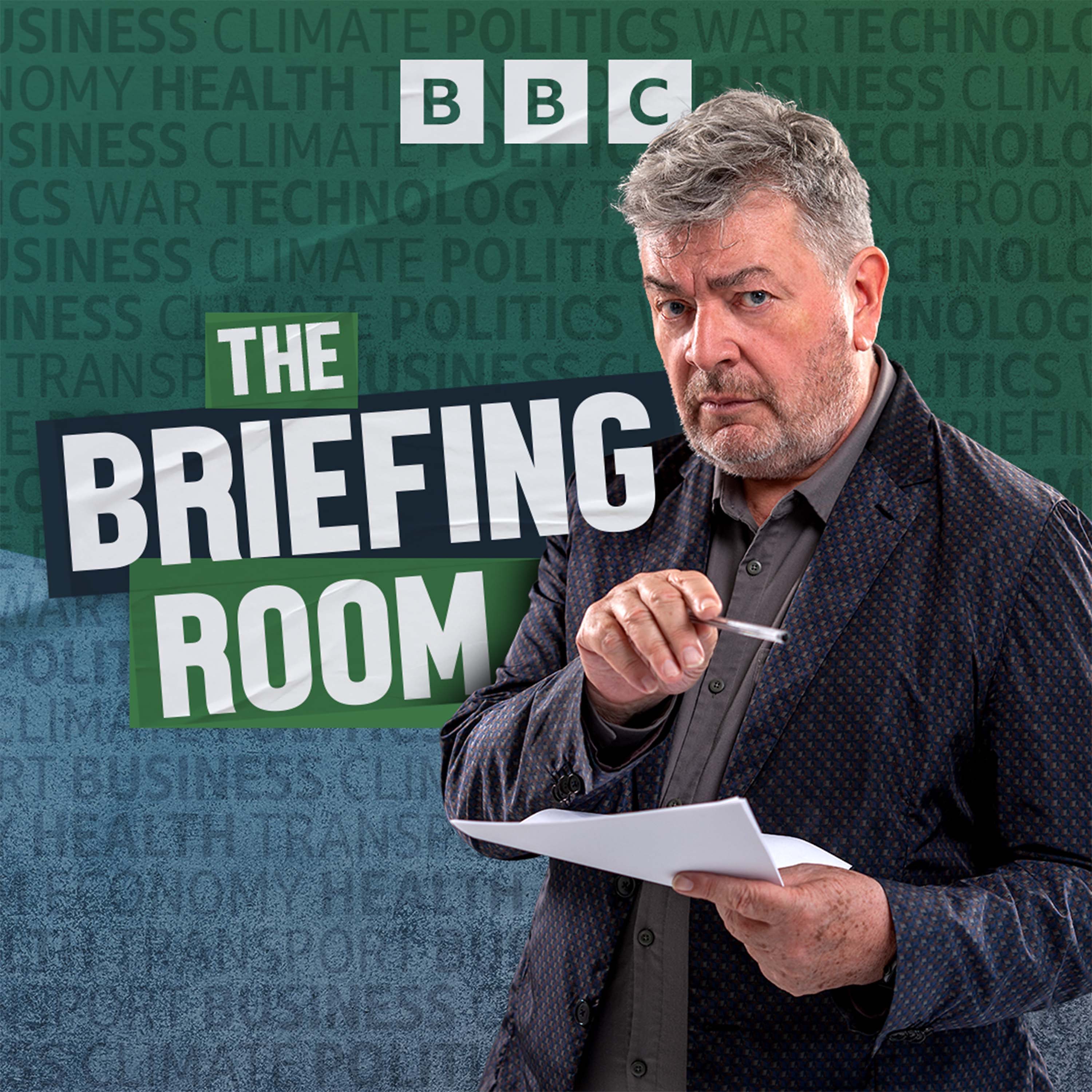
The Briefing Room
by BBC Radio 4
Is this your podcast?On the show
From 21 epsHost
Recent guests
Recent episodes
How will climate change affect our farms?
Oct 15, 2026
28m 34s
Why does the Yemen war matter to the world?
Oct 8, 2026
28m 38s
Are Gen Z movements reshaping politics?
Aug 27, 2026
28m 24s
How do we prepare for a future water shortage?
Aug 20, 2026
28m 37s
Part 2: How do we reform social care?
Aug 10, 2026
28m 59s
Insights from recent episode analysis
Audience Interest
Podcast Focus
Publishing Consistency
Platform Reach
Insights are generated by CastFox AI using publicly available data, episode content, and proprietary models.
Most discussed topics
Brands & references
Total monthly reach
Blended from 1 signal.
Built from
By chart position
- 🇬🇧United Kingdom · News CommentaryHOME#1612K to 78K
- 🇧🇪BE · News Commentary#19567 to 3.5K
- 🇮🇹Italy · News Commentary#63397 to 2.5K
- 🇪🇸Spain · News Commentary#75383 to 2.4K
- 🇦🇺Australia · News Commentary#99355 to 2.2K
- Per-Episode Audience
Est. listeners per new episode within ~30 days
17K to 107K🎙 Daily cadence·397 episodes·Last published 4d ago - Monthly Reach
Unique listeners across all episodes (30 days)
57K to 358K🇬🇧73%🇧🇪3%🇮🇹2%+13 more - Active Followers
Loyal subscribers who consistently listen
23K to 143K
Market Insights
Platform Distribution
Reach across major podcast platforms, updated hourly
Total Followers
—
Total Plays
—
Total Reviews
—
* Data sourced directly from platform APIs and aggregated hourly across all major podcast directories.
Social Links & Contact
Official channels & resources
Official Website
Login
RSS Feed
Login
| Date | Episode | Topics | Guests | Brands | Places | Keywords | Sponsor | Length | |
|---|---|---|---|---|---|---|---|---|---|
| 10/15/26 | How will climate change affect our farms? | Will we still be able to grow enough food as temperatures rise and rainfall becomes more erratic? What changes will farmers need to make to keep feeding the nation? As Radio 4 marks 75 years of the farming drama The Archers, David Aaronovitch examines the future of British farming. Models suggest large parts of the South East of England will no longer be favourable for growing cereals like wheat and even barley, important for things like beer and whiskey. Strawberries may be far too difficult to grow at all. Some areas of the UK may become better for farmers and new crops may grow that we've never been able to grow before, but it presents a huge challenge for farmers who will have to change their entire way of working. What must farmers do to adapt and what do we need to do to ensure we keep the food on our plates? GUESTS:Charlie Ireland, a farming consultant at Ceres consultancy, who advises Jeremy Clarkson on Clarkson’s Farm Professor Nicola Cannon, Royal Agricultural University. Neil Ward, Professor of Rural and Regional Development at the University of East Anglia Tom Lancaster, Head of Land, Food and Farming at The Energy and Climate Intelligence Unit | 28m 34s | ||||||
| 10/8/26 | Why does the Yemen war matter to the world? | The ceasefire between the Saudi-backed Yemen government and the Houthi rebels is over. As the fighting for control of land and sea intensifies, what are the knock on effects for the rest of the world?Guests:Nawal Al-Maghafi, BBC senior international investigations correspondent Baraa Shiban, researcher and political analyst on Yemen and the Gulf at the defence and security thinktank, RUSI Dr Elisabeth Kendall, Arabist & Middle East specialist and also The Mistress of Girton College at the University of Cambridge Frank Gardner, BBC Security CorrespondentPresenter: David Aaronovitch Producers: Ben Carter, Phoebe Keane and Kirsteen Knight Editor: Richard Vadon Sound engineer: James Beard Production co-ordinator: Maria Ogundele | 28m 38s | ||||||
| 8/27/26 | Gen Z movementspolitical protests+3 | Dr Nayana PrakashErica Frantz+1 | Minderoo Centre for Technology and DemocracyUniversity of Cambridge+3 | IndiaSerbia+1 | Gen Zprotests+7 | — | 28m 24s | ||
| 8/20/26 | water shortagedrought+3 | Sir John ArmittProfessor Jim Hall+1 | The Public Private Partnership CommissionOxford University+1 | EnglandWales | water shortagedrought+5 | — | 28m 37s | ||
| 8/10/26 | social care reformfunding+3 | Thea SteinSimon Bottery+1 | Nuffield TrustThe King's Fund | — | social carereform+3 | — | 28m 59s | ||
| 8/6/26 | social careUK politics+5 | Thea SteinSimon Bottery+1 | Nuffield TrustThe King's Fund | — | social careUK+8 | — | 28m 47s | ||
| 7/27/26 | immigrationlegal migration+4 | Madeleine SumptionDominic Casciani+1 | Migration ObservatoryUniversity of Oxford+2 | — | immigration policypublic concerns+5 | — | 28m 48s | ||
| 7/23/26 | immigrationasylum seekers+4 | Madeleine SumptionDominic Casciani | Migration ObservatoryUniversity of Oxford+1 | — | immigration policyasylum+4 | — | 28m 07s | ||
| 7/16/26 | devolutioneconomy+4 | Jennifer WilliamsTony Travers+2 | Financial TimesLSE Department of Government+2 | — | devolutioneconomic growth+5 | — | 28m 42s | ||
| 7/9/26 | relationship trendscoupling+3 | Dr Alice EvansJohn Burn-Murdoch | StanfordFinancial Times+1 | — | couplingrelationship recession+3 | — | 28m 38s | ||
Want analysis for the episodes below?Free for Pro Submit a request, we'll have your selected episodes analyzed within an hour. Free, at no cost to you, for Pro users. | |||||||||
| 7/2/26 | IranUS-Iran relations+4 | Shashank JoshiAli Vaez+1 | The EconomistCrisis Group+1 | IranUnited States+1 | IranUS+6 | — | 28m 23s | ||
| 5/21/26 | RussiaUkraine+4 | Steve RosenbergChristopher Miller+1 | BBCThe Financial Times+1 | RussiaUkraine | RussiaUkraine+5 | — | 27m 57s | ||
| 5/14/26 | anniversarypolitics+4 | Anand MenonBronwen Maddox+1 | King’s College LondonChatham House+1 | — | The Briefing Roomanniversary+5 | — | 28m 42s | ||
| 5/7/26 | space explorationMars mission+4 | Dr Julia BalmProfessor Andrew Coates+1 | Freeman Air and Space InstituteKing’s College London+3 | Pacific Ocean | MarsArtemis II+5 | — | 28m 03s | ||
| 4/30/26 | digital sovereigntyUS tech dependency+3 | Stanley PignalCecilia Rikap+1 | The EconomistUCL Institute for Innovation and Public Purpose+1 | BritainEurope+1 | digital sovereigntyUS tech+3 | — | 28m 22s | ||
| 4/23/26 | Iran conflictworld economy+3 | Joseph StiglitzDuncan Weldon+1 | International Monetary Fund | United StatesIsrael+2 | Iran conflictworld economy+3 | — | 28m 50s | ||
| 4/16/26 | pensionstriple lock+3 | Carl EmmersonSophie Hale+1 | London EconomicsResolution Foundation+2 | — | triple lockstate pension+3 | — | 28m 31s | ||
| 4/9/26 | CubaDonald Trump+3 | — | BBC Radio 4 | CubaKey West | CubaDonald Trump+5 | — | 28m 24s | ||
| 4/2/26 | Gaza peace planUS-Israel war+5 | Rushdi Abu AloufAnshel Pfeffer+2 | BBCThe Economist+1 | GulfGaza+2 | Gazapeace plan+8 | — | 28m 08s | ||
| 3/26/26 | youth unemploymentNEETS+3 | Jack KennedyLindsay Judge+2 | Indeed Hiring LabThe Resolution Foundation+2 | UK | youth unemploymentNEETS+3 | — | 28m 44s | ||
| 3/19/26 | UK armed forcesmilitary operations+4 | General Sir Richard BarronsDr Jack Watling+2 | Chatham HouseRoyal United Services Institute+2 | UKUS+3 | UK armed forcesmilitary operations+8 | — | 28m 35s | ||
| 3/12/26 | global economyenergy prices+4 | Ben ChuDuncan Weldon+2 | BBC VerifyOxford Institute for Energy Studies+1 | IranUnited States+2 | Iranglobal economy+5 | — | 28m 50s | ||
| 3/5/26 | US-Israel relationsIran conflict+4 | Anshel PfefferProfessor Ali Ansari+2 | The EconomistInstitute of Iranian Studies at St Andrews University+2 | IranUS+1 | US-Israel warIran+5 | — | 28m 44s | ||
| 2/26/26 | Four years of war in Ukraine - when will it end? | It’s four years this week since Vladimir Putin invaded Ukraine. And by this summer the conflict will have gone on for longer than the First World War. Casualties run into the hundreds of thousands. Peace talks brokered by the US have been off and on for the past few months, with President Putin demanding that Ukraine gives Russia full control of the eastern Donbas region, including the part it does not occupy. President Zelensky refuses. Meanwhile, Ukraine has experiened one of its harshest winters as its cities and energy infrastructure have been pounded by Russian drones and missiles. Still both sides fight on in a war which has become dominated by advanced drone technology. David Aaronovitch asks his guests whether anyone is winning and when and how this war might end. Guests:Mark Galeotti, head of Mayak Intelligence and author of "Forged in War: a military history of Russia from its beginnings to today." Dr Jack Watling, Senior Research Fellow for Land Warfare at the Royal United Services Institute and author of "The Arms of the Future: Technology and Close Combat in the Twenty First Century." Rebecca Lissner, Senior fellow for U.S. foreign policy at the Council on Foreign Relations and lecturer at the Jackson School of Global Affairs, Yale University. Christopher Miller, Chief Ukraine Correspondent, The Financial Times and author of "The war came to us: life and death in Ukraine."Presenter: David Aaronovitch Producers: Caroline Bayley and Kirsteen Knight Production Co-ordinator: Maria Ogundele Sound engineer: Neil Churchill Editor: Richard Vadon | 28m 29s | ||||||
| 2/19/26 | Should the Government ban social media for young people? | Pressure is building in the UK for a ban on social media use for young people as countries across the world watch Australia, which introduced its own ban for under 16s last December. Meanwhile, the government here is launching a public consultation on children’s use of social media which will look at a range of options, including a ban. It also said this week that it wants to create new legal powers so it can take action quickly. David Aaronovitch asks what the evidence so far tells us about social media and harm to young people and what else could be done about it short of an outright ban.Guests: Katy Watson, Sydney Correspondent Luke Tryl, Director More in Common Professor Amy Orben, Programme Leader at the MRC Cognition and Brain Sciences Unit, University of Cambridge Professor Sonia Livingstone, Department of Media and Communications, London School of Economics Pete Etchells, Professor of Psychology and Science Communication, Bath Spa UniversityPresenter: David Aaronovitch Producers: Caroline Bayley and Kirsteen Knight Production Co-ordinator: Maria Ogundele Sound engineer: James Beard Editor: Richard Vadon | 28m 41s | ||||||
Showing 25 of 397
Pitch Fit is a Pro feature
See how bookable this show is for guests, which brands already advertise, the per-episode ad value, and the best-fit guest and sponsor profile. The numbers are blurred on the free plan.
How readily this show books outside guests like you.
How proven this show is for host-read sponsorships.
For Guests
ProFor Advertisers
ProUpgrade to Pro to unlock guest cadence, sponsor categories, fit scores, and per-episode ad value for this show.
Similar Audience Demographics
Podcasts that attract a similar listener profile





Chart history for The Briefing Room
Peaked at #16 in United Kingdom, currently #16 in United Kingdom.
| Market | Genre | Peak | Current | Trend |
|---|---|---|---|---|
| United Kingdom | — | #16 | #16 | — |
| BE | — | #19 | #19 | — |
| MY | — | #32 | #32 | — |
| KE | — | #40 | #40 | — |
| Ireland | — | #48 | #48 | — |
| PT | — | #50 | #50 | — |
| PL | — | #58 | #58 | — |
| HK | — | #60 | #60 | — |
| Italy | — | #63 | #63 | — |
| CH | — | #63 | #63 | — |
| GR | — | #63 | #63 | — |
| NG | — | #65 | #65 | — |
| Sweden | — | #69 | #69 | — |
| Spain | — | #75 | #75 | — |
| New Zealand | — | #80 | #80 | — |
| AT | — | #86 | #86 | — |
| CL | — | #86 | #86 | — |
| SG | — | #98 | #98 | — |
| Australia | — | #99 | #99 | — |
| HU | — | #101 | #101 | — |
Chart Positions
40 placements across 39 markets.
Chart Positions
40 placements across 39 markets.