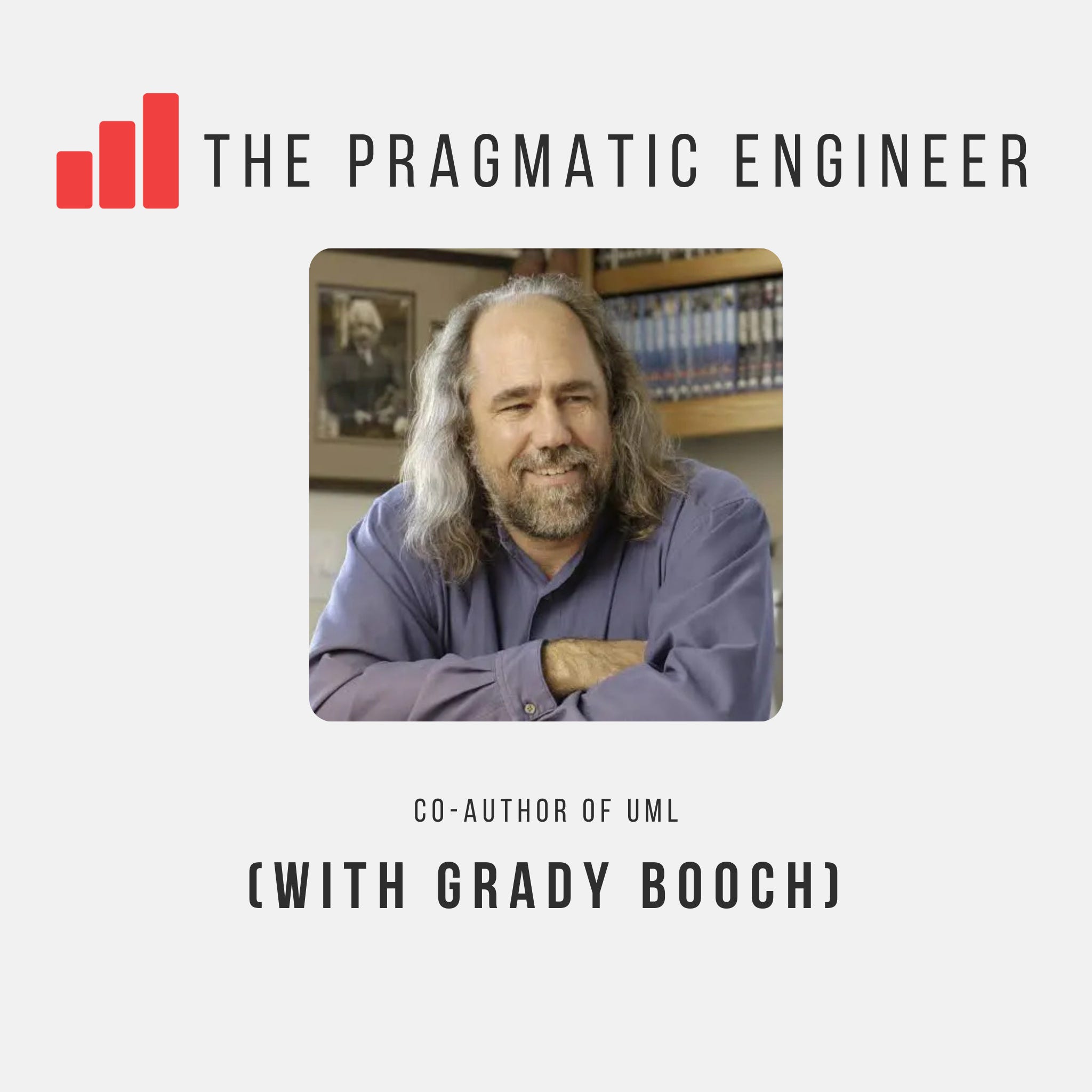
The third golden age of software engineering – thanks to AI, with Grady Booch
About this episode
In this episode, Gergely Orosz interviews Grady Booch about the historical context of AI and automation in software engineering.
Brought to You By: • Statsig — The unified platform for flags, analytics, experiments, and more. • Sonar – The makers of SonarQube, the industry standard for automated code review • WorkOS – Everything you need to make your app enterprise ready. — Every few decades, software engineering is declared “dead” or on the verge of being automated away. We’ve heard versions of this story before. But what if it’s just the start of a new “golden age” of a different type of software engineering, like it has been many times before? In this episode of The Pragmatic Engineer, I’m joined once again by Grady Booch , one of the most influential figures in the history of software engineering, to put today’s claims about AI and automation into historical context. Grady is the co-creator of the Unified Modeling Language, author of several books and papers that have shaped modern software development, and Chief Scientist for Software Engineering at IBM, where he focuses on embodied cognition. Grady shares his perspective on three golden ages of computing since the 1940s, and how each emerged in response to the constraints of its time. He explains how technical limits and human factors have always…
People in this episode
Host: Gergely Orosz
Guest: Grady Booch
Topics covered
- software engineering
- AI
- automation
- history of computing
- human factors
- systems thinking
Keywords
- golden age
- software engineering
- AI
- automation
- Grady Booch
- historical context
- human judgment
Sponsors
Statsig, Sonar, WorkOS
Mentioned in this episode
Organizations: IBM
More episodes of The Pragmatic Engineer
- Designing Data-intensive Applications with Martin Kleppmann
- DHH’s new way of writing code
- Scaling Uber with Thuan Pham (Uber’s first CTO)
- Building WhatsApp with Jean Lee
- From IDEs to AI Agents with Steve Yegge
- Building Claude Code with Boris Cherny
Explore listener stats, chart rankings, contacts and more on the The Pragmatic Engineer podcast page.