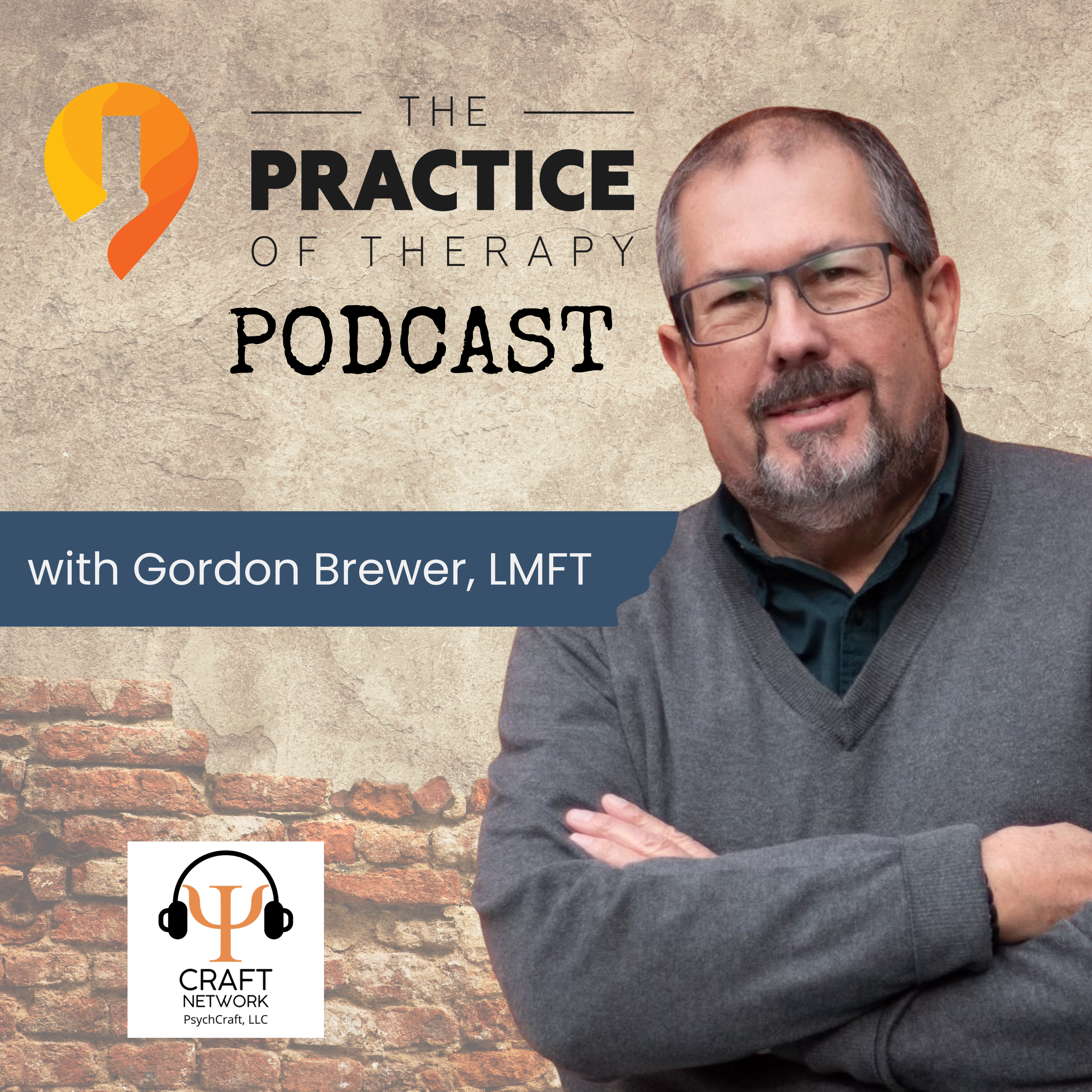
The Practice of Therapy Podcast
by Gordon Brewer, MEd, LMFT: Therapist | Consultant | Writer | Speaker
Is this your podcast?Insights from recent episode analysis
Audience Interest
Podcast Focus
Publishing Consistency
Platform Reach
Insights are generated by CastFox AI using publicly available data, episode content, and proprietary models.
Most discussed topics
Brands & references
Total monthly reach
Estimated from 2 chart positions in 2 markets.
By chart position
- 🇨🇦CA · Careers#7730K to 100K
- 🇺🇸US · Careers#1745K to 30K
- Per-Episode Audience
Est. listeners per new episode within ~30 days
11K to 39K🎙 Daily cadence·435 episodes·Last published 4d ago - Monthly Reach
Unique listeners across all episodes (30 days)
35K to 130K🇨🇦77%🇺🇸23% - Active Followers
Loyal subscribers who consistently listen
14K to 52K
Market Insights
Platform Distribution
Reach across major podcast platforms, updated hourly
Total Followers
—
Total Plays
—
Total Reviews
—
* Data sourced directly from platform APIs and aggregated hourly across all major podcast directories.
On the show
From 10 epsHost
Recent guests
Recent episodes
Building a Private Practice Right Out of Grad School | Jarrod Hoffman | TPOT 437
Jun 22, 2026
Unknown duration
What I'd Do Differently If I Started Private Practice Today | TPOT 436
Jun 15, 2026
Unknown duration
From Imposter Syndrome to Confident Private Practice Owner | Bianca Hughes | TPOT 435
Jun 8, 2026
Unknown duration
How to Make Therapy More Culturally Responsive | Dr. Phebe Brako | TPOT 434
May 25, 2026
Unknown duration
Why Private Practice Looks So Different Now | Lex E Santí | TPOT 433
May 18, 2026
Unknown duration
Social Links & Contact
Official channels & resources
Official Website
Login
RSS Feed
Login
| Date | Episode | Topics | Guests | Brands | Places | Keywords | Sponsor | Length | |
|---|---|---|---|---|---|---|---|---|---|
| 6/22/26 | ![]() Building a Private Practice Right Out of Grad School | Jarrod Hoffman | TPOT 437 | Can you really build a successful private practice right out of grad school? In this episode of The Practice of Therapy Podcast, I talk with Jarrod Hoffman about building a private practice right out of grad school and the lessons he has learned in those early years of practice ownership. Jarrod shares his experience of stepping into private practice, navigating pricing, working through imposter syndrome, and learning how to communicate the value of the work he does. We also talk about why niching matters, how our own stories often shape the clients we feel called to serve, and why private practice requires both strategy and internal growth. This conversation is a great reminder that building a sustainable private practice is not just about getting more clients. It is about knowing your value, understanding the transformation you offer, and creating a practice with intention and purpose. Resources Mentioned In This Episode Subscribe to YouTube Read the show notes here Watch on YouTube Use the promo code "GORDON" to get 2 months of Therapy Notes free Consulting with Gordon The PsychCraft Network Follow us on Instagram Meet Jarrod Hoffman LPC-MHSP, RPT Jarrod Hoffman is a Licensed Professional Counselor-Mental Health Service Provider Temp who works with teens, adults, and families navigating anxiety, depression, grief, addiction, and life transitions. Before becoming a counselor, Jarrod graduated from Covenant College and worked in youth ministry. His own experiences with grief, anxiety, depression, addiction, job loss, and isolation have shaped his passion for helping others find healing and transformation. Jarrod loves walking alongside clients as they grow healthier, feel more empowered, and begin to move through life with greater freedom and hope. Originally from Florida, Jarrod now calls Memphis home. He is married to Katie and enjoys jiu-jitsu, soccer, reading, coffee on rainy days, and bike rides on sunny ones. LinkedIn Website | — | ||||||
| 6/15/26 | ![]() What I'd Do Differently If I Started Private Practice Today | TPOT 436 | When I started my private practice nearly 20 years ago, there were not nearly as many resources available for therapists as there are today. I learned a lot by trial and error, and looking back, there are definitely some things I would do differently. In this episode, I'm sharing what I wish I had known when I first started private practice. One of the biggest lessons I learned is that I made things more complicated than they needed to be. From keeping paper records to waiting too long to outsource, I can see now how simpler systems would have made a big difference early on. I talk about the importance of having a good practice management platform, building your website and SEO, networking in your community, and using tools like AI to help with marketing and systems. I also share why I think it's important not to quit your day job too quickly, how to build financial reserves, and what to think about when deciding between insurance, private pay, or a hybrid model. I also get into the difference between the clinical side and business side of your practice, why those systems need to stay separate, and how learning Profit First can help make your practice more sustainable and profitable. Whether you are just starting private practice or you've been in it for a while, I hope this episode helps you think about how to simplify, plan ahead, and build a practice that supports both your clients and your life. Resources Mentioned In This Episode Subscribe to YouTube Watch on YouTube Use the promo code "GORDON" to get 2 months of Therapy Notes free Consulting with Gordon The PsychCraft Network Follow us on Instagram Therapy Intake Pro Profit First for Therapists Workbook Making Profit First Work For You | — | ||||||
| 6/8/26 | ![]() From Imposter Syndrome to Confident Private Practice Owner | Bianca Hughes | TPOT 435 | Are you charging enough in private practice, or does guilt keep getting in the way? In this episode, Gordon is joined by Bianca Hughes, LPC, therapist, speaker, mentor, and founder of Authentically BU and the Soulful Clinician Collective. Bianca shares how she moved from hospital work into private practice and the mindset shifts that helped her build a career that feels aligned, sustainable, and authentic. Gordon and Bianca talk about money mindset, imposter syndrome, marketing, confidence, and why therapists need to see themselves as both clinicians and business owners. Bianca also shares why it's important to respect the value of your license, ask for help, find community, and do your own personal work along the way. If you've ever struggled with charging your worth, owning your value, or building a private practice without burning out, this conversation is for you. Resources Mentioned In This Episode Subscribe to YouTube Use the promo code "GORDON" to get 2 months of Therapy Notes free Consulting with Gordon The PsychCraft Network Follow us on Instagram Meet Bianca Hughes Bianca Hughes, LPC is a therapist, speaker, mentor, and founder of Authentically BU and the Soulful Clinician Collective. As a Licensed Professional Counselor in Georgia with more than 10 years of experience, Bianca is passionate about helping ambitious mental health clinicians build careers that feel aligned, authentic, and sustainable. Known as a "Soul Aligner," Bianca guides newer clinicians through the challenges of licensure, job searches, salary negotiation, confidence, and career clarity. Through heart-centered community and mentorship, she helps therapists move beyond uncertainty and create a path that honors both their professional goals and their true selves. Bianca has built a thriving private practice rooted in her values, proving that clinicians do not have to chase hustle culture to be successful. Her work has earned recognition, including Richmont Graduate University's 2024 Alumni of the Year award, and she has spoken for conferences and organizations, including Amazon. She has also hosted two podcasts and appeared on more than 37 podcasts as a trusted voice in the mental health field. Therapy Website Instagram LinkedIn Threads Soulful Clinician Collective Website Threads Instagram YouTube Free Quiz | — | ||||||
| 5/25/26 | ![]() How to Make Therapy More Culturally Responsive | Dr. Phebe Brako | TPOT 434 | In this episode, I'm joined by Dr. Phebe Brako for a really thoughtful conversation about what it means to make therapy more culturally responsive. So many of the clinical theories we learn were developed through a Western lens, and while those theories can be helpful, they don't always fit every client, every family system, or every cultural background. Dr. Phebe talks about why therapists need to examine their own worldview, stay curious about their clients' lived experiences, and be willing to adapt the models they use in the therapy room. We talk about culture, family systems, CBT, attachment, mindfulness, and why good therapy is not one-size-fits-all. This is such an important reminder that culturally responsive care is not a box to check. It is an ongoing commitment to learning, listening, and doing the work. Resources Mentioned In This Episode Subscribe to YouTube Watch on YouTube Use the promo code "GORDON" to get 2 months of Therapy Notes free Consulting with Gordon The PsychCraft Network Follow us on Instagram Meet Dr. Phebe Brako Phebe Brako, LMFT, LMHC, NCC, is a licensed therapist, educator, speaker, and host of Between Two Worlds with Dr. Phebe. She is the Founder and CEO of 253 Therapy and Consult, a group therapy practice based in University Place, Washington. Phebe's work focuses on culturally responsive therapy and the ways traditional clinical theories can be adapted to better serve Black, Brown, Indigenous, and other communities of color. She is also passionate about supporting the next generation of therapists through supervision, training, and consultation. Website Instagram Facebook LinkedIn 253 Therapy Summer Training Institute | — | ||||||
| 5/18/26 | ![]() Why Private Practice Looks So Different Now | Lex E Santí | TPOT 433 | Private practice has changed a LOT over the last few years… and therapists are still trying to figure out what comes next. In this episode, Gordon talks with Lex E. Santi about the evolution of therapy after telehealth, online platforms, insurance shifts, and changing client expectations. They dive into why more clinicians are entering private practice, why clients still crave in-person connection, and how companies like BetterHelp, Alma, and Headway are reshaping the profession. They also explore the pressure therapists feel to market themselves, build niches, and create an online presence in a rapidly changing industry. Toward the end of the conversation, Lex shares how writing, narrative therapy, mindfulness, and storytelling intersect in his clinical work and creative life. Resources Mentioned In This Episode Subscribe to YouTube Read the show notes here Watch on YouTube Use the promo code "GORDON" to get 2 months of Therapy Notes free Consulting with Gordon The PsychCraft Network Follow us on Instagram Meet Lex E Santí Lex Enrico Santí is a therapist, clinical supervisor, and the founder of A Key Therapy PLLC, where he works at the intersection of evidence-based practice and the deeper human questions that bring people into therapy in the first place. Trained as a licensed clinical social worker and currently completing his doctorate at the University of Kentucky, Lex brings a grounded, integrative approach to his work — drawing on modalities like CBT, ACT, and mindfulness alongside his own framework for healing he calls the AMI model. The son of Cuban immigrants and a former Peace Corps volunteer in Romania, Lex carries a lifelong fluency in crossing cultures — literally and emotionally. He speaks three languages and brings that same attunement to difference, displacement, and belonging into his clinical work. In the therapy room, he holds space for individuals navigating anxiety, identity, and the transitions that quietly reshape a life. He also supervises emerging clinicians, teaches workshops on meditation and understanding anxiety, and is building A Key Therapy into a group practice rooted in presence, curiosity, and care. He believes that good therapy — like good writing — is about learning to tell a truer story about yourself. Beyond the therapy room, Lex is a published author with an MFA in Creative Writing from George Mason University — the author of four books of poetry and a collection of short stories and essays. A meditator and someone who thinks seriously about the spiritual dimensions of mental health, he lives in the Finger Lakes region of New York with his family. He is a proud husband, father, and has another child on the way. Website Facebook LinkedIn The Song of the Midnight Rider | — | ||||||
| 5/11/26 | ![]() What to Say to Someone Grieving (Most People Get This Wrong) | Shelby Forsythia | TPOT 432 | Grief is something every one of us will face at some point, and yet most of us have no idea what to say when someone is hurting. In this episode, I'm joined by Shelby Forsythia, a grief coach, author, and host of the Grief Grower podcast. Shelby shares her own story of profound loss and how it shaped the work she does today, helping people navigate grief in a way that actually honors what they are going through. We talk about why so many common phrases miss the mark, what grieving people are really experiencing beneath the surface, and how grief doesn't just affect your emotions, it changes your identity. Shelby also breaks down the three simple phrases that can completely shift how you support someone in pain. If you've ever felt unsure of what to say, or worried about saying the wrong thing, this conversation will give you a clearer path forward. Resources Mentioned In This Episode Subscribe to YouTube Watch on YouTube Use the promo code "GORDON" to get 2 months of Therapy Notes free Consulting with Gordon The PsychCraft Network Follow us on Instagram Meet Shelby Forsythia Shelby Forsythia (she/her) is a grief coach, author, and podcast host. In 2020, she founded Life After Loss Academy, an online course and community that has helped dozens of grievers grow and find their way after death, divorce, diagnosis, and other major life transitions. Following her mother's death in 2013, Shelby began calling herself a "student of grief" and now devotes her days to reading, writing, and speaking about loss. Through a combination of mindfulness tools and intuitive, open-ended questions, she guides her clients to welcome grief as a teacher and create meaningful lives that honor and include the heartbreaks they've faced. Her work has been featured in Huffington Post, Bustle, and The Oprah Magazine. Website Grief Grower Podcast Shelby on Instagram | — | ||||||
| 5/4/26 | ![]() What It Really Takes to Run a Profitable Private Practice | Brandy Mabra | TPOT 431✨ | private practiceprofitability+4 | Brandy Mabra | Savvy Clover Coaching & ConsultingThe PsychCraft Network | The Ohio State University | private practiceprofitability+5 | Therapy NotesGORDON | 32m 56s | |
| 4/27/26 | ![]() Why A Lot of Therapists Struggle in Private Practice | Katie Piura | TPOT 430✨ | private practicetherapist mindset+4 | Katie Piura | The PsychCraft Network | Latin AmericaUnited States | private practicetherapist+6 | Therapy NotesGORDON | 30m 33s | |
| 4/20/26 | ![]() How This Simple Method Transforms Private Practice Sessions | Tanya Dantus | TPOT 429✨ | private practicetherapy techniques+4 | Tanya Dantus | The PsychCraft Network | — | RIFRA Methodemotional disconnection+5 | Therapy NotesGORDON | 36m 34s | |
| 4/13/26 | ![]() Are Superbills Worth It in Private Practice? | Mark Florian | TPOT 428✨ | insuranceprivate practice+4 | Mark Florian | Deputy Care | — | superbillsinsurance+5 | — | 28m 48s | |
Want analysis for the episodes below?Free for Pro Submit a request, we'll have your selected episodes analyzed within an hour. Free, at no cost to you, for Pro users. | |||||||||
| 4/6/26 | ![]() Private Pay vs Insurance: What Therapists Get WRONG | Avivit Fisher | TPOT 427✨ | private payinsurance+3 | Avivit Fisher | REdD StrategyThe PsychCraft Network | — | private payinsurance+4 | Therapy NotesGORDON | 34m 26s | |
| 3/30/26 | ![]() Thoughts on AI and Tech Platforms in Private Practice | TPOT 426✨ | AI in therapytechnology in private practice+3 | — | BetterHelpHidden Brain Podcast+2 | — | AIBetterHelp+5 | Therapy NotesGORDON | 41m 19s | |
| 3/23/26 | ![]() Helping Clients Navigate Digital Overwhelm in Private Practice | Eli Singer | TPOT 425✨ | digital overwhelmtechnology+3 | Eli Singer | Wealth & Worth WithinCEO Fina | — | digital overwhelmtechnology habits+3 | — | 30m 39s | |
| 3/16/26 | ![]() How Therapists Can Use Social Media Without Feeling Fake | Jazzmyn Proctor | TPOT 424✨ | social media marketingtherapist visibility+4 | Jazzmyn Proctor | The PsychCraft NetworkWealth & Worth Within+1 | — | social mediatherapists+5 | Therapy NotesGORDON | 24m 32s | |
| 3/9/26 | ![]() Scaling a Private Practice with Intensives, Classes, and Conferences | Dr. Wyatt Fisher | TPOT 423✨ | couples therapymarriage intensives+3 | Dr. Wyatt Fisher | Wealth & Worth WithinCEO Financial Clarity Corner+1 | — | couples therapymarriage intensives+3 | Therapy NotesGORDON | 26m 49s | |
| 3/3/26 | ![]() Doing Couples Therapy as a Husband-and-Wife Team | Kiana & Andrew Joyner | TPOT 422✨ | couples therapyprivate practice+4 | Kiana JoynerAndrew Joyner | The PsychCraft NetworkWealth & Worth Within+1 | — | couples counselingprivate practice+3 | Therapy NotesGORDON | 30m 29s | |
| 2/23/26 | ![]() Diversifying Your Income Without Burning Out | Jenny Melrose | TPOT 421 | If you've ever thought, "There has to be a way to make money in my private practice besides just seeing more clients," this episode is for you. In this conversation, I'm joined by Jenny Melrose, host of the Practice to Profit podcast, and we dive into what it really looks like to diversify your income as a therapist. We talk about moving from one-to-one work into one-to-many offers, creating resources based on the same questions your clients ask over and over, and building income streams that do not require you to be in the therapy room 40 hours a week. Jenny shares practical ideas like workshops, group programs, retreats, train-the-trainer models, and digital products. We also talk about the importance of growing an email list, using SEO the right way, and how AI can help you create content faster without losing your voice. If you are curious about passive income, scaling your expertise, or simply building a private practice that works for your life instead of running it, you will get a lot out of this one. I'm excited for you to meet Jenny and start thinking differently about what is possible in your practice. Resources Mentioned In This Episode Watch on YouTube Use the promo code "GORDON" to get 2 months of Therapy Notes free Consulting with Gordon The PsychCraft Network Meet Jenny Melrose Jenny Melrose helps entrepreneurs stop spinning their wheels and start building profitable, sustainable businesses. As the host of the Practice to Profit podcast, she teaches business owners how to shift from busy work to strategic action using clear plans, simple metrics, and CEO-level decision making. Her work focuses on turning effort into results, without overwhelm or hustle culture. Website Strategic Growth Plan | — | ||||||
| 2/16/26 | ![]() Private Practice Profit Margins: What's Healthy (and What's a Red Flag) | Gretchen Roberts | TPOT 420 | Running a private practice usually means you did not set out to become a numbers person. You are trained to help people, not to read profit and loss statements or stress about tax projections. But the reality is this. If you own a practice, you are running a business. In this episode, I sit down with Gretchen Roberts of Red Bike Advisors to talk about the financial side of private practice in a way that feels practical and doable. We unpack how to use your financial reports as a management tool, what healthy profit margins actually look like, and the payroll mistakes that can quietly drain your profit. We also talk about cash flow and why it is what truly keeps the doors open, especially during the ups and downs that come with business ownership. Since we are in tax season, we cover common tax mistakes, why taxes should not be a once-a-year event, and how to avoid those painful surprises at filing time. If you have ever avoided looking at your numbers or felt unsure about what they are telling you, this conversation will help you think more like a business owner. Your practice needs financial clarity to stay sustainable. And you deserve a business that supports you, not one that burns you out. Resources Mentioned In This Episode Use the promo code "GORDON" to get 2 months of Therapy Notes free Consulting with Gordon The PsychCraft Network Profit First for Therapists Workbook Meet Gretchen Roberts I'm Gretchen Roberts, CEO of Red Bike Advisors, a national tax, accounting, and advisory firm serving healthcare practices, dental practices, and scaling service businesses that need a truly strategic financial partner. Since 2009, we've helped hundreds of practice owners, including dentists, medical practice owners, chiropractors, physical therapists, veterinarians, and alternative medicine practitioners, simplify their finances, optimize profitability, reduce tax burdens, and build businesses that generate real and lasting wealth. Our mission is to help practice owners move from financial stress to becoming Financially Retired by Design by building a business that funds your life, freedom, and future. As a business owner myself, I bring an operator's mindset that blends real-world experience with deep expertise in practice finance, tax strategy, profitability optimization, and exit readiness. At Red Bike Advisors, we provide year-round partnership to healthcare practices generating one to fifteen million dollars in revenue. Our services include proactive accounting, strategic tax planning, financial advisory, and tax-focused wealth building that eliminates financial guesswork and supports long-term growth and exit readiness. Website LinkedIn | — | ||||||
| 2/9/26 | ![]() Treating Neuroplastic Pain in Therapy and Private Practice | Dr. Melissa Tiessen | TPOT 419 | What if chronic pain isn't a sign that your body is broken—but that your nervous system is trying to protect you? In this episode, Dr. Melissa Tiessen, a clinical psychologist and neuroplastic pain specialist, joins the show to unpack a paradigm-shifting way of understanding chronic pain and persistent physical symptoms. Drawing on neuroscience, trauma-informed therapy, and real-world clinical experience, Melissa explains how pain can exist without tissue damage—and why that realization can actually be good news. You'll learn how neuroplastic pain develops, why symptoms can move, change, or intensify without a clear medical cause, and how fear, emotional suppression, and learned nervous system patterns can keep people stuck in cycles of pain and distress. Melissa also shares her own experience with neuroplastic pain, making this conversation deeply human, accessible, and hopeful. Whether you're a therapist, a practice owner, or someone who's been told "you'll just have to live with it," this episode offers a compassionate and science-backed framework for understanding pain, anxiety, and the body's threat response—and what it really means to get unstuck. Resources Mentioned In This Episode Use the promo code "GORDON" to get 2 months of Therapy Notes free Consulting with Gordon The PsychCraft Network Meet Dr. Melissa Tiessen Dr. Melissa Tiessen is a clinical psychologist in private practice, serving clients virtually throughout Ontario, Canada. Her practice focuses on the treatment of chronic pain and other chronic neuroplastic symptoms. She is passionate about health professional education and well-being, and is also the co-founder of Intentional Therapist, a continuing education initiative designed to support mental health therapists in protecting and reclaiming their own well-being. She co-hosts the podcast Putting You In Your Schedule and can be found on LinkedIn quietly creating a self-care revolution. Learn more about Dr. Tiessen: https://linktr.ee/drmelissatiessen | — | ||||||
| 2/2/26 | ![]() Diversifying a Private Practice Through Couples Work | Erin Valente | TPOT 418 | What if couples therapy isn't about fixing the other person at all? In this episode, Gordon sits down with Erin Valente, a couples therapist based in Los Angeles, to talk about one of the most common mistakes couples make when they come to therapy—and why real change doesn't live with one partner, but in the relationship itself. They explore why couples work can feel intimidating for therapists, how regulation and co-regulation shape meaningful conversations, and what it really takes to help couples move out of blame and into connection. Erin also shares how she's structured her private practice to avoid burnout, including her work with ketamine-assisted therapy, groups, and coaching. Whether you work with couples, are curious about relationship dynamics, or are thinking about new ways to diversify your practice, this episode offers a grounded, thoughtful look at what healing in relationships actually looks like. Resources Mentioned In This Episode Read the show notes here Use the promo code "GORDON" to get 2 months of Therapy Notes free Consulting with Gordon The PsychCraft Network Meet Erin Valente Erin Valente is a Licensed Marriage and Family Therapist specializing in trauma-focused therapy for individuals and couples. With advanced training in EMDR, Psychedelic-Assisted Therapy, and somatic and narrative therapy, Erin helps clients reconnect with their inner voice and move toward healing, growth, and authentic connection. A lifelong student of the human experience, Erin explores the intersections of psychology, emotion, and personal wisdom. She believes that while psychology offers valuable direction, true healing emerges when we integrate our own understanding of who we are and what we need. Her approach centers on helping individuals and couples rediscover alignment, resilience, and self-compassion as they navigate life's inevitable challenges—heartbreak, love, loss, and transformation. Drawing from her background in trauma-informed therapy, domestic violence work, and somatic awareness, Erin creates a deeply resonant therapeutic experience that empowers lasting change. She has been featured on multiple podcasts, hosts her own show, and is launching a group coaching program designed to help individuals and couples cultivate passionate, healthy relationships that support the healing of the human experience. Website Instagram Private Podcast: Healing the Human Experience | — | ||||||
| 1/26/26 | ![]() Free Continuing Education for Therapists | Tobin Richardson | TPOT 417 | In today's episode, I'm excited to introduce you to Tobin Richardson, the founder of a platform called Save the Therapist. When I first learned about what Tobin is building, I knew this was something many of you would want to hear about. Continuing education is a requirement for all of us, but let's be honest. It can be expensive, time-consuming, and sometimes hard to fit into an already full schedule. Tobin saw that problem firsthand and decided to do something about it. He created a platform that offers high-quality, accredited continuing education for therapists that is completely free. In this conversation, Tobin shares his background in counselor education, what led him to start Save the Therapist, and how the platform works. We talk about why the podcast format is such a powerful way to learn, how therapists can earn CE credits without added financial pressure, and why accessibility in education matters now more than ever. If you've ever felt overwhelmed by the cost or logistics of earning CE credits, or if you're simply looking for a more practical and user-friendly way to keep learning as a clinician, I think you'll really enjoy this episode. Resources Mentioned In This Episode Use the promo code "GORDON" to get 2 months of Therapy Notes free Consulting with Gordon The PsychCraft Network Profit First for Therapists Workbook Ten Sessions Meet Tobin Richardson, EdD, NCC Tobin Richardson, EdD, NCC, is a counselor educator with a decade of experience building and delivering innovative educational resources to therapists in both community mental health and large VC-backed provider organizations. Since launching in early 2025, his NPR-style CE platform, Save the Therapist, has garnered over 4,000 therapist registrants and more than 7,000 course completions. Website Instagram | — | ||||||
| 1/19/26 | ![]() Preventing Burnout in Private Practice | Dr. Julie Merriman | TPOT 416 | There are some conversations you record where you know right away that they're going to land differently. In today's episode, I sit down with Dr. Julie Merriman, a therapist, professor, and longtime advocate for helpers who are quietly burning out. We talk about something that hits close to home for many of us in this profession: what happens when we're really good at helping everyone else, but don't know how to receive ourselves. Julie shares how so many therapists become what she calls "floating heads of competence." We're full of knowledge, skill, and clinical insight, yet deeply disconnected from our bodies, our needs, and our sense of purpose beyond performance. We talk honestly about burnout, compassion fatigue, money, boundaries, nervous system regulation, and why private practice itself isn't what burns us out. Disconnection is. This isn't a conversation about working harder or pushing through. It's about staying human in a profession that asks a lot of us, and learning how to stay in it without losing ourselves. If you've ever felt tired in a way that rest doesn't fix, this episode is for you. Resources Mentioned In This Episode Read the show notes here Watch on YouTube Use the promo code "GORDON" to get 2 months of Therapy Notes free Consulting with Gordon The PsychCraft Network Profit First for Therapists Workbook Meet Dr. Julie Merriman Dr. Julie Merriman is a licensed professional counselor, counselor educator, professor, and author, and the voice behind From Burnout to Freedom—a movement helping high-achieving women in healthcare over 50 heal from burnout and reclaim their freedom. With more than 30 years of experience in clinical practice and counselor education, Dr. Merriman has trained hundreds of emerging therapists, served as an associate dean, department director, and clinical coordinator, and led CACREP accreditation work. Her scholarship and teaching span compassion fatigue, burnout, trauma-informed care, polyvagal theory, spiritual integration, and the lived experience of long-term helpers. After experiencing a profound, career-shaping burnout that ultimately contributed to her breast cancer diagnosis, Dr. Merriman rebuilt her life and work from the inside out. Today, she blends neuroscience, embodiment practices, and decades of clinical wisdom to guide women healers through identity transitions, emotional exhaustion, and the "scorched earth" season that often arrives after 50. Her podcast, From Burnout to Freedom, offers honest conversations and research-backed strategies for women who have spent a lifetime caring for everyone else and are finally ready to reclaim creativity, joy, and purpose. Dr. Merriman brings a relatable, deeply human presence to every interview. She combines academic rigor with ranch-life storytelling, humor, and a fierce commitment to helping helpers heal. Website Instagram YouTube LinkedIn Facebook | — | ||||||
| 1/12/26 | ![]() When Narcissism Walks Into Your Therapy Office | Dr. Anthony Mazzella | TPOT 415 | If you've ever found yourself thinking, "Why is this client so hard to reach?" or "Why does every conversation turn into a power struggle?" this episode is for you. Today, I'm joined by Dr. Anthony Mazzella, a psychoanalyst who specializes in working with narcissistic dynamics. We go far beyond surface-level conversations about narcissism. This isn't about labels, buzzwords, or quick fixes. It's about what's actually happening underneath the behavior and what truly helps. We talk about why arguing over "reality" never works, why confrontation often backfires, and how curiosity, containment, and staying with the process can completely change the way therapists work with narcissistic clients and how partners survive narcissistic relationships. Whether you're a therapist sitting with these dynamics in the room, a supervisor guiding clinicians through complex cases, or someone trying to understand a relationship that feels confusing and exhausting, this conversation offers a grounded and compassionate framework for understanding narcissism. This is one of those episodes that stays with you, and I'm really glad to share it with you today. Resources Mentioned In This Episode Read the show notes here Watch on YouTube Use the promo code "GORDON" to get 2 months of Therapy Notes free Consulting with Gordon The PsychCraft Network Profit First for Therapists Workbook Meet Dr. Mazzella As a leader and expert in the field, Dr. Mazzella holds various clinical positions, including, but not limited to, treating patients in his private practice, training professionals at two post-graduate training institutes, conducting research, and lecturing across the country. While his focus with his patients is psychodynamic in nature, his main goals are to build a trusting relationship and help each patient reduce the frequency and intensity of their emotionally painful thoughts and suffering. He helps his patients overcome both acute and long-standing problems that may be more embedded in their personality. Website Instagram Podcast Facebook LinkedIn YouTube | — | ||||||
| 1/10/26 | ![]() The Unconventional Path: Why Your Practice Doesn't Need Another Resolution | TPOT 414 | As we step into a new year, many of us feel it—that quiet but persistent pressure to do more, fix more, and somehow have everything figured out right now. New goals, new systems, bigger numbers—and for practice owners, that pressure can feel especially heavy and often pretty lonely. In today's episode, I want to invite you to think about January differently—not as a month for pushing harder or becoming more efficient, but as a chance to slow down and get honest about what you can actually hold. Drawing on Barbara Brown Taylor's Home by Another Way and Oliver Burkeman's 4,000 Weeks, we'll talk about burnout, the efficiency trap, and why things don't magically get easier "once we get there." This conversation is about reconnecting with your why, redefining what growth really means, and considering what it might look like to go home by another way this year—one that creates more space, alignment, and sustainability in your practice and your life. Resources Mentioned In This Episode Use the promo code "GORDON" to get 2 months of Therapy Notes free Consulting with Gordon The PsychCraft Network Profit First for Therapists Workbook Home By Another Way Four Thousand Weeks | — | ||||||
| 12/22/25 | ![]() How AI Can Transform Private Practice Marketing | Greg Goodman | TPOT 413 | I am so excited for today's episode because we're diving into one of the most transformative tools in private practice right now: AI. And joining me is someone who has been living at the intersection of mental health, creativity, and digital marketing for nearly two decades—Greg Goodman of Goodman Creatives. Greg isn't a therapist, but his story is rooted deeply in the world of mental health. Inspired by his father's work as a clinician, he built a career helping therapists share their voice, grow their practices, and create meaningful impact through smart, authentic marketing. Today, he runs an international creative agency that exists to support helpers—and now he's leaning all the way into how AI can make marketing more accessible than ever. In our conversation, Greg and I talk about the real, practical ways therapists can use AI to save time, generate powerful copy, create content with confidence, and stand out in a growing field. We also explore the ethical concerns around AI, the importance of keeping our humanity in the process, and how to train AI to actually sound like you. If you've been curious—or even hesitant—about how AI fits into your private practice, this episode is going to open your eyes to what's possible. Greg brings a blend of heart, tech wisdom, and decades of industry experience, and I can't wait for you to learn from him. Resources Mentioned In This Episode Read the show notes here Watch on YouTube Use the promo code "GORDON" to get 2 months of Therapy Notes free Consulting with Gordon The PsychCraft Network Profit First for Therapists Workbook Meet Greg Goodman Greg Goodman is a marketing and web design expert with two decades of experience helping therapists grow thriving practices. With a deep understanding of the mental health industry, Greg specializes in creating authentic, client-centered marketing strategies that resonate with both therapists and the people they serve. His passion for visual storytelling plays a key role in his work, as he believes powerful imagery can make a therapist's message more relatable and emotionally impactful. Driven by a calling to "help the helpers," Greg's dream is to positively impact the mental health of more than 1,000,000 people around the world. As the founder of Goodman Creatives, he combines artistry and strategy through thoughtful web design, empathetic copywriting, ethical AI, and photographic storytelling—helping therapists feel confident, reduce overwhelm, and build practices that thrive long term. Website Facebook Instagram | — | ||||||
Showing 25 of 443
Pitch Fit is a Pro feature
See how bookable this show is for guests, which brands already advertise, the per-episode ad value, and the best-fit guest and sponsor profile. The numbers are blurred on the free plan.
How readily this show books outside guests like you.
How proven this show is for host-read sponsorships.
For Guests
ProFor Advertisers
ProUpgrade to Pro to unlock guest cadence, sponsor categories, fit scores, and per-episode ad value for this show.
Chart Positions
2 placements across 2 markets.
Chart Positions
2 placements across 2 markets.


