
The Science of Happiness
by PRX and Greater Good Science Center
Is this your podcast?On the show
From 33 epsHosts
Recent guests
Recent episodes
Happiness Break: A Breathing Technique to Help You Relax
Oct 15, 2026
8m 38s
How to Breathe Away Anxiety
Oct 8, 2026
24m 06s
Happiness Break: A Practice In Appreciating Your Friends
Oct 1, 2026
9m 28s
How Smell Shapes Memory
Sep 24, 2026
26m 24s
Happiness Break: A Meditation on the Uniqueness of Your Voice
Sep 17, 2026
8m 07s
Insights from recent episode analysis
Audience Interest
Podcast Focus
Publishing Consistency
Platform Reach
Insights are generated by CastFox AI using publicly available data, episode content, and proprietary models.
Most discussed topics
Brands & references
Total monthly reach
Based on 1 signal.
Built from
By chart position
- 🇺🇸United States · Social SciencesHOME#8724K to 3.8M
- 🇨🇦Canada · Social Sciences#555K to 290K
- 🇮🇳India · Social Sciences#742K to 222K
- 🇬🇧United Kingdom · Social Sciences#1135K to 184K
- 🇦🇺Australia · Social Sciences#1412K to 66K
- Per-Episode Audience
Est. listeners per new episode within ~30 days
989K to 5.2M🎙 ~2x weekly·350 episodes·Last published 4d ago - Monthly Reach
Unique listeners across all episodes (30 days)
2.0M to 10M🇺🇸73%🇨🇦6%🇮🇳4%+10 more - Active Followers
Loyal subscribers who consistently listen
1.1M to 5.8M
Market Insights
Platform Distribution
Reach across major podcast platforms, updated hourly
Total Followers
—
Total Plays
—
Total Reviews
—
* Data sourced directly from platform APIs and aggregated hourly across all major podcast directories.
Social Links & Contact
Official channels & resources
Official Website
Login
RSS Feed
Login
| Date | Episode | Topics | Guests | Brands | Places | Keywords | Sponsor | Length | |
|---|---|---|---|---|---|---|---|---|---|
| 10/15/26 |  Happiness Break: A Breathing Technique to Help You Relax | Dr. David Spiegel leads us in a practice of cyclic sighing, a simple breathing technique that uses slow, extended exhales to calm your nervous system, ease stress and anxiety, and help you feel more relaxed.How To Do This Practice: Prepare: Find a comfortable seated or standing position in a quiet environment. Relax your shoulders and jaw. First Inhale: Inhale slowly and deeply through your nose. Start with your abdomen, allowing it to expand (diaphragmatic breathing) as you fill your lungs about halfway. Hold this breath briefly. Second Inhale: Continue inhaling through your nose, now expanding your chest to completely fill your lungs. Hold this combined breath (abdomen and chest filled) for a moment. Exhale: Exhale slowly and completely through your mouth. Make sure the exhale is gentle and lasts about twice as long as the combined inhales. Repeat the Cycle: Repeat the inhale sequence for a total of 3 cycles (or as desired): Start with a diaphragmatic inhale through your nose, expanding your abdomen. Follow with a chest expansion inhale through your nose to fill your lungs completely. Hold briefly after each combined inhale. Exhale slowly and completely through your mouth, ensuring it's twice as long as the inhales. Reflect and Relax: After completing the cycles, take a moment to observe how your body feels. Notice any sensations of relaxation, reduced tension, or a calmer state of mind. The Science of Happiness, is a Top 5 finalist in the Signal Awards for a series about how cities can inspire awe. We’d love your vote! Vote for The Science of Happiness here. Email us at [email protected] with a screenshot of your vote for a chance to win a signed copy of host Dacher Keltner’s book, Awe: The New Science of Everyday Wonder and How It Can Transform Your Life. Today’s Guide:DR. DAVID SPIEGEL is Willson Professor and Associate Chair of Psychiatry & Behavioral Sciences at Stanford University School of Medicine. He is also the co-founder of the clinically backed self-hypnosis app Reveri. Read Dr. Spiegel’s cyclic sighing study here: https://pubmed.ncbi.nlm.nih.go...Related Happiness Break Episodes:A Mindful Breath Meditation: https://tinyurl.com/5b454xu9A Humming Technique To Calm Your Nerves: https://tinyurl.com/tyhwkwe2Related Science of Happiness Episodes:The Science of Humming: https://tinyurl.com/yvedc8z3How To Breathe Away Anxiety: https://tinyurl.com/3taj9ybeWe’d love to hear about your experience with this practice! Share your thoughts at [email protected] or use the hashtag #happinesspod.Find us on Apple Podcasts: https://tinyurl.com/2p9h5aapHelp us share Happiness Break! Leave a 5-star review and share this link: https://tinyurl.com/2p9h5aapTranscription: https://tinyurl.com/fmk63bjw | 8m 38s | ||||||
| 10/8/26 | 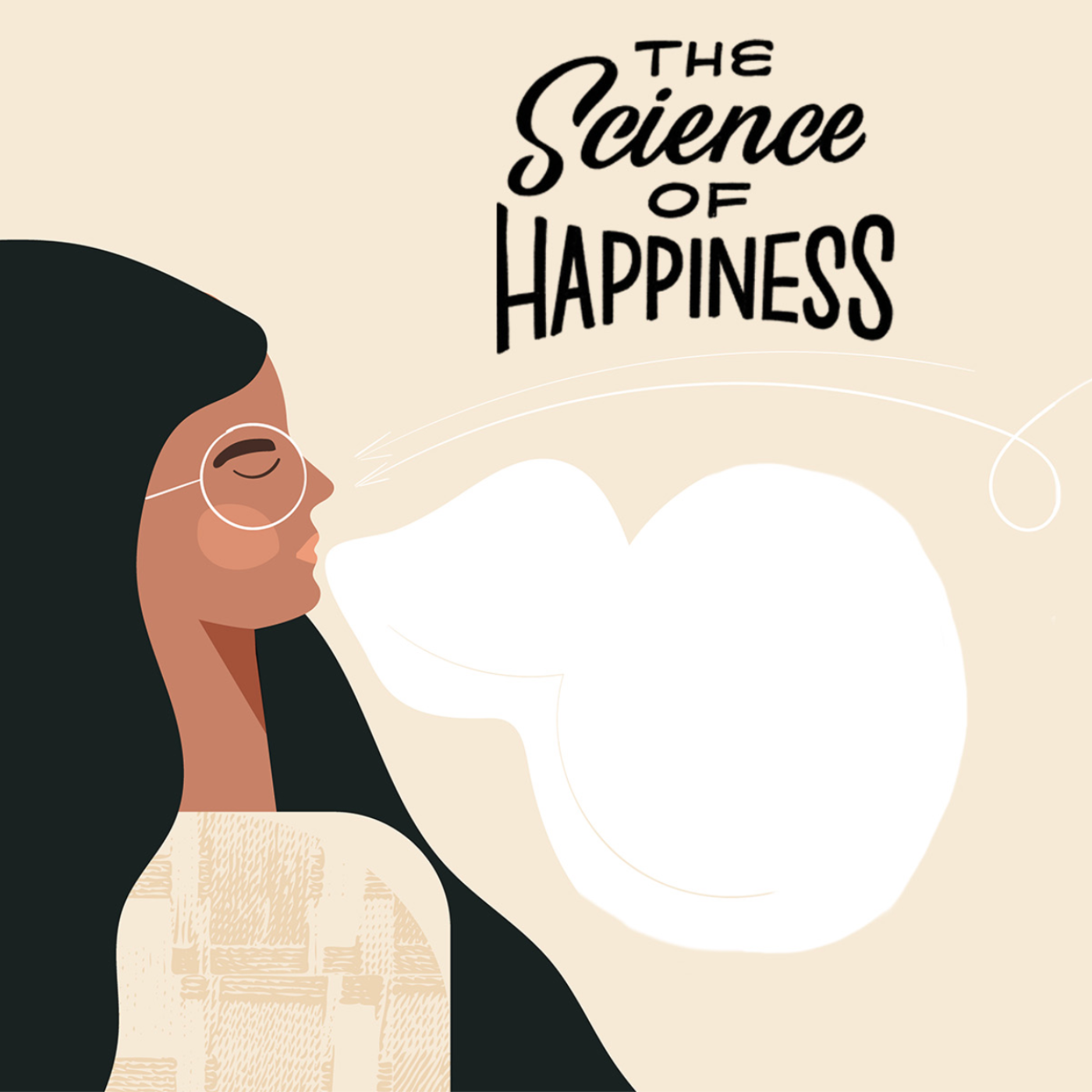 How to Breathe Away Anxiety | Explore how cyclic sighing, a simple controlled breathing technique, can help reduce anxiety, promote relaxation, and bring greater calm to everyday stressful moments.Summary: In this episode of The Science of Happiness, professional surfer and chemistry professor Sarah Gerhardt shares how she uses cyclic sighing to manage anxiety and stress in everyday situations. Then Stanford psychologist David Spiegel explains the science behind the technique and how five minutes of daily practice can improve mood and lower respiratory rate. Together, they explore how controlled breathing can help us shift our body’s response to stress and feel calmer in moments of overwhelm. How To Do This Practice: Prepare: Find a comfortable seated or standing position in a quiet environment. Relax your shoulders and jaw. First Inhale: Inhale slowly and deeply through your nose. Start with your abdomen, allowing it to expand (diaphragmatic breathing) as you fill your lungs about halfway. Hold this breath briefly. Second Inhale: Continue inhaling through your nose, now expanding your chest to completely fill your lungs. Hold this combined breath (abdomen and chest filled) for a moment. Exhale: Exhale slowly and completely through your mouth. Make sure the exhale is gentle and lasts about twice as long as the combined inhales. Repeat the Cycle: Repeat the inhale sequence for a total of 3 cycles (or as desired). Start with a diaphragmatic inhale through your nose, expanding your abdomen. Follow with a chest expansion inhale through your nose to fill your lungs completely. Hold briefly after each combined inhale. Exhale slowly and completely through your mouth, ensuring it's twice as long as the inhales. Reflect and Relax: After completing the cycles, take a moment to observe how your body feels. Notice any sensations of relaxation, reduced tension, or a calmer state of mind. Scroll down for a transcription of this episode.The Science of Happiness is a Top 5 finalist in the Signal Awards for our series on how cities can inspire awe, and we’d love your vote! Find the voting link here or on our Instagram page, @scienceofhappinesspod.Then email [email protected] with a screenshot of your vote for a chance to win a signed copy of host Dacher Keltner’s book, Awe: The New Science of Everyday Wonder and How It Can Transform Your Life.Today’s Guests:SARAH GERHARDT is a pro-surfer and chemistry professor based out of Santa Cruz, California DR. DAVID SPIEGEL is Willson Professor and Associate Chair of Psychiatry & Behavioral Sciences at Stanford University School of Medicine. He is also the co-founder of the clinically backed self-hypnosis app Reveri. Message us or leave a comment on Instagram @scienceofhappinesspod. E-mail us at [email protected] or use the hashtag #happinesspod.Help us share The Science of Happiness! Leave us a 5-star review on Apple Podcasts or share this link with someone who might like the show: https://tinyurl.com/2p9h5aapTranscription: https://tinyurl.com/3u69tefe | 24m 06s | ||||||
| 10/1/26 |  Happiness Break: A Practice In Appreciating Your Friends | Take a moment to appreciate the friends who know you, support you, and make your life richer with their presence, with author Alex Elle.How To Do This Practice: Take a few deep breaths: Inhale through your nose and exhale slowly, relaxing your shoulders and jaw. Bring a friend to mind: Think of someone who has become an important part of your life. Remember how they’ve known you: Reflect on the stories, experiences, and versions of yourself that this person has witnessed. Notice the ordinary moments: Bring to mind a laugh, conversation, meal, road trip, or small gesture that captures your friendship. Feel your gratitude: Let yourself appreciate what it means to be seen, remembered, supported, and accepted by a friend. Consider how you can show you care: Think of one small way you can tend to the friendship, whether by reaching out, checking in, or simply telling them you appreciate them. Scroll down for a transcription of this episode.The Science of Happiness is a Top 5 finalist in the Signal Awards for our series on how cities can inspire awe, and we’d love your vote! Find the voting link here or on our Instagram page, @scienceofhappinesspod.Then email [email protected] with a screenshot of your vote for a chance to win a signed copy of host Dacher Keltner’s book, Awe: The New Science of Everyday Wonder and How It Can Transform Your Life.Today’s Guide:ALEX ELLE is a breathwork coach, author and restorative writing teacher.www.alexelle.com/aboutRelated Happiness Break episodes:A Meditation on Original Love and Interconnectedness:https://tinyurl.com/mu2uzs2cOur Deep Interconnectedness: https://tinyurl.com/y2epxyxnMaking Space for You, with Alex Elle: https://tinyurl.com/45arsb76Related Science of Happiness episodes:Why Compassion Requires Vulnerability: https://tinyurl.com/mrxsad33When It's Hard To Connect, Try Being Curious: https://tinyurl.com/mr32nwtvThe Contagious Power of Compassion: https://tinyurl.com/y6bpvbv5We’d love to hear about your experience with this practice! Share your thoughts at [email protected] or use the hashtag #happinesspod.Find us on Apple Podcasts: https://tinyurl.com/2p9h5aapHelp us share Happiness Break! Leave a 5-star review and share this link: https://tinyurl.com/2p9h5aapTranscription: https://tinyurl.com/mvhnrk5b | 9m 28s | ||||||
| 9/24/26 |  How Smell Shapes Memory | Discover how our sense of smell can transport us back to meaningful memories, shape our emotions, and influence the brain systems involved in memory and mood.Summary: Smell is one of our most powerful and underappreciated senses, with a unique ability to evoke memories and emotions. On this episode of The Science of Happiness, we look at the science behind smell’s close relationship with memory, emotion, and our environment and we explore how paying attention to the scents around us can bring us back into our bodies and help us feel more connected to the present moment. How To Do This Practice: Step outside: Spend 10–15 minutes somewhere you can notice natural scents, such as a park, garden, or neighborhood. Breathe through your nose: Take a few slow breaths in through your nose and notice the scents carried in the air. Pay attention: Notice what catches your attention; don’t be concerned with trying to identify smells Follow your curiosity: Move toward different plants, trees, flowers, or other natural elements and see how their scents change. Notice what comes up: Pay attention to any memories, emotions, or sense of place that a particular scent evokes. Stay present: Take a moment to appreciate the experience and notice how you feel after giving your sense of smell your full attention. Scroll down for a transcription of this episode.The Science of Happiness is a Top 5 finalist in the Signal Awards for our series on how cities can inspire awe, and we’d love your vote! Find the voting link here or on our Instagram page, @scienceofhappinesspod.Then email [email protected] with a screenshot of your vote for a chance to win a signed copy of host Dacher Keltner’s book, Awe: The New Science of Everyday Wonder and How It Can Transform Your Life.Today’s Guests:SAMIN NOSRAT is a chef, TV Host, and best selling author of the book "Salt, Fat, Acid, Heat."ciaosamin.comLUCIA JACOBS is a Professor Emerita of Psychology at UC Berkeley. psychology.berkeley.edu/people/lucia-f-jacobsRelated Science of Happiness episodes:What Humans Can Learn From Trees: https://tinyurl.com/48te84psAre You Remembering the Good Times: https://tinyurl.com/ysbwrnr4Related Happiness Break episodes:How to Be in Harmony in Nature—Wherever You Are, With Yuria Celidwen: https://tinyurl.com/5n6pfsn2How To Ground Yourself in Nature: https://tinyurl.com/25ftdxpmMessage us or leave a comment on Instagram @scienceofhappinesspod. E-mail us at [email protected] or use the hashtag #happinesspod.Help us share The Science of Happiness! Leave us a 5-star review on Apple Podcasts or share this link with someone who might like the show: https://tinyurl.com/2p9h5aapTranscription: https://tinyurl.com/368p4u5v | 26m 24s | ||||||
| 9/17/26 |  Happiness Break: A Meditation on the Uniqueness of Your Voice | In celebration of Latinx Heritage Month, embrace the beauty of your accent in this self-compassion meditation. Mindfulness and meditation teacher Criss Cuervo invites you to reflect on your history, heritage, and connection to your ancestors.How To Do This Practice: Find a Comfortable Position: Sit in a relaxed yet alert posture, either on a cushion or chair. Gently lower your gaze or close your eyes if that feels comfortable. Focus on Your Breath: Take a deep breath in and slowly exhale. Allow yourself to transition from your daily activities into this moment of reflection. Acknowledge Your Accent: Bring awareness to the way you speak, recognizing that your voice carries your history, culture, and personal journey. Repeat Self-Compassion Phrases: Silently or aloud, repeat affirmations such as, “my accent makes me unique,” “my accent carries my story,” “my accent connects me to my ancestors.” Place a Hand on Your Heart: If it feels right, gently place a hand on your heart, offering yourself warmth and kindness as you continue to breathe deeply. Close with Gratitude: Take a final deep breath, sending appreciation to yourself, your ancestors, and the uniqueness of your voice before gently opening your eyes. Scroll down for a transcription of this episode.The Science of Happiness is a Top 5 finalist in the Signal Awards for our series on how cities can inspire awe, and we’d love your vote! Find the voting link here or on our Instagram page, @scienceofhappinesspod.Then email [email protected] with a screenshot of your vote for a chance to win a signed copy of host Dacher Keltner’s book, Awe: The New Science of Everyday Wonder and How It Can Transform Your Life.Today’s Happiness Break Guide:CRISS CUERVO is a mindfulness and meditation teacher, Bridging Differences Coordinator at the Greater Good Science Center, and author of PERTENÆCER: Eight-Week Mindfulness and Meditation Training and Practices for Latinx Immigrants in the United. Learn more about Criss Cuervo here: https://tinyurl.com/4npjwn6mRead her book here: https://tinyurl.com/3byby84bRelated Happiness Break episodes:A Meditation on Original Love: https://tinyurl.com/5u298cv4Loving Kindness Meditation: https://tinyurl.com/2kr4fjz5Follow us on Instagram: @ScienceOfHappinessPodWe’d love to hear about your experience with this practice! Share your thoughts at [email protected] or use the hashtag #happinesspod. Find us on Apple Podcasts: https://tinyurl.com/2p9h5aapHelp us share Happiness Break! Leave a 5-star review and share this link: https://tinyurl.com/2p9h5aapTranscription: https://tinyurl.com/5fdce47a | 8m 07s | ||||||
| 9/10/26 | neuroplasticitybrain health+3 | CRYSTAL LEWIS | — | — | memoryneuroplasticity+5 | — | 25m 48s | ||
| 9/3/26 | Buddhist meditationappreciative joy+3 | Anushka Fernandopulle | — | — | Muditajoy+5 | — | 4m 55s | ||
| 9/2/26 | public artcommunity identity+3 | Cita Sadeli | PRXGreater Good Science Center | — | public artCita Sadeli+5 | — | 37m 36s | ||
| 8/27/26 | small talkwellbeing+3 | — | — | — | small talkwellbeing+5 | — | 24m 11s | ||
| 8/20/26 | mindfulnessstress reduction+3 | Jonathan Relucio | — | — | mindful movementbreathing+3 | — | 8m 51s | ||
| 8/13/26 | joyconnection+3 | Ross Gay | The Science of HappinessPRX+1 | — | joyconnection+5 | — | 15m 08s | ||
| 8/6/26 | meditationembodied awareness+3 | Spring Washam | Greater Good Science CenterPRX+1 | — | body scanmeditation+6 | — | 10m 54s | ||
| 7/30/26 | social supportmentorship+3 | Danny MurilloGilbert Murillo+1 | Social Mobility LabGreater Good Science Center+1 | — | successmentorship+3 | — | 20m 03s | ||
| 7/23/26 | embodiment practicecompassion+3 | Lyla June Johnston | DinéGreater Good Science Center | — | compassiondifficult emotions+3 | — | 10m 26s | ||
| 7/16/26 | revengeforgiveness+4 | James Kimmel Jr. | Yale School of Medicine | — | revengeforgiveness+5 | — | 23m 18s | ||
| 7/9/26 | meditationanger management+3 | Eve Ekman | — | — | meditationanger+4 | — | 7m 25s | ||
| 7/2/26 | climate actionjoy+4 | Elizabeth DunnJiaying Zhao | The Science of HappinessPRX+1 | — | climate-friendly habitsjoy+5 | — | 22m 26s | ||
| 6/25/26 | personal journeysautobiographical writing+3 | Dr. Lyla June Johnston | — | — | happinessreflection+3 | — | 9m 27s | ||
| 6/18/26 | awewonder+4 | Dorien DaviesHalle Stanford | PBS Kids | — | awewonder+6 | — | 23m 25s | ||
| 6/11/26 | self-compassionmental health+3 | Kristin Neff | University of Texas at Austin | — | self-judgmentcompassion+3 | — | 9m 58s | ||
| 6/10/26 | health inequitiesdiagnostic tools+3 | — | New England Journal of Medicine | — | health inequitiesdiagnostic tools+3 | — | 25m 01s | ||
| 6/4/26 | communicationempathy+4 | — | The Science of HappinessPRX+1 | — | empathylistening skills+5 | — | 23m 44s | ||
| 5/28/26 | walking meditationmindfulness+3 | — | 10% HappierGreater Good Science Center+1 | — | walking meditationmindfulness+3 | — | 7m 00s | ||
| 5/21/26 | anxietywalking meditation+3 | Raina Telgemeier | The Science of HappinessPRX+1 | — | anxietywalking meditation+5 | — | 21m 46s | ||
| 5/14/26 | art appreciationmindfulness+4 | Nathalie Ryan | National Gallery of Art | Washington D.C. | slow lookingart+6 | — | 8m 37s | ||
| 5/12/26 | lovelife stages+3 | — | Stories from a Stranger | — | lovestrangers+5 | — | 48m 40s | ||
| 5/7/26 | artslow looking+4 | — | Nevada Museum of Art | — | slow lookingart appreciation+3 | — | 26m 42s | ||
| 4/30/26 | meditationinspiration+3 | — | — | — | happinessmeditation+5 | — | 7m 40s | ||
| 4/23/26 | aweurban spaces+4 | BOB MCKINNON | City University of New York | Harlem | awe walkurban exploration+5 | — | 20m 59s | ||
| 4/16/26 | loving-kindnessself-care+3 | Kristin Neff | — | — | loving-kindnessself-compassion+3 | — | 9m 09s | ||
| 4/9/26 | urban designpublic spaces+4 | BLAINE MERKERSETHA LOW | GehlCity University of New York+1 | San Francisco | parkleturban design+5 | The Gambrell Foundation | 24m 22s | ||
| 4/2/26 | uncertaintypoetic reflection+3 | Yrsa Daley-Ward | The Catch | — | happinessuncertainty+3 | — | 3m 57s | ||
| 3/31/26 | poetryneuroscience+3 | SUSAN MAGSAMEN | Your Brain On Art: How the Arts Transform UsJohn Hopkins | — | poetryneuroscience+3 | — | 17m 15s | ||
| 3/26/26 | collective workteam dynamics+3 | NINO SERRANOJENABI PAREJA+1 | UnderstoryPangea Legal Services+1 | Oakland | collective decision-makingworker-owned restaurant+3 | — | 25m 48s | ||
| 3/19/26 | meditationstress relief+3 | — | Greater Good Science CenterGGSC | — | meditationto-do list+5 | — | 5m 23s | ||
| 3/12/26 | neurosciencemusical improvisation+4 | — | PRX and Greater Good Science Center | — | improvisationcreativity+6 | — | 21m 54s | ||
| 3/5/26 | meditationcuriosity+3 | Scott Shigeoka | — | — | meditationcuriosity+3 | — | 8m 32s | ||
| 2/26/26 | Job Craftingwork satisfaction+4 | — | PRX and Greater Good Science Center | — | Job Craftingwork satisfaction+6 | — | 16m 25s | ||






















Showing 38 of 350
Pitch Fit is a Pro feature
See how bookable this show is for guests, which brands already advertise, the per-episode ad value, and the best-fit guest and sponsor profile. The numbers are blurred on the free plan.
How readily this show books outside guests like you.
How proven this show is for host-read sponsorships.
For Guests
ProFor Advertisers
ProUpgrade to Pro to unlock guest cadence, sponsor categories, fit scores, and per-episode ad value for this show.
Similar Audience Demographics
Podcasts that attract a similar listener profile

The Happiness Lab with Dr. Laurie Santos
Pushkin Industries

10% Happier with Dan Harris
10% Happier

Untangle
Untangle

Hidden Brain
Hidden Brain, Shankar Vedantam

A Slight Change of Plans
Pushkin Industries

The One You Feed | Personal Growth, Emotional Resilience & Purpose
Eric Zimmer
Being Well with Forrest Hanson and Dr. Rick Hanson
Rick Hanson, Ph.D., Forrest Hanson
Chart history for The Science of Happiness
Peaked at #2 in GR, top 10 in 12 of 50 tracked markets, currently #2 in GR.
| Market | Genre | Peak | Current | Trend |
|---|---|---|---|---|
| GR | — | #2 | #2 | — |
| IS | — | #4 | #4 | — |
| RO | — | #4 | #4 | — |
| PH | — | #4 | #4 | — |
| Canada | — | #5 | #5 | — |
| SA | — | #7 | #7 | — |
| India | — | #7 | #7 | — |
| United States | — | #8 | #8 | — |
| Ireland | — | #10 | #10 | — |
| Denmark | — | #10 | #10 | — |
| MY | — | #10 | #10 | — |
| KE | — | #10 | #10 | — |
| United Kingdom | — | #11 | #11 | — |
| PE | — | #11 | #11 | — |
| New Zealand | — | #12 | #12 | — |
| PT | — | #12 | #12 | — |
| Japan | — | #12 | #12 | — |
| HU | — | #13 | #13 | — |
| PH | — | #13 | #13 | — |
| Australia | — | #14 | #14 | — |
Chart Positions
50 placements across 43 markets.
Chart Positions
50 placements across 43 markets.