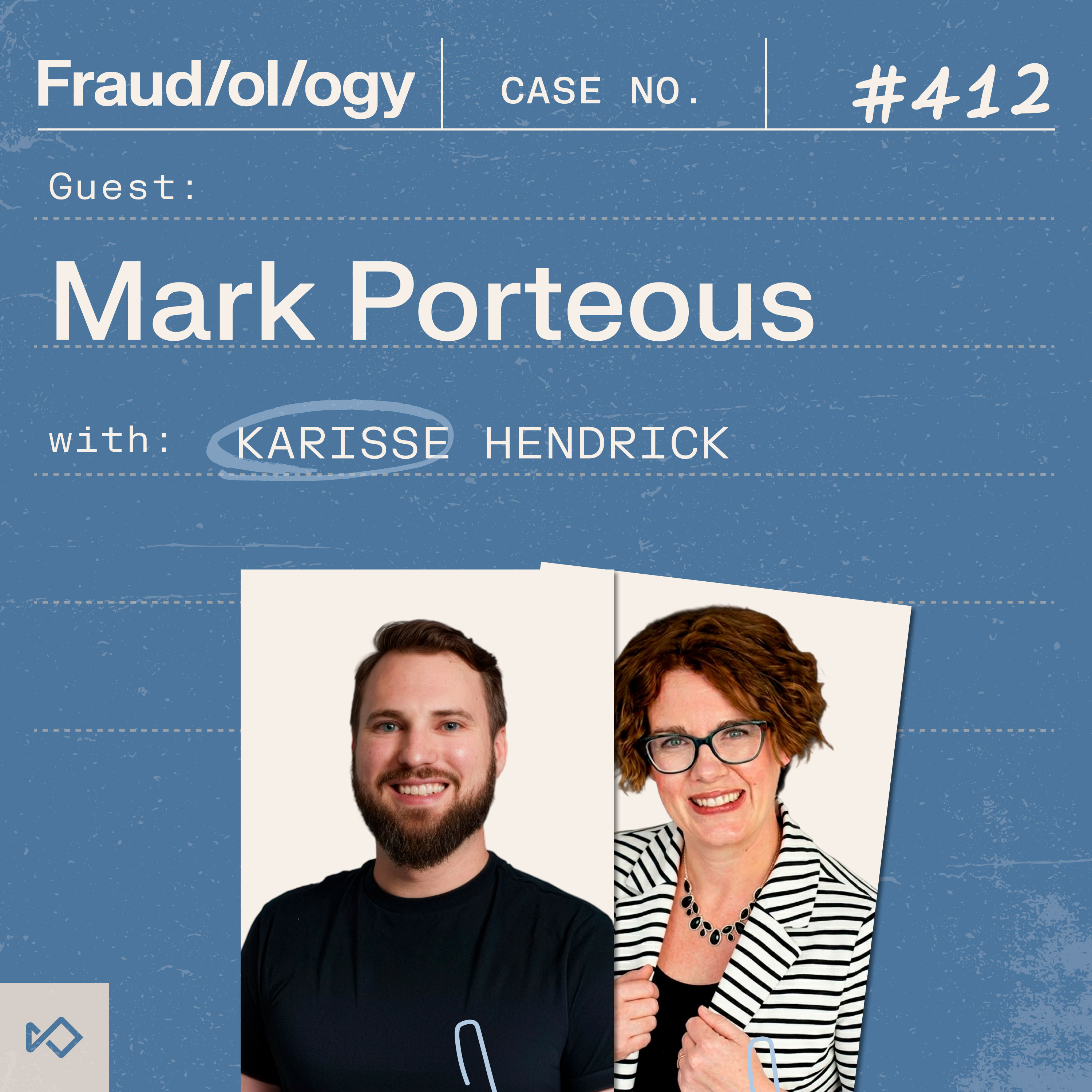
Fraudology Podcast with Karisse Hendrick
by Karisse Hendrick
Is this your podcast?Insights from recent episode analysis
Audience Interest
Podcast Focus
Publishing Consistency
Platform Reach
Insights are generated by CastFox AI using publicly available data, episode content, and proprietary models.
Most discussed topics
Brands & references
Total monthly reach
Estimated from 6 chart positions in 6 markets.
By chart position
- 🇹🇷TR · Management#4910K to 30K
- 🇸🇬SG · Management#723K to 10K
- 🇰🇪KE · Management#132500 to 3K
- 🇮🇪IE · Management#170500 to 3K
- 🇭🇰HK · Management#180500 to 3K
- Per-Episode Audience
Est. listeners per new episode within ~30 days
4.5K to 16K🎙 Daily cadence·396 episodes·Last published today - Monthly Reach
Unique listeners across all episodes (30 days)
15K to 52K🇹🇷58%🇸🇬19%🇰🇪6%+3 more - Active Followers
Loyal subscribers who consistently listen
4.5K to 16K
Market Insights
Platform Distribution
Reach across major podcast platforms, updated hourly
Total Followers
—
Total Plays
—
Total Reviews
—
* Data sourced directly from platform APIs and aggregated hourly across all major podcast directories.
On the show
From 19 epsHost
Recent guests
Recent episodes
When AI Cancels Your Account: 966 Million Reasons to Get Chargeback Disputes Right
Sep 3, 2026
Unknown duration
Fraud News: AI Document Fraud, Zombie Credit Cards, and a Digital Arrest Scam
Aug 27, 2026
Unknown duration
The One-Shot Phishing Attack
Aug 20, 2026
Unknown duration
Organizational Convergence for Fraud: New Benchmarks and What Actually Works
Aug 13, 2026
Unknown duration
Stablecoin fraud risk, agentic commerce, and the chargeback liability gap nobody has solved
Aug 6, 2026
Unknown duration
Social Links & Contact
Official channels & resources
Official Website
Login
RSS Feed
Login
| Date | Episode | Topics | Guests | Brands | Places | Keywords | Sponsor | Length | |
|---|---|---|---|---|---|---|---|---|---|
| 9/3/26 | When AI Cancels Your Account: 966 Million Reasons to Get Chargeback Disputes Right | Welcome back to Fraudology.It’s just me for this episode, but I’ve got two stories to dig into. They are genuinely important for anyone dealing with chargeback disputes. Whether you’re on the merchant side or the banking side.The first is Uber and the nearly billion dollars in fines for automated account deactivation. The second story is the story that I really want to unpack. Hims and Hers blowing past their chargeback threshold on their weight loss subscription business.It’s rare that this stuff becomes public, and I think there’s a lot merchants can learn from it. I know a lot of companies leaning on AI right now to cancel buyer or seller accounts. We will walk through the math on chargeback fee per dispute, what’s actually driving these disputes, and what I’d tell these businesses if they were my client.What you’ll hear:Why Uber's near-billion-dollar GDPR fine over automated account deactivation AI should matter to any company using AI to cancel buyer or seller accounts, not just ride-share platforms.How Visa's acquirer monitoring program actually works, including the chargeback threshold merchants need to stay under and the real dollar cost once they don't.A full breakdown of the Hims and Hers chargeback situation, including the FTC lawsuit, Restore Online Shoppers Confidence Act violations, and real customer complaints pulled from public FOIA records.How I'd approach chargeback root cause analysis if this were a client, from subscription billing practices to refund policy gaps.Real examples of merchants using generative AI chargeback response tools, including one who took their chargeback win rate strategies from a 40% to 65% win rate.Why dispute monitoring program penalties go far beyond the per-chargeback fee, and how they can affect your relationship with your payment processor.How to calculate the true cost of a chargeback, including fees, fines, operational costs, and the merchant reputation and chargebacks damage that doesn't show up on a balance sheet.A reminder that subscription chargebacks are almost always a symptom, not the actual disease, and what usually causes them.You should listen to this episode if you:Are a merchant, especially recurring or subscription-based businesses, currently on or worried about landing on Visa's acquirer monitoring program.Are a fraud, risk, or payments professionals who want a practitioner's breakdown of what actually drives chargeback disputes.Are using or considering AI to automate account decisions, cancellations, or chargeback responses.Are a banking professional curious about the ecommerce and merchant side of dispute management.Are a business leader weighing whether an aggressive subscription or cancellation policy is actually saving money, or just deferring a bigger cost. | — | ||||||
| 8/27/26 | Fraud News: AI Document Fraud, Zombie Credit Cards, and a Digital Arrest Scam | Welcome back to Fraudology.Since I’ve been back from SardineCon, I’ve thought about how much faster and cheaper AI is making fraud. That thread runs through basically everything I’m covering today. I’m digging into a new report from Inscribe showing a 4X increase in AI generated documents. I’ll walk through the difference between a document that’s built entirely by AI and one that’s a real document with AI alterations. Because they are not the same problem.Then we will go deep on a digital arrest scam, and this is the one I really want you to sit with. Frank McKenna has been predicting digital arrests would hit the US for almost a year. I found a first person account from a woman who got a call claiming to be from her local sheriff’s department. What happened to her over the next several hours is genuinely hard to listen to. I think this is one every fraud fighter needs to be able to explain to the people in their own life who aren’t in this industry.Along the way, I’m covering a case out of Spain where a man was arrested for using deepfakes to get past identify verification checks, a new report on Grok deepfakes, and a study out of UMass on zombie credit cards. Which is a real NFC fraud loophole. It’s a lot but stick with me.What you’ll hear:A quick recap of SardineCon 2026 and why AI was the theme of nearly every conversation I had thereInscribe's new fraud report showing a 4X increase in AI generated documents, and why bank statement fraud, fake invoices, and fake pay stubs make up more than half of what they're catchingThe difference between AI generated documents and AI altered ones, and why the altered ones are actually harder to catchHow synthetic identity fraud and first party fraud both show up in lending fraud, even when the person applying is realA case out of Spain where deepfakes almost got a man through identity verification, until a one second glitch gave him awayA new report on Grok deepfakes and what it means that one platform is tied to the majority of tracked incidentsA UMass study on zombie credit cards and the NFC fraud loophole that can bring expired cards back to lifeThe full, first person story of a digital arrest scam, including the jury duty scam call, someone impersonating law enforcement, a bond scam demand, and a PayPal fraud payment that couldn't be undoneYou should listen to this episode if you:Want to understand what a digital arrest scam actually sounds like from the insideAre in lending, underwriting, or KYC and need to know how bank statement fraud and fake pay stubs are evolvingWant to know the real difference between synthetic identity fraud and first party fraudHave family members who don’t work in fraud and need a real example to help them recognize a jury duty scam or someone impersonating law enforcementAre tracking deepfakes and want to know where Grok deepfakes fit into the bigger pictureProcess card not present or in person transactions and haven't heard about the zombie credit card loophole yet | — | ||||||
| 8/20/26 | The One-Shot Phishing Attack | Welcome back to Fraudology.I have to tell you I’m genuinely excited about this one. Today’s guest was highly recommended by Matt Vega, someone whose opinion I trust completely in this industry. By the time we finally hit record, we’d already been talking for 45 minutes off air. That’s a pretty good sign this episode is going to deliver.Cy Khormaee spent years at Google, building out what eventually became the company’s user protection platform and the technology that now runs quietly in the background protecting billions of devices worldwide from phishing and malware. He took that experience and eventually founded Aegis.AI, and he just got back from Black Hat, which means he is walking into this conversation with a front-row view of exactly where adversarial AI is heading next.What I wasn’t fully prepared for was how far he was willing to take the demonstration. Cy didn’t just tell me adversarial AI is a growing thread, he showed me, live. Using nothing more than ChatGPT and information freely available online. It’s the kind of moment that changes how you think about a threat you thought you already understood.We cover a lot of ground in this one. And if you work in fraud, trust and safety, or security in any capacity, this is one you’ll want to sit with.What you’ll hear in this episode:Cy's path from Google's user protection platform, home of reCAPTCHA and Safe Browsing, to founding Aegis.AI, and how credential stuffing defense evolved into a hundred-million-dollar business.A live ChatGPT phishing demo where Cy used open source intelligence to research himself and generate a convincing, contextualized phishing email and matching fake conference website in minutes.Why AI phishing attacks have moved from theoretical to fully operational, with real-world state actor phishing tactics now automatable at near-zero cost.The staggering AI phishing email bypass rate statistics: over 50% of emails now slip past existing security email filter bypass controls.Why AI red team fraud thinking, treating AI as a gardener to nurture rather than a carpenter to micromanage, changes how fraud and security teams should actually deploy these tools.How the real Robinhood phishing attack shows why login fraud detection signals and upstream fraud detection AI matter more than ever.Why fraud and cybersecurity convergence isn't optional anymore, and how fraud data sharing across teams closes gaps that adversaries are actively exploiting.How automated sandboxing fraud detection can catch attacks before a user ever clicks, and why carding attack prevention and account takeover detection increasingly rely on the same signals as cybersecurity teams. You should listen to this episode if you:Work in fraud, trust and safety, or security and want to understand how adversarial AI is changing social engineering and phishing attacks.Are responsible for account takeover detection, credential stuffing detection, or synthetic identity risk at a bank, fintech, or merchant.Assumed business email compromise had been mostly solved and need a reality check.Are evaluating AI fraud investigation automation tools and want a clearer sense of what can realistically be automated today.Are trying to build the case internally for fraud and cybersecurity convergence and fraud data sharing across teams. | — | ||||||
| 8/13/26 | Organizational Convergence for Fraud: New Benchmarks and What Actually Works | Welcome back to Fraudology.Today's a solo episode built around a study that puts a real number on something fraud leaders have been debating for years: does organizational convergence for fraud actually move the needle on performance, or is it just an org chart trend?For years, we've all benchmarked ourselves the same way. Approval rate here, chargeback rate there, maybe a manual review rate if we're being thorough. But the problem I've seen play out in company after company is this: optimize your approval rate, and your chargeback rate quietly creeps up. Optimize your chargeback rate by blocking more, and your approval rate takes the hit. You're never seeing the whole picture, just one lever moving at the expense of the other.The Precise Yes metric is the headline finding from a new Liminal and Accertify study, but the study itself is much bigger than one metric. It surveyed 250 senior fraud, security, and risk leaders across five industry verticals specifically to test the thesis of organizational convergence for fraud and cybersecurity. I walk through what the data says, what forms of convergence actually improve fraud performance, and which ones don't move the needle at all.This is a data-heavy episode, and I mean that as a compliment to the study. If you've ever needed a fraud KPI for CFO reporting that actually captures the full tradeoff between approvals and fraud loss, this is the one to bring back to your team. What you'll hear in this episode:How the Precise Yes metric is calculated, and why approval rate vs chargeback rate alone can hide the real story of your fraud programWhy organizational convergence for fraud and cybersecurity is being driven by operational necessity, not executive mandates, and what that means for how teams are actually changingWhy login has become the new fraud control point, with account takeover, credential stuffing, and bot attacks all converging at that stageWhy 63.6% of organizations still cannot distinguish a cyber attack from a fraud attack in real time, and what that costs them operationallyHow CISO fraud ownership is showing up earlier in the vendor decision process, and why board level fraud reporting is becoming a real governance topicWhy partial integration is the highest-performing model for organizational convergence for fraud, and why pushing to full structural integration can actually erode the domain expertise that makes teams effectiveWhy sharing just two or more use cases between fraud and cyber teams is the real performance tipping point, delivering a 1.5x improvement in fraud performance scoresWhy separate budgets between fraud and cyber teams actually outperform unified ones, contradicting one of the most common assumptions about convergenceHow fraud metrics by industry vertical vary, including why ecommerce and retail lead the pack while marketplaces lag significantly behindWhat the study found on agentic commerce fraud controls and synthetic identity fraud in ecommerce specificallyWho should listen:Fraud leaders looking for a fraud KPI for CFO reporting that captures the real tradeoff between approvals and fraud loss.Anyone building a business case for fraud and cybersecurity convergence and needing real data to support it.CISOs and security leaders increasingly involved in fraud tool evaluation and vendor decisions.Fraud teams trying to figure out where to start with shared fraud and cyber use cases without a full reorg.Ecommerce and marketplace fraud professionals wanting an ecommerce fraud benchmarking study to compare their own performance against.Anyone responsible for board level fraud reporting or making the case for fraud visibility at the executive level. | — | ||||||
| 8/6/26 | Stablecoin fraud risk, agentic commerce, and the chargeback liability gap nobody has solved | Welcome back to Fraudology.This week I’m joined by Dave G., who spent years investigating money laundering, wire fraud, and scams before moving into e-commerce and, eventually, directly into crypto. Dave was on the ground floor of Bitcoin back when the white paper first came out, and he brings a rare vantage point on stablecoin fraud risk as someone who has watched a payment technology evolve from a niche curiosity into the backbone of a real conversation about agentic commerce.We start with a story that sets the tone for the whole conversation. It demonstrates how unpredictable this space has always been, and how easily it is to miss where the real value and the real risk end up landing. From there, we get into the heart of what a stablecoin actually is, and why stablecoin unit economics change the payment fraud conversation entirely. They function less like a new currency and more like an infrastructure upgrade.That capability sounds abstract until you follow it to its logical endpoint; agentic e-commerce. Everyone wants to talk about AI agents buying jackets, concert tickets, or collectibles, the high-consideration, emotionally driven purchases people actually enjoy shopping for. But Dave argues the real volume, and the real fraud exposure, is going to show up in the boring stuff. Bread, milk, and eggs. The things nobody wants to spend time discovering, just delivered. And when those transactions are worth pennies instead of dollars, low-dollar transaction fraud stops looking like a nuisance and starts looking like a scalable business model for criminals willing to take a cent at a time instead of hundreds of dollars at once. That shift exposes a chargeback liability gap that already has real victims. A reminder that new payment technology fraud adoption always follows the same pattern: whatever gets built, someone tries to exploit before the guardrails exist. What you'll hear in this episode:How Dave went from investigating money laundering and wire fraud to working directly in crypto, and the story of accidentally giving away roughly $1.5 million in Bitcoin at industry conferences.Why stablecoin fraud risk needs to be understood separately from Bitcoin fraud history, and how stablecoins function more like an infrastructure upgrade than a new currency.How stablecoin unit economics make micropayment fraud economics viable at a scale traditional card and ACH rails were never built to support.Why the agentic e-commerce conversation has it backwards, focusing on high-consideration purchases like jackets and concert tickets instead of the low-dollar transaction fraud risk hiding in everyday purchases like bread, milk, and eggs.A real chargeback liability example where a cardholder admitted an AI agent made the purchase, and the merchant still had no compelling evidence chargeback rules to fight it.Why device-based identity verification is a weaker foundation than the industry treats it as, and an early look at an emerging protocol for verifying AI agent identities.How consortium fraud data sharing can create real, sometimes irreversible fraud blacklist consortium risk when a label gets attached to the wrong entity.A subscription chargebacks story involving an antivirus company that charged customers for software that did nothing at all.Why every new payment technology, from ACH to stablecoins, follows the same pattern: fraud arrives before the guardrails do.You should listen to this episode if you:Work in payments, fraud risk, or chargeback management and want to understand where stablecoin fraud risk and agentic commerce actually intersect.Are responsible for card network relationships or dispute strategy and want to understand the chargeback liability gap in agent-initiated purchases.Are evaluating identity verification strategies and want a real critique of device-based identity as a long-term solution.Participate in a fraud consortium and want to better understand the risk and responsibility that comes with labeling data.Are trying to get ahead of new payment technology fraud adoption instead of reacting to it after losses show up.Want a grounded, practitioner-level conversation about crypto fraud and payment fraud that goes beyond the hype cycle. | — | ||||||
| 7/30/26 | From snapshot to journey: Holistic fraud detection in the age of AI, with Tal Yeshanov | In this episode, I'm sitting down with Tal Yeshanov. Someone I've known for a very long time in this industry, and one of the sharpest risk leaders I know. Tal's path into fraud started almost by accident at Google and YouTube. Then took her through building fraud programs at Eventbrite, before its IPO, and Uber during its earliest hockey-stick growth years. Tal has spent her career building holistic fraud detection systems from scratch, in industries where there was no playbook to follow.For years, fraud teams operated off a snapshot. Device at checkout. IP at checkout. Did the payment information match? Tal walks through why that single-moment view is no longer enough. And why the shift toward an orchestration platform, one that pulls in customer journey risk signals from the moment a user lands on your site rather than just the moment they transact, is where modern fraud programs are actually headed.The deeper theme of this episode is what happens when you stop treating fraud detection as a scoring exercise, and start treating it as a full picture. Tal shares a personal story about a rule she built early in her career that was, on paper, flawless. It caught the exact triangulation fraud pattern it was designed for. It also caught a company executive, because his girlfriend used his credit card in a different city. That's false positive reduction in fraud detection in its most human form, and it's a direct argument for upstream fraud prevention data collection: pulling in more signals earlier in the journey instead of adding more rules at the transaction point.What you'll hear in this episode:How Tal moved from Google and YouTube into building fraud programs at Eventbrite and Uber with no existing playbook to follow.Why holistic fraud detection means tracking customer journey risk signals from first visit to transaction, not just a snapshot at checkout.How an orchestration platform unifies device, IP, email, and behavioral data that used to live in separate point solutions.A real story about false positive reduction in fraud detection, including a rule that was technically perfect and still failed a legitimate customer.How the same holistic approach extends to account takeover detection, including typing cadence, autofill behavior, and device history.Why domain expertise vs AI in fraud isn't a competition, and how agentic AI is being used right now to query databases, support customer service teams, and triage escalations.A candid conversation about AI replacing fraud jobs, including a real example of a company that prematurely laid off its fraud leadership.Why fraud team tribal knowledge doesn't transfer to an AI model, and what companies risk losing when it walks out the door.Tal's fraud leadership philosophy, built on transparency and empathy, and why it creates teams that stay in touch for years.The ongoing industry shift from risk team vs fraud team naming, and why more companies are choosing the broader term.You should listen to this episode if you:Work in fraud detection, risk operations, account security, or trust and safety.Are evaluating an orchestration platform or trying to move your fraud program beyond point-in-time scoring.Want a practical, non-hypothetical look at where agentic AI actually fits in fraud operations today.Are a fraud leader worried about AI replacing fraud jobs on your team, or trying to make the case for why domain expertise still matters.Care about fraud leadership philosophy and want to build a team that stays loyal and stays sharp. | — | ||||||
| 7/23/26 | Quarterly Fraud Report 2026: Catching Today’s Fraud While Preparing for Tomorrow’s Schemes | Welcome back to Fraudology.Every once in a while I come across a report that makes me stop what I was planning to talk about because it's just that important. This is one of those weeks.Matt Vega recently released his quarterly fraud report 2026, and after reading it, I knew we needed to break it down together. Not because it's predicting what might happen next year. Because every attack covered in this report is already happening.One of the biggest themes running through the report is that fraud is simply moving faster than fraud teams are. AI is making sophisticated attacks cheaper, easier to launch, and much harder to detect. Criminals no longer need deep technical skills when they can rent the tools they need through fraud as a service marketplaces.So what does that actually look like?In this episode, I walk through several of the newest fraud tactics already showing up in the wild, including malware hidden behind fake unsubscribe links, banking malware that can piggyback on a customer's trusted device, and session hijacking techniques that make account takeover fraud incredibly difficult to detect using traditional fraud detection models.At first glance, many of these attacks look legitimate. That's exactly the problem.We also talk about why fraud teams can't rely on individual trust signals like device intelligence, IP reputation, or even behavioral analytics by themselves anymore. Criminals have learned how to blend into legitimate customer behavior, which means our approach to fraud detection and fraud prevention has to evolve too.This is where things get interesting.One of my biggest takeaways from Matt's report is that the answer isn't one new tool or one new model. It's layering better fraud intelligence, sharing information across consortium networks, and understanding the broader cybercrime trends happening outside your own organization. Because by the time a new attack reaches your queue, there's a good chance another company has already seen it.I also spend a few minutes sharing an update on the Merchant Fraud Alliance conference, including our new AI bootcamp that's focused on practical ways fraud teams can start using AI in fraud prevention today. Not because AI replaces fraud analysts, but because it helps good teams move faster.If you work in merchant fraud, banking fraud, online fraud, or e-commerce fraud, this is one of those episodes that will help you recognize the patterns before they become your next incident.What you'll hear in this episode:Why Matt Vega's quarterly fraud report 2026 is one of the most valuable fraud intelligence resources released this year.How AI is accelerating modern cybercrime and making sophisticated attacks accessible through fraud-as-a-service platforms.A breakdown of several emerging fraud tactics already targeting merchants and financial institutions.How unsubscribe phishing campaigns are being used to install malware and keyloggers.Why banking malware is becoming increasingly effective at bypassing traditional fraud controls.How session hijacking enables criminals to perform account takeover fraud from trusted customer devices.Why device intelligence, IP reputation, and behavioral analytics all need to be evaluated together instead of independently.How fraud intelligence sharing and consortium data help organizations identify emerging threats faster.An update on the Merchant Fraud Alliance conference and its new AI in fraud prevention bootcamp.You should listen to this episode if you:Lead fraud, risk, or trust & safety teams.Manage fraud prevention for an ecommerce merchant, fintech, bank, or payments company.Want to stay ahead of the latest cybercrime trends instead of reacting after attacks become widespread.Are evaluating how AI is changing both fraud prevention and AI fraud.Build or manage fraud detection models.Investigate account takeover, synthetic identity, or online fraud.Want practical fraud prevention best practices instead of theoretical discussions.Rely on device intelligence, IP reputation, or behavioral analytics as part of your fraud strategy. | — | ||||||
| 7/16/26 | market volatilityfraud prevention+4 | Mark Porteous | StockX | — | market volatilityfraud prevention+5 | — | 1h 06m 37s | ||
| 6/30/26 | artificial intelligencedigital fraud+5 | — | VisaOpenAI+3 | — | fraudpayments+7 | — | 38m 57s | ||
| 6/23/26 | real-time collaborationFinCEN guidance+4 | Hailey Windham | SardineFinCEN+5 | — | FinCEN314B+6 | — | 43m 53s | ||
Want analysis for the episodes below?Free for Pro Submit a request, we'll have your selected episodes analyzed within an hour. Free, at no cost to you, for Pro users. | |||||||||
| 6/16/26 | fraud preventionAI in commerce+4 | — | SardineMerchant Risk Council+2 | — | fraudpayments+6 | — | 47m 43s | ||
| 6/16/26 | Beyond the AI Hype: Government Model Suspensions, BIN Enumeration Attacks & UK APP Fraud Mandates | In this episode of Fraudology, host Karisse Hendrick cuts through the AI noise to analyze the critical fraud news and regulatory developments impacting the industry today. Inspired by conversations with Merchant Fraud Alliance ambassadors, Karisse separates empty hype from actionable intelligence to help fraud and payments professionals better protect their organizations.The episode kicks off with a personal story: a real-time "fraud phone a friend" scenario involving a reissued credit card that suffered an enumeration attack (card testing) before it was even activated. Karisse breaks down the mechanics of modern BIN enumeration attacks. How fraudsters leverage AI to narrow down math equations like the Luhn algorithm, test numbers across friction-free merchant checkouts, and navigate the lack of activation requirements or AVS letter checks in payments. She also touches on Visa's merchant enumeration thresholds and the lesser-known Visa Issuer Monitoring Program (VIMP).Karisse then reviews four major industry news stories driving the future of cyber fraud:The Fall of Frontier Models & The KYC Paradox: Following the U.S. government forcing AI models Mythos 5 and Fable 5 offline over cybersecurity concerns, frontier AI labs are pushing for strict, bank-grade Know Your Customer (KYC) identity verification. Karisse reads an insightful debrief explaining why traditional KYC will fail to stop threat actors due to pre-verified accounts, session-hijacking infostealer logs, and deepfake biometrics.Meta's $16 Billion Scam Economy: New statistics and internal documents reveal that Meta platforms (Facebook, Instagram, WhatsApp) account for up to 68% of fraud reported by major institutions like Lloyds Bank—and that Meta actively profits off fraudulent ad traffic rather than taking it down.The Reality of the UK's Mandatory APP Fraud Reimbursement: A 15-month progress check on the UK's 50/50 mandatory scam reimbursement policy for banks. While 89% of in-scope losses were returned to victims, APP fraud losses actually climbed year-over-year due to high-value, long-gestation social engineering scams.Google's RICO Lawsuit Against "Outsider": Google files a lawsuit targeting "Outsider," a massive PhaaS (Phishing-as-a-Service) Telegram network responsible for 9,000 fake sites, $1.9 billion stolen, and over 3.87 million compromised credit cards using AI-assisted smishing templates. | — | ||||||
| 6/9/26 | fraud preventionsystemic change+4 | Kathy Stokes | AARPNational Elder Fraud Coordination Center+3 | — | fraud ecosystemsAARP+5 | — | 36m 41s | ||
| 6/2/26 | gift card scamsAI vulnerabilities+4 | — | MythosAnthropic+2 | — | fraudgift card theft+5 | — | 37m 22s | ||
| 5/26/26 | crypto ATMsfraud landscape+4 | Marc Evans | Fraud HeroBitcoin Depot | Las Vegas | crypto ATMfraud+5 | — | 46m 53s | ||
| 5/19/26 | e-commerce fraudcybersecurity+4 | Dr. Nicola Harding | MastercardAccertify+1 | — | AI hallucinationse-commerce fraud+7 | — | 29m 52s | ||
| 5/12/26 | organizational securityhuman factors in security+5 | Robert Siciliano | Fraudology | — | Strategic Human FirewallHuman Blind Spot+5 | — | 54m 58s | ||
| 5/5/26 | AI in fraud strategyhuman element in fraud operations+4 | Holly Sandberg | MRCReverb | — | fraud strategyAI+5 | — | 41m 35s | ||
| 4/28/26 | fraud industry updatesAI-driven commerce+5 | — | ACE Developer KitAmerican Express+3 | Southeast Asia | fraudAI+7 | — | 40m 01s | ||
| 4/21/26 | fraud preventionscam awareness+3 | Hailey WindhamJen Lamont | AIautomation+2 | Charlotte, North Carolina | fraudscams+7 | — | 57m 00s | ||
| 4/14/26 | AI and fraudidentity theft+4 | Ron Zayas | Ironwall | — | artificial intelligencefraud+5 | — | 37m 11s | ||
| 4/7/26 | scamdemictransnational organized crime+4 | Erin West | Operation Shamrock | CambodiaSihanoukville+1 | pig butcheringscam industry+5 | — | 48m 06s | ||
| 3/24/26 | Agentic AIfraud prevention+5 | — | SardineMerchant Risk Council+2 | — | Agentic AIfraud+7 | — | 50m 45s | ||
| 3/17/26 | phishingsession hijacking+5 | Frank McKenna | StarkillerTycoon 2FA+3 | — | Starkillersession hijacking+6 | — | 34m 29s | ||
| 3/10/26 | global advocacyfraud education+4 | Keith Briscoe | Merchant Risk CouncilEthoca+2 | Las Vegas | fraud preventionMerchant Risk Council+6 | — | 48m 48s | ||
Showing 25 of 415
Pitch Fit is a Pro feature
See how bookable this show is for guests, which brands already advertise, the per-episode ad value, and the best-fit guest and sponsor profile. The numbers are blurred on the free plan.
How readily this show books outside guests like you.
How proven this show is for host-read sponsorships.
For Guests
ProFor Advertisers
ProUpgrade to Pro to unlock guest cadence, sponsor categories, fit scores, and per-episode ad value for this show.
Chart history for Fraudology Podcast with Karisse Hendrick
Peaked at #49 in TR, currently #49 in TR.
| Market | Genre | Peak | Current | Trend |
|---|---|---|---|---|
| TR | — | #49 | #49 | — |
| SG | — | #72 | #72 | — |
| KE | — | #132 | #132 | — |
| Ireland | — | #170 | #170 | — |
| HK | — | #180 | #180 | — |
| NG | — | #187 | #187 | — |
Chart Positions
6 placements across 6 markets.
Chart Positions
6 placements across 6 markets.