Neuroscience Meets Social and Emotional Learning
by Andrea Samadi
Is this your podcast?Andrea Samadi is an independent podcast creator and educator known for her work in social and emotional learning (SEL) and neuroscience. With a background in teaching, she has dedicated her career to exploring the intersection of educationa…
Insights from recent episode analysis
Audience Interest
- social emotional learning strategies
- neuroscience research applications
Podcast Focus
- implementing social emotional learning
- neuroscience in education
Publishing Consistency
- 396 episodes produced
- active for 6 years
Platform Reach
- available on major podcast platforms
- growing audience potential
Insights are generated by CastFox AI using publicly available data, episode content, and proprietary models.
Most discussed topics
Brands & references
Total monthly reach
Estimated from 22 chart positions in 22 markets.
By chart position
- 🇺🇸US · How To#1385K to 30K
- 🇲🇽MX · How To#7100K to 300K
- 🇪🇸ES · How To#2630K to 100K
- 🇮🇳IN · How To#3930K to 100K
- 🇳🇱NL · How To#6610K to 30K
- Per-Episode Audience
Est. listeners per new episode within ~30 days
169K to 540K🎙 Daily cadence·396 episodes·Last published 4d ago - Monthly Reach
Unique listeners across all episodes (30 days)
565K to 1.8M🇲🇽17%🇨🇱17%🇵🇪17%+19 more - Active Followers
Loyal subscribers who consistently listen
226K to 720K3.9K real followers tracked across platforms
Market Insights
Platform Distribution
Reach across major podcast platforms, updated hourly
Total Followers
—
Total Plays
—
Total Reviews
—
* Data sourced directly from platform APIs and aggregated hourly across all major podcast directories.
On the show
From 15 epsHost
Recent guests
Recent episodes
Episode 400: Sales Leadership Under Pressure with Majid Samadi: 7 Lessons Learned from 7 Years of Neuroscience
Jun 20, 2026
47m 56s
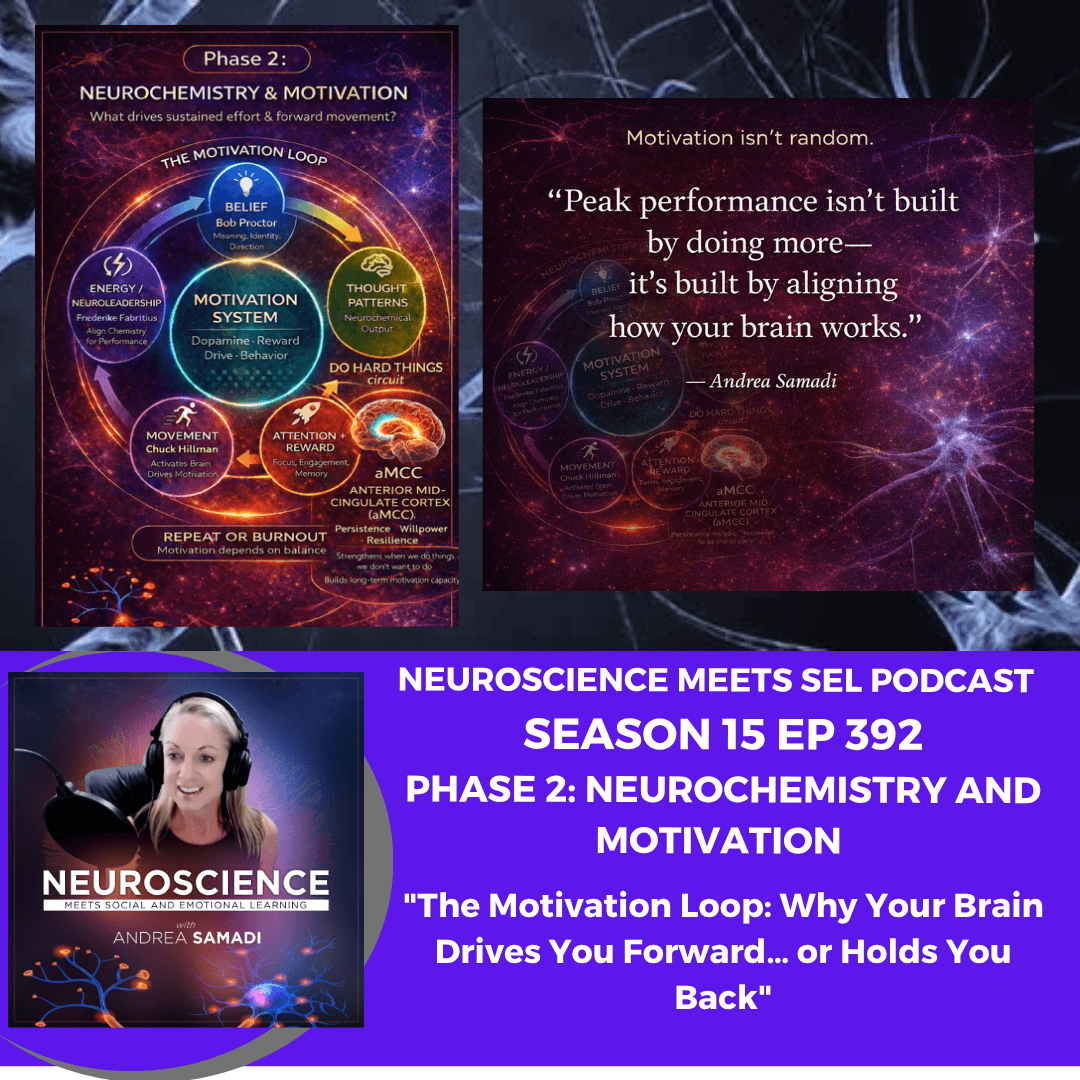
Phase 2 Review: The Motivation Loop: How to Keep Effort Worthwhile
Jun 14, 2026
28m 54s
Fun, Fear, Focus: Closing the Motivation Loop with Friederike Fabritius
Jun 9, 2026
23m 52s
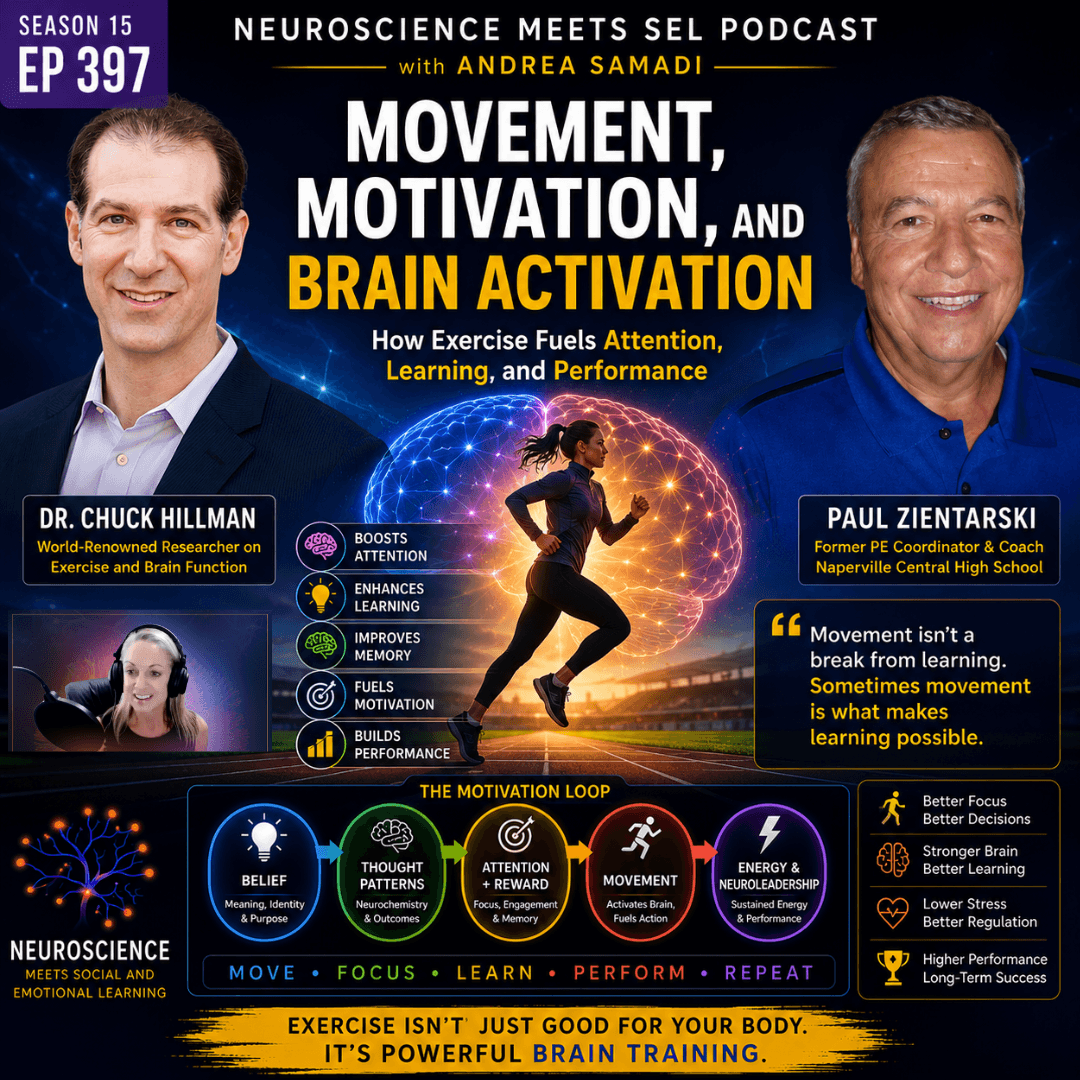
Move to Learn: How Movement Activates the Brain and Fuels Motivation (with Dr. Chuck Hillman and Paul Zientarski)
May 31, 2026
35m 05s
Dopamine, Motivation and Why the Brain Repeats Behavior with Dr. Anna Lembke
May 24, 2026
23m 26s
Social Links & Contact
Official channels & resources
Official Website
Login
RSS Feed
Login
| Date | Episode | Topics | Guests | Brands | Places | Keywords | Sponsor | Length | |
|---|---|---|---|---|---|---|---|---|---|
| 6/20/26 | ![]() Episode 400: Sales Leadership Under Pressure with Majid Samadi: 7 Lessons Learned from 7 Years of Neuroscience | <p>In this milestone episode (400), Andrea Samadi celebrates seven years of the Neuroscience Meets SEL Podcast with her husband Majid Samadi. They reflect on the journey of translating neuroscience into practical strategies for performance, learning, and well-being.</p> <p>Together they review core lessons — everything begins with the brain, safety before performance, how thoughts shape biology, the power of movement, recovery as a performance strategy, and the central role of relationships and support. Majid also shares leadership insights from his decades in educational sales, including stress management, motivation, continuous learning, and the guiding motto: do the right thing.</p> <p>They close by looking ahead to the next phase on movement, learning and cognition and invite listeners to subscribe for future episodes.</p> <p>Sales Leadership Under Pressure: Applying the Neuroscience of High Performance to Real-World Leadership</p> <p>Guest: Majid Samadi Listen to YouTube interview here <a href='https://youtu.be/SSZH3qwPqf8'>https://youtu.be/SSZH3qwPqf8</a></p> <p>Intro: Top 7 Lessons from the past 7 years</p> <p>Guest: Majid Samadi (Interview begins at 10:16)</p> <p>EP 400: Sales Leadership Under Pressure with Majid Samadi</p> <p></p> <p>In this milestone 400th episode, Andrea welcomes back her husband, Majid Samadi, who first appeared on Episode 1 when the podcast launched in 2019.</p> <p>Together, they reflect on seven years, fifteen seasons, and 400 episodes of exploring the neuroscience behind achievement, leadership, learning, motivation, and human potential.</p> <p>In this episode, we will cover:</p> <p>✔ The Top 7 Lessons Learned from 7 Years and 400 Episodes</p> <p>✔ Why understanding the brain changes the way we learn, lead, and perform</p> <p>✔ The neuroscience of stress, self-regulation, and leadership under pressure</p> <p>✔ How high-performing leaders sustain motivation without burning out</p> <p>✔ The connection between movement, learning, cognition, and peak performance</p> <p>✔ Why relationships are the foundation of leadership and long-term success</p> <p>✔ The role trust plays in building high-performing teams</p> <p>✔ Leadership lessons learned through organizational change, uncertainty, and growth</p> <p>✔ How the definition of success evolves over a lifetime and career</p> <p>✔ Why no meaningful achievement happens alone</p> <p>As Andrea reflects on the lessons learned from hundreds of conversations with neuroscientists, educators, physicians, psychologists, business leaders, and peak performers, she shares the one lesson that stands above all the rest:</p> <p>Behind every meaningful accomplishment is someone who believed in you enough to help you keep going.</p> <p>Welcome back to Season 15 of the Neuroscience Meets Social and Emotional Learning Podcast. I'm Andrea Samadi, and on this podcast, we bridge the science behind social and emotional learning, emotional intelligence, and practical neuroscience so we can create measurable improvements in well-being, achievement, productivity, and results.</p> <p>Over the past 399 episodes, we’ve explored the neuroscience behind performance, learning, stress, motivation, and human potential. For this milestone Episode 400, I wanted to do something different.</p> <p>Instead of interviewing another neuroscientist, or reviewing past episodes, we’re going to explore what happens when these ideas are applied in the real world.</p> <p>Joining me is someone listeners heard on EP 1<a href='#_edn1'>[i]</a> my husband, Majid Samadi, where we laid out the framework for future episodes, EP 200<a href='#_edn2'>[ii]</a> (Why we launched this podcast), and EP 300<a href='#_edn3'>[iii]</a> (a special episode with my Mom, Hazel MacPhail, where she taught us “how to live the good life”).</p> <p>I’ll never forget EP 1, when I asked Majid if he would record with me to help me to launch this podcast thing I wanted to start. He had just come home from working LAUSD (in California) and he put his suit jacket on my desk, and sat down in front of the microphone. I showed him the questions I would ask him, and off we went. I learned that when you start something, it doesn’t have to be perfect. Just start.</p> <p>What 15 Seasons Taught Me</p> <p></p> <p>Before we begin today's conversation, I wanted to take a moment to reflect on what I've learned over the past seven years and 400 episodes of the Neuroscience Meets Social and Emotional Learning Podcast. I had sketched out a framework, and had some ideas of what I wanted to cover on at least the first 50 episodes.</p> <p>When I started this idea in 2019, I thought I was creating a platform to share neuroscience research (as it connected to Social and Emotional Learning).</p> <p></p> <p>What I didn't realize was that the journey would change me.</p> <p>After hundreds of interviews with neuroscientists, physicians, educators, psychologists, business leaders, and peak performers, there are a few lessons that stand above all the rest. I’ll always say it took me 50 episodes to get started. I found it really difficult to ask questions and breathe at the same time.</p> <p>Lesson #1: Everything begins with the brain.</p> <p>Whether we're talking about achievement, learning, leadership, health, relationships, or performance, success starts with understanding how the brain works.</p> <p>When we understand the brain, we stop fighting ourselves and start working with ourselves. We all have our own journey here. Mine started when an educator, Jeff Kleck, from EP 246<a href='#_edn4'>[iv]</a> challenged me to add neuroscience to my work. This was around 2014 when I had partnered with AZ Department of Education with a character ed/leadership program, and Jeff Kleck told me that I wouldn’t go wrong if I wrote a whole new book that focused on the brain and learning. That’s when I sat down, and started to study some of the leading researchers in this field.</p> <p>I’ve heard similar stories from other authors like Dr. Doug Fisher, who told me that he sat in classes with medical students to unwrap how the brain learns best.</p> <p>Lesson #2: Safety comes before performance.</p> <p>One of the most important themes of Season 15 has been that a dysregulated nervous system cannot perform at its best.</p> <p>Before growth, before learning, before leadership, the brain must feel safe.</p> <p>This lesson applies in our homes, our schools, our workplaces, and our relationships.</p> <p>I’ll never forget asking Dr. David Stephen on EP 388<a href='#_edn5'>[v]</a> about a situation where I was under unusual stress, and my eyesight (or ability to read) stopped working. He explained the neuroscience behind this example, that I’ll never forget and his solution to my problem that was to eat glucose before any important meeting or presentation.</p> <p>Lesson #3: Our thoughts become biology.</p> <p>Through experts like Dr. Caroline Leaf, Bob Proctor, Dawson Church, and many others, I learned that our thoughts are not just ideas.</p> <p>They influence our chemistry, our attention, our habits, and ultimately our results.</p> <p>What we repeatedly think becomes what we repeatedly do.</p> <p>This one I’ve believed since my days working in the seminar industry with Bob Proctor. He would hammer this concept into everyone’s mind in every seminar. I just always thought this was something he really believed in, until I heard the SAME thing from Dr. Caroline Leaf, and Dr. Korotkov from Russia. It’s also behind Dr. Joe Dispenza’s work. To this day, I watch the words I think and say out loud.</p> <p>Lesson #4: Movement changes the brain.</p> <p>This lesson became personal.</p> <p>The science is clear: movement improves attention, memory, mood, resilience, and learning.</p> <p>But over the years, I experienced it firsthand through hiking, walking, strength training, and building daily movement into my life.</p> <p>This is how I’ve always been. I remember putting on my rollerblades when I was 16 and rollerblading to the local YMCA that wasn’t really in my neighborhood.</p> <p>Motivation got me moving.</p> <p>Movement changed my brain.</p> <p>And this is how I still find the energy to sit at my desk and write podcasts episodes every Saturday. I have to exercise (or move) first, and then I can create. Over time this has probably been my healthiest habits.</p> <p>Lesson #5: Recovery drives performance.</p> <p>For years I focused on doing more.</p> <p>The neuroscience taught me something different.</p> <p>Growth doesn't happen during effort.</p> <p>Growth happens during recovery.</p> <p>Sleep, stress regulation, recovery, and reflection are not luxuries—they are performance strategies.</p> <p>This took me years to finally put into practice.</p> <p>Lesson #6: Relationships change everything.</p> <p>If there is one lesson that appears in every field of neuroscience, it is this:</p> <p>We are wired for connection.</p> <p>The quality of our relationships influences our health, happiness, resilience, leadership, and longevity.</p> <p>And that brings me to perhaps the most important lesson of all.</p> <p>Lesson #7: No meaningful achievement happens alone.</p> <p>People often see the finished podcast episode.</p> <p>They don't see the support system behind it.</p> <p>For 400 episodes, there has been one person supporting this mission from behind the scenes.</p> <p>My husband, Majid.</p> <p>While I was researching, writing, recording, editing, and building this platform, Majid was encouraging me when things were difficult, celebrating the wins, offering perspective when I needed it, and helping me continue when the path wasn't always clear.</p> <p>Many of these episodes were written because someone believed in me enough to keep me going.</p> <p>The podcast may have my name on it, but it has always been supported by both of us.</p> <p>As we celebrate Episode 400, that's the lesson I want to leave everyone with.</p> <p>Achievement is rarely a solo journey.</p> <p>Behind every meaningful accomplishment is a person, a mentor, a teacher, a spouse, a friend cheering you along the way from the sidelines, or a community that helped make it possible.</p> <p>The neuroscience taught me how the brain works.</p> <p>Life taught me that relationships are what make everything work.</p> <p>And that's why there is no better person to join me for Episode 400 than Majid Samadi.</p> <p>Welcome Majid! Thank you for taking the time to record this milestone episode with me. I know your time is limited. Before we get started, can you share what it is that you do when you are not being strong armed to record podcast episodes for me?</p> <p>So, we have been covering 5 phases in Season 15, showing how the brain comes online and changes with each phase. So I’ve got some questions for you that will cover each phase. Does that sound good?</p> <p></p> <p>🧠 PHASE 1 REGULATION &amp; SAFETY</p> <p>Leading Through Stress</p> <p>“We began Season 15 with a fundamental question: Is the brain safe enough to learn, think, and perform?”</p> <p>Questions</p> <p>1. You’ve led teams through growth, uncertainty, organizational change, and high-pressure environments. When stress is elevated, what do you notice first in yourself? How have you learned to shield this stress from those who report to you, or take the brunt of it off of them? </p> <p> </p> <p>2. Looking back, have there been moments when pressure impacted your decision-making, and what did you learn from those experiences?</p> <p> </p> <p>3. Many leaders spend years operating in “go mode.” How do you recognize when you’re pushing too hard? What advice have you given to your colleagues when you see them pushing too hard?</p> <p> </p> <p>4. What habits help you reset your nervous system and regain perspective when demands are high?</p> <p> </p> <p>5. If leadership performance begins with self-regulation, what advice would you give leaders who feel overwhelmed right now?</p> <p>⚡ PHASE 2: MOTIVATION &amp; DRIVE: Sustaining Performance Without Burning Out</p> <p>“In Phase 2, we explored the Motivation Loop—meaning, belief, attention, action, reward, and recovery.”</p> <p>Questions</p> <p>6. What has motivated you throughout your career, and has that motivation changed over time?</p> <p>7. When facing major challenges, what keeps you moving forward when results aren’t immediate?</p> <p>8.What role does purpose play in maintaining motivation?</p> <p>9. Have you ever achieved a goal that didn’t feel as rewarding as you expected?</p> <p>10. What have you learned about balancing ambition with recovery/rest?</p> <p>🚶♂️ PHASE 3: LEARNING, MOVEMENT &amp; COGNITION</p> <p>Staying Sharp in a Fast-Paced World</p> <p>“Our next phase explores how movement, learning, and cognition work together to support performance.”</p> <p>Questions</p> <p>11. Leadership requires continuous learning. How do you continue growing while managing significant responsibilities?</p> <p>12. When information is incomplete and decisions need to be made quickly, how do you approach decision-making?</p> <p>13. What habits have helped you stay mentally sharp over the years?</p> <p>14.How important has physical health been in supporting your professional performance?</p> <p>15.What’s one lesson you’ve learned about the connection between health and leadership that you wish you understood earlier?</p> <p>🤝 PHASE 4</p> <p>SOCIAL INTELLIGENCE &amp; RELATIONSHIPS: The Human Side of Leadership</p> <p>“Some of the most important neuroscience research shows us that performance happens through relationships.” This is where I think you excel. I remember being at a meeting, that you would have been at, except you moved onto a new position with your promotion to where you are now. I can’t even tell you how many people approached me from Senior Leadership (top of the company) to people I had never even heard of, asking how you are. </p> <p>Questions</p> <p>16. When you think about the best leaders you’ve worked with, what qualities stand out?</p> <p>17. How do you build trust within a team?</p> <p>18. What have you learned about motivating different personalities?</p> <p>19. How do you navigate difficult conversations while maintaining strong relationships?</p> <p>20. Why do you think you made a lasting impact on so many people?</p> <p>🧭 PHASE 5</p> <p>INTEGRATION, INSIGHT &amp; MEANING</p> <p>Lessons from the Journey</p> <p>“Our final phase focuses on integration—bringing everything together.”</p> <p>Questions</p> <p>21.</p> <p>Looking back across your career, what leadership lesson took the longest to learn?</p> <p>22. How has your definition of success evolved?</p> <p>MILESTONE QUESTION</p> <p>“If there was one principle that has guided you through leadership, business, family, setbacks, and success—what would it be?”</p> <p> </p> <p>Majid, I want to thank you for taking the time out of your day off today when you could have been cleaning the garage, to record this episode with me. I want to thank you for supporting me with this podcast the past 7 years. I couldn’t have done this without you.</p> <p> </p> <p>And next week, we’re taking the next step as we launch Phase 3 of our season on Movement, Learning, and Cognition.</p> <p> </p> <p>Because once we understand how to regulate stress and sustain motivation, the next question becomes:</p> <p> </p> <p>How do we optimize the brain to learn, think, adapt, and grow?</p> <p> </p> <p>We’ll begin that journey in Episode 401 with Greg Hill, where we’ll explore one of the most important ingredients in high-performing teams: Trust.”</p> <p> </p> <p>REFERENCES:</p> <p><a href='#_ednref1'>[i]</a>Neuroscience Meets Social and Emotional Learning Podcast EPISODE 1 <a href='https://andreasamadi.podbean.com/e/the-why-behind-setting-up-a-social-and-emotional-learning-program-in-your-school-or-emotional-intelligence-training-for-your-workplace/'>https://andreasamadi.podbean.com/e/the-why-behind-setting-up-a-social-and-emotional-learning-program-in-your-school-or-emotional-intelligence-training-for-your-workplace/</a></p> <p> </p> <p><a href='#_ednref2'>[ii]</a>Neuroscience Meets Social and Emotional Learning Podcast EPISODE 200 <a href='https://andreasamadi.podbean.com/e/our-200th-milestone-episode-with-majid-samadi-returning-guest-from-episode-1-on-why-we-began-this-podcast/'>https://andreasamadi.podbean.com/e/our-200th-milestone-episode-with-majid-samadi-returning-guest-from-episode-1-on-why-we-began-this-podcast/</a></p> <p> </p> <p> </p> <p><a href='#_ednref3'>[iii]</a>Neuroscience Meets Social and Emotional Learning Podcast EPISODE 300 <a href='https://andreasamadi.podbean.com/e/my-mom-hazel-macphail-with-majid-samadi-on-leaving-a-legacy-how-to-live-the-good-life/'>https://andreasamadi.podbean.com/e/my-mom-hazel-macphail-with-majid-samadi-on-leaving-a-legacy-how-to-live-the-good-life/</a></p> <p> </p> <p><a href='#_ednref4'>[iv]</a>Neuroscience Meets Social and Emotional Learning Podcast EPISODE 246 <a href='https://andreasamadi.podbean.com/e/jeff-kleck-on-using-neuroscience-to-inspire-thinkers-in-schools-sport-and-the-workplace/'>https://andreasamadi.podbean.com/e/jeff-kleck-on-using-neuroscience-to-inspire-thinkers-in-schools-sport-and-the-workplace/</a></p> <p> </p> <p><a href='#_ednref5'>[v]</a>Neuroscience Meets Social and Emotional Learning Podcast EPISODE 388 <a href='https://andreasamadi.podbean.com/e/the-glucose-protocol-how-fueling-your-brain-restores-clarity/'>https://andreasamadi.podbean.com/e/the-glucose-protocol-how-fueling-your-brain-restores-clarity/</a></p> <p> </p> | 47m 56s | ||||||
| 6/14/26 | ![]() Phase 2 Review: The Motivation Loop: How to Keep Effort Worthwhile | Episode 399 reviews Phase 2 of Season 15 and introduces the Motivation Loop — the sequence of meaning, belief, attention, action, reward, and recovery that drives sustained effort. The episode explains common loop breakers (loss of meaning, negative thoughts, distracted attention, too much challenge, poor recovery, and no visible progress) and how to diagnose which link is failing. Practical takeaway: identify your gap, reconnect purpose, protect attention, celebrate small wins, and balance challenge with recovery to keep motivation alive. In This Episode 399, We Will Cover: ✅ The Motivation Loop — what it is, why it matters, and how it influences behavior, focus, effort, and achievement. ✅ What Keeps the Loop Alive — the role of meaning, belief, attention, action, reward, recovery, and growth. ✅ What Breaks the Loop — how loss of meaning, negative thoughts, distraction, lack of progress, poor recovery, and burnout weaken motivation. ✅ The Neuroscience of Motivation — why the brain repeats what it rewards and how dopamine reinforces behavior. ✅ The Difference Between Challenge and Burnout — finding the sweet spot where effort creates growth instead of exhaustion. ✅ My Personal Motivation Loop Story — how I watched my own loop begin to break in real time while pushing too hard with hiking and what I learned from it. ✅ How to Repair a Broken Loop — practical strategies to restore motivation before burnout takes hold. ✅ The Anterior Mid-Cingulate Cortex (AMCC) — the brain region associated with persistence, self-regulation, resilience, and doing hard things. ✅ Why Doing Hard Things Grows the Brain — how meaningful challenges strengthen the neural circuits responsible for sustained effort. ✅ Finding Your Gap — using our Brain's Operating System framework to identify where your system may be out of alignment. ✅ The Biggest Lessons from Phase 2: Neurochemistry & Motivation — insights from Bob Proctor, Dr. Caroline Leaf, Dr. John Medina, Dr. Anna Lembke, Dr. Chuck Hillman, and Friederike Fabritius. ✅ What's Next — a preview of Episodes 400 and 401 on Leadership and Trust, and our transition into Phase 3: Movement, Learning & Cognition. Key Question of the Episode "When motivation begins to disappear, have we lost our drive—or is there simply a broken link in the loop?" Aha Moment The goal isn't to push harder. The goal is to identify the broken link, repair it, and keep the loop alive. EP 399: The Motivation Loop: What Keeps It Going—and What Breaks It? Welcome back to the Neuroscience Meets Social and Emotional Learning Podcast. This week, we're wrapping up Phase 2: Neurochemistry and Motivation. Over the past several months, we've explored some of the most important drivers of human behavior, attention, effort, learning, and performance. Through the work of Bob Proctor, Dr. Caroline Leaf, John Medina, Dr. Anna Lembke, Chuck Hillman, and Friederike Fabritius, we've been focused on one fundamental question: What drives sustained effort and forward movement? Today, I want to zoom out and connect everything we've learned into one simple framework: The Motivation Loop. More importantly, we'll look at: What keeps the loop going What causes it to break How we can strengthen it over time And why doing hard things may actually help grow parts of our brain responsible for persistence and self-regulation. The Brain's Operating System of Human Performance Before we dive into the Motivation Loop, let's remember what we’ve covered so far. One of the biggest insights from neuroscience is that high performance doesn't happen in one part of the brain. It happens through a sequence. Just like a computer has an operating system, our brains have an operating system for learning, achievement, and human performance. Over the past several months, we've been building that system one phase at a time. Phase 1: Regulation & Safety REGULATE The first question we asked was: "Is the nervous system safe enough to learn?" Before mo | 28m 54s | ||||||
| 6/9/26 | ![]() Fun, Fear, Focus: Closing the Motivation Loop with Friederike Fabritius✨ | motivationneuroscience+5 | Friederike Fabritius | — | — | motivationdopamine+5 | — | 23m 52s | |
| 5/31/26 | ![]() Move to Learn: How Movement Activates the Brain and Fuels Motivation (with Dr. Chuck Hillman and Paul Zientarski)✨ | movement and brain activationexercise and motivation+3 | Dr. Chuck HillmanPaul Zientarski | Naperville Central High SchoolSpark | — | brain activationmotivation+5 | — | 35m 05s | |
| 5/24/26 | ![]() Dopamine, Motivation and Why the Brain Repeats Behavior with Dr. Anna Lembke✨ | dopaminemotivation+3 | Dr. Anna Lembke | — | — | dopaminemotivation+5 | — | 23m 26s | |
| 5/17/26 | ![]() Theory of Mind: The Missing Link Between Attention, Reward, and Motivation with John Medina✨ | Theory of MindAttention+4 | John Medina | — | — | Theory of Mindattention+6 | — | 37m 05s | |
| 4/26/26 | ![]() Thought Patterns & Neurochemistry — The Hidden Drivers of Your Life (Revisiting Dr. Caroline Leaf)✨ | thought patternsneurochemistry+5 | Dr. Caroline Leaf | — | — | biological instructionsneural pathways+6 | — | 25m 58s | |
| 4/19/26 | ![]() The Neuroscience of Belief: How Meaning, Identity and Frequency, Drive Motivation (Featuring Bob Proctor)✨ | neurosciencebelief+3 | Bob Proctor | The Neuroscience of Belief: How Meaning, Identity and Frequency, Drive Motivation (Featuring Bob Proctorthe Neuroscience Meets Social and Emotional Learning Podcast | — | motivation loopdaily practice+2 | — | 28m 56s | |
| 4/12/26 | ![]() The Motivation Loop: How Your Brain Decides What’s Worth Doing✨ | neurochemistrymotivation+4 | — | The Motivation Loop: | — | motivation loopearned dopamine+5 | — | 19m 20s | |
| 4/5/26 | ![]() When Brains Dream: How Sleep Integrates Emotion, Insight, and Creativity (Revisiting Antonio Zadra)✨ | dreamssleep+5 | Antonio Zadra | — | — | NEXTUP modelNetwork Exploration to Understand Possibilities+3 | — | 21m 31s | |
Want analysis for the episodes below?Free for Pro Submit a request, we'll have your selected episodes analyzed within an hour. Free, at no cost to you, for Pro users. | |||||||||
| 3/27/26 | ![]() What Gets Measured Gets Improved: Sleep, Recovery & Peak Performance with Dr. Kristen Holmes✨ | sleeprecovery+8 | Dr Kristen Holmes | WHOOP | — | competitive advantageshutdown routine+7 | — | 27m 17s | |
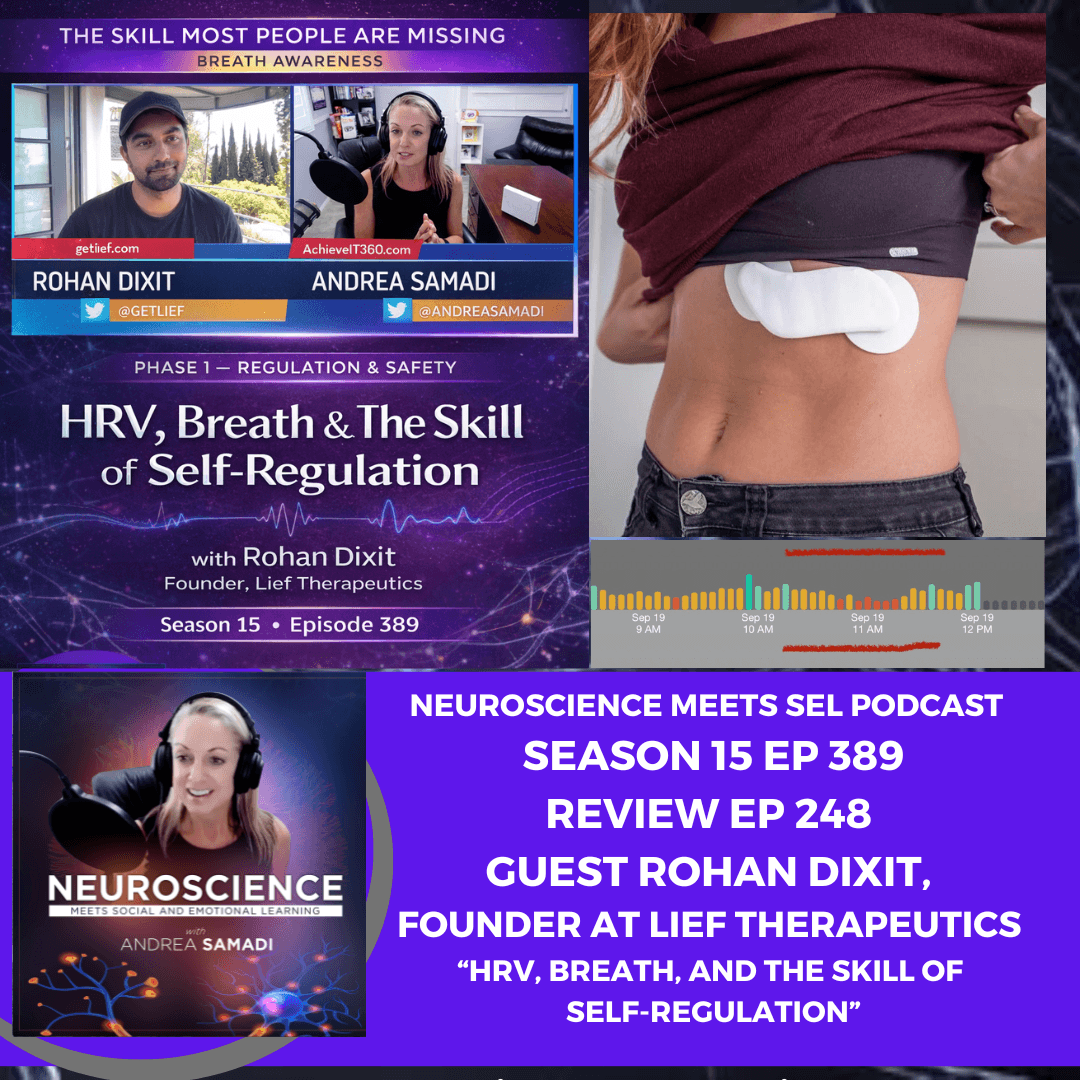
| 3/15/26 | ![]() Breathe to Reset: How HRV Tech Reveals Hidden Stress (Rohan Dixit)✨ | heart rate variabilitybreath awareness+4 | Rohan Dixit | Lief Therapeutics deviceLeaf Therapeutics+1 | — | physiological sighslow breathing+3 | — | 17m 07s | |
| 3/9/26 | ![]() The Glucose Protocol: How Fueling Your Brain Restores Clarity with Dr. David Stephens✨ | glucosebrain function+6 | Dr David Stephens | The Glucose ProtocolThe Glucose Protocol: How Fueling Your Brain Restores Clarity with Dr. David Stephens+1 | — | brain restorationcognitive performance+3 | — | 48m 01s | |
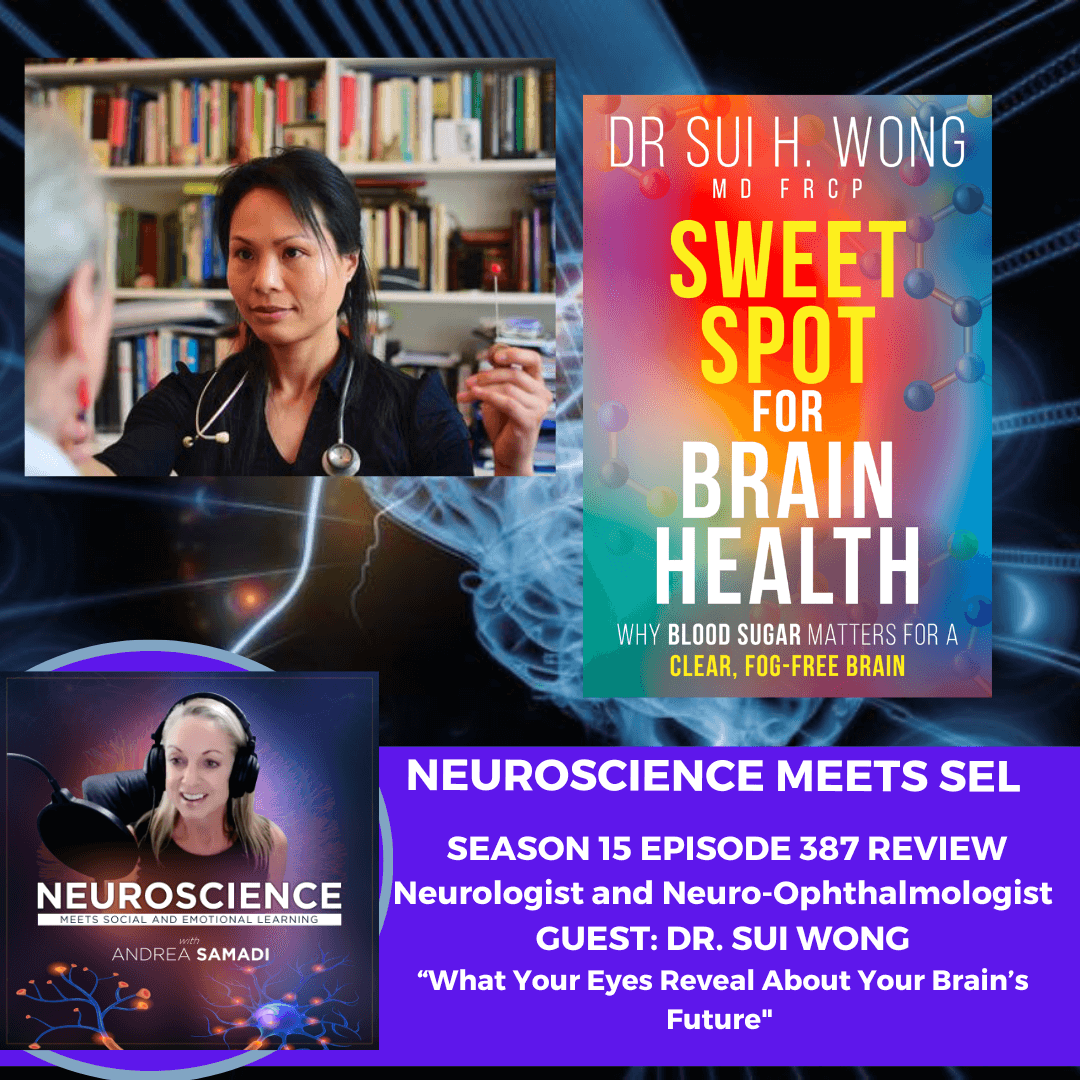
| 3/2/26 | ![]() What Your Eyes Reveal About Your Brain's Future (Revisiting Dr. Sui Wong)✨ | neuroscienceeye health+4 | Dr Sui Wong | — | — | dilated eye examsblood sugar+4 | — | 18m 08s | |
| 2/22/26 | ![]() Can AI Personalize Your Brain Health? Inside Brain.One's Protocols with Thoryn Stephens✨ | AI in brain healthpersonalized wellness+5 | Thoryn Stephens | Brain.Brain.One+2 | — | brain healthwellness advice+3 | — | 43m 46s | |
| 2/16/26 | ![]() Safety First: Why a Regulated Brain Is the Key to Learning (Revisiting Dr. Bruce Perry)✨ | safetyregulation+5 | Dr Bruce Perry | Foundational QuestionIs | — | nervous-system safetymicro-repetition+3 | — | 24m 37s | |
| 2/1/26 | ![]() How Learning Begins in the Brain: Sleep, Safety and Curiosity (Revisiting Dr. Baland Jalal)✨ | learningcreativity+4 | Dr Baland Jalal | — | — | sleep paralysishypnagogic window+6 | — | 26m 17s | |
| 1/18/26 | ![]() Sales Mastery is Not a Tactic: It Requires Decision, Persistence and the Power of the Mastermind PART 3 Think and Grow Rich for Sales | Episode 383 applies Napoleon Hill’s timeless principles to sales, showing how decision, persistence, and the mastermind turn inner preparation into consistent results. Learn practical, neuroscience-backed actions to make clear decisions, sustain effort through resistance, and multiply success by aligning with the right people. Welcome back to Season 15 of The Neuroscience Meets Social and Emotional Learning Podcast — where we bridge the science behind social and emotional learning, emotional intelligence, and practical neuroscience to create measurable improvements in well-being, achievement, productivity, and results. I’m Andrea Samadi. And seven years ago, when we launched this podcast, it was driven by a question I had never been taught to ask — either in school, in business, or in life: If productivity and results matter — and they matter now more than ever — how exactly are we using our brain to make them happen? Most of us were never taught how to work with our brain instead of against it. We were taught what to do — but not how to think, decide, persist, or align with others in ways that produce consistent results. That question pulled me into a decade-long exploration of the mind–brain–results connection — and how neuroscience can be applied to everyday decisions, conversations, and performance. That’s why this podcast exists. Each week, I bring you the world’s leading experts so we can break down complex science — and turn it into practical strategies you can apply immediately for predictable, science-backed outcomes. And that brings us to today’s Episode 383 — where we are going back to reconnect to a powerful 6-part series we originally recorded in 2022 around a book that has shaped achievement for generations: Think and Grow Rich by Napoleon Hill. Connecting Back to Our 6-Part Think and Grow Rich Series[i] We used that book as a framework to launch our year, back in 2022, walking chapter by chapter through the principles my mentor, Bob Proctor, studied for over 50 years of his life. Not casually. Not occasionally. But as a daily discipline for creating results — in business, health, relationships, and purpose. That 6-part series was about the basics — the inner mechanics that govern all achievement. And those basics still matter just as much today. What we’re doing now is not revisiting this material because it’s old. We’re revisiting it because it’s timeless. PART 3 — From Decision to Momentum Decision • Persistence • The Power of the Mastermind In Part 3 today, of our Think and Grow Rich for Sales study, we move from inner preparation to outer execution. Up to this point, the earlier chapters have shaped belief, certainty, vision, and authority. But results are not created by preparation alone. They are created when inner mastery is followed by decisive action, sustained effort, and collective intelligence. This is where most people stall—and where sales mastery is forged. Decision We begin with Decision, the moment where intention becomes irreversible.Indecision leaks certainty. Decision creates momentum. Successful people decide quickly and change course slowly. In sales, this means committing to your value, your process, and your outcome before the conversation begins—so hesitation never enters the room. Persistence Next comes Persistence, the force that carries decisions through resistance, delay, and rejection. Persistence is not intensity—it is refusal to quit when progress is invisible. In sales, persistence keeps conversations alive, turns “no” into information, and allows momentum to compound long after others have disengaged. The Power of the Mastermind Finally, we arrive at The Power of the Mastermind—where individual effort becomes exponential. When two or more minds unite in harmony around a definite purpose, a third force emerges: clarity, creativity, and certainty launch beyond individual thinking. This chapter reveals why no great achievement—and no sustained sales success—is built a | 33m 12s | ||||||
| 1/3/26 | ![]() Sales Mastery From the Inside Out: Autosuggestion, Authority, Imagination and Execution PART 2 (Think and Grow Rich for Sales) | Season 14, Episode 382 reviews chapters 4–7 of Think and Grow Rich for Sales, showing how autosuggestion, specialized knowledge, imagination, and organized planning transform inner belief into consistent sales results. This episode explains practical steps to program confidence, build authority, paint future outcomes for buyers, and design repeatable sales systems that create certainty and close deals more naturally. Today EP 382 PART 2 of our Think and Grow Rich for Sales Series, we will cover: ✔ Chapter 4: Autosuggestion: How Your Inner Script Becomes Your Outer Results Sales Application (Practical Use) Pre-call priming: Speak your outcome out loud before every call (“I bring clarity and certainty to this conversation.”) Language audit: Eliminate soft phrases (“I think,” “hopefully,” “maybe”) from your sales vocabulary. Repetition builds belief: Read your sales goals twice daily as if already achieved. Emotion matters: Read goals with feeling—belief is emotional, not intellectual. Interrupt negative mindsets: Replace “They won’t buy” with “I help people make confident decisions.” Consistency over intensity: Daily repetition beats occasional motivation. Key Insight: Belief is built deliberately, not accidentally. ✔ Chapter 5: Specialized Knowledge: From Information to Authority 5 Sales Application Tips Organize your expertise into simple frameworks buyers can easily follow. Know their world better than they do—pain points, language, pressures, timing. Stop overloading: Say less, but say it with authority. Borrow brilliance: Use mentors, subject experts, and masterminds to extend your knowledge. Teach while you sell: Authority grows when you help buyers understand, not when you impress them. Key Insight: You are not selling information. You are selling guidance. ✔ Chapter 6: Imagination: Where Sales Innovation Is Born 7 Sales Application Tips Paint the “after” picture: Describe life, work, or outcomes post-solution. Use sensory language: Help them see, feel, and experience the result. Rehearse success aloud: Walk the buyer through implementation as if it’s already happening. Normalize the decision: Familiarity reduces fear and resistance. Tell transformation stories: Stories activate imagination faster than facts. Slow the moment down: Imagination needs space—don’t rush the close. Anchor certainty visually: “Imagine six months from now…” becomes a mental commitment. Key Insight: People don’t buy solutions. They buy who they become after the solution. ✔ Chapter 7: Organized Planning: Putting Desire Into Action 6 Sales Application Tips Create a repeatable sales process you trust and follow consistently. Plan the work—then work the plan, even when results lag. Refine the plan, not the goal when setbacks occur. Prepare for objections before they arise—confidence comes from readiness. Track behaviors, not just outcomes (calls, follow-ups, conversations). Use structure to eliminate emotion-based decisions during the sales cycle. Key Insight: A plan creates certainty. Certainty creates momentum. Welcome back to our final series of SEASON 14 of The Neuroscience Meets Social and Emotional Learning Podcast, where we connect the science-based evidence behind social and emotional learning and emotional intelligence training for improved well-being, achievement, productivity and results—using what I saw as the missing link (since we weren’t taught this when we were growing up in school), the application of practical neuroscience. I’m Andrea Samadi, and seven years ago, launched this podcast with a question I had never truly asked myself before: (and that is) If productivity and results matter to us—and they do now more than ever—how exactly are we using our brain to make them happen? Most of us were never taught how to apply neuroscience to improve productivity, results, or well-being. About a decade ago, I became fascinated by the mind-brain-results connection—and how | 41m 48s | ||||||
| 12/29/25 | ![]() Think and Grow Rich for Sales: Why Thought, Desire, and Faith Create Results PART 1 | Episode 381 reframes Napoleon Hill’s Think and Grow Rich for sales professionals, reviewing Chapters 1–3 to show how thought, desire, and faith create predictable sales results. Andrea Samadi connects these timeless principles to practical steps—how to set burning goals, build unwavering belief through repetition, and transfer certainty to buyers. Listeners will get actionable frameworks (a five-step belief plan and the six steps to impress desire) and a clear roadmap for aligning mindset with sales execution, plus a preview of the next episode continuing the series. Welcome back to our final series of SEASON 14 of The Neuroscience Meets Social and Emotional Learning Podcast, where we connect the science-based evidence behind social and emotional learning and emotional intelligence training for improved well-being, achievement, productivity and results—using what I saw as the missing link (since we weren’t taught this when we were growing up in school), the application of practical neuroscience. I’m Andrea Samadi, and seven years ago, launched this podcast with a question I had never truly asked myself before: (and that is) If productivity and results matter to us—and they do now more than ever—how exactly are we using our brain to make them happen? Most of us were never taught how to apply neuroscience to improve productivity, results, or well-being. About a decade ago, I became fascinated by the mind-brain-results connection—and how science can be applied to our everyday lives. That’s why I’ve made it my mission to bring you the world’s top experts—so together, we can explore the intersection of science and social-emotional learning. We’ll break down complex ideas and turn them into practical strategies we can use every day for predictable, science-backed results. Connecting Back to Our 6-Part Think and Grow Rich Series (2022) For today’s EP 381, we are connecting back to our 6-PART Series from 2022[i], where we covered the well-known book, Think and Grow Rich by Napoleon Hill, to make 2022 our best year ever. Today we will cover: ✔ Chapter 1: The Power of Thought: A 5 STEP Plan to Improve Sales (Outer World) by Improving Your Thoughts (Inner World) ✔ Chapter 2: Desire With a 6 STEP Plan to Achieve ANY Goal ✔ Chapter 3: Faith With 3 Ways to Build Unwavering Faith That Will Change Your Life Back in 2022, we didn’t just read Think and Grow Rich—we lived inside it as we launched 2022. Over a 6-part podcast series that began the beginning of January 2022, we walked through this book chapter by chapter, not as theory, but as a personal operating system for growth, performance, and results. This series will always be special for me, as I had heard that my mentor, who inspired me to study this book, Bob Proctor, became ill while I was writing the last episode in the series PART 6. He passed away before it was released, and I’ll always remember this episode series, connected to the many people, globally, that he inspired through his work. At the time, the focus of our 6 PART Series was broad. We covered: Personal development Mindset mastery Vision, purpose, and belief We covered the BASICS of this book that Bob Proctor studied for his entire lifetime (over 50 years) that can be applied to whatever it is that you want to create with your life. Today, we are going to look at this timeless piece of knowledge, through a new lens. What we’re covering today—Think and Grow Rich for Sales—is not new material. It’s the application of this series, towards a specific discipline. You could apply this book to any discipline, but this one, I have wanted to cover for a very long time. How the 6-Part Series Maps DIRECTLY to Sales Mastery Here’s the reframe that matters: Every principle we covered in 2022 becomes a sales advantage when applied correctly. In order for me to have gained this understanding, I have to give credit, where credit is due here. I would not have been able to cover our 2022 series without following Paul Martine | 33m 23s | ||||||
| 12/21/25 | ![]() Sleep, Learning and the Brain: Why Performance Collapses Without Rest PART 3 with Dr. Shane Creado | In this Season 14 review (Part 3) Andrea revisits key insights from Dr. Shane Creado on the critical link between sleep, concussions and performance. The episode explains how even mild or repeated head impacts and sleep deprivation damage the same brain regions that support learning, memory, decision-making and emotional regulation, and how one all‑nighter can reduce hippocampal learning capacity by around 40%. Practical takeaways include treating sleep as neurological recovery (7–9 hours), protecting the brain after head jolts, avoiding late alcohol and screens, and prioritizing consistent sleep routines to restore learning, resilience and long‑term brain health for athletes, students and professionals. Welcome back to SEASON 14 of The Neuroscience Meets Social and Emotional Learning Podcast, where we connect the science-based evidence behind social and emotional learning and emotional intelligence training for improved well-being, achievement, productivity and results—using what I saw as the missing link (since we weren’t taught this when we were growing up in school), the application of practical neuroscience. I’m Andrea Samadi, and seven years ago, launched this podcast with a question I had never truly asked myself before: (and that is) If productivity and results matter to us—and they do now more than ever—how exactly are we using our brain to make them happen? Most of us were never taught how to apply neuroscience to improve productivity, results, or well-being. About a decade ago, I became fascinated by the mind-brain-results connection—and how science can be applied to our everyday lives. That’s why I’ve made it my mission to bring you the world’s top experts—so together, we can explore the intersection of science and social-emotional learning. We’ll break down complex ideas and turn them into practical strategies we can use every day for predictable, science-backed results. As we are nearing the end of Season 14 here, it has been about reflection as we have looked back and reviewed past interviews. Our goal has not been about nostalgia, or remembering these interviews, the goal has been about integrating what we have learned. Taking what we know, aligning it with how the brain actually functions, and applying it consistently enough to change outcomes. And if there’s one thing this season has reinforced, it’s this: Sustainable success isn’t built on intensity or focus alone—it’s built on alignment. As we move into what’s next, (Season 15) the focus shifts from understanding this alignment to bringing this alignment into a tangible, physical form, or embodiment. Not more information—but better execution. After hundreds of conversations with neuroscientists, educators, peak performers, and thought leaders, one truth keeps resurfacing— lasting success is never about doing more. It’s about alignment. Alignment between how the brain actually works, how emotions drive behavior, and how daily habits compound over time. Season 14 has been about stepping back—not to reminisce, but to integrate what we have learned into our current life. I knew the minute that I was sent a couple of video clips from our past episodes, that I had forgotten about, that while I thought I had implemented the ideas from our past guests, I had some work to go myself. For this reason, we spent Season 14 and will resume with Season 15 next January, reviewing past episodes, with the goal of noticing what we have now aligned, that’s bringing us results in our daily life. Core Reflection When we started this podcast 7 years ago, the goal was simple: bridge neuroscience research with practical strategies people could actually use. What I didn’t fully appreciate then—what only became clear through repetition, reflection, and real-life application—is that information alone doesn’t create change. Understanding the brain doesn’t matter if we ignore what to do with the information we release each week: improving our sleep reducing our stress pract | 23m 45s | ||||||
| 12/7/25 | ![]() Sleep Is Your Superpower: Optimizing Brain Health & Performance with The Silva Method PART 2 with Dr. Shane Creado | Join Andrea Samadi as she reviews Dr. Shane Creado’s insights on why sleep is a core pillar of brain health, how chronic sleep deprivation harms reaction time, inflammation, pain perception, and why children pay the highest price. Learn practical sleep strategies—consistent schedules, light management, wind-down routines—and how the Silva Method’s mind-training can deepen restorative sleep for athletes, high performers, and families. Welcome back to SEASON 14 of The Neuroscience Meets Social and Emotional Learning Podcast, where we connect the science-based evidence behind social and emotional learning and emotional intelligence training for improved well-being, achievement, productivity and results—using what I saw as the missing link (since we weren’t taught this when we were growing up in school), the application of practical neuroscience. I’m Andrea Samadi, and seven years ago, launched this podcast with a question I had never truly asked myself before: (and that is) If productivity and results matter to us—and they do now more than ever—how exactly are we using our brain to make them happen? Most of us were never taught how to apply neuroscience to improve productivity, results, or well-being. About a decade ago, I became fascinated by the mind-brain-results connection—and how science can be applied to our everyday lives. That’s why I’ve made it my mission to bring you the world’s top experts—so together, we can explore the intersection of science and social-emotional learning. We’ll break down complex ideas and turn them into practical strategies we can use every day for predictable, science-backed results. This week, we move onto PART 2 of our review of EP 72[i] with Shane Creado, MD and his book Peak Sleep Performance for Athletes recorded back in July of 2020. In PART 1[ii], we covered: How strategic napping, morning brain habits, and even the Silva Method all work together to reset your brain, boost performance, and transform your health from the inside out. Today, PART 2 we will continue with our review, diving a bit deeper into sleep deprivation and its impact of performance (whether you are an athlete, or just someone looking to improve productivity). PART 3, next week, we will go a bit deeper into the impacts of concussions and brain injuries on our sleep and performance. Just a reminder: Dr. Creado is a double board-certified sleep medicine doctor and psychiatrist who practices functional sleep medicine, integrative psychiatry, and sports psychiatry. He brings all of these specialties together to uncover the underlying factors that sabotage our sleep and then treats them comprehensively, helping people to achieve their health and performance goals with sleep at the forefront As we work through our reviews, we will spend a considerable amount of time on this important health staple that’s scientifically proven to boost our physical and mental health. For today’s EP 379, and PART 2 of our review of our 2020 interview with Dr. Shane Creado, we will cover: ✔ Sleep as a core pillar of health according to Dr. Shane Creado, author of Peak Sleep Performance for Athletes. ✔ Sleep deprivation is a national crisis and kid’s pay the highest price. ✔ 7 Well-Known Tips for Improving Sleep ✔ Applying the Silva Method to Reset and Improve Our Sleep ✔ Important sleep tips for athletes and high performers Let’s go back to 2020 and revisit what Dr. Creado had to say about sleep. CLIP 1 — Why Sleep Is Non-Negotiable for Brain Health Short Explanation:In Clip 1, Dr. Shane Creado explains that sleep is a foundational pillar of brain health, equal in importance to exercise and nutrition. He emphasizes that without optimizing sleep, it is impossible to truly optimize learning, emotional regulation, focus, or performance. Dr. Creado highlights that chronic sleep deprivation is widespread in the U.S., often unnoticed, and especially damaging for children—where lack of deep sleep suppresses growth hormone, increases obesit | 29m 43s | ||||||
| 11/23/25 | ![]() Unlock Peak Performance with Strategic Napping — Dr. Shane Creado's Sleep Research Combined with The Silva Method | Episode 378 revisits Dr. Shane Creado’s science-driven advice on sleep, strategic napping, and why sleep is foundational for health, hormones, immunity, and performance. Learn practical nap protocols (10–20 minutes or 90-minute recovery naps), timing, environment tips, and how to protect your morning from cortisol-spiking habits like checking phones. The episode also shows how combining a short nap with the Silva Method — setting an intention and entering alpha — can boost creativity, insight, and problem-solving. It concludes with actionable routines to improve sleep consistency, support shift workers, and make sleep a strategy for better productivity and well-being. ✔Learn practical nap protocols (10–20 minutes or 90-minute recovery naps), timing, environment tips, and how to protect your morning from cortisol-spiking habits like checking phones.✔The episode also shows how combining a short nap with the Silva Method — setting an intention and entering alpha — can boost creativity, insight, and problem-solving. ✔ It concludes with actionable routines to improve sleep consistency, support shift workers, and make sleep a strategy for better productivity and well-being. Welcome back to SEASON 14 of The Neuroscience Meets Social and Emotional Learning Podcast, where we connect the science-based evidence behind social and emotional learning and emotional intelligence training for improved well-being, achievement, productivity and results—using what I saw as the missing link (since we weren’t taught this when we were growing up in school), the application of practical neuroscience. I’m Andrea Samadi, and seven years ago, launched this podcast with a question I had never truly asked myself before: (and that is) If productivity and results matter to us—and they do now more than ever—how exactly are we using our brain to make them happen? Most of us were never taught how to apply neuroscience to improve productivity, results, or well-being. About a decade ago, I became fascinated by the mind-brain-results connection—and how science can be applied to our everyday lives. That’s why I’ve made it my mission to bring you the world’s top experts—so together, we can explore the intersection of science and social-emotional learning. We’ll break down complex ideas and turn them into practical strategies we can use every day for predictable, science-backed results. This week, in our review of EP 72 with Shane Creado, MD and his book Peak Sleep Performance for Athletes and will learn: How strategic napping, morning brain habits, and even the Silva Method all work together to reset your brain, boost performance, and transform your health from the inside out. Clip 1: The Science of Strategic Napping In Clip 1, Dr. Shane Creado explains why every cell in the body follows its own circadian rhythm—and why humans were historically wired for polymodal sleep, with natural dips in alertness that make afternoon naps biologically appropriate.You’ll learn: Why the “post-lunch crash” is actually a melatonin rise, not just fatigue Why old advice to “avoid naps” is outdated How short, intentional naps can boost alertness, learning, mood, and performance The simple rules behind strategic napping: length, timing, and environmentThis clip lays the groundwork for using naps as a tool—not a crutch—for better brain function. Clip 2: Your Morning Cortisol Curve & Hidden Sleep Dangers Clip 2 shifts the focus to the first moments of your day.Dr. Creado warns that checking your phone the moment you wake up spikes cortisol and sends your brain into danger mode, increasing anxiety and disrupting emotional regulation for the entire day.You’ll also learn: Why shift work fragments DNA Why the WHO classifies shift work as a possible carcinogen How sleep protects your hormones, immune system, gut health, and long-term agingThis clip reinforces that sleep is foundational biology, not optional or replaceable. How This All Connects to The Silva Method We clo | 27m 28s | ||||||
| 11/9/25 | ![]() Half a Million and Just Getting Started: Lessons from 7 Years of Neuroscience Meets SEL | Andrea Samadi reflects on seven years hosting the Neuroscience Meets SEL podcast and celebrates reaching 500,000 downloads. She shares seven strategies—clarifying mission and vision, defining the audience, setting measurable goals, creating systems, staying mission-driven, building partnerships, and building momentum—and eight personal lessons learned, including the power of practice, research, adaptation, and praxis. This episode offers practical, science-backed guidance for anyone looking to apply neuroscience to improve productivity, well-being, and long-term results. On today's episode #377, we cover a break from our interviews, with a celebration episode! ✔ 7 Strategies that took our podcast from 0-500,000 downloads (including clarifying our mission, vision, defining our audience, setting measurable goals, creating systems, staying mission-driven, and building partnerships). ✔ 8 Personal Lessons learned over the past 7 years (including the power of spaced repetition, research, adaptation and praxis). Welcome back to SEASON 14 of The Neuroscience Meets Social and Emotional Learning Podcast, where we connect the science-based evidence behind social and emotional learning and emotional intelligence training for improved well-being, achievement, productivity and results—using what I saw as the missing link (since we weren’t taught this when we were growing up in school), the application of practical neuroscience. I’m Andrea Samadi, and seven years ago, launched this podcast with a question I had never truly asked myself before: (and that is) If productivity and results matter to us—and they do now more than ever—how exactly are we using our brain to make them happen? Most of us were never taught how to apply neuroscience to improve productivity, results, or well-being. About a decade ago, I became fascinated by the mind-brain-results connection—and how science can be applied to our everyday lives. That’s why I’ve made it my mission to bring you the world’s top experts—so together, we can explore the intersection of science and social-emotional learning. We’ll break down complex ideas and turn them into practical strategies we can use every day for predictable, science-backed results. For today’s EP #377 we will take a break from our interview reviews, and look back over the past 7 years, and 14 Seasons, as we hit an important milestone in the podcasting world, our 500,000th download. I remember when we hit the 300,000th marker, back in March 2023[i] we reflected back on the lessons learned in our first 4 years of hosting this podcast. I remember looking at the next milestone of half a million, thinking it was such a distance from where we currently were. It just took 3 years to get here, and now we have our eye on the next 500,000 downloads, which from here, looks like a lifetime away. As we reflect back over the past 7 years, many of our strategies remain the same as when we first began. Some strategies we did have to change. We reviewed some of these concepts on EP 279[ii] back in March 2023. As we review what got us here, I think that these strategies can be applied to anything we are doing, with a long-term vision. 7 STRATEGIES WE USED TO HIT THE 500K DOWNLOAD MILESTONE 1. Know Your Mission (What You’re Doing) The mission of the Neuroscience Meets Social and Emotional Learning podcast is to bridge the gap between neuroscience research and practical applications in education, business, and personal development. The podcast shares insights, strategies, and best practices to enhance learning, performance, and well-being by integrating neuroscience (which we like to make simple) and connecting it to social and emotional skills (SEL). Our goal is to provide valuable information listeners can apply in their work and personal lives to achieve peak performance and overall self-improvement, with a deeper understanding of how our brain works — something many of us were never taught in school. When the missio | 23m 53s | ||||||
| 10/26/25 | ![]() Move, Eat, Connect: 3 Science-Backed Keys to Brain Health PART 2 with Dr. John Ratey | In this Season 14 review (episode 376) Andrea Samadi revisits highlights from her interview with Dr. John Ratey about the science of exercise, nutrition, and social connection for brain health and longevity. The episode explains Peter Attia's rule for foundational fitness, warns against sugar dependence and fat phobia, and presents the three biggest levers for healthy aging: exercise, diet, and social connection, plus practical tips to track and apply these habits. Takeaway: prioritize consistent movement, whole foods, and meaningful connection to boost mood, memory, and overall well-being. On today's episode #376, we review PART 2 of our 2021 interview with Dr. John Ratey and will learn: ✔ 3 Science-backed keys to brain health: Exercise, Nutrition and Connection ✔ What is Attia's Rule that allows us to dive deep into diet and nutrition? ✔ Practical Tips for improving consistent movement, our diet and social connection to boost overall well-being and brain health. Welcome back to SEASON 14 of The Neuroscience Meets Social and Emotional Learning Podcast, where we connect the science-based evidence behind social and emotional learning and emotional intelligence training for improved well-being, achievement, productivity and results—using what I saw as the missing link (since we weren’t taught this when we were growing up in school), the application of practical neuroscience. I’m Andrea Samadi, and seven years ago, launched this podcast with a question I had never truly asked myself before: (and that is) If productivity and results matter to us—and they do now more than ever—how exactly are we using our brain to make them happen? Most of us were never taught how to apply neuroscience to improve productivity, results, or well-being. About a decade ago, I became fascinated by the mind-brain-results connection—and how science can be applied to our everyday lives. That’s why I’ve made it my mission to bring you the world’s top experts—so together, we can explore the intersection of science and social-emotional learning. We’ll break down complex ideas and turn them into practical strategies we can use every day for predictable, science-backed results. Episode 376: PART 2 Featuring Dr. John Ratey For today’s Episode 376, we continue with PART 2 of our review with Dr. John Ratey, covering the first health staple that we know is scientifically proven to boost our physical and mental health: exercise. We first met Dr. Ratey on Episode 116[i] (back in March 2021) on his book “The Revolutionary New Science of Exercise and the Brain.” Dr. Ratey is also an Associate Clinical Professor of Psychiatry at Harvard Medical School and an internationally recognized expert in Neuropsychiatry. Dr. Ratey has published over 60 peer-reviewed articles and 11 books in 17 languages. You’ll notice that around the time of the pandemic, in 2020, our interviews took a turn towards health and wellness, and to stay on track, I created a framework of our Top 5 Health Staples on Episode 87[ii], which eventually evolved into our Top 6 Health Staples. 🎧 Listen to Episode 87:The Top 5 Brain Health and Alzheimer’s Prevention Strategies[iii] 🌐 Learn more about Dr. Ratey:www.johnratey.com We also did a Deep Dive into Dr. Ratey’s books 🎧 Listen to Episode 118[iv]: A Deep Dive into Dr. Ratey’s books, Spark, Go Wild and Driven to Distraction. Before we go into Dr. Ratey’s first clip, with the thoughts of debating diet plans or supplements, (a broad and deep topic) Dr. Peter Attia[v] the author of the book The Science and Art of Longevity suggests we first get our “exercise house in order.” He argues that until we can do the following, our time is better spent building foundational fitness. For those of us who want to dive into this topic, he asks us to do the following, which has been coined as: Attia’s Rule. Dead hang for 1 minute Wall sit for 2 minutes Deadlift your body weight for 10 reps Achieve a VO₂ max at or above the 75th percentile As Dr. Attia | 24m 52s | ||||||
Showing 25 of 229
Pitch Fit is a Pro feature
See how bookable this show is for guests, which brands already advertise, the per-episode ad value, and the best-fit guest and sponsor profile. The numbers are blurred on the free plan.
How readily this show books outside guests like you.
How proven this show is for host-read sponsorships.
For Guests
ProFor Advertisers
ProUpgrade to Pro to unlock guest cadence, sponsor categories, fit scores, and per-episode ad value for this show.
Similar Audience Demographics
Podcasts that attract a similar listener profile
Chart Positions
23 placements across 22 markets.
Chart Positions
23 placements across 22 markets.