Scaling Therapist Podcast: More Income, More Independence, More Impact (Not More Hours)
by James Marland
Is this your podcast?Insights from recent episode analysis
Audience Interest
Podcast Focus
Publishing Consistency
Platform Reach
Insights are generated by CastFox AI using publicly available data, episode content, and proprietary models.
Most discussed topics
Brands & references
Est. Listeners
Insufficient chart data. Estimates will improve as the show charts.
- Per-Episode Audience
Est. listeners per new episode within ~30 days
N/A🎙 Daily cadence·160 episodes·Last published 2d ago - Monthly Reach
Unique listeners across all episodes (30 days)
N/A - Active Followers
Loyal subscribers who consistently listen
N/A
Market Insights
Platform Distribution
Reach across major podcast platforms, updated hourly
Total Followers
—
Total Plays
—
Total Reviews
—
* Data sourced directly from platform APIs and aggregated hourly across all major podcast directories.
On the show
From 14 epsHost
Recent guests
Recent episodes
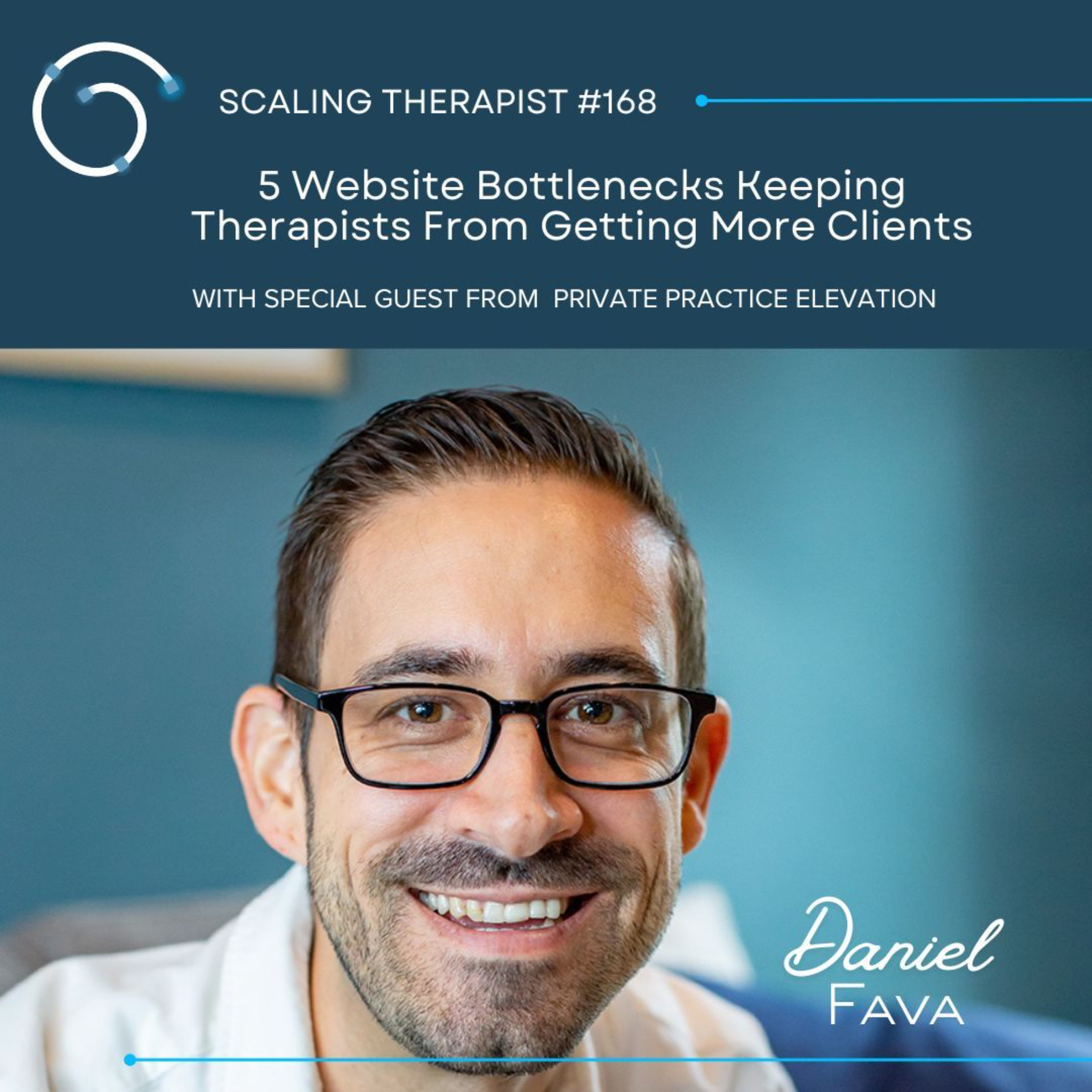
STP 168 | 5 Website Bottlenecks Keeping Therapists From Clients
Jun 22, 2026
38m 20s
STP 167 | Success on Paper, Trapped by the Clock
Jun 15, 2026
22m 12s
STP 166 | Move Forward Scared: Redefining Success When Fear Shows Up with guest Tammy Gustafson
Jun 8, 2026
37m 01s
STP 165 | Refusal to Quit: How Evan Owens Helped Launch a Movement from His Living Room
Jun 1, 2026
30m 31s
STP 164 | Tough Economy? Here’s a Smarter Way to Market Your Therapy Practice
May 25, 2026
34m 46s
Social Links & Contact
Official channels & resources
Official Website
Login
RSS Feed
Login
| Date | Episode | Topics | Guests | Brands | Places | Keywords | Sponsor | Length | |
|---|---|---|---|---|---|---|---|---|---|
| 6/22/26 | ![]() STP 168 | 5 Website Bottlenecks Keeping Therapists From Clients | 5 Website Bottlenecks Keeping Therapists From Clients In this episode of The Scaling Therapist Podcast, James talks with Daniel Fava of Private Practice Elevation about why therapy websites often fail to convert. Daniel breaks down the bottlenecks preventing sites from helping clients find, trust, and hire therapists. Three Key Insights 1. Visibility is evolving Search behavior has shifted. AI summaries and updated search algorithms prioritize trusted, relevant answers over simple keyword stuffing. You need clear, topic-specific service pages that address your ideal client’s actual questions. 2. Prioritize client trust Clients need to feel understood before they care about your credentials. Your copy should focus on their lived experience and whether they feel safe reaching out to you. 3. Remove friction If traffic isn't converting, look for friction. Choose one consistent call to action, like “Schedule a Consultation” and repeat it clearly across your site. Timestamped Highlights 00:00 – Changing search landscape: How AI and new search behaviors have changed how clients find therapists. 03:45 – About Private Practice Elevation: Overview of services: web design, SEO, and AI optimization for therapists. 05:45 – The 4 main bottlenecks: Overview of the common barriers preventing client inquiries. 10:00 – Bottleneck 1: Visibility: Why you can't rely solely on word-of-mouth or directories. 11:30 – Service-specific pages: Creating pages targeting specific services and locations (e.g., “Couples Therapy in Atlanta”). 13:00 – Content strategy: Using FAQ-style content to answer client questions and boost search visibility. 17:00 – Content cleanup: Audit existing blog posts; improve, combine, or prune weak content. 18:30 – Bottleneck 2: Trust: Stop focusing on modalities and start focusing on client problems. 19:30 – Human language: Use empathetic copy that speaks to the client’s experience. 22:00 – Clarity: Ensure your site states what you offer and who it’s for immediately. 23:15 – Bottleneck 3: Conversion: Why visitors aren't taking the next step. 24:15 – Single CTA: Standardize your call to action language across the entire site. 25:15 – Accessibility: Keep contact info easy to find on all devices. 26:00 – Set expectations: Describe the intake process to reduce client anxiety. 27:15 – Simplify forms: Keep initial contact forms brief to avoid scaring off leads. 29:30 – Bottleneck 4: Efficiency: Stop using your website as a manual information desk. 30:30 – FAQ effectiveness: Use FAQs to handle logistics, freeing up time for actual therapy. 32:00 – Fit signaling: Explicitly state who you are best suited to help. 34:15 – The website journey: Summary of the path from discovery to booking. 35:00 – Growth tool: Transitioning your site from a brochure to a growth engine. 36:00 – Connect with Daniel: Visit Private Practice Elevation for resources and Listen to the Podcast for more SEO and website tips. Mission in Motion Don't overhaul your whole site this week. Pick one page, your homepage or a service page, and ask: "Does this clearly show I understand their problem and know the next step?" If the answer is no, make one small change today. Clarity is kind. If your website feels like a bottleneck you do not want to solve alone, connect with Daniel Fava and the team at Private Practice Elevation: https://privatepracticeelevation.com Tell them James Marland sent you. You can also find trusted providers who help therapy practices grow inside the Scaling Therapist Services Directory: https://scalingtherapistservices.com | 38m 20s | ||||||
| 6/15/26 | ![]() STP 167 | Success on Paper, Trapped by the Clock | Success on Paper, Trapped by the Clock This episode is for therapists, practice owners, and helping professionals who look successful on the outside but feel trapped by the clock on the inside. James talks about the quiet cost of tying your income, impact, and identity to billable hours. A full calendar can look like success, but it can also steal your margin, your rest, your family time, and the space you need to build something more sustainable. If you’ve ever wondered, “How long can I keep going like this?” this episode will help you slow down, tell the truth, and start noticing where your work may be taking more than it gives. Top 3 Reasons to Listen You’ll learn why a full calendar is not always the same thing as a healthy life. You’ll hear why your value is bigger than the next hour someone pays for. You’ll be invited to consider new ways to share your wisdom, like workshops, speaking, courses, or podcasts. What You’ll Learn In this episode, you’ll learn: What the “clock trap” is and why so many therapists fall into it. Why trading more hours for more income has a real cost. How a full schedule can quietly become a ceiling instead of a blessing. Why your wisdom does not disappear when the session ends. How to begin thinking about your work beyond one-to-one service. A simple question to ask this week: “Is my calendar supporting my mission, or has my mission trapped me inside my calendar?” Highlights 00:03 — When success on paper still feels unsustainable 00:55 — James shares the breaking point that helped him see the clock trap 02:14 — Why giving more time is not always the answer 03:02 — What the “clock trap” really is for therapists and helpers 04:48 — When the clock stops being a tool and starts becoming a chain 06:37 — Your wisdom does not expire every 60 minutes 07:00 — The false promise of a full calendar 08:18 — The hidden trade-offs behind “just one more client” 09:32 — Why time is not just a business issue 10:00 — The Tolkien quote that reframes how we use time 11:29 — Why your work should not require your personhood to disappear 12:00 — The ladder-on-the-wrong-wall warning 14:30 — Peter Drucker’s reminder that time is the scarcest resource 15:29 — Why more money cannot replace lost time 17:00 — The answer is not caring less 17:25 — Ways to share your wisdom beyond the therapy hour 18:35 — The question to sit with this week 19:19 — Warning signs to notice in your schedule, family, and energy 20:12 — Invitation to continue the conversation inside the community 20:58 — Thanks to the show partners and services directory Memorable Lines “Your value does not start and end when the session starts.” “The clock was made to measure time. It was never meant to measure your value.” “A full client schedule will not fix your broken life.” “Fully booked does not mean free.” “Be careful what you hand your hours to because eventually your hours become your life.” “Is your calendar supporting your mission, or has your mission trapped you inside your calendar?” Resources and Mentions Course Creation Studio community: https://coursecreationstudio.com/store Course Creation Studio library: https://coursecreationstudio.com/library Scaling Therapist Services directory: https://scalingtherapistservices.com J.R.R. Tolkien quote mentioned: “All we have to decide is what to do with the time that is given us.” Peter Drucker quote mentioned: “Time is the scarcest resource, and unless it is managed, nothing else can be managed.” Jim Rohn quote mentioned: “Time is more valuable than money. You can get more money, but you cannot get more time.” Partners Mentioned Humor Speaks RevKey The Practice Co-Lab Arc Integrated TheraSaaS CRM Guest Compliance and Consulting LLC Freedom Business Solutions Bosco LLC Profit Comes First Closing If this episode helped you notice where the clock may be running your life, take one small step this week. Ask yourself: Is my work supporting my life, or slowly taking it over? And if you want to talk through what margin could look like in your work, join the conversation inside the Course Creation Studio community. You do not need to leave the work you love. You may just need a better structure around it. | 22m 12s | ||||||
| 6/8/26 | ![]() STP 166 | Move Forward Scared: Redefining Success When Fear Shows Up with guest Tammy Gustafson | Fear has a way of making the next step feel bigger than it really is. In this episode of The Scaling Therapist Podcast, James talks with Tammy Gustafson, licensed professional counselor and author of Broken to Brave, about risk, failure, healing, and what it means to keep moving even when you feel scared. Tammy shares how her own story of intimate betrayal became part of her calling, her book, and her work with women who are healing after betrayal. She also talks honestly about the fear behind writing, speaking, launching, and trying things that may not work. Her reminder is simple and strong: “I don’t wanna let fear be the driver and the thing that decides what I do and don’t do.” If you are a therapist, coach, or helper with a message inside you, this episode will encourage you to take the next small step, even before you feel fully ready. Top 3 Reasons to Listen You’ll hear why fear does not have to decide what you do next. You’ll learn how Tammy redefined success as showing up, learning, and continuing forward. You’ll be reminded that failure is not your identity. It is part of the process. You’ll Learn How to move forward when you feel afraid. Why writing a book or building a business often takes more courage than people see. Why safe people matter when you are taking risks. How to separate failure from your self-worth. Why small experiments are better than waiting for the perfect plan. How to redefine success when the outcome is uncertain. Highlights 00:00 — What to do when your business idea does not work 00:31 — Why fear makes the next step feel bigger than it is 01:08 — How to move forward when your story, course, or message is stuck 02:10 — Join the next free Mission Lab on Tuesday, June 16 03:20 — Meet Tammy Gustafson, author of Broken to Brave 04:20 — Why your relationship with risk and failure affects your success 05:05 — Tammy’s healing story after intimate betrayal 06:00 — The hidden fear behind writing a book 07:30 — How Tammy knew she had a book inside her 08:40 — Why small steps matter when building a larger mission 09:05 — What happens when you launch something and nobody buys 10:05 — How to stop letting fear drive your decisions 11:30 — Why courage often starts with one open door 13:00 — The difference between confidence and handling vulnerability 14:05 — Why you need safe people when doing brave work 15:05 — The antidote to risk, fear, and failure 16:00 — How to trust yourself when something fails 17:00 — Why hard things are harder when you do them alone 17:40 — How your relationship with fear shapes your future 18:30 — Why taking big risks means learning how to handle failure 19:20 — How to separate success and failure from self-worth 20:20 — Why small experiments are better than expensive guesses 20:45 — How fear of failure keeps your idea in the desk drawer 21:30 — What to do when you want to delete the whole project 22:00 — The question Tammy asked that helped her keep writing 23:25 — Learning to do things scared 24:35 — How your past shapes your relationship with risk 25:10 — What do you want to be proud of at the end of your life? 26:05 — James shares the eulogy exercise from Hero on a Mission 27:10 — How to rewrite old fear stories 28:10 — Why healing is possible, even when it does not feel possible 29:35 — How safe people help you grow stronger 31:00 — Tammy’s advice if you feel stuck or afraid to move 31:20 — Redefine success as showing up, learning, and taking the next step 33:40 — Where to find Tammy and learn about her Paris retreat 35:00 — Thank you to our Pro Level sponsors 36:00 — Final invitation to join the next Mission Lab so you are not alone Resources and Mentions Tammy Gustafson’s Website: https://tammygustafson.com Broken to Brave: Your Courageous Act of Healing After Intimate Betrayal on Amazon: https://www.amazon.com/Broken-Brave-Courageous-Intimate-Betrayal/dp/0800746554 Baker Publishing page for Broken to Brave: https://bakerpublishinggroup.com/products/9780800746551_broken-to-brave Course Creation Studio Store: https://www.coursecreationstudio.com/store Scaling Therapist Services: https://scalingtherapistservices.com Free Mission Lab Invitation The next free Mission Lab is Tuesday, June 16. If you have a course idea, a message, or a calling that keeps sitting on the shelf because you are not sure what to do next, come join us. You can ask questions, get encouragement, and see that you are not the only one trying to move forward scared. To join, go to: https://www.coursecreationstudio.com/store Look for the Course Creation Community and use the free community link. Once you sign up, the community will show up in your library. Thank You to Our Pro Level Sponsors Thank you to our Pro Level sponsors for supporting the show and helping us encourage more therapists, coaches, and helpers to put their mission in motion: Humor Speaks RevKey The Practice Co-Lab Arc Integrated TheraSaaS CRM Guest Compliance Consulting Freedom Business Solutions Bossco Profit Comes First You can find these providers at: https://scalingtherapistservices.com Final Encouragement You do not have to wait until fear goes away. You do not have to wait until you have the perfect plan. You do not have to build your mission alone. Come to the next free Mission Lab and see that you are not alone. There are other people taking small steps, asking questions, and moving through fear too. It’s time to put your mission in motion. See you in the Mission Lab. | 37m 01s | ||||||
| 6/1/26 | ![]() STP 165 | Refusal to Quit: How Evan Owens Helped Launch a Movement from His Living Room✨ | leadershipcommunity building+3 | Evan Owens | REBOOT Recovery | — | REBOOT RecoveryEvan Owens+3 | — | 30m 31s | |
| 5/25/26 | ![]() STP 164 | Tough Economy? Here’s a Smarter Way to Market Your Therapy Practice✨ | marketingtherapy practice+4 | John Sanders | RevKey | — | therapy marketingGoogle Ads+5 | — | 34m 46s | |
| 5/18/26 | ![]() STP 163 | What Do You Really Sell? And 6 Questions to Answer BEFORE Launch✨ | clarifying offerstherapist marketing+4 | — | — | — | therapistcoach+7 | — | 31m 00s | |
| 5/11/26 | ![]() STP 162 | The Hidden Cost of Caring (And What to Do About It) with Laura Howe✨ | burnoutcompassion fatigue+4 | Laura Howe | — | — | burnoutcompassion fatigue+5 | — | 32m 02s | |
| 5/7/26 | ![]() STP CLC Bonus | The Leadership Development Shortcut (Hint: It Doesn’t Exist)✨ | leadership developmentmentoring+3 | — | Watermark Church | — | leadershipdevelopment+5 | — | 33m 53s | |
| 4/27/26 | ![]() STP 161: Just Get It to Exist: Launching the Mission in You with Dr. Evan Marbury✨ | traumacreativity+3 | Dr. Evan Marbury | — | — | traumacreativity+3 | — | 33m 31s | |
| 4/20/26 | STP 160 | Fail Fast, Move Forward: Turning Mistakes into Progress✨ | mistakesprogress+3 | — | — | — | fail fastfeedback+5 | — | 35m 24s | |
Want analysis for the episodes below?Free for Pro Submit a request, we'll have your selected episodes analyzed within an hour. Free, at no cost to you, for Pro users. | |||||||||
| 4/16/26 | STP 159 | What I Do When WillPower Stops Working✨ | focusproductivity+3 | — | — | — | willpowerdistraction+3 | — | 17m 22s | |
| 4/13/26 | STP 158 | Why You Shouldn’t Build It Alone: Unpause Your Mission (Part 3)✨ | online course creationsupport systems+3 | — | Mission LabUnpause Playbook+1 | — | missionprogress+5 | — | 13m 11s | |
| 4/10/26 | STP 157 | You Did Everything Right… So Why Isn’t It Working?✨ | discouragementbusiness challenges+3 | Stephanie KorpalChristy Pennison | The Practice Collab | — | discouragementbusiness+3 | — | 35m 12s | |
| 4/6/26 | STP 156 | How To Start Moving Again with Purpose and Clarity (Unpause Your Mission Part 2)✨ | therapistscoaching+4 | — | — | — | stuckclarity+5 | — | 13m 28s | |
| 4/2/26 | STP 150 | Secretly Wounded Leaders and the Cost of Carrying Trauma (With Jeff Mattson)✨ | leadership traumamental health+3 | Jeff Mattson | Living Wholehearted | — | leadershiptrauma+5 | — | 38m 47s | |
| 3/30/26 | STP 155 | How to Stop Sounding Generic in Your Therapy Marketing✨ | therapy marketinghuman connection+3 | Adrienne Wilkerson | — | — | therapy marketingAI content+3 | — | 34m 04s | |
| 3/23/26 | STP 154 | What to Do When You Feel Stuck and the Next Step Isn’t Clear✨ | feeling stucknext steps+4 | — | Scaling Therapist Services | — | stucknext step+6 | Freedom Business Solutions | 12m 17s | |

| 3/16/26 | STP 153 | How to Start Something Great When You Don’t Feel Ready Yet | Action Creates Clarity This episode is for therapists, coaches, and helpers who feel called to share their knowledge beyond the therapy room, but aren’t sure how to begin. James sits down with psychologist Dr. Alicia Brown, who shares how she created Wholeness After Trauma, a healing program designed to help women process trauma in safe community. If you’ve ever felt the nudge to build something bigger than your one-to-one work, but wondered if you were ready, this conversation will encourage you. In this episode, you’ll hear: How Alicia turned a church support group into a virtual program Why waiting until you feel “ready” can keep you stuck What it looks like to build something meaningful while still running a private practice Top 3 Reasons to Listen You’ll learn how a therapist can start building an online course while still seeing clients. You’ll hear how clarity and confidence often come after taking action, not before. You’ll be encouraged to pursue your mission even when the path feels uncertain. Timestamped Highlights 02:27 – From Private Practice to Purposeful ProgramHow Alicia’s heart for trauma recovery led her to create Wholeness After Trauma. 04:55 – Why Group Work Can Be So PowerfulHow healing accelerates when people realize they are not alone. 07:24 – What Happens When People Don’t Have Safe Places to HealThe emotional and relational consequences of processing trauma alone. 09:05 – Starting Local Before Going OnlineHow Alicia first launched her program in her church community. 10:10 – The Unexpected Nudge to Go VirtualA pastor’s email that sparked the idea to take the program beyond one church. 11:37 – The Difference Between Ideas and ImpactWhy action is the bridge between a good idea and helping real people. 12:16 – Moving Through Fear and Learning New SkillsFrom video creation to email marketing—how Alicia tackled unfamiliar challenges. 14:05 – Why Your “Why” MattersThe role of mission and values in pushing through difficult seasons. 15:19 – Balancing Private Practice and Building Something NewHow Alicia manages the tension between client work and course creation. 17:19 – The Hidden Ceiling of One-to-One TherapyWhy seeing more clients isn’t always the best path to impact or sustainability. 19:06 – Honoring Human Limits in a Helping ProfessionWhy sustainable work matters—spiritually and practically. 22:25 – What Wholeness After Trauma Looks Like TodayA look inside Alicia’s 10-week virtual course and how it helps women heal. Resources and Mentions Main Website/Offer: Wholeness After Trauma Facebook: Wholeness After Trauma Page Instagram: @wholenessaftertrauma LinkedIn: Wholeness After Trauma Company Profile YouTube: @WholenessAfterTrauma The Scaling Therapy Podcast The Unpause Handbook Scaling Therapist Services Directory Closing Invitation If this episode resonated with you, share it with a therapist, coach, or helper who has something meaningful to teach but isn’t sure how to start. You don’t have to feel completely ready. Sometimes the next step becomes clear only after you take the first one. Take one small step this week. Your mission may be waiting on it. | 26m 56s | ||||||
| 3/9/26 | STP 152 | Clarity, Confidence, and Freedom Through Better Bookkeeping | STP 152: Clarity, Confidence, and Freedom Through Better Bookkeeping Short description If QuickBooks feels like a constant guessing game, this episode is for you. James sits down with Jacob Hensley (Freedom Business Solutions) to talk about what a bookkeeper actually does, why reconciling matters, and how accurate books protect your taxes, your decisions, and your sanity. Who it’s for This episode is for therapists, practice owners, and helpers who: Feel behind or overwhelmed with QuickBooks Want clean financials without spending hours fixing small errors Need better clarity to hire, invest, or grow with confidence Top 3 reasons to listen You’ll understand the real job of a bookkeeper (and how it connects to taxes). You’ll learn why reconciliations are non-negotiable if you want accurate financials. You’ll see how good reporting supports better decisions—not just “what’s in the bank.” What you’ll learn Why bookkeeping errors can quietly roll into your tax return How QuickBooks suggestions can mis-categorize transactions (and why that matters) What “reconciling” actually does and how it catches hidden issues Why bank balance doesn’t tell the whole story of profitability How clean books help you evaluate software, marketing spend, and new income streams Why partnering with a bookkeeper helps you “buy back your time” and stay in your zone of genius Highlights 00:00 — Why unreconciled QuickBooks can hide stacking errors (and you wouldn’t know) 01:00 — James shares his frustration: “hours for a five-minute task” 02:00 — Meet Jacob Hensley and Freedom Business Solutions (Northern Kentucky) 04:00 — CPA vs bookkeeper: how bookkeeping and taxes are tightly connected 06:30 — QuickBooks can be “the wild west” if you trust auto-suggestions 08:00 — The reconciliation process: matching reality to what QuickBooks says happened 09:00 — Payroll and journal entries: what QuickBooks won’t handle cleanly by itself 11:00 — Why it’s not worth your time to chase small errors (and how it drains you) 14:30 — Reporting: why the bank balance doesn’t tell the full story 16:00 — Clean data helps you decide: hiring, subscriptions, marketing, and scaling 19:00 — Avoid the April 15 surprise: tax planning throughout the year 22:00 — “Buy back your time”: focus on what lights you up and makes money 25:00 — How to connect with Jacob + who they serve 26:00 — James closing: you’re probably doing too much—shed tasks to do your best work Resources mentioned Freedom Business Solutions: http://freedombusiness.net Find Jacob on LinkedIn: “Freedom Business Solutions, LLC” (Jacob Hensley, CPA, CFP) Book referenced: Buy Back Your Time by Dan Martell Trusted Services for Growing Therapy Practices - Scaling Therapist Services Directory https://www.scalingtherapistservices.com/home Closing encouragement and CTA If QuickBooks keeps stealing your energy, it’s probably not a discipline problem—it’s a “wrong seat” problem. You don’t win by doing everything yourself. You win by building a support system that protects your time and keeps your mission moving. If this episode hit home, subscribe to the Scaling Therapist Podcast and share it with a practice owner friend who’s tired of fighting with their books. | 27m 42s | ||||||
| 2/23/26 | STP 151 | How Schools Use SchoolPulse to Prevent Crisis and Build Resilience | How Schools Use SchoolPulse to Prevent Crisis and Build Resilience What if schools didn’t wait for crisis to happen? What if instead of reacting to student anxiety, depression, and suicide… they built protective factors before students reached a breaking point? In this powerful episode of the Scaling Therapist Podcast, James Marland sits down with Iuri Melo, therapist, author, and co-founder of SchoolPulse, to talk about proactive student mental health and suicide prevention in schools. After losing seven students to suicide in one small Utah community, Iuri and a local principal realized something had to change. As Iuri shares: “Everything we had was reactive… like a fire extinguisher on the wall. We were just waiting for crisis to happen.” That moment sparked the creation of SchoolPulse — a text-based mental health support system that now serves 300+ schools and has supported over 100,000 students. This conversation covers: The shift from reactive to proactive suicide prevention How text-based support removes barriers for teens Building protective factors instead of focusing only on risk What it really takes to build a mission-driven business The realities of scaling in the education system If you care about schools, parents, students, or mental health — this episode matters. Highlights [00:00] The Wake-Up Call Iuri shares how seven student suicides in one year changed everything in his community. [02:00] Adventure-Based Therapy & Renewable Sources of Happiness How rock climbing became a powerful therapeutic tool — and what Iuri calls a “renewable source of happiness.” [09:30] The Birth of SchoolPulse A principal’s frustration with reactive systems leads to a new proactive model. [11:00] Focusing on Protective Factors Why prevention means strengthening resilience, not just reducing risk. [12:00] From Simple Text Check-Ins to Interactive Support How SchoolPulse evolved into a real-time mental health response system. [14:00] Why Texting Works for Teens Lowering the barrier to support through anonymous, accessible communication. [17:30] Crisis Intervention & School Partnerships How SchoolPulse connects students to counselors, parents, and local resources. [21:00] 100,000+ Students Served — And What That Means The measurable impact of proactive mental health engagement. [22:30] Lessons from Building a Mission-Driven Business The stress, the long sales cycles, and the breakthrough year. [28:30] Vision for the Future Iuri’s goal for SchoolPulse as a long-term, sustainable impact model. [33:00] How Parents & Schools Can Advocate for SchoolPulse Key Takeaways Schools need proactive mental health systems — not just crisis response plans. Teens are far more likely to open up through text than by walking into a counselor’s office. Protective factors (resilience, growth mindset, connection) matter just as much as risk factors. Scaling impact in schools requires patience, persistence, and strong partnerships. Mission-driven entrepreneurship is rewarding — and incredibly demanding. About Iuri Melo Iuri Melo is a licensed therapist based in Southern Utah with over 20 years of experience. He is the co-founder of SchoolPulse, a proactive student mental health and suicide prevention platform serving hundreds of schools nationwide. He is also the author of: Know Thy Selfie: Tips, Tricks & Tools for an Awesome Life Mind Over Grey Matter Iuri’s mission is simple but bold: to bless the human family by building resilience and strengthening mental health at scale. Resources & Links SchoolPulse – https://schoolpulse.org 2-Minute Overview Video: A brief summary of the SchoolPulse service and how schools implement the strategy SchoolPulse Video Library for Teens – Collection of short, practical videos created specifically for adolescents Get SchoolPulse by contacting Iuri Melo – Iuri@schoolpulse.org Know Thy Selfie: Tips, Tricks & Tools for an Awesome Life – by Iuri MeloMind Over Grey Matter Scaling Therapist Services – https://scalingtherapistservices.com Listen to the interview STP 150 Books by Iuri Melo • Know Thy Selfie: Tips, Tricks & Tools for an Awesome Life Know Thy Selfie • Mind Over Grey Matter https://t.ly/SxNUU Scaling Therapist Podcast • Episode Page: https://www.coursecreationstudio.com/podcasts/scaling-therapist-podcast-more-income-more-independence-more-impact-not-more-hours/episodes/2149169421 • Scaling Therapist Services: https://scalingtherapistservices.com Mentioned in This Episode • Profit Comes First (Rocky Lalvani) https://profitcomesfirst.com Share This Episode If you know: A school administrator A district leader A counselor A parent involved in PTA Or someone who knows someone in education Send them this episode. Reactive programs respond to tragedy. Proactive programs prevent it. Let’s put your mission in motion. | 36m 29s | ||||||
| 2/16/26 | STP 149 | How Building a Support System Strengthens Your Confidence | People to Support Your Success When you’re trying to grow your practice or step into something new, the friction can feel like proof you should stop. In this episode, you’ll learn why that discomfort is normal—and why isolation makes it heavier than it needs to be. If you’ve been carrying your vision alone, this conversation will help you see how the right support can steady your confidence and keep you moving forward. TOP 3 REASONS TO LISTEN• You’ll feel grounded when business growth feels uncomfortable, slow, or uncertain.• You’ll learn how the right people can help you interpret fear and keep your confidence steady.• You’ll discover the kinds of support that make it easier to carry your vision without burnout. TIMESTAMPED HIGHLIGHTS[00:02:07] – A personal story about a meaningful vision that faded—not because it was wrong, but because it was carried alone[00:09:00] – Why many growth struggles aren’t skill problems—they’re support problems[00:12:12] – Understanding how your brain interprets discomfort as danger when you step outside your comfort zone[00:14:00] – How isolation fuels self-sabotage and confirmation bias during seasons of growth[00:18:20] – Why confidence erodes when you try to interpret uncertainty by yourself[00:19:40] – The three types of people who help you stay steady: coaches, peers, and encouragers[00:23:15] – A powerful question to ask when you feel like giving up: “Who am I traveling with?” RESOURCES & MENTIONS• Scaling Therapist Services Directory – https://scalingtherapistservices.com• Course Creation Studio – https://coursecreationstudio.com• The Mountain Is You by Brianna Wiest• 10x Is Easier Than 2x by Dan Sullivan & Dr. Benjamin Hardy• Who Not How by Dan Sullivan & Dr. Benjamin Hardy• Coach Builder (Donald Miller)• Time as a Tool CLOSING CTAYou were never meant to carry your vision alone. Take one small step toward support this week, and let others help you keep moving forward with steady confidence. | 26m 14s | ||||||
| 2/9/26 | STP 148 | How to Use a Path That Simplifies Your Growth Decisions | This episode is for therapists, coaches, and helpers who are working hard but still feel scattered, unsure, or exhausted. If you’re doing “all the right things” but progress feels slow—or nonexistent—James explains why the issue isn’t motivation or discipline. It’s direction. You’ll learn how a clear path brings confidence, simplifies decisions, and helps your work finally add up to the life you’re trying to build. This episode is especially helpful if you: Feel busy and committed, but not confident you’re moving forward Worry about choosing the “wrong” opportunity and wasting time Have too many good ideas and not enough clarity Want to grow your impact and income without burning out or losing integrity Top 3 Reasons to Listen You’ll understand why hard work alone doesn’t create confidenceJames explains why effort without direction leads to burnout—not freedom. You’ll learn how a single clear path simplifies hundreds of decisionsDiscover how one “filter goal” removes overwhelm and decision fatigue. You’ll walk away with a practical exercise to clarify your next seasonA simple letter-to-your-future-self exercise that helps you choose your path with intention. What You’ll Learn Why feeling scattered is a direction problem, not a character flaw How having too many “good” options can keep you stuck The difference between small goals that exhaust you and big goals that clarify you How a clear path builds steady confidence instead of emotional highs and lows Why your future—not your past—should guide today’s decisions Highlights 00:00 The Problem: Working Hard Without Progress 06:06 Introduction: James Marland 06:42 The Three Pillars Series Overview 07:29 Pillar 1: Clarity - Why and What 07:54 Pillar 3: Confidence Through Path 08:42 The Scalable Income Framework 09:44 Too Many Good Options Problem 11:10 Clear Path Simplifies Decisions 12:50 Today's Topic: The Path 13:43 Start with Big Goals Not Small 15:33 Big Goals Force Better Choices 16:33 How to Find Your Clear Path 17:11 Work Backwards from Future Goal 18:19 Examples: $100K vs $1M Goals 18:50 Business Goals Filter Behavior 20:19 Choose Your Future First 21:44 Future vs Past Control 22:27 Eliminate Choices with Filter Goal Resources & Mentions Time Is a Tool by Benjamin Hardy (book) Hero on a Mission – Free daily goal-setting apphttps://heroonamission.com FutureMe.org – Write a letter to your future selfhttps://www.futureme.org Course Creation Studio – Free PDF journal mentioned in the episode Destination Planner Closing Invitation If this episode helped you breathe a little easier or see your next step more clearly, consider sharing it with someone who’s quietly carrying too much. You don’t need more motivation.You don’t need to work harder. You just need a clearer path—and one faithful step forward. | 24m 09s | ||||||
| 2/2/26 | STP 147 | How to Use Proof to Beat Imposter Syndrome and Build Your Scaling Confidence | STP 147 | Confidence How to Use Proof to Beat Imposter Syndrome and Build Your Scaling Confidence Episode Introduction Confidence doesn’t disappear because you’re bad at something. It fades when you expect yourself to be perfect at something you’ve never done before. In this episode, James Marland talks directly to therapists and helpers who feel confident in the therapy room—but shaky when it comes to business, marketing, teaching, or creating something new. If you’ve ever sent an email, launched an offer, or shared an idea and thought, “Maybe this isn’t for me,” this episode will feel uncomfortably familiar—in the best way. James explains why those negative thoughts feel so convincing, why they’re not facts, and how confidence is built through proof, not positive thinking. This is the third pillar in the Scalable Income framework, and it may be the one that keeps you from quietly quitting on the work that matters most to you. 3 Reasons to Listen to This Episode 1. You Feel Confident as a Therapist—but Not in Business You’ve trained for years to sit with clients. But marketing, writing, selling, teaching, or building something new can make you feel like a beginner again. This episode explains why that discomfort is normal—and not a sign you should quit. 2. Your Mind Uses Silence Against You When you don’t get feedback, your brain fills in the gaps with doubt and half-truths. James shows how confirmation bias feeds imposter syndrome—and how collecting proof can stop that mental loop. 3. You Want Confidence That Lasts on Hard Days Motivation fades. Emotions dip. This episode teaches how to build grounded confidence—confidence based on evidence—so you can keep going even when results are slow or invisible. SEO Highlights & Key Moments (with Timestamps) [00:00 – 02:30] Why Confidence Crumbles When You Try Something New: James explains how negative “half-truths” sound convincing but are really just interpretations driven by uncertainty—not facts [02:30 – 04:00] Being a Beginner Again Doesn’t Mean You’re Failing: You wouldn’t tell a client to quit after one awkward attempt—so why do you say that to yourself? [04:00 – 05:30] The Three Pillars of Scalable Income: An overview of clarity, connection, and confidence—and why confidence determines whether you keep going. [05:30 – 07:30] The Core Idea of Confidence: Confidence has two sides: believing in yourself and earning trust from others. These two sides feed each other—for better or worse. [07:30 – 09:00] The Curse of Knowledge for Therapists: Why therapists radically undervalue their experience and overlook their own proof. [09:00 – 11:30] What Happens When You Don’t Track Proof: Silence becomes fuel for imposter syndrome. Your brain fills the gap with worst-case stories. [11:30 – 14:30] The Gym & Hiking Metaphor for Confidence: Confidence grows when you track progress toward an unseen goal—just like training for a hike you can’t do yet. [14:30 – 17:30] Ethical Ways to Ask for Proof and Feedback: Clear guidance on who therapists can and cannot ask for testimonials, based on professional ethics. [17:30 – 19:00] Four Questions That Create Strong Testimonials: Simple questions that gather real proof without asking for praise. [19:00 – 21:30] Where Proof Belongs: How to use proof on your website, in emails, and in your own mind when confidence dips. [21:30 – 24:00] Your Next Step: Download the handout, send one email, collect proof, and keep your mission in motion. Resources Mentioned in This Episode Testimonials & Proof Handout: A downloadable resource mentioned in the show notes that includes: Final Takeaway Confidence isn’t about believing in yourself harder. It’s about believing you’re walking in the right direction—even when you can’t see the outcome yet. “Proof is a sign on the road that you’re heading in the right direction.” If this episode resonated with you, your next step is simple: collect one piece of proof, save it, and let it carry you through the next hard day. Links and Resources STP 147 Resource - Great Testimonials - 4 questions that get great testimonials every time Visit Course Creation Studio to explore tools and support for building educational offers Explore ScalingTherapistServices.com for resources designed specifically for therapists growing beyond the therapy room Message me on LinkedIn - I am always looking to help people put their mission in motion. | 24m 28s | ||||||
| 1/26/26 | Episode 146 | How to Share Your Work Without Selling Out: Use A TRUST-BASED Marketing System | You’re working hard. You care deeply. You’ve built something that helps people—but it feels like no one knows you exist. If you’re a therapist, coach, or helper, you’ve probably said to yourself, “I don’t want to feel like a marketer.” You might already have a website or lead magnet, but something’s missing. You’re still the best-kept secret, and the right clients never seem to find you at the right time. In this episode of the Scaling Therapist Podcast, host James Marland breaks down why good marketing doesn’t have to feel fake—and how to build a system that helps people find you without selling out. We explore the heart-centered approach to promotion that actually fits your values as a helper. In This Episode, You'll Learn: Why your ideal clients don’t see you—even when they need you What a “promotion to share” is, and why it’s the missing piece How to stay present in people’s inboxes without feeling annoying The real reason people only buy during short “frustration windows” How to build a simple lead magnet and follow-up system What nurture emails are—and how they quietly build trust over time Why this type of promotion actually feels like service, not selling “If you never build this promotion piece, you’ll keep hoping people find you—while the ones who need you most pass you by.” — James Marland This isn’t about chasing followers or being louder. It’s about building familiarity, connection, and trust—so when someone hits that “I can’t do this alone anymore” moment, you’re the one they think of. Whether you’re just starting or trying to make your content actually connect, this episode will walk you through a simple, honest system to get found—and stay found. Who This Episode Is For: Therapists and coaches who feel invisible online Helpers who are tired of “pushy” marketing advice Anyone who wants clients to find them without selling their soul Practitioners who have great content but no system to share it Episode Highlights [00:00:05] – The Hard Truth About Visibility “If you never build this promotion piece, you’ll just keep working hard and hoping people find you.” James sets the tone with a reality check about what happens when helpers don’t market intentionally. [00:01:09] – The "Best-Kept Secret" Problem Even with a website and a lead magnet, many therapists still feel invisible. James explains why—and how to fix it. [00:01:48] – Three Pillars of Scalable Income Quick recap: Clarity, Connection, and Confidence. This episode focuses on the second pillar—Connection—and the “promotion to share” concept. [00:02:50] – What is a Promotion to Share? James defines it clearly: “Everything you do to stay in touch with people after they first discover you.” [00:05:00] – Why It Matters: The Frustration Window Clients don’t buy when everything’s fine. They buy when they hit a breaking point. James shows how being consistently visible helps you show up right when they need you. [00:06:47] – Marketing That Matches Your Values This isn’t about pressuring people—it’s about extending the “enlightenment phase” of the client journey until it overlaps with their readiness. [00:08:17] – What Makes a Good Lead Magnet? Small, focused, and valuable. Think checklists, assessments, or mini-trainings that solve a real problem. [00:09:54] – Two Things Every Lead Magnet Must Do Qualify your ideal clients. Build trust and deliver real help. [00:11:14] – How to Pick the Right Lead Magnet Don’t guess. Start with the problem your clients already know they have. Then offer a small win. [00:13:00] – The Role of Follow-Up Emails A lead magnet without a follow-up is like a first date with no text after. James outlines how email builds trust over time. [00:14:10] – A Simple Email Sequence That Works Using story-based marketing principles, James shares a six-part email framework that invites rather than sells. [00:15:47] – What to Say in Your Emails Examples of tone, structure, and clear calls to action—without sounding pushy. [00:17:45] – Why Nurture Emails Are Your Secret Weapon Most people won’t buy right away. Staying present over weeks or months keeps you top of mind without being annoying. [00:18:39] – What Kind of Content to Send Weekly Real-life examples of emails that feel helpful and human: teaching tips, stories, resources, and soft offers. [00:20:11] – Why This Kind of Promotion Feels Good It fits your values as a helper. You’re not chasing people—you’re simply being available when they’re ready. [00:21:00] – Summary: What to Do This Week James gives a practical action plan: define one client problem, create a lead magnet, write one helpful welcome email. Simple and doable. [00:22:57] – Closing Encouragement “You weren’t meant to live forever on the road to burnout. It’s possible to build a new road.” Resources Mentioned: Coach Builder by Donald Miller How to Sell What You Know by Graham Cochrane Joey Ragona – Heart-Centered Marketing James Marland’s free tools and lead magnet builder - https://www.coursecreationstudio.com/ Previous episodes on the Clarity and Connection pillars | 23m 27s | ||||||
| 1/19/26 | STP 145 | How to Go From Invisible to Unforgettable. | How to Go From Invisible to Unforgettable With a Clear Connection PageLearn the simple structure to help people say “This is for me” within seconds. The intro title image was not added to the video file (my mistake!) This episode is for therapists, coaches, and mission-driven helpers who want to reach more people without burnout. If your website, profile, or “about” page feels more like a resume than an invitation—this is your episode. You’ll learn why people don’t buy the best services—they buy what they understand the fastest. And how to build a simple, clear page that moves someone from “just browsing” to “this is what I need.” 📌 Top 3 Reasons to Listen You’ll learn what a “page to show” is—and why it’s more than just a webpage. You’ll get a simple, story-based structure to help your clients see themselves in your message. You’ll discover how to write clearly and connect deeply without hype or perfection. ⏱️ Timestamped Highlights 00:50 – The 3 Pillars of Scalable Income (Clarity, Connection, Confidence) 02:00 – Why clients don’t buy degrees—they buy clear solutions 04:00 – “Page to show” defined (Hint: It’s more than just a website) 06:00 – What makes a forgettable profile—and how to fix it 08:20 – Your page is an invitation, not a resume 10:01 – Shark bite problems vs. mosquito bite problems 13:00 – Use “the grunt test” to clarify your message fast 15:00 – Simple headline formula: “I help [who] who feel [what] get [result] so they can [why]” 16:10 – Show the stakes: what happens if nothing changes 18:00 – Build a menu: freebies, workshops, group programs 20:30 – Create a simple 3-step plan to help reduce fear 21:43 – Use proof and reassurance to help the right people self-select 24:00 – Start with a rough draft. Done is better than perfect. 26:11 – Homework: Draft your first “page to show” in a Google Doc 🔗 Resources & Mentions Free Template: Page to Show Google Doc → https://docs.google.com/document/d/1ixypDQRK_wM9uQ6WPZPfYuoQubQX47nBXkW3XsWo7bI/edit?usp=sharing Book: Building a StoryBrand by Donald Miller Inspiration: PrivatePracticeElevation.com (clarity in action) Mentioned: Catalyst (book on how people change) https://a.co/d/cBObA4BConnect: james@coursecreationstudio.com ✅ Closing CTA Your people are scanning for someone who “gets them.” When your words are clear, they’ll stop scrolling and start reading. You don’t need a perfect page. Just one faithful draft. If this helped, share it with a fellow helper who’s ready to grow without burning out. | 27m 50s | ||||||
Showing 25 of 171
Pitch Fit is a Pro feature
See how bookable this show is for guests, which brands already advertise, the per-episode ad value, and the best-fit guest and sponsor profile. The numbers are blurred on the free plan.
How readily this show books outside guests like you.
How proven this show is for host-read sponsorships.
For Guests
ProFor Advertisers
ProUpgrade to Pro to unlock guest cadence, sponsor categories, fit scores, and per-episode ad value for this show.