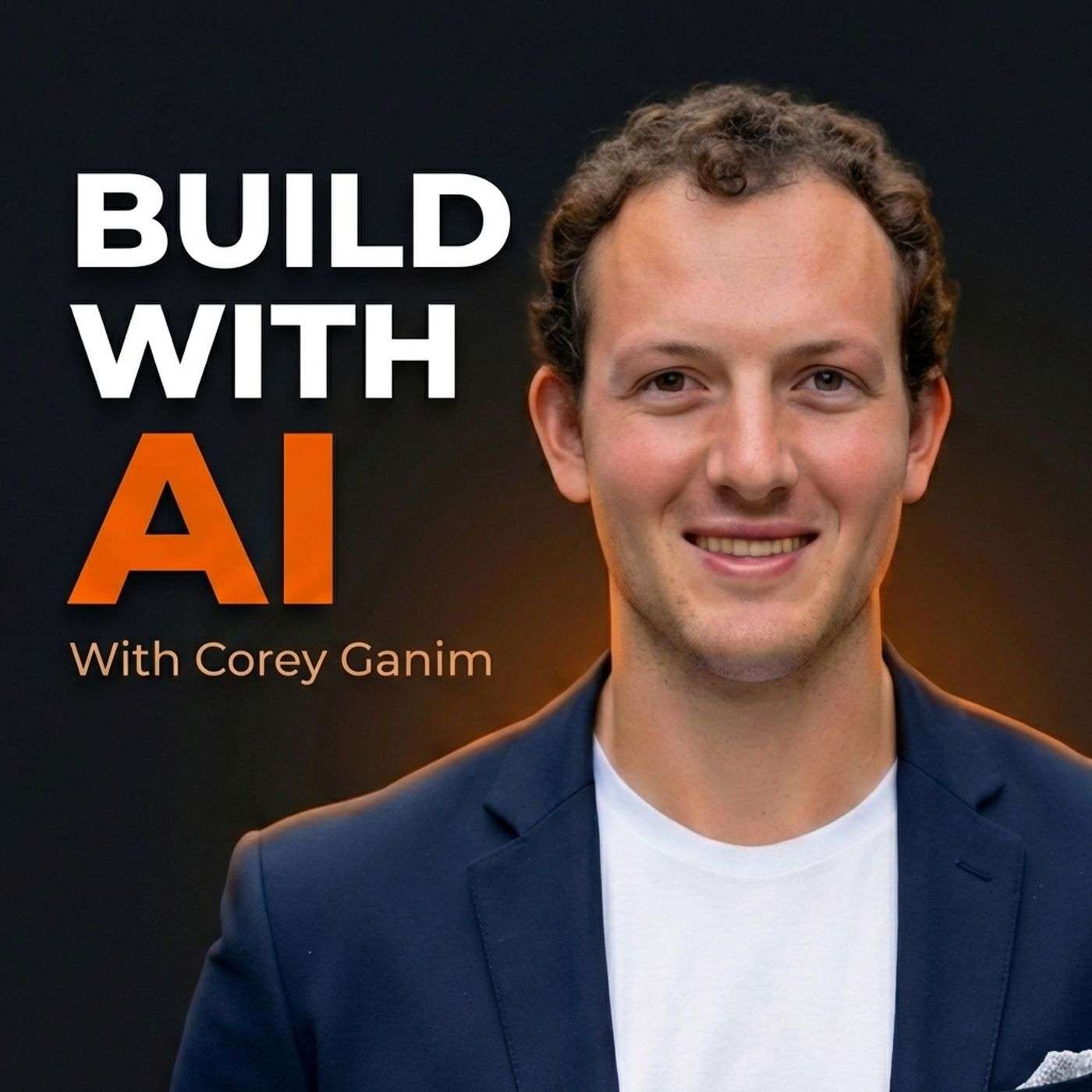
Build With AI
Most AI podcasts talk about what's possible. Build With AI shows you how it's done, live. Each episode, host Corey Ganim brings on entrepreneurs and operators who share their screen and build real AI automations, workflo...
Insights from recent episode analysis
On the show
- Nick Spisak2 eps
- Justin Brooke2 eps
- Leon van Zyl1 ep
Also: Eliot Prince, James Dickerson, Kevin Fernando, Chris Koerner, Tom Crawshaw, Mike Dion, Nick Puru, Susan Westwater, Adam Sandler, Nick Vasilescu, Alex McDonnell
Audience Interest
Podcast Focus
Publishing Consistency
Insights are generated by CastFox AI using publicly available data, episode content, and proprietary models.
Most discussed topics
Brands & references
Total monthly reach
Based on 1 signal.
Built from
By chart position
- 🇧🇷Brazil · Entrepreneurship#652.2K to 12K
- 🇹🇭TH · Entrepreneurship#28817 to 4.3K
- 🇦🇺Australia · Entrepreneurship#169173 to 914
- 🇵🇭PH · Entrepreneurship#99126 to 668
- 🇵🇹Portugal · Entrepreneurship#10197 to 513
- Per-Episode Audience
Est. listeners per new episode within ~30 days
3.5K to 19K🎙 Daily cadence·72 episodes·Last published 4d ago - Monthly Reach
Unique listeners across all episodes (30 days)
12K to 63K🇺🇸71%🇧🇷18%🇹🇭7%+3 more - Active Followers
Loyal subscribers who consistently listen
6.5K to 34K
Market Insights
Platform Distribution
Reach across major podcast platforms, updated hourly
Total Followers
—
Total Plays
—
Total Reviews
—
* Data sourced directly from platform APIs and aggregated hourly across all major podcast directories.
| Date | Episode | Topics | Guests | Brands | Places | Keywords | Sponsor | Length | |
|---|---|---|---|---|---|---|---|---|---|
| 10/19/26 | 8 github repos that print $$$ | Close your first (or next) AI services client within 90 days or get 100% of your money back: https://www.skool.com/aioperatoracademy/aboutGet all my FREE resources (including the ones mentioned in this video): https://www.skool.com/aioperatorhub/aboutIn this solo episode, I walk through 8 open-source GitHub repos you can turn into a cash-flowing AI services business without knowing how to code. For each one, I break down the exact offer, who to sell it to, realistic pricing, and how to find verified buyers with Treg. I also share which repo I'd start with and the next step to take tonight.Links mentioned in this episode:Treg (find verified leads): https://treg.to/ListMonk: https://github.com/knadh/listmonkPostiz: https://github.com/gitroomhq/postiz-appWhisperX: https://github.com/m-bain/whisperXPipeCat: https://github.com/pipecat-ai/pipecatDocling: https://github.com/docling-project/doclingComfyUI: https://github.com/Comfy-Org/ComfyUIBrowser Use: https://github.com/browser-use/browser-useClaude Finance (Anthropic financial services): https://github.com/anthropics/financial-servicesTimestamps:[00:00] - Intro: 8 GitHub Repos To Monetize[00:28] - The Simple Playbook For Every Repo[01:02] - Repo 1: ListMonk Win-Back Offer[03:54] - Finding Leads With Treg[05:07] - Repo 2: Postiz Social Autopilot[07:27] - Repo 3: WhisperX Call Scorecards[10:01] - Free Resource: All 8 Repos[10:34] - Repo 4: PipeCat After-Hours Receptionist[12:57] - Repo 5: Docling Invoice Entry[15:31] - Repo 6: ComfyUI Listing Images[17:53] - Repo 7: Browser Use Permit Tracker[19:53] - Repo 8: Claude Finance Listing Packs[22:02] - The Scoreboard And Where To Start[22:54] - Next Steps: Pull 100 LeadsFIND ME ON SOCIAL:X/Twitter: https://x.com/coreyganimInstagram: https://www.instagram.com/coreyganim/LinkedIn: https://www.linkedin.com/in/coreyganim/YouTube: https://www.youtube.com/@coreyganim | 23m 54s | ||||||
| 10/16/26 | If feel behind on AI, it’s not too late | Close your first (or next) AI services client within 90 days or get 100% of your money back: https://www.skool.com/aioperatoracademy/aboutGet all my FREE resources (including the ones mentioned in this video): https://www.skool.com/aioperatorhub/aboutIn this solo episode, I break the loop of feeling behind on AI, freezing, and falling further behind. I explain why you're way less behind than your feed makes it look, the habits that guarantee you stay behind, and the three step ladder from using AI on one task to getting paid for your expertise. I also share how I went from free mini assessments to $8,000 per month in AI concierge revenue.[00:00] - Intro: You're Not Too Late[00:21] - The Gap Between Feed And Reality[01:44] - Ways To Guarantee You Stay Behind[02:19] - The Knowledge Arbitrage Opportunity[03:07] - Invert It: Do The Opposite[03:29] - Build One Thing Per Week[04:02] - Stop Chasing Every New Launch[04:37] - Start With A Free 15 Minute Assessment[05:37] - AI Operator Academy And The Guarantee[06:14] - Three Step Ladder: Use AI First[07:03] - Rung Two: Turn Tasks Into Skills[08:18] - Rung Three: Sell What You Know[08:58] - The Text Message To Get Clients[09:41] - Upsell Paid Assessment Then AI Concierge[10:34] - My $8,000 Per Month Concierge Revenue[11:59] - Next Step: Take One Step TonightFIND ME ON SOCIAL:X/Twitter: https://x.com/coreyganimInstagram: https://www.instagram.com/coreyganim/LinkedIn: https://www.linkedin.com/in/coreyganim/YouTube: https://www.youtube.com/@coreyganim | 12m 40s | ||||||
| 10/15/26 | He made $100K in his first year selling AI services (CASE STUDY) | Close your first (or next) AI services client within 90 days or get 100% of your money back: https://www.skool.com/aioperatoracademy/aboutGet all my FREE resources (including the ones mentioned in this video): https://www.skool.com/aioperatorhub/aboutIn this episode, I sit down with Denis Laflamme, an IT consultant of 30 years who has made over $100,000 in revenue in his first year selling AI services. He walks through a real AI tools assessment that saves a client roughly 15 hours a week, how he prices AI concierge work at 10% of the client's annual savings, and a $2,000 website deal he closed in a single call. If you want proof that you don't need to be a tech bro to win clients, this is it.Timestamps:[00:00] - Intro: Meet Denis Laflamme[00:50] - Denis's 30 Year IT Background[01:40] - You Don't Need To Be Technical[02:45] - Speech Therapy AI Agent Walkthrough[04:05] - Is This Build Out Of Reach[04:55] - Selling The AI Tools Assessment[05:20] - The Free 15 Minute Assessment[06:00] - Power Equipment Client Assessment Results[07:15] - Quick Wins And Tools Recommended[08:10] - Phone Agent, Reviews, And Quote Builder[08:55] - Tying Every Build To Outcomes[10:10] - Small Wins First With Whisperflow[11:20] - Connecting Composio In Days Three Four[12:10] - Explaining The Four Month Journey[13:00] - Ask Questions And Let Clients Vent[14:30] - Calculating ROI: $10K Per Month Saved[15:35] - Pricing At 10% Of Annual Savings[16:20] - Why Four Month Engagements Reduce Churn[17:20] - Month Four Upsell And Next Proposal[18:20] - Enterprise Versus Small Business Conversations[19:20] - AI Concierge: Outcomes Plus Training[20:30] - The $2,000 Deal Closed In Hours[22:40] - Anchoring Price Against $10,000 Builds[24:10] - Recapping The Referral And Close[25:15] - Building The Site Faster Than The Call[27:00] - Why Denis Isn't A Coder[28:10] - Assessments Beat Complex Custom Builds[29:10] - Advice For Anyone On The Fence[30:40] - Where To Find Denis LaflammeFIND ME ON SOCIAL:X/Twitter: https://x.com/coreyganimInstagram: https://www.instagram.com/coreyganim/LinkedIn: https://www.linkedin.com/in/coreyganim/YouTube: https://www.youtube.com/@coreyganimFIND DENIS LAFLAMME ON SOCIAL:Denis Laflamme, Claude Academy (Ottawa, Canada)Website: https://claudeacademy.ca/ | 32m 12s | ||||||
| 10/13/26 | How to build (and sell) AI employees | Close your first (or next) AI services client within 90 days or get 100% of your money back: https://www.skool.com/aioperatoracademy/aboutGet all my FREE resources (including the ones mentioned in this video): https://www.skool.com/aioperatorhub/aboutIn this solo episode, I give you the full playbook for building AI employees in Claude and selling them to clients for monthly recurring revenue. I walk through the five steps, from finding the job and writing the job description to loading context, building the skill, and running the monthly loop. I also cover what can go wrong, how to price it, and why I start with a $1,000 assessment first.Timestamps:[00:00] - Intro: Building And Selling AI Employees[00:24] - What An AI Employee Actually Is[01:32] - The Five Step Process Overview[04:06] - Step One: Find The Job[05:30] - Impact Versus Effort Quick Wins[06:26] - Step Two: Write The Job Description[07:53] - Step Three: Load The Context[10:16] - Step Four: Build The Skill[10:48] - Idea To Diagram Skill Example[12:49] - The Prompt To Build A Skill[13:36] - Step Five: The Monthly Loop[14:52] - What Can Go Wrong[16:28] - Handling Scope Creep[17:42] - The Money Math: Assessments First[18:37] - Managed Agents Versus AI Concierge[19:28] - Next Steps: Write A Job Description[20:00] - AI Operator Academy And GuaranteeFIND ME ON SOCIAL:X/Twitter: https://x.com/coreyganimInstagram: https://www.instagram.com/coreyganim/LinkedIn: https://www.linkedin.com/in/coreyganim/YouTube: https://www.youtube.com/@coreyganim | 20m 47s | ||||||
| 10/12/26 | Reinvent your small business with AI in 90 days | Close your first (or next) AI services client within 90 days or get 100% of your money back: https://www.skool.com/aioperatoracademy/aboutGet all my FREE resources (including the ones mentioned in this video): https://www.skool.com/aioperatorhub/aboutIn this solo episode, I walk through the full playbook for reinventing your small business with Claude in 90 days, without hiring anyone or writing code. You'll learn how to audit your week, then automate admin in month one, sales follow up in month two, and delivery in month three, one workflow at a time with you approving the output. I also break down the math on how this can get you roughly 15 hours back per week.Timestamps:[00:00] - Intro: Reinvent Your Business With AI[00:50] - The Old Playbook Versus AI Agents[01:38] - Stop Asking Which Tool To Buy[02:25] - Old Way Versus New Way[03:40] - Your New Role: Approver[04:33] - Day Zero: Audit Your Business[06:05] - Month One: Automate Admin Work[07:49] - Month Two: Sales Follow Up[09:11] - Example Prompt: Drafting Proposals[10:09] - Month Three: Delivery With Skills[12:04] - Pushing Through Weeks Three To Seven[13:19] - The 15 Hours Per Week Math[14:54] - Next Steps: Run The AuditFIND ME ON SOCIAL:X/Twitter: https://x.com/coreyganimInstagram: https://www.instagram.com/coreyganim/LinkedIn: https://www.linkedin.com/in/coreyganim/YouTube: https://www.youtube.com/@coreyganim | 16m 03s | ||||||
| 10/9/26 | He made $1,000,000 in 30 days brokering data to AI labs | Close your first (or next) AI services client within 90 days or get 100% of your money back: https://www.skool.com/aioperatoracademy/aboutRefer deals to Ryan and earn 6% commission (average deal size is $300K): https://polyshares.com/signup?ref=79d8d9e1c1e01ca16357eef8f5e16d8eGet all my FREE resources (including the ones mentioned in this video): https://www.skool.com/aioperatorhub/aboutIn this episode, I sit down with Ryan Lock, co-founder of Polyshares, who tracked $1M in revenue in his first month securing private company data for the frontier AI labs. He breaks down what a real deal takes, why the average deal is around $300,000, how de-identification works, and where this market is headed. If you want to refer deals, he also explains the 6% finder's fee.Timestamps:[00:00] - Intro: Ryan Lock And Polyshares[01:00] - What You'll Learn In This Episode[01:45] - How The Data Brokering Model Works[02:40] - Average Deal Size And Big Exits[03:35] - What It Takes To Close A Deal[04:05] - Why Full Workflow Context Matters[07:00] - Earning A 6% Referral Commission[07:35] - Being Value Additive As A Broker[08:50] - Data Brokering Is Like Business Brokering[09:40] - How Long Will This Market Last[10:50] - Egocentric Data And Robotics Training[12:15] - Enterprises Training Their Own Models[15:20] - What Data The Labs Actually Want[16:25] - The Perfect Company For Data Deals[17:40] - Minimum Employees And Years In Business[18:40] - Industries The Labs Want Right Now[19:20] - Healthcare And Regulated Industry Data[21:00] - How Data De-Identification Works[22:50] - Who Is Liable If Something Breaks[23:40] - Insurance For Data Transactions[24:50] - Common Objections From Business Owners[26:50] - Why Third Party De-Identification Wins[27:35] - Exclusivity Periods Explained[29:40] - Selling Your Business After Licensing Data[31:45] - Does Data Revenue Count As EBITDA[32:20] - Closing: The Lead Gen OpportunityFIND ME ON SOCIAL:X/Twitter: https://x.com/coreyganimInstagram: https://www.instagram.com/coreyganim/LinkedIn: https://www.linkedin.com/in/coreyganim/YouTube: https://www.youtube.com/@coreyganimFIND RYAN LOCK ON SOCIAL:Website: https://polyshares.com/X/Twitter:https://x.com/RyanLockAI | 35m 37s | ||||||
| 10/8/26 | The $50k/month managed AI agent business (full course) | Close your first (or next) AI services client within 90 days or get 100% of your money back: https://www.skool.com/aioperatoracademy/aboutJoin Idea Browser here: https://join.ideabrowser.com/Corey Find Jordan’s diagram here: https://link.excalidraw.com/readonly/GlQ14k4YsyZZ2vesYFoY Get all my FREE resources (including the ones mentioned in this video): https://www.skool.com/aioperatorhub/aboutIn this episode, I sit down with Jordan Mickle, co-founder of Idea Browser, for a full course on the Leveraged AI Agency, also known as managed agents or agents as a service. Jordan walks through how to find a job a company does manually, build an agent that does it, and deliver the result like an employee on their team. We cover where to find opportunities, a seven-day sprint experiment, building prospect lists, cold outreach, the offer equation, and how to price against a fully burdened hire.Timestamps:[00:00] - Intro: The Leveraged AI Agency[01:46] - What Agents As A Service Actually Is[03:05] - AI Employee Example: Insurance Claims[03:58] - Find The One Key Decision Maker[05:12] - From Traditional Agency To Agents[07:13] - Start As A Service, Learn The Problem[08:07] - Sell Outcomes, Not AI Agents[10:01] - Why Build A Vertical Harness[11:39] - Where To Find Agent Opportunities[17:11] - Idea Browser And Finding Ideas[18:38] - The Seven-Day Sprint Experiment[21:41] - Collect Cash, Not Soft Commits[24:13] - Example Idea: Managed Lead Intelligence[28:12] - Validating Speed To Lead Offers[30:02] - Picking A Niche With Idea Browser[31:00] - Building Prospect Lists With Exa[36:31] - Positioning, Landing Pages, And VSLs[40:14] - Cold Outreach Templates That Work[45:07] - LinkedIn Networking And Dream 100[49:34] - The Offer Equation[53:38] - The $2,000 Inbound Audit Offer[54:26] - Pricing Against Jobs To Be Done[57:41] - Final Thoughts On Starting[58:58] - Where To Find JordanFIND ME ON SOCIAL:X/Twitter: https://x.com/coreyganimInstagram: https://www.instagram.com/coreyganim/LinkedIn: https://www.linkedin.com/in/coreyganim/YouTube: https://www.youtube.com/@coreyganimFIND JORDAN MICKLE ON SOCIALX: @jrdnmix Idea Browser on X: @ideabrowserFree niche quiz: ideabrowser.com/archetype | 1h 00m 29s | ||||||
| 10/6/26 | Build an AI business that makes you immune to model releases | Close your first (or next) AI services client within 90 days or get 100% of your money back: https://www.skool.com/aioperatoracademy/aboutGet all my FREE resources (including the ones mentioned in this video): https://www.skool.com/aioperatorhub/aboutIn this solo episode, I break down how to build an AI business that gets stronger every time a new model drops instead of getting wiped out. I explain why wrapper apps, prompt packs, one-off automations, and "tool guy" positioning keep resetting to zero, and why AI assessments and AI concierge retainers compound with every release. By the end, you'll have a litmus test to run your current offer through and a simple loop for turning every model release into a reason to call your clients.Timestamps:00:00 - Intro: Building Immunity In AI00:48 - The Typical Model Release Cycle01:28 - What Immunity Actually Means01:58 - The Four Businesses Model Releases Killed04:07 - The Vicious Cycle Of Constant Pivoting04:44 - The Kind Of Business That Is Immune05:03 - The $999 AI Tools Assessment06:14 - The AI Concierge Retainer Moat07:36 - Why Your Context Is A Competitive Advantage08:27 - Head To Head: The Immunity Litmus Test09:00 - Example: How Record A Skill Helped My Business11:07 - The Loop: Rerun The Assessment On Every Release12:49 - The Release-Day Text Message Script13:30 - The Verdict: Assessment As Wedge, Concierge As Moat14:42 - Next Steps: Audit Your Current Offer15:06 - Why I Stopped Building Knowledge Bases15:31 - AI Operator Academy InviteFIND ME ON SOCIALX/Twitter: https://x.com/coreyganim Instagram: https://www.instagram.com/coreyganim/ LinkedIn: https://www.linkedin.com/in/coreyganim/ YouTube: https://www.youtube.com/@coreyganim | 16m 08s | ||||||
| 10/5/26 | How I deliver a $999 AI assessment with Claude | Close your first (or next) AI services client within 90 days or get 100% of your money back: https://www.skool.com/aioperatoracademy/aboutGet all my FREE resources (including the ones mentioned in this video): https://www.skool.com/aioperatorhub/aboutIn this solo episode, I walk through exactly how I deliver and fulfill a $999 AI tools assessment for small business owners, start to finish. I cover the discovery call script, how I hand the transcript to Claude to find and rank tools on an impact versus effort matrix, and exactly what goes into the final report and review call. By the end, you'll have the complete step-by-step process to deliver this entire offer yourself in about two hours for $500 an hour.Timestamps:00:00 - Intro: How I Deliver A $999 Assessment00:34 - What An AI Tools Assessment Actually Is01:35 - How The Engagement Works: The Discovery Call03:14 - Who The Ideal Client Is03:42 - The Scope Of The Engagement04:28 - The Three Outcomes Framework05:02 - Step 1: The Discovery Call05:52 - The Exact Discovery Call Prompt For Claude07:26 - AOA's Question Bank And Assessment Skill08:22 - Step 2: Pasting The Transcript Into Claude09:37 - Step 3: Building The Report11:10 - Walking Through The Report Template12:36 - The Four Day Quick Wins Plan13:14 - What Comes After Quick Wins: Major Projects14:01 - The Financial Impact Slide14:37 - Step 4: The 30-Minute Review Call15:02 - Pitching The AI Concierge Upsell15:45 - The Full Offer Ladder: Mini To Paid To Concierge16:55 - Next Steps: Run A Free Mini Assessment This WeekFIND ME ON SOCIAL:X/Twitter: https://x.com/coreyganim Instagram: https://www.instagram.com/coreyganim/ LinkedIn: https://www.linkedin.com/in/coreyganim/ YouTube: https://www.youtube.com/@coreyganim | 17m 57s | ||||||
| 10/2/26 | How to reinvent yourself as an AI consultant in 90 days | Close your first (or next) AI services client within 90 days or get 100% of your money back: https://www.skool.com/aioperatoracademy/aboutGet all my FREE resources (including the ones mentioned in this podcast): https://www.skool.com/aioperatorhub/aboutIn this solo episode, I give you the full 90 day roadmap to land your first or next paying AI client, the exact protocol I followed myself, broken into three phases with scripts you can copy today. I walk through building your outreach list, running free mini assessments, converting those into a $999 paid assessment, and upselling into an AI concierge retainer. By the end, you'll know exactly what to do every day for the next 90 days, including how to push through the point where most people quit.Timestamps: 00:00 - Intro: The Full 90-Day Roadmap00:38 - The Day 0, 30, 60, 90 Plan01:17 - The Three Phases Overview01:39 - Free Resources Mentioned in This Episode01:56 - The Reinvention: Killing Your Limiting Beliefs02:41 - Becoming a Technical Translator04:10 - Who This Roadmap Is For05:07 - Who Your Ideal Client Actually Is06:07 - Phase 1 (Days 1-30): Building Your Identity and List06:30 - Weeks 1 and 2: Running Claude and Building Your Contact List07:17 - Charlie's 670-Contact Case Study08:32 - Week 3: Sending the Free Offer08:44 - Week 4: Running Five Mini Assessments09:05 - The Exact Outreach Text Script09:48 - What the Free Mini Assessment Actually Is10:48 - The SaneBox Example12:02 - Phase 2 (Days 31-60): Selling the Paid Assessment12:49 - Pitching the $999 Assessment at the End of the Call13:50 - Delivering the Assessment with Claude14:56 - The Effort vs. Impact Matrix16:14 - Phase 3 (Days 61-90): The AI Concierge Upsell17:54 - Landing Your Second Retainer by Week 1218:31 - The Daily Protocol: Sleep, Deep Work, Health20:30 - The Pit: Where Most People Quit Around Day 4521:58 - The Actual Money Math on 90 Days23:02 - Next Steps: Text 10 People Right NowFIND ME ON SOCIAL:X/Twitter: https://x.com/coreyganim Instagram: https://www.instagram.com/coreyganim/LinkedIn: https://www.linkedin.com/in/coreyganim/ YouTube: https://www.youtube.com/@coreyganim | 24m 04s | ||||||
Want analysis for the episodes below?Free for Pro Submit a request, we'll have your selected episodes analyzed within an hour. Free, at no cost to you, for Pro users. | |||||||||
| 9/30/26 | Why it sucks to run an AI automation agency | Close your first (or next) AI services client within 90 days or get 100% of your money back: https://www.skool.com/aioperatoracademy/aboutGet all my FREE resources (including the ones mentioned in this video): https://www.skool.com/aioperatorhub/aboutIn this solo episode, I explain why the AI automation agency model is already dead, and why it's following the exact same commoditization curve I watched play out in the Amazon FBA space from 2020 to 2025. I break down the four rules of a commodity market, why business owners don't actually want automation, and the two offers, the AI tools assessment and the AI concierge, that let your value go up as the models get better instead of down. By the end, you'll know exactly why to drop the word "automation" from your offer this week and what to replace it with.Timestamps:00:00 - Intro: AI Automation Sucks01:00 - Why You Should Listen: Corey's Amazon Background01:24 - The Amazon FBA Gold Rush Parallel02:19 - The Same Story Playing Out in AI03:13 - The Platform Risk Parallel03:42 - The Four Rules of a Commodity Market06:11 - Who Actually Wins: Relationships, Distribution, Exclusivity07:18 - The Solution: Stop Selling Automation08:33 - What an AI Concierge Actually Is09:46 - Why Teaching the Owner Builds the Relationship10:44 - Comparing Dollars Per Hour Across Three Offers11:46 - The AI Tools Assessment Offer13:18 - AI Concierge Retainers and the $7,500/Month Example14:19 - Free Resources Mentioned in This Episode14:41 - Next Steps: Drop the Word "Automation" This Week15:17 - AI Operator Academy and the 90-Day GuaranteeFIND ME ON SOCIAL:X/Twitter: https://x.com/coreyganim Instagram: https://www.instagram.com/coreyganim/ LinkedIn: https://www.linkedin.com/in/coreyganim/ | 15m 54s | ||||||
| 9/29/26 | AI Concierge clearly explained | Close your first (or next) AI services client within 90 days or get 100% of your money back: https://www.skool.com/aioperatoracademy/about Get all my FREE resources (including the ones mentioned in this podcast): https://www.skool.com/aioperatorhub/aboutIn this solo episode, I break down my AI Concierge model step by step, the exact done-with-you consulting offer I've used to generate $8,000 in monthly recurring revenue in a 10 day span. I walk through the four deliverables, the intake form, the two monthly strategy calls, Voxer access, and the Notion hub, plus my Audit Optimize Automate framework and the exact pricing ladder I use to raise rates with every new client. By the end, you'll have a complete, replicable consulting model you can pitch to your existing network this week.Timestamps:00:00 - Intro: The AI Concierge Model00:48 - The Offer: Two Calls, Voxer, and a Notion Hub01:10 - The Opportunity and the Hourly Rate Math02:02 - A Community Member's $30K Six-Month Retainer02:22 - Who the Ideal Client Actually Is03:52 - The Real Problem You're Solving05:34 - The Four Deliverables Overview07:57 - Walking Through the Jotform Intake Form08:31 - The Time-Sink Questions That Drive Engagement10:02 - The Calls and the "Audit, Optimize, Automate" Framework11:33 - Call One: Onboarding the Client to Claude12:21 - The Onboarding Plugin Walkthrough14:15 - Why Voxer Access Works So Well15:32 - Walking Through the Notion Hub17:44 - Client Retention and a Churn Story18:16 - Pricing and Margins Breakdown19:09 - Why Corey Now Prices at $2,500/Month19:48 - Next Steps: Pitch Your Existing Clients This Week20:40 - AI Operator Academy's Business-In-A-Box OfferFIND ME ON SOCIAL:X/Twitter: https://x.com/coreyganimInstagram: https://www.instagram.com/coreyganim/LinkedIn: https://www.linkedin.com/in/coreyganim/ YouTube: https://www.youtube.com/@coreyganim | 21m 09s | ||||||
| 9/28/26 | Listen to me fulfill a real $999 AI consulting call | Close your first (or next) AI services client within 90 days or get 100% of your money back: https://www.skool.com/aioperatoracademy/aboutGet all my FREE resources (including the ones mentioned in this podcast): https://www.skool.com/aioperatorhub/aboutIn this episode, you're listening in on a real $999 AI consulting call with my client Alex, where he shares his screen and shows me his full AI agent setup. I give him live feedback on what's working, what's overbuilt, and exactly how to re-architect his agent team to prospect more effectively and close more deals. By the end, you'll see a real consulting engagement play out start to finish, including the exact tools and workflow fixes I recommend.Timestamps:00:00 - Intro: A Real Client Call With Alex01:02 - Alex's Goal: Grokbot For Prospecting02:05 - Walking Through The Agent Workflow So Far03:56 - Screen Share: Diagnosing The Overbuilt System06:17 - The Mistake: Letting Claude Code Configure Grokbot06:41 - The Simple Chief Of Staff Prompt09:30 - How Many Bots You Actually Need11:32 - The Step-By-Step Rebuild Plan13:21 - Dumping Context And The Transcript Into The Bot14:44 - Turning The Workflow Into A Skill15:41 - Question: Running Multiple Agent Teams18:35 - Recommendation: GoHighLevel As Source Of Truth19:10 - Connecting GHL To Grokbot With Composio20:37 - How To Install Composio21:49 - Composio's Multiple Account Connections22:32 - Composio Lets Claude Edit Sheets And Docs23:33 - Alex's Plan To Rebuild From Scratch23:53 - Corey's Own Grokbot Team Setup25:06 - Final Recommendation: One Prospecting AgentFIND ME ON SOCIAL:X/Twitter: https://x.com/coreyganim Instagram: https://www.instagram.com/coreyganim/ LinkedIn: https://www.linkedin.com/in/coreyganim/ YouTube: https://www.youtube.com/@coreyganim | 26m 05s | ||||||
| 9/25/26 | I built my whole brand with Claude Design in 20 minutes (no designer) | Join AI Operator Academy: https://www.skool.com/aioperatoracademy/aboutGet all my FREE resources (including the ones mentioned in this podcast): https://www.skool.com/aioperatorhub/aboutIn this solo episode, I fire my designer and build an entire brand from scratch using Claude Design, live on screen, in under 20 minutes. I walk through building eight logo concepts, locking in a full design system, and turning that into a sales one pager and a working landing page, then break down three ways to turn this into a paid service. By the end, you'll have a repeatable system for building professional brand assets for yourself or your clients without hiring a designer.Timestamps:00:00 - Intro: Firing Your Designer With Claude Design00:43 - Building A Full Brand In Under 20 Minutes01:37 - The Four Deliverables: Logo, System, One Pager, Landing Page02:18 - Opening Claude Design In The App03:05 - Prompting Eight Logo Concepts04:31 - Reviewing The Eight Logo Concepts05:08 - What A Design System Actually Is05:53 - Saving A Logo As Your Design System07:02 - The Full Design System Claude Delivered07:36 - Uploading The Design System Zip File08:24 - Design System Fully Generated09:06 - Building The Sales One Pager09:48 - Prompting The $497 AI Tools Assessment One Pager10:46 - First Draft Of The One Pager11:10 - Using Comments To Edit The One Pager13:21 - Claude Applies All The Edits13:56 - Exporting And Pushing To Other Tools14:41 - Building The Free Mini Assessment Landing Page16:08 - Wireframe Options And Picking 1A16:42 - The Finished Landing Page18:30 - Recap: Four Deliverables Built18:43 - Why This Makes You Look Legit From Day One19:30 - AI Operator Academy And The 90-Day Guarantee19:56 - Use This As A Free Lead-Gen Logo Build20:52 - Upselling A Client Brand Refresh Via AI Concierge22:00 - Branding Your Paid AI Assessment Reports22:48 - Tonight's Action Item: Build Your Eight Logos23:12 - Closing AI Operator Academy InviteFIND ME ON SOCIAL:X/Twitter: https://x.com/coreyganim Instagram: https://www.instagram.com/coreyganim/LinkedIn: https://www.linkedin.com/in/coreyganim/YouTube: https://www.youtube.com/@coreyganim | 23m 48s | ||||||
| 9/23/26 | Overlooked way to sell $2,500 AI workshops to SMBs (full breakdown) | Join AI Operator Academy: https://www.skool.com/aioperatoracademy/aboutGet all my FREE resources (including the ones mentioned in this video): https://www.skool.com/aioperatorhub/aboutIn this episode, I sit down with Dennis Morales, an AI Operator Academy member who landed his first paid AI workshop using a free coworking office hours method. Dennis breaks down the exact three-part playbook, landing the venue, running the session, and converting attendees, that turned a single free lunch and learn into a $2,500 paid workshop and multiple ongoing AI concierge clients. By the end, you'll have a real, replicable system for turning free local workshops into paid AI services clients.Timestamps:(00:00) Intro: Dennis's First Paid AI Workshop(00:30) The Problem: No Referral Network Or Pipeline(01:14) Cold Calling Local Coworking Spaces(02:10) Who To Pitch: Community Manager Or Owner(03:35) The Free Lunch And Learn Pitch Script(04:15) AI Operator Academy's Office Hours Course(05:13) Part 1: Landing The Venue Workflow(06:20) Using A Survey To Pick The Session Topic(08:08) The Three-Part Framework Overview(08:37) Conversion Rate On Cold Calls (50%)(09:21) Aiming For Consistency And Repeat Bookings(09:53) Sitting In The Coworking Space For Walk-Ups(11:02) The First $2,500 Paid Workshop Result(11:56) Landing AI Concierge Engagements(13:02) Charging $3-5K For AI Policy Work(13:58) Part 2: Running The Session(16:02) Handling AI-Forward, Technical Attendees(17:59) Part 3: Converting Attendees Into Clients(19:10) Pitching The Paid Assessment At The End(19:57) Free Vs. Paid Assessment Decision(21:07) Corey's Advice: Add Real Scarcity To The Offer(23:32) Why Dennis Recommends AI Operator Academy(25:14) Where To Find And Work With DennisFIND ME ON SOCIAL:X/Twitter: https://x.com/coreyganimInstagram: https://www.instagram.com/coreyganim/LinkedIn: https://www.linkedin.com/in/coreyganim/ YouTube: https://www.youtube.com/@coreyganimFIND DENNIS ON SOCIAL X/Twitter: @TIPBTDennis | 25m 55s | ||||||
| 9/22/26 | Jev clearly explained (and how to make money with it) | Try Orgo (3 days free + 20% off your first 3 months): https://www.orgo.ai/?r=COREYJoin AI Operator Academy: https://www.skool.com/aioperatoracademy/aboutGet all my FREE resources (including the ones mentioned in this video): https://www.skool.com/aioperatorhub/aboutIn this episode, I sit down with Nick Vasilescu, co-founder of Orgo, to break down JEV, the new multiple-choice decision model that's blowing up on X. Nick explains exactly what JEV is, why it's absurdly fast and cheap compared to LLMs like Claude or GPT, and the specific high-volume, high-structure workflows (insurance claims, competitive intelligence, e-commerce arbitrage) where it can save you real money. By the end, you'll know exactly when JEV is worth building with and when it's just a distraction.Timestamps:(00:00) Intro: Everyone's Talking About JEV(01:06) Defining JEV: A Multiple-Choice Decision Model(02:57) Nick's Origin Story: Building Computer Use Agents(05:18) When You Should (And Shouldn't) Use JEV(06:08) Comparing JEV To Claude Cowork Style Agents(08:07) The Insurance Claims High-Volume Use Case(08:26) Why Nick Charges $5K/Month For Managed Agents(10:44) Demo: JEV Playing Minecraft(12:28) Demo: The "Look Now" Model-Release Detector(13:34) The Orgo Promo And What It Unlocks(15:35) Use Case: Competitive Intelligence At Scale(16:48) Use Case: E-Commerce Arbitrage And Price Scraping(17:58) Orgo's Preview Playground For JEV(18:39) Demo: JEV Playing Chess Fast (But Dumb)(19:46) Will OpenAI Or Anthropic Build Their Own JEV?(21:40) The 80/20 Summary On JEV(22:17) Dewey (Nick's Hermes Agent) Demos More Use Cases(23:55) Ask Your Existing Agent To Explain New Tools(24:24) Where To Find Nick And Try OrgoFIND ME ON SOCIAL:X/Twitter: https://x.com/coreyganimInstagram: https://www.instagram.com/coreyganim/ LinkedIn: https://www.linkedin.com/in/coreyganim/ YouTube: https://www.youtube.com/@coreyganimFIND NICK ON SOCIAL X/Twitter: @nickvasilez YouTube: @nickvasilez | 25m 17s | ||||||
| 9/21/26 | how to print money with AI in 2026 (even if you’re new) | Join AI Operator Academy: https://www.skool.com/aioperatoracademy/aboutGet all my FREE resources (including the ones mentioned in this podcast): https://www.skool.com/aioperatorhub/aboutIn this solo episode, I break down six different AI assessments you can sell for $1,000 or more in 2026, even with zero experience. For each one I cover the exact discovery questions to ask, the deliverable you hand the client, and how you use Claude to do the legwork. By the end, you'll have six ready-to-sell offers plus the pricing and time framework behind all of themTimestamps:.(00:00) Intro: Get Paid To Ask Questions(00:49) Offer 1: The AI Tools Assessment(01:47) Discovery Questions For The AI Tools Assessment(02:50) Deliverable: Impact Vs Effort Matrix(03:37) AI Operator Academy: Selling This As A Foot In The Door(03:57) Offer 2: The Speed To Lead Assessment(04:42) Discovery Questions For Speed To Lead(05:46) Deliverable: Pipeline Leak Map(06:47) Offer 3: The Marketing Assessment(07:32) Discovery Questions For The Marketing Assessment(08:30) Deliverable: Channel ROI Scorecard(09:26) Offer 4: The Back Office Assessment(10:01) Discovery Questions For The Back Office Assessment(12:10) Deliverable: Hours Recovered And Automation Blueprint(12:46) Offer 5: The Hiring And Onboarding Assessment(13:35) Discovery Questions For Hiring And Onboarding(14:12) Deliverable: Hiring Funnel Time Audit(15:14) Offer 6: The Data And Reporting Assessment(15:41) Discovery Questions For Data And Reporting(16:14) Deliverable: Data Source Map And AI Dashboard Plan(17:00) The Three Outcomes: Effectiveness, Efficiency, Quality(18:17) Next Steps And AI Operator Academy InviteFIND ME ON SOCIAL:X/Twitter: https://x.com/coreyganimInstagram: https://www.instagram.com/coreyganim/ LinkedIn: https://www.linkedin.com/in/coreyganim/ YouTube: https://www.youtube.com/@coreyganim | 18m 57s | ||||||
| 9/18/26 | Making $2K in 30 days selling AI + $50K in pipeline (CASE STUDY) | Join AI Operator Academy: https://www.skool.com/aioperatoracademy/about Get all my FREE resources (including the ones mentioned in this podcast): https://www.skool.com/aioperatorhub/about In this episode, I sit down with Charlie Madison, a member of AI Operator Academy, who sold two $999 paid assessments in his first 30 days and uncovered roughly $50K in additional pipeline. Charlie walks through the exact outreach system he used, a personalized video sent to his entire contact list, and breaks down how he qualifies hungry buyers and pitches the paid assessment with a 50 percent close rate. By the end, you'll have a real, replicable case study for landing your first AI services clients fast.Timestamps:(00:00) Intro: Meet Charlie Madison(02:30) Charlie's 60-Second Outreach Video Strategy(04:41) Breaking Down The Outreach Numbers(07:01) AI Operator Academy Community Plug(08:28) Charlie's Biggest Insight: Mutual Buy-In(11:07) How Charlie Pitches The Paid Assessment(14:20) Qualifying Leads: The Hungry Audience(17:57) Selling Outcomes, Not AI(21:55) Quantifying The $50K Pipeline(22:43) Charlie's Advice On Joining AI Operator Academy(24:23) Where To Find And Connect With CharlieFIND ME ON SOCIAL:X/Twitter: https://x.com/coreyganim Instagram: https://www.instagram.com/coreyganim/ LinkedIn: https://www.linkedin.com/in/coreyganim/ YouTube: https://www.youtube.com/@coreyganimYou can find Charlie here via Fire Busy Work:🔗 https://firebusyworkfreepeople.com/ | 25m 18s | ||||||
| 9/16/26 | 5 Github repos that print $$$ | Join AI Operator Academy: https://www.skool.com/aioperatoracademy/about Get all my FREE resources (including the ones mentioned in this podcast): https://www.skool.com/aioperatorhub/about In this solo episode, I break down five free, open source GitHub repos you can turn into cash flowing AI services offers, even with zero coding experience: competitor price tracking, a company handbook chatbot, an SEO audit tool, automated podcast clipping, and instant proposal decks. For each one I cover exactly what to sell, who to sell it to, realistic pricing, and how to find leads using a new tool called Treg. By the end, you'll have five ready-to-launch offers plus a clear starting point if you're new.Timestamps:00:00 - Intro: 5 Free GitHub Repos That Print Cash01:20 - Repo 1: Scrapeling For Competitor Price Tracking02:59 - Finding Leads With Treg's People Search04:46 - Repo 2: Dify For A Company Handbook Chatbot06:33 - Finding Leads For The Handbook Bot Offer07:33 - Repo 3: Open SEO As A Semrush Alternative09:35 - AI Operator Academy: Selling The Audit11:12 - Finding SEO Audit Leads With Treg11:49 - Repo 4: Open Shorts For Podcast Clipping13:37 - Finding Leads For The Clipping Offer14:45 - Repo 5: Present On For Instant Proposal Decks16:40 - Finding Leads For The Proposal Deck Offer17:15 - Scorecard: Which Repo To Start With17:59 - Next Steps And AI Operator Academy InviteFIND ME ON SOCIAL:X/Twitter: https://x.com/coreyganimInstagram: https://www.instagram.com/coreyganim/ LinkedIn: https://www.linkedin.com/in/coreyganim/ YouTube: https://www.youtube.com/@coreyganimFind Github Links here:https://github.com/D4Vinci/Scrapling https://github.com/langgenius/dify https://github.com/every-app/open-seo https://github.com/mutonby/openshorts https://github.com/presenton/presenton | 18m 51s | ||||||
| 9/15/26 | How i'd start a $10K/month AI business with claude in 30 days | Join AI Operator Academy: https://www.skool.com/aioperatoracademy/about Get my free AI Assessment template: https://audittemplate.ai/ In this solo episode, I lay out the exact 30-day playbook I'd follow to build a $10,000/month AI business from scratch using nothing but Claude, zero coding required. I walk through the offer, a $999 AI tools assessment, the outreach system that actually fills your pipeline, and the upsell path from a free mini assessment to a paid assessment to a recurring AI concierge engagement. By the end, you'll have the full math on how just eight clients a month gets you to $10K.Timestamps:(00:00) Intro: The $10K/Month Claude Playbook(02:10) Who This Business Model Is For(03:36) The Offer: What Is An AI Tools Assessment(04:23) The Three Outcomes Framework(05:13) Pricing, The Free Template, And The Claude Skill(06:45) The Elevator Pitch That Closes Clients(07:36) Week 1: Picking And Pricing Your Offer(08:08) Week 2: The Outreach That Actually Makes Money(09:43) The Free 15-Minute Mini Assessment(11:13) Week 3: Upselling To The Paid Assessment(12:15) Posting Content To Attract Inbound Leads(12:47) Week 4: Upselling To AI Concierge(14:51) The Math Behind Hitting $10K A Month(16:27) Next Steps And AI Operator Academy InviteFIND ME ON SOCIALX/Twitter: https://x.com/coreyganim Instagram: https://www.instagram.com/coreyganim/ LinkedIn: https://www.linkedin.com/in/coreyganim/ YouTube: https://www.youtube.com/@coreyganim | 17m 31s | ||||||
| 9/14/26 | Copy my Claude skills template, it makes me $8,000 every 30 days | Join AI Operator Academy: https://www.skool.com/aioperatoracademy/about Get all my FREE resources (including the ones mentioned in this podcast): https://www.skool.com/aioperatorhub/about In this solo episode, I break down the exact Claude Skills blueprint I use inside my AI concierge consulting practice to make $8,000 a month across five clients. I walk through my AOA framework, Audit, Optimize, Automate, then show a real example of a 24-step client onboarding process we turned into five Claude skills plus one orchestrator skill. By the end, you'll have the exact process to turn any client's manual workflow into a set of reusable, scheduled Claude skills.Timestamps:00:00 - Intro: The $8K/Month Claude Skills Blueprint00:58 - The AOA Framework: Audit, Optimize, Automate02:06 - Step 1: Auditing The Current Process04:18 - Step 2: Optimizing Before You Automate07:04 - AI Operator Academy Community Plug07:35 - Step 3: Automating One Skill At A Time09:19 - Testing And Iterating On The First Skill10:27 - Why New Skills Should Draft, Not Auto-Send11:50 - Building An Orchestrator Skill12:34 - Scheduling Skills To Run On Autopilot13:18 - Real Client Example: A 24-Step Onboarding Process14:01 - How The Audit And Optimize Calls Went14:53 - Correcting Claude's Misreads And Fixing Tools16:09 - Splitting Skills At The Human Boundaries16:51 - Automating And Locking In The Build Plan17:14 - Wrap-Up And AI Operator Academy InviteFIND ME ON SOCIALX/Twitter: https://x.com/coreyganimInstagram: https://www.instagram.com/coreyganim/ LinkedIn: https://www.linkedin.com/in/coreyganim/ YouTube: https://www.youtube.com/@coreyganim | 17m 45s | ||||||
| 9/11/26 | Building an AI agency from scratch episode 3 | Get $100 of free Hyperagent credits with any paid plan when you use this link: https://hyperagent.com/Corey100Join AI Operator Academy: https://www.skool.com/aioperatoracademy/about Get all my FREE resources (including the ones mentioned in this podcast): https://www.skool.com/aioperatorhub/about In this episode, you watch me sell then fulfill a real AI assessment from start to finish. I confirm a discovery call with a custom home builder, uncover his back office bottlenecks, and build a HyperAgent bot that analyzes the transcript and prescribes a simple fix. I demo the recommendation in person, close him on the spot for a paid NotebookLM pilot, then use HyperAgent again to build and QA the entire deliverable. By the end, you'll see the full sales-to-fulfillment loop for a real AI services client, agents and all.Timestamps:00:00 - Intro: Selling And Fulfilling A Real Deal00:40 - Calling Ben To Confirm The Discovery Call00:55 - Uncovering Back Office Pain Points03:45 - The Invoice Coding And Approval Process06:07 - Estimates And Proposals Workflow08:38 - Client Updates Through Job Tread10:36 - Draw Requests And Lender Paperwork14:13 - Wrapping The Call And Booking The Follow-Up17:40 - Recap: What Just Happened In The Mini Assessment19:19 - Building The Bottleneck Audit Agent In HyperAgent20:26 - Configuring The Agent's Model And Settings22:47 - Running The Assessment On Ben's Transcript28:04 - Reviewing The Two Opportunities It Found30:14 - Choosing NotebookLM For The Live Demo34:08 - Testing The Demo Before The Meeting36:32 - Closing Ben On The Spot In Person38:35 - Kicking Off The Paid Pilot Fulfillment43:34 - The Fulfillment Materials And Zip File44:50 - Setting Up The Notebook In NotebookLM46:54 - QA Testing The Notebook's Answers50:24 - Building The Team Quick Start Guide53:07 - Recording The Client Walkthrough Video54:15 - What's Coming In Episode Four56:02 - Wrap-Up And AI Operator Academy InviteFIND ME ON SOCIAL:X/Twitter: https://x.com/coreyganim Instagram: https://www.instagram.com/coreyganim/ LinkedIn: https://www.linkedin.com/in/coreyganim/ YouTube: https://www.youtube.com/@coreyganim | 57m 28s | ||||||
| 9/10/26 | How to print money with GPT-6 Astra (before everyone ruins it) | Join AI Operator Academy: https://www.skool.com/aioperatoracademy/about Get all my FREE resources (including the ones mentioned in this podcast): https://www.skool.com/aioperatorhub/about In this solo episode, I use GPT-6 Astra inside Codex to fully automate the two heaviest steps of my $1,000 AI Tools Assessment offer: the pain point analysis and the client report build. I prompt it live to research tools, score them on an effort versus impact matrix, calculate ROI, and turn the whole report into a shareable client website, then package each step into a reusable Codex skill. By the end, you'll see exactly how to automate 60 to 70 percent of this entire offer in under 30 minutes.Timestamps:00:00 - Intro: Automating The AI Assessment Offer00:50 - Breaking Down The Six-Step Offer03:19 - Opening Codex To Start Automating04:47 - Prompting GPT-6 Astra On The Transcript06:19 - The Tool Recommendations It Found08:44 - Scoring Effort Versus Impact And ROI11:10 - AI Operator Academy Community Plug11:54 - Free Playbook Download Offer12:37 - ROI Results And Steering GPT Away From Overkill14:43 - Building The AI Tools Analysis Skill16:05 - AI Tools Analysis Skill Complete17:06 - Automating The Report With Codex Sites20:20 - Reviewing The Completed Report Site21:50 - The Priority Matrix Section22:27 - Tools And Pricing Breakdown23:14 - The Four-Day Quick Start Plan24:01 - Financial Impact And ROI Slide25:14 - Turning The Report Into A Skill26:00 - Assessment Report Skill Complete26:24 - Building An Orchestrator Skill Next27:34 - Wrap-Up And Where To Get The PlaybookFIND ME ON SOCIAL:X/Twitter: https://x.com/coreyganimInstagram: https://www.instagram.com/coreyganim/LinkedIn: https://www.linkedin.com/in/coreyganim/ YouTube: https://www.youtube.com/@coreyganim | 28m 37s | ||||||
| 9/8/26 | How I Fulfill $999 AI Assessments (step by step) | Join AI Operator Academy: https://www.skool.com/aioperatoracademy/about Get the Free AI Audit Template: https://audittemplate.ai/ In this solo training, I walk through my exact end-to-end workflow for fulfilling a real $999 AI assessment, from pasting in a Fathom call transcript to handing a client a polished, ready-to-present report. I show how I run Claude's AI Tools Assessment skill on the transcript, then drop the output into Claude Design to auto-fill the assessment template with recommended tools, a four-day quick win plan, and full ROI numbers. By the end, you'll have the exact plug-and-play process to run this for your own clients in minutes.Timestamps:00:00 - Intro: The Assessment Workflow Question00:28 - Installing The AI Tools Assessment Skill00:57 - Running It On A Fathom Transcript01:24 - The Two Outputs: JSON And DOCX01:40 - Opening A Real Client Assessment01:58 - Reviewing The Recommended Solutions02:46 - Finding Alternative Tools If Needed03:31 - Importing The Blank Template Into Claude Design04:19 - Auto-Filling The Template From The DOCX04:58 - Reviewing The Completed Report05:34 - Effort Vs Impact Matrix And Quick Wins06:01 - Recommended Solutions Filled In Perfectly06:21 - The Four-Day Quick Win Plan06:41 - Financial Impact And ROI Calculation07:06 - Next Steps And Scheduling The Review Call07:50 - Exporting As PowerPoint Or PDF08:04 - Wrap-Up: Full Workflow RecapFIND ME ON SOCIAL:X/Twitter: https://x.com/coreyganimInstagram: https://www.instagram.com/coreyganim/ LinkedIn: https://www.linkedin.com/in/coreyganim/YouTube: https://www.youtube.com/@coreyganim | 9m 19s | ||||||
| 9/4/26 | 12 ways to land AI services clients (ranked) | Join AI Operator Academy: https://www.skool.com/aioperatoracademy/about Grab the free AI for Business Meetup Prompt here: https://corey-ganim.kit.com/f0f27f0f58In this solo episode, I rank all 12 ways to land clients for your AI services business, from door knocking to paid ads to referral partnerships. I break down which methods are S tier, which ones are a waste of time, and exactly which one you should start with if you're new. By the end, you'll have a full playbook for how to go out and land clients so you can start making money with AI.Timestamps:00:00 - Intro: Ranking 12 Client Methods00:27 - Door Knocking Local Businesses (A Tier)02:25 - Cold Calling Grind (D Tier)04:14 - Content Marketing Wins (S Tier)06:39 - Hosting Local AI Events (A Tier)09:32 - Cold Email At Scale (B Tier)11:07 - Cold DMs Done Right (C Tier)12:38 - Warm Outreach, The Best Starting Point (A Tier)14:09 - In-Person Networking Events (B Tier)15:53 - Referral Partnerships (S Tier)18:32 - Borrowing Other People's Audiences (A Tier)21:10 - Paid Ads As A Scaling Lever (B Tier)22:32 - Marketplaces Like Upwork And Fiverr (F Tier)FIND ME ON SOCIAL:X/Twitter: https://x.com/coreyganimInstagram: https://www.instagram.com/coreyganim/ LinkedIn: https://www.linkedin.com/in/coreyganim/ YouTube: https://www.youtube.com/@coreyganim | 27m 26s | ||||||
| 7/20/26 | AI servicesbusiness growth+3 | — | AI Operator AcademyClaude+3 | — | AI servicesbusiness course+4 | — | 1h 07m 47s | ||
| 7/16/26 | AI startupentrepreneurship+3 | — | AI Assessment frameworkExcalidraw+4 | — | AI startup ideaAI assessment+3 | — | 25m 37s | ||
| 7/13/26 | lead generationAI services+3 | — | AI Operator Academy | — | AI serviceslead generation+3 | — | 21m 48s | ||
| 7/9/26 | AI systemsbusiness model+4 | Justin Brooke | ClaudeChatGPT+5 | — | AI operating systemCMO HQ+5 | — | 33m 49s | ||
| 7/6/26 | AI automationbusiness strategy+3 | — | AI assessmentsExcalidraw diagram+1 | — | AI automation agencyassessment report template+3 | — | 24m 58s | ||
| 7/2/26 | AI auditsbusiness assessment+4 | — | Claude DesignAI Operator Academy Community+1 | — | AI toolsaudit template+4 | — | 13m 30s | ||
| 6/29/26 | AI business modelclient onboarding+3 | — | AI Concierge playbookNotion+3 | — | AI businessclient intake+3 | — | 20m 45s | ||
| 6/25/26 | AI knowledge basebusiness strategy+3 | Adam Sandler | Viable Edge | — | AI second brainsknowledge base+3 | — | 53m 22s | ||
| 6/22/26 | AI agent businessentrepreneurship+3 | Nick Vasilescu | OrgoHermes+1 | — | AI agentbusiness model+3 | Orgo.aiCOREY | 47m 50s | ||
| 6/18/26 | AI servicesbusiness model+4 | Alex McDonnell | Airtable | Veslo Family Restaurant | AI offerbusiness model+7 | HyperagentCOREY | 45m 53s | ||
| 6/2/26 | AI consultingbusiness model+3 | — | AI Concierge OfferClaude+2 | — | AI consultingbusiness infrastructure+3 | — | 15m 22s | ||
| 5/27/26 | AI finance departmentautomation+5 | Mike Dion | N8n | — | AI agentfinance automation+5 | — | 43m 44s | ||
| 5/19/26 | AI marketingpredictive analytics+3 | Justin Brooke | HarvardStanford+1 | — | AI agentmarketing+5 | — | 50m 24s | ||
| 5/15/26 | AI content creationInstagram marketing+3 | Nick Puru | Claude Code | — | Claude CodeInstagram+5 | — | 32m 44s | ||
| 5/12/26 | AI voice agentsno code development+4 | Susan Westwater | VoiceflowVAPI+3 | — | AI voice agentVoiceflow+6 | — | 59m 14s | ||
| 5/8/26 | AIsecond brain+4 | — | HermesClaude Code+6 | — | AI second brainHermes agent+5 | HostingerCOREY10 | 18m 41s | ||
| 5/5/26 | automationcontent creation+4 | Tom Crawshaw | Claude CodeWhisperflow+3 | — | Claude Codeautomation+6 | — | 57m 29s | ||
| 4/29/26 | AI assessmentssmall business+4 | Chris Koerner | AI assessmentsAI audit+5 | — | AI auditsmall business owners+3 | — | 36m 13s | ||
| 4/23/26 | Claude Cowork setuponboarding process+3 | — | Claude CoworkCowork Onboarding plugin+4 | — | Claude Coworkonboarding+4 | — | 26m 52s | ||
| 4/17/26 | web designAI tools+3 | Leon van Zyl | Google StitchClaude Code+4 | — | web designAI-generated websites+3 | — | 1h 05m 07s | ||
| 4/14/26 | automationClaude Code+4 | — | X trend scannerClaude Code Routines+2 | — | Claude Codeautomation modes+5 | — | 5m 11s | ||
| 4/10/26 | AI agentsClaude Managed Agents+4 | Nick Spisak | AnthropicClaude Managed Agents+4 | — | Claude Managed AgentsAI agent builder+5 | — | 12m 40s | ||
| 4/7/26 | second brainObsidian+4 | Nick Spisak | Claude CodeObsidian+3 | — | second brainObsidian vault+6 | — | 22m 20s | ||
| 4/3/26 | SEOAI tools+4 | Eliot Prince | ReturnMyTime.comPerplexity Computer+2 | — | SEOPerplexity Computer+5 | — | 46m 19s | ||
| 4/1/26 | marketingAI tools+3 | James Dickerson | Claude CodeBoring Marketer+2 | — | Claude Codemarketing funnel+3 | — | 1h 12m 01s | ||
| 3/27/26 | OpenClaw setupAI agent+4 | — | OpenClawNode.js+4 | — | OpenClawsetup guide+5 | — | 7m 08s | ||
| 3/25/26 | social media automationAI tools+3 | Kevin Fernando | AppySolopreneur YouTube channel+2 | — | social mediaautomation+5 | — | 30m 48s | ||
| 3/20/26 | AI tools comparisonproductivity software+3 | — | Perplexity ComputerManus+3 | — | AI toolsPerplexity Computer+5 | — | 15m 12s | ||
Showing 53 of 72
Pitch Fit is a Pro feature
See how bookable this show is for guests, which brands already advertise, the per-episode ad value, and the best-fit guest and sponsor profile. The numbers are blurred on the free plan.
How readily this show books outside guests like you.
How proven this show is for host-read sponsorships.
For Guests
ProFor Advertisers
ProUpgrade to Pro to unlock guest cadence, sponsor categories, fit scores, and per-episode ad value for this show.
Similar Audience Demographics
Podcasts that attract a similar listener profile

Claude AI Daily
Claude AI
The Startup Ideas Podcast
Greg Isenberg

How I AI
Claire Vo

AI Hustle: Make Money with AI
Jaeden Schafer and Jamie McCauley

Everyday AI Podcast – An AI and ChatGPT Podcast
Everyday AI

Leveraging AI
Isar Meitis

Using AI at Work: AI in the Workplace & Generative AI for Business Leaders
Chris Daigle
Chart history for Build With AI
Peaked at #28 in TH, currently #28 in TH.
| Market | Genre | Peak | Current | Trend |
|---|---|---|---|---|
| TH | — | #28 | #28 | — |
| Brazil | — | #65 | #65 | — |
| PH | — | #99 | #99 | — |
| PT | — | #101 | #101 | — |
| MY | — | #135 | #135 | — |
| Australia | — | #169 | #169 | — |
| Sweden | — | #173 | #173 | — |
| CZ | — | #181 | #181 | — |
Chart Positions
8 placements across 8 markets.
Chart Positions
8 placements across 8 markets.