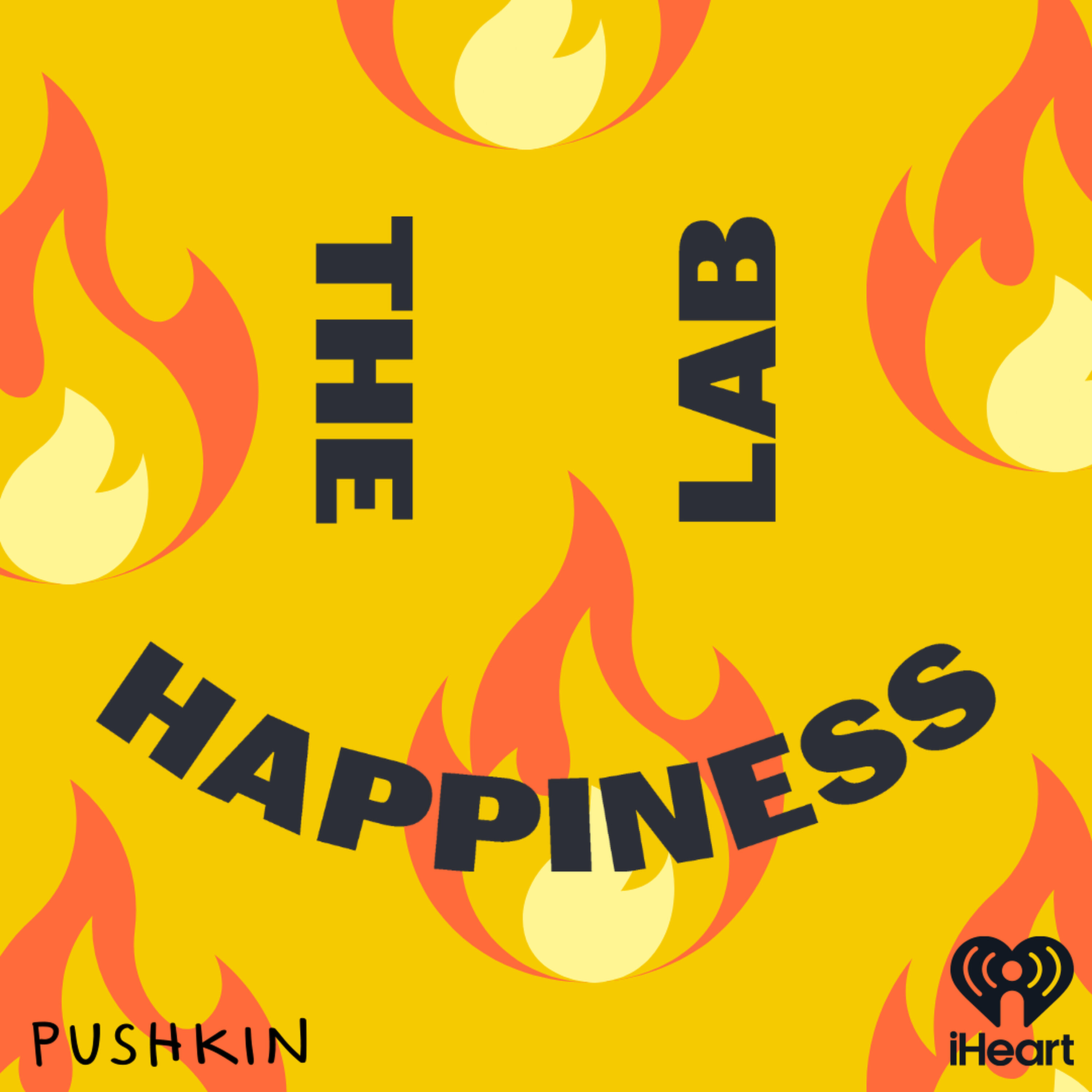
The Happiness Lab with Dr. Laurie Santos
The Happiness Lab is serving up scientifically-backed takes this summer that are so hot, even your SPF 50 won’t protect you.With the help of behavioral scientists, historians, and cultural critics, Yale psychologist Dr. ...
AI overview.Pushkin Industries is an independent podcast creator known for producing compelling audio content that merges storytelling with deep research. They focus on inn…
Insights from recent episode analysis
On the show
- Dr. John Gottman2 eps
- Dr. Julie Schwartz Gottman2 eps
- Darrin McMahon2 eps
Also: Bruce Hood, Amit Kumar, Cait Flanders, Leidy Klotz, Wendy Wood, Dr. Fred Luskin, Dr. Cass Sunstein, Dr. Jean Twenge, Guy Winch, Dr. Paul Eastwick, Manoush Zomorodi, Jessamyn Stanley, Susan David, Shawn Achor, Tom Hodgkinson, Leslie John, Nick Epley
Audience Interest
- science of happiness
- psychology research
Podcast Focus
- Yale happiness course insights
- scientific research on happiness
Publishing Consistency
- active for six years
- weekly episode cadence
Insights are generated by CastFox AI using publicly available data, episode content, and proprietary models.
Most discussed topics
Brands & references
Total monthly reach
Based on 3 signals.
Built from
By chart position
- 🇺🇸United States · Society & CultureHOME#12635K to 187K
- 🇮🇳India · Society & Culture#2626K to 140K
- 🇨🇦Canada · Society & Culture#764.4K to 23K
- 🇲🇽Mexico · Society & Culture#872.6K to 14K
- 🇻🇳VN · Society & Culture#441.5K to 8.1K
- Per-Episode Audience
Est. listeners per new episode within ~30 days
78K to 413K🎙 ~2x weekly·272 episodes·Last published 4d ago - Monthly Reach
Unique listeners across all episodes (30 days)
156K to 825K🇺🇸45%🇮🇳34%🇨🇦6%+10 more - Active Followers
Loyal subscribers who consistently listen
86K to 454K125K real followers tracked across platforms
Market Insights
Platform Distribution
Reach across major podcast platforms, updated hourly
Total Followers
—
Total Plays
—
Total Reviews
—
* Data sourced directly from platform APIs and aggregated hourly across all major podcast directories.
| Date | Episode | Topics | Guests | Brands | Places | Keywords | Sponsor | Length | |
|---|---|---|---|---|---|---|---|---|---|
| 11/16/26 |  How to Find Joy in an Imperfect Life with Dr. Kate Bowler | We tend to think of joy as something we have to earn. Once we land that dream job, find the perfect partner, or get our lives in order, then we'll finally experience it. But life rarely goes according to plan. So what happens to our capacity for joy when things aren't going our way? In this live conversation from the Aspen Ideas Festival, Dr. Laurie is joined by Duke Divinity School professor Kate Bowler, author of Joyful, Anyway, to challenge the idea that a good life is one in which we're always happy. They explore how our relentless pursuit of self-improvement can leave us feeling unfulfilled, why joy and suffering aren't mutually exclusive, and how we can become more open to unexpected moments of delight in everyday life. Experts Mentioned Kate Bowler, Professor of Religious History at Duke University Norman Vincent Peale, Protestant clergyman Oliver Burkeman, author and journalist Ron Rolheiser, Catholic priest and theologian Charles Taylor, Professor Emeritus of Philosophy at McGill University Lisa Damour, clinical psychologist Kostadin Kushlev, Associate Professor of Psychology at Georgetown University Resources Mentioned Joyful, Anyway, by Kate Bowler (2026) Blessed: A History of the American Prosperity Gospel, by Kate Bowler (2013) The Power of Positive Thinking, by Norman Vincent Peale (1952) Rethinking Positive Thinking, by Gabriele Oettingen (2014) The Malaise of Modernity, by Charles Taylor (1991) The Emotional Lives of Teenagers: Raising Connected, Capable, and Compassionate Adolescents, by Lisa Damour (2023) “Do happy people care about society’s problems?,” by Kostadin Kushlev, Danielle Drummond, Samantha Heintzelman, and Ed Diener (The Journal of Positive Psychology, 2020) Everything Happens with Kate Bowler (podcast) Related Episodes “Why ‘The Pursuit of Happiness’ Is a Bad Idea” “Don’t Accentuate the Positive” “How to Embrace Imperfection" See omnystudio.com/listener for privacy information. | 35m 31s | ||||||
| 11/9/26 |  Are You Taking Fun Seriously Enough? | Between work, family, and our never-ending to-do lists, finding time for fun can feel like a luxury. But what if having fun isn't just a nice bonus in life — what if it's essential to our happiness, our health, and even our ability to make the world a better place? In this live conversation from the Aspen Ideas Festival, Dr. Laurie is joined by science journalist Catherine Price and psychologist Elizabeth Dunn to explore why we should all be taking fun more seriously. Experts Mentioned Catherine Price, health and science journalist Elizabeth Dunn, Professor of Social Psychology at the University of British Columbia Charles Duhigg, Pulitzer Prize-winning author Bill Nye, science communicator Ross Gay, poet, essayist, and Professor of English at Indiana University Bloomington Resources Mentioned How to Break Up With Your Phone: The 30-Day Plan to Take Back Your Life, by Catherine Price (2018) The Power of Fun: How to Feel Alive Again, by Catherine Price (2021) Happy Money: The Science of Happier Spending, by Elizabeth Dunn and Michael Norton (2013) Leave the Lights On: How Joyful Decisions Can Save Our Species, by Elizabeth Dunn and Jiaying Zhao (2026) Flow: The Psychology of Optimal Experience, by Mihaly Csikszentmihalyi (1990) “What does a good day look like?: An interpretable machine learning approach to the American Time Use Survey,” by Dunigan Folk, Mirka Henninger, and Elizabeth Dunn (PNAS Nexus, 2026) “Valuing time over money predicts happiness after a major life transition: A preregistered longitudinal study of graduating students,” by Ashley Whillans, Lucía Macchia, and Elizabeth Dunn (Scientific Advances, 2019) “Smartphone use undermines enjoyment of face-to-face social interactions,” by Ryan J. Dwyer, Kostadin Kushlev, and Elizabeth Dunn (Journal of Experimental and Social Psychology, 2018) The Power of Habit: Why We Do What We Do in Life and Business, by Charles Duhigg (2012) “The holiday happiness curve: a preliminary investigation into mood during a holiday abroad,” by Jeroen Nawijn (International Journal of Tourism Research, 2009) “Procrastination of Enjoyable Experiences,” by Suzanne Shu and Ayelet Gneezy (Journal of Marketing Research, 2010) “Happiness and Voting Behavior,” by George Ward (World Happiness Report, 2019) The Book of Delights: Essays, by Ross Gay (2019) “Explicit Signals Enhance Social Engagement Between Strangers,” by Ruo-Ning Li, Iris Lok, Säde Stenlund, and Elizabeth Dunn (Social Psychological and Personality Science, 2025) “How to Feel Alive with Catherine Price,” by Catherine Price (Substack) Related Episodes “Laurie Gets a Fun-tervention (Part One)” “Laurie Gets a Fun-tervention (Part Two: Beach Party)” “For Whom the Alarm Clock Tolls” See omnystudio.com/listener for privacy information. | 39m 29s | ||||||
| 11/2/26 |  AI Is the New Social Media. Can We Protect Kids This Time? | We’re still reckoning with the effects of social media on young people’s mental health. Now, with artificial intelligence rapidly becoming part of our everyday lives, we’re at risk of making the same mistakes all over again. In this live conversation from SXSW EDU, Dr. Laurie is joined by Bruce Reed — head of AI at Common Sense Media and former White House deputy chief of staff — to explore how social media and AI are shaping young people’s happiness and wellbeing, and what parents, educators, and policymakers can do to help kids thrive in an increasingly AI-driven world. Experts Mentioned: Jean Twenge, Professor of Psychology at San Diego State University Bruce Reed, Head of AI at Common Sense Media Catherine Price, science journalist Vivek Murthy, former Surgeon General of the United States Cass Sunstein, Professor at Harvard Law School Elizabeth Dunn, Professor of Psychology at the University of British Columbia Nicholas Epley, Professor of Behavioral Science at the University of Chicago Booth School of Business Michael Inzlicht, Professor of Psychology at the University of Toronto Mihaly Csikszentmihalyi, Professor of Psychology and Management at Claremont Graduate University and “the father of flow” Robyn Koslowitz, clinical psychologist and parenting educator David Yeager, Professor of Psychology at the University of Texas at Austin Jonathan Haidt, Professor of Business and Society at New York University Kristin Neff, Associate Professor of Educational Psychology at the University of Texas at Austin Jamil Zaki, Professor of Psychology at Stanford University Resources Mentioned: “Have Smartphones Destroyed a Generation?,” by Jean Twenge (The Atlantic, 2017) “The Common Sense Census: Media Use by Kids Zero to Eight,” (Common Sense Media, 2025) How to Break Up with Your Phone, (07:33) by Catherine Price (2018) “Constant Companion: A Week in the Life of a Young Person's Smartphone Use,” (Common Sense Media, 2023) “Social Media and Youth Mental Health,” (The U.S. Surgeon General’s Advisory, 2023) “Social media, wasting time, and product traps,” by Cass Sunstein (World Happiness Report, 2026) “Teens and Mental Health: How Girls Really Feel About Social Media,” (Common Sense Media, 2023) “Teens and social media: Key findings from Pew Research Center surveys,” by Emily A. Vogels and Risa Gelles-Watnick (Pew Research Center, 2023) “Scroll With Caution: Another State Requires Social Media Warning Labels,” by Jennifer Vilcarino (Education Week, 2026) “From Australia to Europe, countries move to curb children's social media access,” (Reuters, 2026) “Australia’s Social Media Ban Is Floundering. Can It Still Help Younger Kids?,” by Victoria Kim (The New York Times, 2026) “Mark Zuckerberg Thinks AI 'Friends' Can Solve The Loneliness Crisis. Here's What AI Experts Think.,” by Brittany Wong (HuffPost, 2025) The Anxious Generation: How the Great Rewiring of Childhood Is Causing an Epidemic of Mental Illness, (32:24) by Jonathan Haidt (2024) “Social AI Companions Risk Assessment,” (Common Sense Media, 2025) “Talk, Trust, and Trade-Offs: How and Why Teens Use AI Companions,” (Common Sense Media, 2025) “A Teen Was Suicidal. ChatGPT Was the Friend He Confided In.,” by Kashmir Hill (The New York Times, 2025) “How Does Turning to AI for Companionship Predict Loneliness and Vice Versa?,” by Dunigan Folk and Elizabeth Dunn (Psychological Science, 2026) “Is a random human peer better than a highly supportive chatbot in reducing loneliness over time?,” by Ruo-Ning Li, Dunigan Folk, Abhay Singh, Lyle Ungar, and Elizabeth Dunn (Journal of Experimental Social Psychology, 2026) A Little More Social: How Small Choices Create Unexpected Happiness, Health, and Connection, by Nicholas Epley (2026) “The Effort Paradox: Effort Is Both Costly and Valued,” by Michael Inzlicht, Amitai Shenhav, and Christopher Y Olivola (Trends in Cognitive Sciences, 2018) “The IKEA effect: When labor leads to love,” by Michael Norton, Daniel Mochon, and Dan Ariely (Journal of Consumer Psychology, 2012) Flow: The Psychology of Optimal Experience, by Mihaly Csikszentmihalyi (1990) “Generation Al: What Kids and Families Think About Al,” (Common Sense Media, 2026) “Collaborative Problem Solving reduces children's emotional and behavioral difficulties and parenting stress: Two key mechanisms,” by Georgina Heath, Christopher Fife-Schaw, Lu Wang, Christopher Eddy, Michael Hone, Alisha Pollastri (Journal of Clinical Psychology, 2020) 10 to 25: The Science of Motivating Young People, (30:52) by David Yeager (2024) The Amazing Generation: Your Guide to Fun and Freedom in a Screen-Filled World, (32:21) by Jonathan Haidt and Catherine Price (2025) “The benefits of radical acceptance of reality as a standalone strategy for emotion regulation,” by Or Segal, Karin Bronshtein, and Noam Weinbach (Current Psychology, 2025) Self-Compassion: The Proven Power of Being Kind to Yourself, by Kristin Neff (2011) Hope for Cynics: The Surprising Science of Human Goodness, (40:38) by Jamil Zaki (2024) Related Episodes: “What is Social Media Doing to Kids? with Dr. Jean Twenge” “Why You’re Still Using Social Media (Even If You Want to Stop) with Dr. Cass Sunstein” “Reducing the Stress of Parenting with Dr Vivek Murthy” “How Smartphones Changed Childhood (And What to do About it)” “How to Think Like a Child (with David Yeager)” See omnystudio.com/listener for privacy information. | 43m 46s | ||||||
| 10/26/26 |  The Unexpected Science of Cats and Happiness | Cats have a reputation for being aloof, independent, and sometimes downright indifferent to their human companions. But what if we've been getting cats all wrong? In honor of National Cat Day, Dr. Laurie is joined by cat behavior expert Dr. Kristyn Vitale to explore the surprising science of our relationships with cats. They unpack what cats really think about their human caregivers, how our feline friends can boost our happiness and wellbeing, and what we can do to make their lives happier, too. Experts Mentioned: Kristyn Vitale, Certified Applied Animal Behaviorist and internationally recognized expert in cat behavior and the cat-human relationship John Bowlby, psychiatrist, psychoanalyst, and founder of attachment theory Mary Ainsworth, developmental psychologist and creator of the Strange Situation assessment Harry Harlow, University of Wisconsin-Madison researcher and former director of their Primate Laboratory Karen McComb, Emeritus Professor of Animal Behaviour and Cognition at the University of Sussex Wendy Berry Mendes, Professor of Psychology at Yale University Mikel Maria Delgado, animal behavioural scientist Resources Mentioned: “Social interaction, food, scent or toys? A formal assessment of domestic pet and shelter cat (Felis silvestris catus) preferences,” by Kristyn Vitale, Lindsay Mehrkam, and Monique Udell (Behavioural Processes, 2017) “The quality of being sociable: The influence of human attentional state, population, and human familiarity on domestic cat sociability,” by Kristyn Vitale and Monique Udell (Behavioural Processes, 2019) “Attachment bonds between domestic cats and humans,” by Kristyn Vitale, Alexandra Behnke, and Monique Udell (Current Biology, 2019) “The Development of Affectional Responses in Infant Monkeys,” by Harry Harlow and Robert Zimmermann (Proceedings of the American Philosophical Society, 1958) “Attachment, Exploration, and Separation: Illustrated by the Behavior of One-Year-Olds in a Strange Situation,” by Mary Ainsworth and Silvia Bell (Child Development, 1970) “Maternal Care and Mental Health,” by John Bowlby (Bulletin of the World Health Organization, 1951) “The cry embedded within the purr,” by Karen McComb, Anna Taylor, Christian Wilson, Benjamin Charlton (Current Biology, 2009) — Thank you to Professor McComb and her team for letting us include the solution purr audio in this episode! “Cardiovascular reactivity and the presence of pets, friends, and spouses: the truth about cats and dogs,” by Karen Allen, Jim Blascovich, and Wendy Mendes (Psychosomatic Medicine, 2002) “Social referencing and cat-human communication,” by Isabella Merola, Martina Lazzaroni, Sarah Marshall-Pescini, and Emanuela Prato-Previde (Animal Cognition, 2015) “Cats (Felis silvestris catus) read human gaze for referential information,” by Péter Pongrácz, Julianna Szulamit Szapu, and Tamás Faragó (Intelligence, 2019) “Domestic cats (Felis catus) discriminate their names from other words,” by Atsuko Saito, Kazutaka Shinozuka, Yuki Ito, and Toshikazu Hasegawa (Scientific Reports, 2019) “The role of cat eye narrowing movements in cat–human communication,” by Tasmin Humphrey, Leanne Proops, Jemma Forman, Rebecca Spooner, and Karen McComb (Scientific Reports, 2020) Play with Your Cat!, by Mikel Maria Delgado (2024) “Cat School” — Youtube channel “Positive Reinforcement Training Educational Toolkit,” by Feline Veterinary Medical Association (2026) Maueyes — Educational resources Related Episodes: “Let Slip the Dogs of More Happiness” “How Dogs Changed my Life (with The Dogist)” “‘Birds Are Like My Afternoon Martini’ (Birding with Lili Taylor)” See omnystudio.com/listener for privacy information. | 46m 22s | ||||||
| 10/19/26 |  Why Happiness Experts Still Struggle to Be Happy with Dr. Ethan Kross | You might assume that people who study happiness for a living have it all figured out. But even happiness experts struggle to follow their own advice. They know the science behind feeling happier, managing difficult emotions, and building healthier habits — but putting that knowledge into practice is another story. Why is it so hard to do the things we know are good for us? In a live conversation recorded at SXSW, Dr. Laurie gets personal with her good friend, psychologist Ethan Kross, about the times they've struggled to practice what they preach. Together, they explore the psychological biases that can get in our way and share science-backed strategies for managing difficult emotions, building better habits, and turning that knowledge into action. Experts Mentioned: Ethan Kross, Professor of Psychology at the University of Michigan Tamar Gendler, Professor of Philosophy and Dean of the Faculty of Arts and Sciences at Yale University Gabriele Oettingen, Professor of Psychology at New York University and the University of Hamburg Carey Morewedge, Professor of Marketing at Boston University Christina Maslach, Professor Emerita of Psychology at the University of California, Berkeley Kristin Neff, Associate Professor of Educational Psychology at the University of Texas at Austin Resources Mentioned: Shift: Managing Your Emotions — So They Don't Manage You, by Ethan Kross (2025) Chatter: The Voice in Our Head, Why It Matters, and How to Harness It, by Ethan Kross (2021) “Knowing is Half the Battle,” by Laurie Santos and Tamar Gendler (Edge, 2014) Müller-Lyer Illusion “Exploring Solomon’s Paradox: Self-Distancing Eliminates the Self-Other Asymmetry in Wise Reasoning About Close Relationships in Younger and Older Adults,” by Igor Grossmann and Ethan Kross (Psychological Science, 2014) WOOP: Wish, Outcome, Obstacle, Plan Rethinking Positive Thinking: Inside the New Science of Motivation, by Gabriele Oettingen (2014) “Thought for Food: Imagined Consumption Reduces Actual Consumption,” by Carey Morewedge, Young Eun Huh, and Joachim Vosgerau (Science, 2010) “Forming a flossing habit: an exploratory study of the psychological determinants of habit formation,” by Gaby Judah, Benjamin Gardner, and Robert Aunger (British Journal of Health Psychology, 2013) How to Change: The Science of Getting from Where You Are to Where You Want to Be, by Katy Milkman (2021) Burnout: The Cost of Caring, by Christina Maslach (1982) Self-Compassion: The Proven Power of Being Kind to Yourself, by Kristin Neff (2011) “Self-Perception Theory,” by Daryl J. Bem (Advances in Experimental Social Psychology, 1972) “Emotion Controllability Beliefs and Young People's Anxiety and Depression Symptoms: A Systematic Review,” by Matthew Somerville, Helen MacIntyre, Amy Harrison, and Iris Mauss (Adolescent Research Review, 2024) “Implicit theories of emotion: Affective and social outcomes across a major life transition,” by Maya Tamir, Oliver John, Sanjay Srivastava, and James Gross (Journal of Personality and Social Psychology, 2007) Related Episodes: “For Whom the Alarm Clock Tolls” “Harnessing People Around us to Feel Happier (Live with Ethan Kross)” “Coach Yourself Through a Crisis” “Don’t Accentuate the Positive” See omnystudio.com/listener for privacy information. | 52m 47s | ||||||
| 10/12/26 |  What Gets Lost When We Text Instead of Talk with Dr. Nick Epley | For most of human history, we only had one way to talk to one another: our voices. Today, we have more ways to communicate than ever before. We can text, call, send a video message, reach out over social media, et cetera. And we often choose whichever option seems easiest or least awkward. But research suggests that how we choose to communicate matters much more than we realize and can have a surprising impact on how well we understand one another and how connected we feel. In a live conversation recorded at the World Happiness Summit at SXSW, Dr. Laurie speaks with psychologist Nick Epley about the common mistakes we make when communicating in the modern world — and the small changes that could help us connect more meaningfully with the people around us. His new book, A Little More Social, is available now. Experts Mentioned: Nicholas Epley, Professor of Behavioral Science at the University of Chicago Booth School of Business Bronisław Malinowski, Polish anthropologist and ethnologist Resources Mentioned: A Little More Social: How Small Choices Create Unexpected Happiness, Health, and Connection, by Nick Epley (2026) “Hello, stranger? Pleasant conversations are preceded by concerns about starting one,” by Juliana Schroeder, Donald Lyons, and Nicholas Epley (Journal of Experimental Psychology: General, 2022) "The Problem of Meaning in Primitive Languages," by Bronisław Malinowski (1923) “Is Conversation Magical?,” by Nicholas Epley (Chicago Booth Review, 2026) “The Humanizing Voice: Speech Reveals, and Text Conceals, a More Thoughtful Mind in the Midst of Disagreement,” by Juliana Schroeder, Michael Kardas, and Nicholas Epley (Psychological Science, 2017) "Egocentrism over e-mail: can we communicate as well as we think?," by Justin Kruger, Nicholas Epley, Jason Parker, and Zhi-Wen Ng (Journal of Personality and Social Psychology, 2005) “The Sound of Intellect: Speech Reveals a Thoughtful Mind, Increasing a Job Candidate's Appeal,” by Juliana Schroeder and Nicholas Epley (Psychological Science, 2015) “It's surprisingly nice to hear you: Misunderstanding the impact of communication media can lead to suboptimal choices of how to connect with others,” by Amit Kumar and Nicholas Epley Journal of Experimental Psychology: General, 2021) Related Episodes: Forget Small Talk: Go Deep Instead You’re Actually Not Bothering People Enough Why Giving is a Great Daily Habit The Surprising Case for Oversharing See omnystudio.com/listener for privacy information. | 44m 59s | ||||||
| 10/5/26 |  Finding the Magic in Everyday Life with Thoreau and Eric Weiner | As we move through our busy lives, it’s easy to stop noticing the tiny, beautiful things all around us. But rediscovering the sense of wonder we had as children might not only bring us more joy — it could also help us better navigate life’s hardest moments. Dr. Laurie explores that idea with traveling philosopher and former NPR correspondent Eric Weiner, author of The Socrates Express: In Search of Life Lessons from Dead Philosophers. Eric shares what he’s learned from walking in the footsteps of Henry David Thoreau, including how the 19th-century philosopher can help us live better in the modern day and see beauty in the things we usually overlook. Experts Mentioned: Eric Weiner, journalist, author, and philosophical traveler Henry David Thoreau, 19th-century American philosopher, poet, environmental scientist, and political activist Socrates, ancient Greek philosopher Epicurus, ancient Greek philosopher Arthur Schopenhauer, 19th-century German philosopher Ralph Waldo Emerson, 19th-century essayist, poet, and philosopher Confucius, ancient Chinese philosopher Nathaniel Hawthorne, 19th-century American novelist and short-story writer Leslie Perrin Wilson, author and former curator of the Special Collections at the Concord Free Public Library Henry Miller, American novelist, short-story writer, and essayist Resources Mentioned: The Socrates Express: In Search of Life Lessons from Dead Philosophers, by Eric Weiner (2020) Walden, by Henry David Thoreau (1854) “Walking,” by Henry David Thoreau (1862) Bhagavad Gita (second or first century BCE) The Journal of Henry David Thoreau “The playful mediator, moderator, or outcome? An integrative review of the roles of play and playfulness in adult-centered psychological interventions for mental health,” by Xiangyou Shen and Leland Masek (The Journal of Positive Psychology, 2024) Related Episodes: “Happiness Lessons of The Ancients: Confucius” “The Science of Attention and Distraction” “The Power of Awe… and Where to Find it” “Sight and Sound: How to Joyfully Awaken Your Senses” See omnystudio.com/listener for privacy information. | 33m 49s | ||||||
| 9/28/26 |  Want More Joy? Try Taking Yourself Less Seriously with Comedian Chris Duffy | When we’re exhausted, overworked, or just going through a difficult time, our instinct is often to put our heads down and simply focus on getting through it. But those serious moments may actually be when we benefit from a little silliness and absurdity the most. Laurie explores the science of humor with comedian Chris Duffy, host of How to Be a Better Human and author of the new book Humor Me: How Laughing More Can Make You Present, Creative, Connected, and Happy. Chris shares what he’s learned about how to find humor in almost any situation — and how embracing the funny can improve our wellbeing in surprising ways. Experts Mentioned: Chris Duffy, comedian, author, and host of How to Be a Better Human E. B. White, writer and essayist Mimi M.Y. Tse, Assistant Professor at The Hong Kong Polytechnic University Ross Gay, poet, essayist, and Professor of English at Indiana University Annie Rauwerda, creator of “Depths of Wikipedia” Aparna Nancherla, comedian and author Greg Bryant, Professor of Communication at UCLA Adam Mastroianni, experimental psychologist and author Resources Mentioned: Humor Me: How Laughing More Can Make You Present, Creative, Connected, and Happy, by Chris Duffy (2026) How to Be a Better Human, TED podcast hosted by Chris Duffy “The impression management benefits of humorous self-disclosures: How humor influences perceptions of veracity,” by T. Bradford Bitterly and Maurice Schweitzer (Organizational Behavior and Human Decision Processes, 2019) “The effect of a pratfall on increasing interpersonal attractiveness,” by Elliot Aronson, Ben Willerman, and Joanne Floyd (Human Learning and Thinking, 1966) “Humor Therapy: Relieving Chronic Pain and Enhancing Happiness for Older Adults,” Mimi Tse, Anna Lo, Tracy Cheng, Eva Chan, Annie Chan, and Helena Chung (Journal of Aging Research, 2010) The Book of Delights: Essays, by Ross Gay (2019) Listers: A Glimpse Into Extreme Birdwatching, directed by Owen Reiser (2025) “Depths of Wikipedia” “Hello, stranger? Pleasant conversations are preceded by concerns about starting one,” by Juliana Schroeder, Donald Lyons, and Nicholas Epley (Journal of Experimental Psychology: General, 2022) “The Perception of Spontaneous and Volitional Laughter Across 21 Societies,” by Greg Bryant et al. (Psychological Science, 2018) “Neural substrates of spontaneous musical performance: an FMRI study of jazz improvisation,” by Charles Limb and Allen Braun (PLoS One, 2008) “Good conversations have lots of doorknobs,” by Adam Mastroianni (Experimental History, 2022) Related Episodes: “Laurie Gets a Fun-tervention (Part One)” “The Surprising Case for Oversharing” “How To Embrace Imperfection” See omnystudio.com/listener for privacy information. | 45m 58s | ||||||
| 9/25/26 |  Small Steps to Happiness: The Science of Mindful Living with Laurie Santos | From The One You Feed | Today we're sharing author Eric Zimmer’s interview with Dr. Laurie on The One You Feed podcast. In this episode, Dr. Laurie Santos discusses the importance of taking small steps to happiness and the science of mindful living. She reminds us that happiness is not a destination, but a practice. By understanding the science behind well-being and implementing small, consistent changes, we can learn how to apply these insights to our own lives to find greater joy and fulfillment. Key Takeaways: Embrace the power of small, consistent actions in shaping our happiness Understand how our environment and social connections influence our behavior Learn the common misconceptions about what truly makes us happy Discover strategies for overcoming loneliness and building meaningful connections If you like what you hear, find The One You Feed wherever you get podcasts.See omnystudio.com/listener for privacy information. | 1h 06m 58s | ||||||
| 9/21/26 |  Why Smaller Goals Can Lead to Bigger Changes with Eric Zimmer | Most of us are familiar with this frustrating pattern: you set a goal, start off strong, but then lose motivation and end up right back at square one. Why does it seem so hard to change — even when you have a plan in place? Turns out, you may be aiming too high, too soon. Laurie breaks down the science behind this pattern with Eric Zimmer, host of the award-winning podcast “The One You Feed” and author of the new book How A Little Becomes A Lot: The Art of Small Changes for a More Meaningful Life. Eric spent years struggling to overcome a heroin addiction before eventually turning his life around. He explains why lasting change often comes from making consistent progress in the right direction rather than attempting one dramatic transformation, and shares what he’s learned about building momentum, overcoming setbacks, and finally reaching the goals we’ve been striving for. Experts Mentioned: Eric Zimmer, author and host of “The One You Feed” Steven Pressfield, author Resources Mentioned: How A Little Becomes A Lot: The Art of Small Changes for a More Meaningful Life, by Eric Zimmer (2026) “The One You Feed,” hosted by Eric Zimmer The War of Art: Break Through the Blocks and Win Your Inner Creative Battles by Steven Pressfield (2002) Related Episodes: "Dump Your Inner Drill Sergeant" "How to Kick Bad Habits (and Start Good Ones)" "You Only Live Once… So Commit" See omnystudio.com/listener for privacy information. | 47m 54s | ||||||
Want analysis for the episodes below?Free for Pro Submit a request, we'll have your selected episodes analyzed within an hour. Free, at no cost to you, for Pro users. | |||||||||
| 9/14/26 |  A Neuroscientist’s Guide to Changing Your Brain with Dr. Richard Davidson | Your brain is changing all the time, whether you realize it or not. Everything from your hobbies and chores to the media you consume can physically shape it. So how can you make sure it’s changing in ways that actually serve you? Laurie speaks with neuroscientist Dr. Richard Davidson, whose decades of work with the Dalai Lama helped pioneer the scientific study of meditation. Drawing on research with Buddhist monks, stressed-out school teachers, and others, Richie explains why psychological flourishing is a skill we can train, and how simple practices involving awareness, connection, insight, and purpose can help us become more resilient, focused, and fulfilled. His new book, Born to Flourish, is out now. Experts Mentioned: Richard Davidson, Professor of Psychology and Psychiatry and Founder and Director of the Center for Healthy Minds at the University of Wisconsin–Madison Cortland Dahl, Contemplative Scientist at the Center for Healthy Minds at the University of Wisconsin–Madison 14th Dalai Lama, spiritual leader of Tibetan Buddhism Matthieu Ricard, Buddhist monk François Jacob, Nobel Prize-winning biologist Resources Mentioned: Born to Flourish: How New Science and Ancient Wisdom Reveal a Simple Path to Thriving, by Richard Davidson and Cortland Dahl (2026) “Neurogenesis in the adult brain: death of a dogma,” by Charles Gordon Gross (Nature Reviews Neuroscience, 2000) “The book of neurogenesis,” by Matthew Sloan (Harvard Health Publishing, 2021) “In pursuit of resilience: stress, epigenetics, and brain plasticity,” by Bruce McEwen (Annals of the New York Academy of Sciences, 2016) “The plasticity of well-being: A training-based framework for the cultivation of human flourishing,” by Cortland Dahl, Christine Wilson-Mendenhall, and Richard Davidson (Proceedings of the National Academy of Sciences, 2020) “Navigation-related structural change in the hippocampi of taxi drivers,” by Eleanor Maguire, David Gadian, Ingrid Johnsrude, Catriona Good, John Ashburner, Richard Frackowiak, and Christopher Frith (Proceedings of the National Academy of Sciences, 2000) “Training induces changes in white-matter architecture,” by Jan Scholz, Miriam Klein, Timothy Behrens, and Heidi Johansen-Berg (Nature Neuroscience, 2009) “Long-term meditators self-induce high-amplitude gamma synchrony during mental practice,” by Antoine Lutz, Lawrence Greischar, Nancy B. Rawlings, Matthieu Ricard, Richard Davidson (Proceedings of the National Academy of Sciences, 2004) “A Randomized Controlled Trial of a Smartphone-Based Well-Being Training in Public School System Employees During the COVID-19 Pandemic,” by Matthew Hirshberg, Corrina Frye, Cortland Dahl, Kevin Riordan, Nathan Vack, Jane Sachs, Robin Goldman, Richard Davidson, and Simon B Goldberg (Journal of Educational Psychology, 2022) “Altered anterior insula activation during anticipation and experience of painful stimuli in expert meditators,” by Antoine Lutz, Daniel McFarlin, David Perlman, Tim Salomons, and Richard Davidson (Neuroimage, 2013) Healthy Minds Program (meditation app) “Integrating mindfulness and connection practices into preservice teacher education results in durable automatic race bias reductions,” by Matthew Hirshberg, Lisa Flook, Evan Moss, Robert Enright, and Richard Davidson (Journal of School Psychology, 2022) “Sitting and Active Meditation Practice: Utilization and Associations with Outcomes in Naturalistic and Clinical Trial Data,” by Simon B Goldberg, Zishan Jiwani, Cortland J Dahl, Raquel Tatar, John D Dunne, Richard J Davidson, Matthew J Hirshberg (Mindfulness, 2026) Related Episodes: “How to Find Your Purpose” “The Power of Awe… and Where to Find It” “Happiness Lessons of The Ancients: Socrates and Self-Knowledge” “How to Adopt a Growth Mindset” See omnystudio.com/listener for privacy information. | 36m 23s | ||||||
| 9/7/26 | achievementpsychology+3 | Dr. Angela Duckworth | Situated: Find the People and Places That Bring Out Your Best | — | achievementgrit+3 | — | 58m 13s | ||
| 8/17/26 | sabbaticalwellbeing+3 | DJ DiDonna | Harvard Business SchoolYale+3 | — | sabbaticalwellbeing+5 | — | 48m 31s | ||
| 8/10/26 | asking for helpsocial psychology+4 | Nicholas EpleyJia Jiang | RejectionTherapy.comRejection Proof: How I Beat Fear and Became Invincible Through 100 Days of Rejection+4 | — | asking for favorshappiness+5 | — | 26m 05s | ||
| 8/3/26 | lonelinesssolitude+4 | Fay Bound-AlbertiMicaela Rodriguez+1 | — | — | lonelinesssolitude+7 | — | 46m 05s | ||
| 7/27/26 | happinesswealth+4 | — | — | — | lotteryhappiness+5 | — | 41m 48s | ||
| 7/20/26 | male friendshipbromance+3 | Andrew McCarthy | Who Needs Friends: An Unscientific Examination of Male Friendship Across AmericaThe Ritual Effect: The Transformative Power of Our Everyday Actions | — | bromancemale friendship+3 | — | 43m 49s | ||
| 7/13/26 | small talkdeep conversations+4 | Claire Eastham | We're All Mad Here: The No-Nonsense Guide to Living with Social AnxietyA Little More Social: How Small Choices Create Unexpected Happiness, Health, and Connection+1 | — | small talkdeep conversations+5 | — | 37m 37s | ||
| 7/6/26 | happiness misconceptionswellbeing improvement+3 | Darrin McMahon | Dartmouth CollegeUniversity of Pennsylvania+8 | — | happinesswellbeing+5 | — | 50m 11s | ||
| 6/29/26 | pursuit of happinessAmerican ideals+3 | Darrin McMahonIris Mauss | Declaration of IndependenceHappiness: A History+3 | — | happinessThomas Jefferson+3 | — | 46m 36s | ||
| 6/22/26 | regretdecision making+3 | Daniel PinkLiz Fosslien | Big Feelings: How to Be Okay When Things Are Not OkayPower of Regret: How Looking Backward Moves Us Forward+2 | — | regrethappiness+3 | — | 30m 57s | ||
| 6/15/26 | mental healthyouth development+3 | Adam Mastroianni | Harvard Graduate School of EducationMental Health in College: What Research Tells Us About Supporting Students+2 | — | anxietydepression+3 | — | 43m 08s | ||
| 6/8/26 | oversharingsocial connections+3 | Leslie JohnNick Epley | Harvard Business SchoolUniversity of Chicago+2 | — | oversharingsocial connections+5 | — | 39m 01s | ||
| 6/1/26 | body imageself-compassion+4 | Jessamyn Stanley | Every Body Yoga: Let Go of Fear, Get On the Mat, Love Your Body | — | happinessbody positivity+3 | — | 34m 46s | ||
| 5/25/26 | negative emotionsemotional healing+3 | Susan David | Harvard Medical SchoolEmotional Agility: Get Unstuck, Embrace Change, and Thrive in Work and Life | — | negative emotionsemotional agility+5 | — | 45m 43s | ||
| 5/18/26 | beliefshappiness+4 | Shawn Achor | The Power of Beliefs: How Strengthening Seven Core Beliefs Predicts Greater Success and a Better LifeThe Happiness Advantage: The Seven Principles of Positive Psychology That Fuel Success and Performance at Work+2 | — | happinessbeliefs+5 | — | 43m 05s | ||
| 5/11/26 | time managementhappiness+3 | Tom Hodgkinson | Harvard Business SchoolUCLA+5 | — | time faminehappiness+6 | — | 35m 17s | ||
| 5/4/26 | screen timephysical health+5 | Manoush Zomorodi | NPRBody Electric+1 | — | screen timephysical health+5 | — | 45m 34s | ||
| 4/27/26 | materialismhappiness+4 | Bruce HoodAmit Kumar+1 | University of BristolUniversity of Texas at Austin+4 | — | happinessmaterial possessions+5 | — | 26m 16s | ||
| 4/20/26 | environmenthappiness+5 | Leidy Klotz | University of VirginiaIn a Good Place+3 | — | happinessenvironment+5 | — | 37m 40s | ||
| 4/13/26 | behavior changehabits+4 | Wendy Wood | University of Southern CaliforniaGeorge Washington School of Medicine and Health Sciences+2 | — | bad habitsbehavior change+5 | — | 33m 22s | ||
| 4/6/26 | forgivenessmental health+4 | Dr. Fred Luskin | Stanford University Forgiveness ProjectYale Divinity School+4 | — | forgivenessgrudge+6 | — | 38m 55s | ||
| 3/23/26 | social mediahappiness+3 | Dr. Cass Sunstein | NudgeWorld Happiness Report 2026+6 | — | social mediaquit+5 | — | 32m 50s | ||
| 3/20/26 | social mediaadolescent happiness+5 | Dr. Jean Twenge | World Happiness ReportPew Research Center+8 | — | social mediateen wellbeing+5 | — | 34m 46s | ||
| 3/16/26 | work stressmental health+3 | Guy Winch | Mind Over Grind: How to Break Free When Work Hijacks Your LifeBurnout: A Review of Theory and Measurement+7 | — | work stressmental health+3 | — | 43m 18s | ||
| 3/9/26 | relationshipsconflict resolution+3 | Dr. John GottmanDr. Julie Schwartz Gottman | Fight Right: How Successful Couples Turn Conflict into Connection | — | couplesconflict+3 | — | 35m 43s | ||
| 3/2/26 | relationshipscouples+3 | Dr. John GottmanDr. Julie Schwartz Gottman | Love LabFight Right: How Successful Couples Turn Conflict into Connection | — | relationship sciencecouples therapy+3 | — | 47m 04s | ||
| 2/23/26 | modern datingevolutionary science+5 | Dr. Paul Eastwick | Bonded by Evolution: The New Science of Love and ConnectionThe Pairing Game: A Classroom Demonstration of the Matching Phenomenon+7 | — | datinglove+8 | — | 41m 11s | ||






Showing 38 of 272
Pitch Fit is a Pro feature
See how bookable this show is for guests, which brands already advertise, the per-episode ad value, and the best-fit guest and sponsor profile. The numbers are blurred on the free plan.
How readily this show books outside guests like you.
How proven this show is for host-read sponsorships.
For Guests
ProFor Advertisers
ProUpgrade to Pro to unlock guest cadence, sponsor categories, fit scores, and per-episode ad value for this show.
Similar Audience Demographics
Podcasts that attract a similar listener profile

A Slight Change of Plans
Pushkin Industries

10% Happier with Dan Harris
10% Happier

Hidden Brain
Hidden Brain, Shankar Vedantam
The Science of Happiness
PRX and Greater Good Science Center

The Curiosity Shop with Brené Brown and Adam Grant
Vox Media Podcast Network

ReThinking
TED

This American Life
This American Life
Distribution & Reach
About the show, platforms, and key insights.
Distribution & Reach
About the show, platforms, and key insights.
Pushkin Industries is an independent podcast creator known for producing compelling audio content that merges storytelling with deep research. They focus on innovative topics across various genres, establishing a reputation for quality and thought-provoking productions. "The Happiness Lab with Dr. Laurie Santos" sets itself apart by translating scientific research on happiness into practical advice for everyday life. Drawing on insights from her popular Yale course, Dr. Santos explores misconceptions about what leads to happiness, addressing themes related to society, culture, and health. The podcast's engaging format combines expert interviews and relatable anecdotes, making complex psychological concepts accessible to a broad audience. Listeners, ranging from those seeking personal improvement to curious minds interested in psychological science, tune in for actionable insights that challenge conventional wisdom about happiness. The show provides valuable tools for enhancing well-being, making it a go-to resource for anyone looking to lead a more fulfilling life.
By the numbers
- Total followers: 139K
- Total plays: 4.2M
- Total reviews: 14K
Platforms
TuneIn
- Followers: 5.8K
Castbox
- Followers: 95K
- Plays: 3.0M
- Reviews: 55
YouTube
- Subscribers: 14K
- Views: 1.3M
- Videos: 465
Podcast App
- Followers: 14K
- Reviews: 14K
Podcast Republic
- Followers: 10K
- Reviews: 16
Find them online
Audience
adults
Key insights
What the show covers
- Yale happiness course insights
- scientific research on happiness
- personal stories about happiness
- misconceptions about happiness
Audience interests
- science of happiness
- psychology research
- self-improvement strategies
- well-being tips
Platform reach
- available on major podcast platforms
- growing listener base
- no specific platforms detected
- unknown total followers
Publishing consistency
- active for six years
- weekly episode cadence
- 254 total episodes
- consistent content delivery
Chart history for The Happiness Lab with Dr. Laurie Santos
Peaked at #26 in India, currently #26 in India.
| Market | Genre | Peak | Current | Trend |
|---|---|---|---|---|
| India | — | #26 | #26 | — |
| VN | — | #44 | #44 | — |
| RO | — | #60 | #60 | — |
| CO | — | #66 | #66 | — |
| Canada | — | #76 | #76 | — |
| AR | — | #77 | #77 | — |
| Mexico | — | #87 | #87 | — |
| HK | — | #91 | #91 | — |
| TR | — | #94 | #94 | — |
| PE | — | #101 | #101 | — |
| PH | — | #104 | #104 | — |
| IL | — | #111 | #111 | — |
| PT | — | #114 | #114 | — |
| NG | — | #119 | #119 | — |
| New Zealand | — | #120 | #120 | — |
| United States | — | #126 | #126 | — |
| SA | — | #139 | #139 | — |
| Spain | — | #143 | #143 | — |
| South Africa | — | #155 | #155 | — |
| TH | — | #163 | #163 | — |
Chart Positions
24 placements across 24 markets.
Chart Positions
24 placements across 24 markets.